The Microbes in Your Gut Are Deciding What Your Skin Does Next
A 2025 review confirmed the gut-skin axis runs in both directions — and the signaling mechanism is stranger, more specific, and more actionable than the probiotic aisle ever let on.
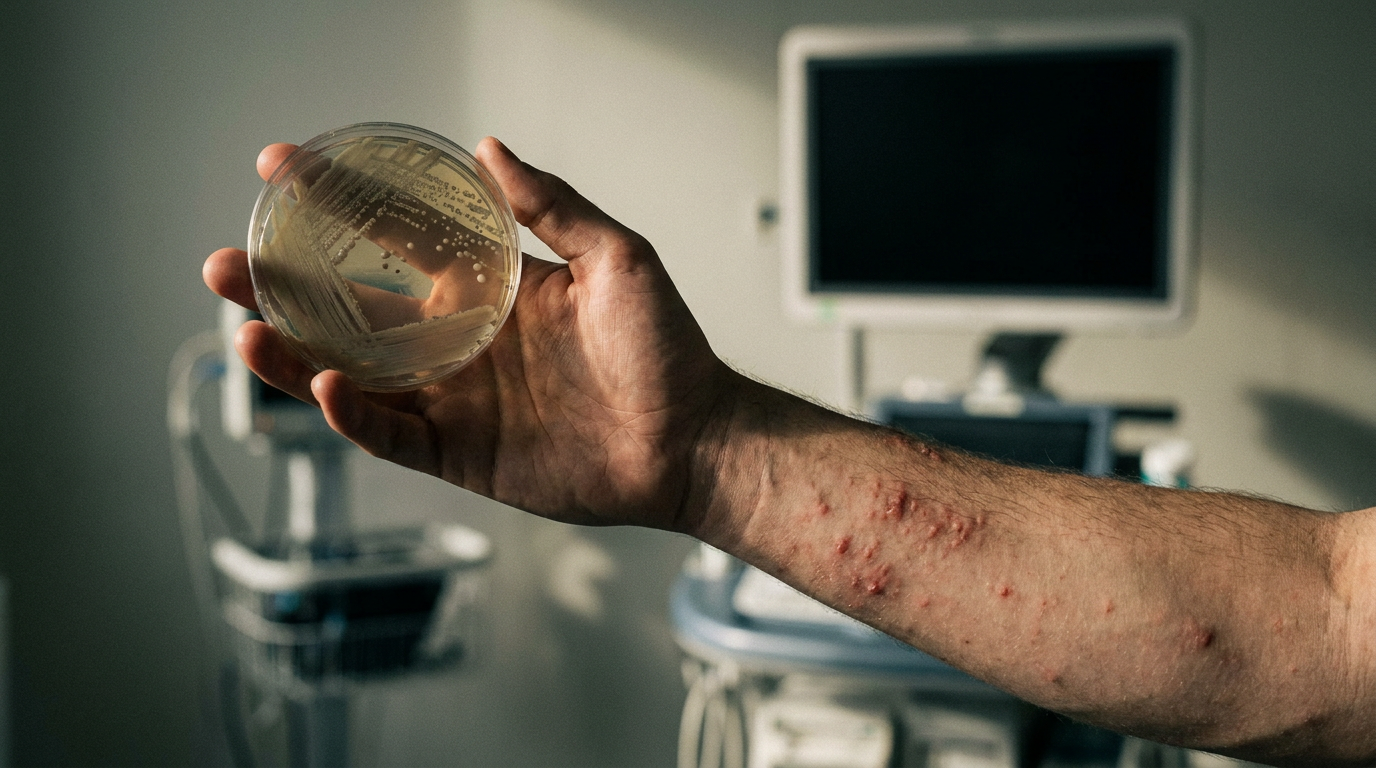
There is a standard version of the gut-skin story that circulates on wellness blogs and supplement packaging: eat better, fix your gut, clear your skin. It is not exactly wrong, but it is missing almost everything interesting. The gut-skin relationship was never a simple input-output line. A 2025 review published in Gut Microbes[4] documented something considerably more unsettling: the communication runs in both directions, through at least three distinct signaling pathways, and the messages the gut sends to the skin are not generic wellness nudges. They are specific, chemically precise, and capable of triggering the kind of inflammatory cascades that dermatologists spend careers trying to suppress with topical creams.
The gut-skin axis is now the formal name researchers use for this channel. Axis implies a clean two-pole relationship, which is already more accurate than most people's intuition: that skin is a surface problem requiring surface solutions. The axis is real, the bidirectionality is documented, and the underlying mechanism involves microbial metabolites, immune cell signaling, the vagus nerve, and circulating short-chain fatty acids — none of which are visible in a mirror, none of which are solved by a face wash.
The part that tends to stop researchers mid-sentence is how specific it gets. This is not a case of general inflammation making general things worse, the sort of vague systemic story that can mean almost anything. Particular microbial species in the gut are linked to particular inflammatory profiles on the skin. Disruptions in the balance of gut bacteria — through antibiotics, dietary shifts, chronic stress, or illness — produce identifiable changes in the immune signals reaching skin tissue, sometimes weeks before anything becomes visible to the person living inside that skin.
Which means the flare-up that appeared on your face last Tuesday may have been decided, at the microbial level, somewhere further south and several days earlier. That is not a metaphor. It is the mechanism the research is now starting to trace with enough precision that calling it speculative feels increasingly difficult to justify.
What the Gut Actually Sends
The gut microbiome — the several trillion microbial residents colonizing the intestinal tract — does not simply digest food. It produces compounds. Short-chain fatty acids like butyrate, propionate, and acetate are manufactured when certain gut bacteria ferment dietary fiber. These are not inert byproducts. Butyrate, in particular, plays a documented role in regulating immune cell behavior: it influences the differentiation of T regulatory cells[1], which are the immune system's volume knob for inflammation. When butyrate production is robust, T regulatory cells tend to keep inflammatory responses calibrated. When gut dysbiosis — a disruption in microbial composition — reduces butyrate output, that calibration shifts.
The skin feels this. Keratinocytes, the primary cells of the outer skin layer, carry receptors for some of the same short-chain fatty acids circulating in the bloodstream. The skin is, in this specific sense, downstream of the gut. Inflammatory cytokines produced in the gut environment — interleukin-17, interleukin-23, tumor necrosis factor-alpha — are the same cytokines implicated in psoriasis plaques and atopic dermatitis lesions. The immune cells producing them are not stuck in the gut. They migrate. They circulate. They arrive at the skin already primed by the microbial conditions they just left.
“The immune cells arrive at the skin already primed by the microbial conditions they just left.”
Researchers have also traced involvement of the vagus nerve, which connects the brainstem to the gut and runs a high-volume channel of bidirectional electrochemical signals. The gut-brain axis has received most of the public attention in this area, but the gut-brain-skin triangle is increasingly hard to ignore. Stress activates the hypothalamic-pituitary-adrenal axis, releasing cortisol. Cortisol alters gut permeability — the literal tightness of the junctions between intestinal cells. When those junctions loosen, microbial products that would normally stay in the intestinal lumen can enter the bloodstream, a state informally called leaky gut and more formally called intestinal hyperpermeability. Those circulating microbial fragments — lipopolysaccharides from gram-negative bacterial walls — are potent inflammatory triggers. The skin responds to them.
The Return Signal: Skin Talking Back
The bidirectionality is where the 2025 review makes its most striking contribution to the conversation. The gut-to-skin direction had enough evidence behind it to be considered relatively established. The skin-to-gut direction is newer, stranger, and considerably less intuitive. The skin is the body's largest immune organ — a claim that sounds like health-magazine filler until you count the dendritic cells, mast cells, T cells, and Langerhans cells embedded in its layers. When the skin is in a state of sustained inflammation, it is not a passive site of damage. It is producing signals.
Cytokines released during active skin conditions like psoriasis are not confined to the skin. They enter systemic circulation and have been traced to effects on gut barrier integrity and gut microbial composition. Studies in mice with induced psoriasis-like conditions have documented measurable shifts in gut microbiome diversity and relative abundance of specific bacterial genera — shifts that were not present before the skin inflammation was induced. In humans, patients with severe psoriasis and atopic dermatitis show gut microbiome profiles that differ from controls in consistent ways: reduced Lactobacillus and Bifidobacterium species, altered ratios of Firmicutes to Bacteroidetes, and in some studies, elevated markers of intestinal permeability. The question of cause and effect is genuinely difficult to answer here, and researchers are honest about that. But the correlation is consistent enough, and the mechanism plausible enough, that the skin-affects-gut direction is now considered documented rather than speculative.
“The skin is not a passive site of damage. It is producing signals.”
There is a further wrinkle that is easy to overlook. The skin has its own microbiome — a distinct community of bacteria, fungi, and viruses living on its surface — and that microbiome communicates with the immune cells in the layers below. Staphylococcus aureus overgrowth on skin is a hallmark of atopic dermatitis flares. The toxins S. aureus produces disrupt the skin barrier and activate local immune responses. But some of those immune signals reach the gut, and some researchers now believe the skin microbiome and the gut microbiome may influence each other through the shared immune axis they both access, without either community ever being in direct contact. Two separate microbial ecosystems, talking to each other through the host.
Acne, Psoriasis, Eczema: Which Conditions Have the Clearest Case
Not every skin condition has the same depth of evidence for gut axis involvement, and collapsing them into a single story would misrepresent the research. The cases worth separating out: psoriasis has the strongest and most replicated gut microbiome associations. Multiple studies have documented reduced microbial diversity in psoriasis patients, and a subset of psoriasis is directly linked to inflammatory bowel disease — Crohn's and ulcerative colitis co-occur with psoriasis at rates well above baseline population coincidence. They share genetic risk variants in immune signaling pathways, and the cytokine profiles overlap so significantly that some biologic drugs developed for one condition have been found effective for the other[3].
Atopic dermatitis — the clinical name for eczema — has strong early-life evidence. Infants born via caesarean section[2], who receive a different initial microbial colonization than vaginally delivered infants, show elevated rates of atopic dermatitis. Infants given antibiotics in the first year of life, which dramatically disrupts gut microbial diversity, show similar elevations. The implication is that the gut microbiome, at its earliest and most malleable stage, is shaping the immune tone that will govern skin reactivity for years afterward.
Acne's relationship with the gut axis is real but more contested. There are documented associations between acne severity and gut dysbiosis, and between acne and intestinal permeability markers. The proposed mechanism involves lipopolysaccharides from dysbiotic gut bacteria driving systemic low-grade inflammation that amplifies the sebaceous gland activity and immune reactivity already implicated in acne pathogenesis. But the effect sizes are smaller and the confounders — diet, stress, hormones — are harder to isolate. The gut connection is plausible and worth tracking. It is not the whole story.
What Disrupts the Axis and Why the Modern Environment Is Hostile to It
The gut-skin axis did not evolve in a world of broad-spectrum antibiotics, ultra-processed food, or chronic psychological stress operating continuously against a background of insufficient sleep. These factors are not incidental. Each of them has documented effects on gut microbial composition, and each of them has tracked, epidemiologically, with rising rates of the skin conditions associated with gut dysbiosis. Antibiotic use, particularly in infancy and childhood, reduces microbial diversity in ways that can persist for months or years. A low-fiber diet removes the substrate gut bacteria need to produce the short-chain fatty acids that regulate skin-relevant immune cells. Chronic stress — not acute, adaptive stress but the sustained, low-grade cortisol activation of modern overload — measurably increases intestinal permeability.
The Western diet specifically reduces the relative abundance of bacteria in the genera Akkermansia, Faecalibacterium, and Roseburia — each of which is associated with gut barrier maintenance and anti-inflammatory metabolite production. These are not obscure species. They are among the most studied commensal bacteria in the human gut, and their depletion is one of the most consistent findings across gut microbiome research in inflammatory disease. Restoring them is not as simple as taking a probiotic that contains neither of them, which describes most commercial probiotic products currently on the market.
What Intervention Actually Looks Like
This is where the research becomes clinically important and commercially complicated at the same time. The supplement industry moved faster than the science did, and the probiotic market is dense with products whose label strains have not been tested for skin outcomes at the doses provided, in the populations buying them, with anything resembling rigorous trial design. That is not a conspiracy. It is the standard dynamics of a market that forms around a plausible biological story before the evidence is tight enough to translate into specific recommendations.
“The supplement industry moved faster than the science did, and most probiotic products contain strains never tested for skin outcomes.”
What the evidence actually supports, at this stage, is more structural than supplemental. Dietary fiber — specifically the prebiotic varieties that preferentially feed commensal bacteria — has the most consistent support for increasing short-chain fatty acid production and improving gut microbial diversity. Fermented foods, in clinical trials, have shown capacity to increase microbial diversity and reduce inflammatory markers. Avoiding unnecessary antibiotic courses protects the microbial communities that regulate immune signaling. Managing chronic stress — however difficult that prescription sounds in practice — measurably reduces intestinal permeability. These are not glamorous interventions. They do not have packaging or brand ambassadors. They are also the ones with the most mechanistic support.
Targeted probiotic research is advancing. Specific strains — Lactobacillus rhamnosus GG, Lactobacillus reuteri, certain Bifidobacterium strains — have been studied in randomized controlled trials for atopic dermatitis with mixed but sometimes significant results, particularly for prevention in at-risk infants rather than treatment of established adult disease. Fecal microbiota transplantation, currently approved in limited clinical contexts, is being investigated for inflammatory skin conditions in early-stage trials. The results are not yet practice-changing. But the directionality of the research is clear, and the mechanistic foundation underneath it is no longer hypothetical.
What Remains Unresolved
The gut-skin axis is real, bidirectional, and mechanistically specific enough that dismissing it as wellness noise is no longer defensible. What remains genuinely unresolved is the clinical translation: which patients benefit most from gut-targeted interventions for skin disease, which microbial compositions are actually causal versus merely correlated with skin pathology, how to measure gut microbiome health in ways that are accurate and affordable at the clinical level, and whether restoring a disrupted microbiome in an adult with established psoriasis produces the same skin benefit that a well-maintained microbiome might have prevented in the first place. These are not small gaps. Prevention and treatment are different problems, even when the mechanism linking them is the same.
The record so far says this: two organ systems separated by significant physical distance are running a continuous, chemically specific, immune-mediated conversation. Disrupting that conversation at either end produces effects at the other. The skin you see in the mirror is, in some documented and meaningful fraction of cases, reporting conditions that originate somewhere you cannot see at all — in a microbial community of trillions, producing molecules with names most people have never encountered, shaping an immune tone that was set in motion long before the first visible flare. That is not a wellness metaphor. That is the mechanism. It is strange enough to deserve a cleaner explanation than it has received, and specific enough that the cleaner explanation might actually change what a dermatologist asks you before writing a prescription.
References
- Commensal microbe-derived butyrate induces the differentiation of colonic regulatory T cells (doi.org)
Provides evidence that butyrate from gut bacteria induces differentiation of T regulatory cells, which regulate inflammatory immune responses. - Gut microbiota modulation: a key determinant of atopic dermatitis susceptibility in children (frontiersin.org)
Establishes that caesarean-born infants receive different microbial colonization and show elevated atopic dermatitis rates compared to vaginally delivered infants. - Psoriasis and inflammatory bowel disease: links and risks (pmc.ncbi.nlm.nih.gov)
Documents shared genetic risk variants and overlapping cytokine profiles between psoriasis and inflammatory bowel disease, supporting biologic drug effectiveness across both conditions. - The gut-skin axis: a bi-directional, microbiota-driven relationship with therapeutic potential (pmc.ncbi.nlm.nih.gov)
2025 review documenting that gut-skin communication runs bidirectionally through three distinct signaling pathways involving microbial metabolites and immune signaling.
About Phoebe Lark
Phoebe Lark writes about the biology and chemistry your body and home would rather you didn't examine too closely — odors, fluids, microbes, parasites, infestations, and the quietly industrious rot happening on and around you right now. She follows disgust down to the mechanism underneath, where the gross thing almost always turns out to be a system doing exactly what it evolved to do.
More like this
When You Cut Yourself, Your Gut Microbiome Changes. Here's the Exact Mechanism.
Researchers traced a single molecular signal from broken skin all the way to the colon, and what it does to gut bacteria there is not what anyone expected.
Your Breath Is a Readout of Your Gut Microbiome. Scientists Just Proved It.
A 2025 Cell Metabolism study confirmed what scientists suspected for years: the microbial fermentation churning through your gut is chemically leaking into your breath — and that volatile signature might be the future of gut diagnostics.

Chronic Loneliness Rewires the Brain — And the Damage Is Not Metaphorical
Prolonged social isolation doesn't just feel bad; it triggers a cascade of stress signaling and neuroinflammation that measurably reshapes the aging brain.