Effect Sizes
Effect sizes measure the actual magnitude or strength of a relationship, showing how big an impact is regardless of sample size. They distinguish between trivial and meaningful results, indicating the practical importance of findings.
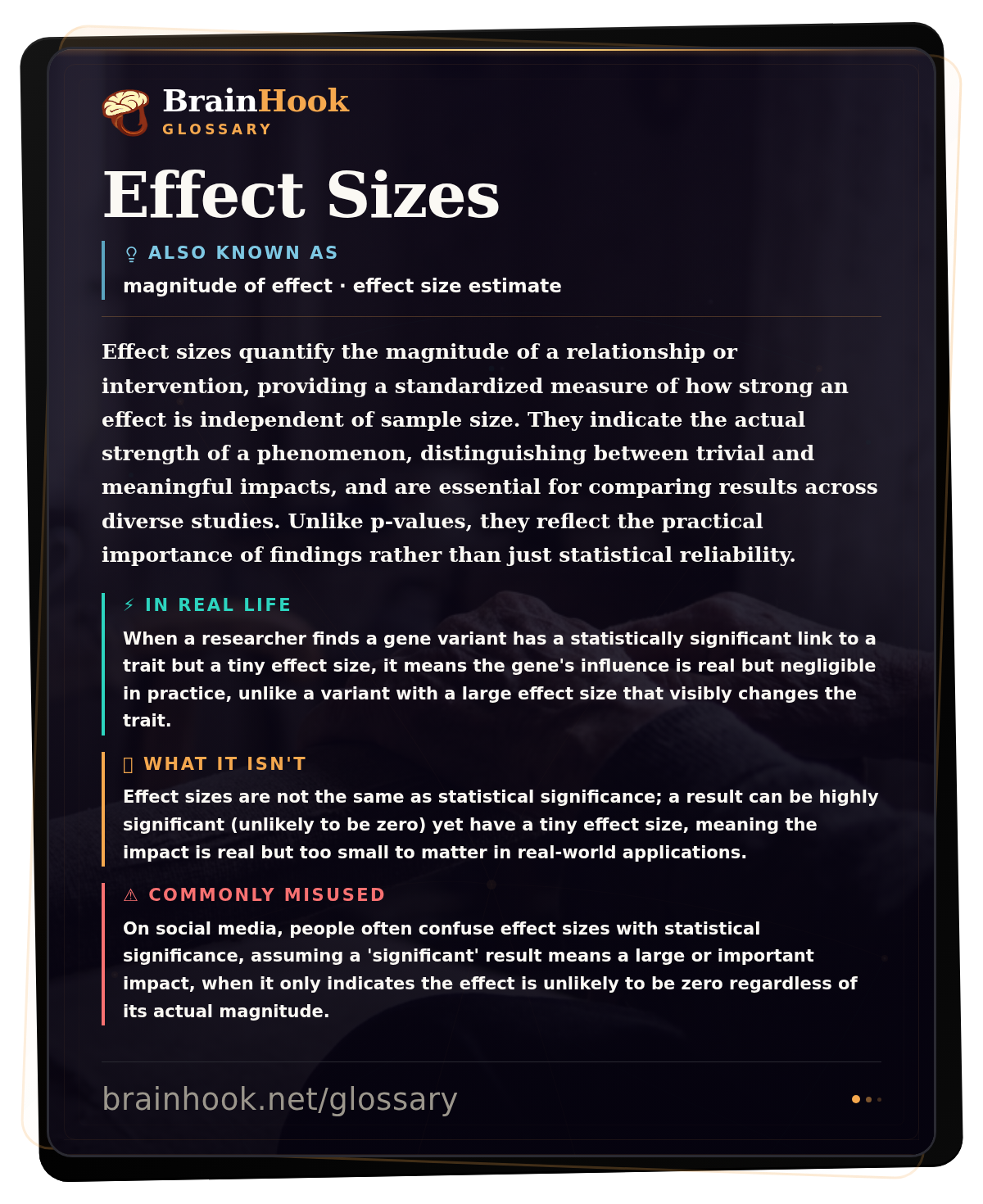
Effect sizes quantify the magnitude of a relationship or intervention, providing a standardized measure of how strong an effect is independent of sample size. They indicate the actual strength of a phenomenon, distinguishing between trivial and meaningful impacts, and are essential for comparing results across diverse studies. Unlike p-values, they reflect the practical importance of findings rather than just statistical reliability.
What this means in real life
A new study drug reduces headache duration by 2 minutes on average. The effect size tells you whether that 2-minute difference is tiny (barely noticeable) or substantial (clinically meaningful)—something a p-value alone cannot convey.
What it isn’t
It is not the same as statistical significance. A study with a huge sample can find a statistically significant but tiny, practically meaningless effect; conversely, a small study might miss a large, important effect.
Commonly misused online
People often treat 'statistically significant' and 'large effect size' as synonyms. Social media posts frequently celebrate p-values without mentioning effect size, misleading readers about real-world impact.