The Mites Living on Your Face Aren't the Problem. Their Bacteria Might Be.
Demodex mites graze on your face sebum around the clock, but new research suggests the bacteria living inside them — not the mites themselves — may be quietly inflaming your skin.
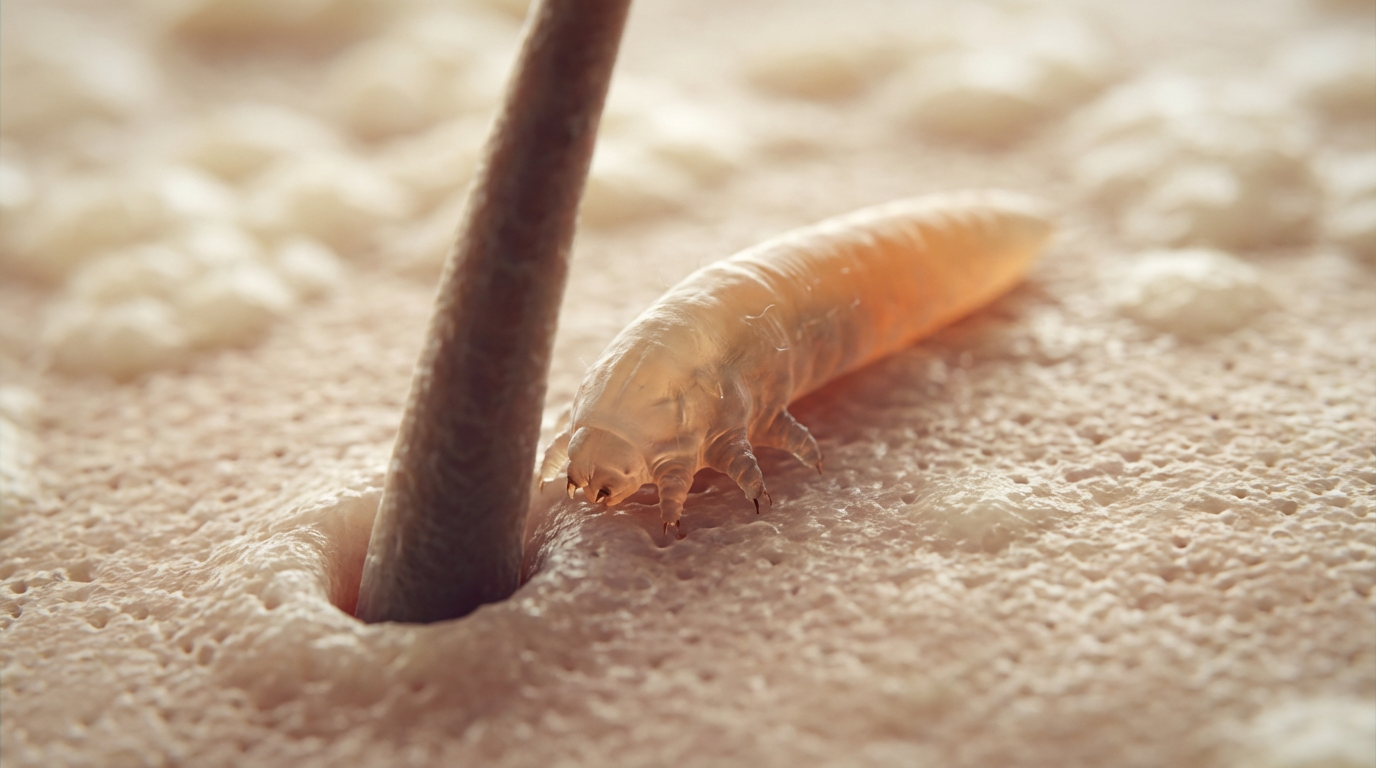
Right now, on your face, mites are grazing. They are roughly 0.3 millimeters long, eight-legged, and shaped vaguely like a carrot if a carrot had claws. They live head-down inside your hair follicles, feeding on sebum and skin cells, and they are present on virtually every adult face on Earth. Demodex folliculorum and its slightly smaller cousin Demodex brevis have been cohabiting with humans for so long that most immunologists classify them as permanent residents rather than invaders. You have probably never once felt them. That is exactly the kind of information that makes some people want to sandblast their cheekbones.
For most people, the mites do nothing obviously harmful. They are ectoparasites in the technical sense — they live on a host and consume its resources — but at low population densities they sit beneath the threshold of clinical concern, quietly cycling through their brief lives without provoking so much as a twitch from the immune system. The relationship is probably better described as reluctant coexistence than active infestation. What makes Demodex scientifically interesting is not that it is there, but what happens when it flourishes in greater numbers on certain faces. Specifically, faces with rosacea.
Rosacea affects somewhere between five and ten percent of the global population, depending on how you count it. It produces persistent facial redness, flushing, visible blood vessels, and in some cases papules and pustules that can look like acne. It is chronic, frequently mismanaged, and poorly understood at the mechanistic level. The Demodex connection has been known for decades — people with rosacea carry significantly higher mite densities than people without it — but dermatologists have long argued about which direction causality runs. Do the mites cause rosacea, or does the skin environment in rosacea simply suit the mites better? A 2025 review in the journal Microorganisms has pushed that argument somewhere more specific, and more unsettling: the mites may matter less than what they are carrying inside them.
The organism in question is Bacillus oleronius, a gram-negative bacterium discovered in the gut of Demodex mites in the late 1990s. It is not a household name, and until recently it barely warranted a footnote in mainstream dermatology. But research over the past several years has been accumulating around it with the kind of quiet insistence that tends to precede a genuine reframing. B. oleronius produces proteins that trigger inflammatory responses in human immune cells[3]. It appears to upregulate enzymes in the skin that disrupt the epidermal barrier. And it may be doing all of this while its mite host grazes peacefully on your follicle wall, completely untroubled by the immunological chaos unfolding nearby.
The Mite That Skips the Toilet
To understand why the bacterial hypothesis matters, it helps to understand the specific biology of Demodex, which is genuinely strange even by parasite standards. Demodex mites lack an anus. This is not a trivial anatomical detail. It means that the mite accumulates waste internally throughout its lifespan — which runs roughly two to three weeks — and then, upon death, decomposes directly inside the follicle, releasing everything it has stored in one concentrated deposit. Historically, this was the centerpiece of the gross-out argument against Demodex: a burst of microbial byproducts and decaying tissue, delivered straight to the skin. That image, viscerally compelling as it is, probably overstates what the decomposing mite itself contributes. But the same biology that makes Demodex a sealed system also makes it an enclosed habitat — and that enclosed habitat carries bacteria that do not need to wait for the mite to die before making trouble.
Demodex mites were not identified as hosts for live bacteria until the late 1990s, when researchers examining the mite's internal contents isolated B. oleronius from specimens collected from rosacea patients[4]. The discovery sat somewhat dormant for years, partly because rosacea research has historically been underfunded relative to the number of people it affects, and partly because proving that a bacterium inside a mite is causing skin pathology in a human host requires working through a very long causal chain. The 2025 Microorganisms review synthesizes the evidence that has slowly built along that chain, and the mechanism it describes is not vague. It is specific, enzyme-level, and increasingly hard to dismiss.
“The mite may be the vehicle. The bacterium appears to be doing the driving.”
Enzymes, Barriers, and the Specific Chemistry of Inflammation
Healthy skin maintains its integrity through a tightly regulated barrier: interlocking keratinocytes sealed by lipids, defended by antimicrobial peptides, and policed by a calibrated immune system that knows the difference between a routine microbe and a genuine threat. Rosacea skin is notable for how thoroughly it fails at several of these tasks simultaneously. The barrier is leaky. The immune response is dysregulated. Inflammatory cytokines circulate at elevated levels. Blood vessels dilate more readily and stay dilated longer than they should. What causes this multi-system failure is what researchers have been trying to pin down for decades.
One candidate mechanism involves serine proteases — enzymes that, in healthy skin, help regulate the normal shedding of dead cells and the processing of antimicrobial peptides. In rosacea skin, serine protease activity is abnormally elevated[1], and this excess activity appears to trigger a cascade: it cleaves cathelicidin antimicrobial peptides into fragments that are, paradoxically, pro-inflammatory rather than protective, and it degrades components of the skin barrier that would otherwise keep irritants out. The 2025 review reports evidence that B. oleronius proteins upregulate this same serine protease pathway. In other words, the bacterium carried by the mite may be pushing precisely the enzymatic lever that makes rosacea skin behave the way it does.
This is not the same as saying the mite causes rosacea through simple irritation. The picture is more layered and, frankly, more interesting than that. B. oleronius proteins have been shown to elicit immune responses in peripheral blood mononuclear cells — the immune cells circulating in the bloodstream — of rosacea patients at significantly higher rates than in healthy controls. The skin of rosacea patients appears to recognize and react to bacterial proteins that most unaffected skin largely ignores. Whether that heightened reactivity is a cause or a consequence of the condition, or some loop of both, remains genuinely open. But the mite-bacteria relationship gives researchers something concrete to target, and it reframes rosacea as a co-infestation story: not one organism causing one problem, but a bacterium hitchhiking inside a mite that is itself tolerated by the immune system until something tips the density or the reactivity the wrong way.
Why Your Immune System Leaves the Mites Alone
The question of why Demodex populations expand on some faces and not others pulls in several directions at once. Age is a reliable correlate — mite densities increase as skin produces more sebum in early adulthood and then as immune surveillance becomes less precise with age, which is why Demodex is rarer on children and more abundant on older adults. Immunosuppression matters too: people on long-term corticosteroid therapy or with compromised immune function often carry dramatically elevated mite loads, a condition sometimes called demodicosis that produces visible skin changes and itching. But rosacea does not track cleanly with immune suppression. Many rosacea patients have immune systems that are, if anything, overreactive — which is part of what makes the Demodex connection complicated.
One hypothesis worth sitting with: Demodex may be tolerated not because the immune system is suppressed but because the mites are genuinely good at hiding. They live head-down in follicles, a location that is somewhat immunologically privileged — the hair follicle environment actively suppresses inflammatory responses, probably to protect the follicle itself from being destroyed by routine immune activation. Demodex may have evolved to exploit exactly that feature. If so, the mite is not evading the immune system so much as parking itself in a zone the immune system is already inclined to leave alone. The bacteria it carries, meanwhile, are releasing proteins that leak out, interact with immune cells, and provoke the kind of diffuse, hard-to-localize inflammatory response that rosacea produces. The mite is the Trojan horse. B. oleronius is what climbs out.
“Rosacea may not be what the mites are doing to your face — it may be what the mites are delivering to it.”
What This Changes About Treatment
The therapeutic implications are already beginning to reshape clinical practice, even as the mechanistic picture remains incomplete. Ivermectin — an antiparasitic drug most famous for its use against river blindness and, more recently, for its spectacularly misapplied pandemic fame — has been used topically for rosacea for several years with meaningful success. The conventional explanation was mechanical: kill the mites, reduce the population, reduce the inflammation. But ivermectin also has documented anti-inflammatory properties[2] independent of its antiparasitic action, which made the story murkier than dermatologists liked. If B. oleronius is the primary inflammatory driver, then ivermectin's efficacy might owe as much to its bacterial disruption — possibly through killing the mite host that shelters the bacteria — as to any direct reduction in mite burden.
Antibiotic treatment for rosacea has a long history, particularly oral doxycycline, which is used at sub-antimicrobial doses for its anti-inflammatory properties rather than its ability to kill bacteria outright. If B. oleronius proves to be a central player, that framing shifts. Targeting the bacterium directly, or targeting its protein products, or blocking the serine protease pathway it appears to upregulate, could eventually produce more precise interventions than the current approach — which, for many patients, amounts to long-term low-dose antibiotics and careful trigger avoidance. That is not a bad toolkit, but it is a blunt one for a condition that may have a specific microbial mechanism underneath it.
Skincare formulations aimed at reducing Demodex populations — tea tree oil-derived products, particularly those containing terpinen-4-ol — have gained clinical traction in the past decade, initially in the context of Demodex-associated eyelid inflammation and more recently in rosacea management. Here again, the bacterial hypothesis adds a layer: if the goal is reducing B. oleronius load, reducing mite density is probably the most reliable way to do it, since the bacteria live inside the mites. But the relationship between mite density and bacterial protein exposure in the skin is not perfectly understood. High mite density almost certainly correlates with higher bacterial exposure. Whether there is a meaningful threshold below which B. oleronius proteins no longer trigger the immune cascade remains an open and genuinely important question.
The Gross Elegance of a Two-Organism Problem
“What your dermatologist calls a skin condition, your follicles are experiencing as a small ecosystem collapse.”
There is something almost elegant, in a deeply uncomfortable way, about the co-infestation model. Rosacea has resisted clean mechanistic explanation for so long partly because researchers kept looking for a single cause at the skin level — a genetic variant, a trigger sensitivity, a sebum composition anomaly — when the actual story appears to involve a bacterium inside a mite inside a follicle, operating through an enzyme cascade, in a person whose immune system has a particular reactivity to bacterial proteins it has presumably been exposed to for decades without incident. The timeline of that slow sensitization is not well characterized. Neither is the question of why some people seem to tolerate high Demodex densities without apparent inflammation while others develop florid rosacea. Individual immune architecture, barrier genetics, and microbiome composition all probably contribute, and pulling those threads apart is the work of the next several years of research.
What the 2025 Microorganisms review contributes is not a solved answer but a better question. The field has spent considerable energy asking whether Demodex causes rosacea. The more productive frame now looks like this: what does Bacillus oleronius do to human skin, how does the mite's biology determine how much of that bacterium reaches the immune system, and what makes certain people's immune systems respond to the bacterial proteins while others do not register them at all. Those are questions with tractable experimental approaches. They point toward specific enzyme targets, specific immune pathways, specific interventions. And they make rosacea — long dismissed as a cosmetic complaint by people who did not have it — into something considerably more strange and interesting than its rosy-cheeked appearance suggests. Your face is an ecosystem. Something in that ecosystem has a passenger. The passenger, it turns out, may be the whole problem.
References
- Increased serine protease activity and cathelicidin promotes skin inflammation in rosacea (nature.com)
Establishes that serine protease activity is abnormally elevated in rosacea skin, the enzymatic pathway the article links to B. oleronius. - New developments in the treatment of rosacea – role of once-daily ivermectin cream (pmc.ncbi.nlm.nih.gov)
Describes ivermectin's dual role as anti-inflammatory and anti-parasitic agent targeting Demodex in rosacea treatment. - Rosacea and the Microbiome: A Systematic Review (pmc.ncbi.nlm.nih.gov)
Provides evidence that Bacillus oleronius proteins trigger inflammatory responses in human immune cells, supporting the article's central claim about bacterial pathogenicity. - Potential role of Demodex mites and bacteria in the induction of rosacea (microbiologyresearch.org)
Documents the late-1990s discovery of Bacillus oleronius bacteria isolated from Demodex mites in rosacea patients.
About Phoebe Lark
Phoebe Lark writes about the biology and chemistry your body and home would rather you didn't examine too closely — odors, fluids, microbes, parasites, infestations, and the quietly industrious rot happening on and around you right now. She follows disgust down to the mechanism underneath, where the gross thing almost always turns out to be a system doing exactly what it evolved to do.
More like this
The Microbes in Your Gut Are Deciding What Your Skin Does Next
A 2025 review confirmed the gut-skin axis runs in both directions — and the signaling mechanism is stranger, more specific, and more actionable than the probiotic aisle ever let on.
The Brain's Immune System Is Supposed to Protect You. With Age, It Starts Working Against You.
Microglia — the brain's resident immune cells — spend a lifetime learning to protect you, then gradually flip into a state that erodes the very circuits they were built to defend.
When You Cut Yourself, Your Gut Microbiome Changes. Here's the Exact Mechanism.
Researchers traced a single molecular signal from broken skin all the way to the colon, and what it does to gut bacteria there is not what anyone expected.