Your Breath Is a Readout of Your Gut Microbiome. Scientists Just Proved It.
A 2025 Cell Metabolism study confirmed what scientists suspected for years: the microbial fermentation churning through your gut is chemically leaking into your breath — and that volatile signature might be the future of gut diagnostics.
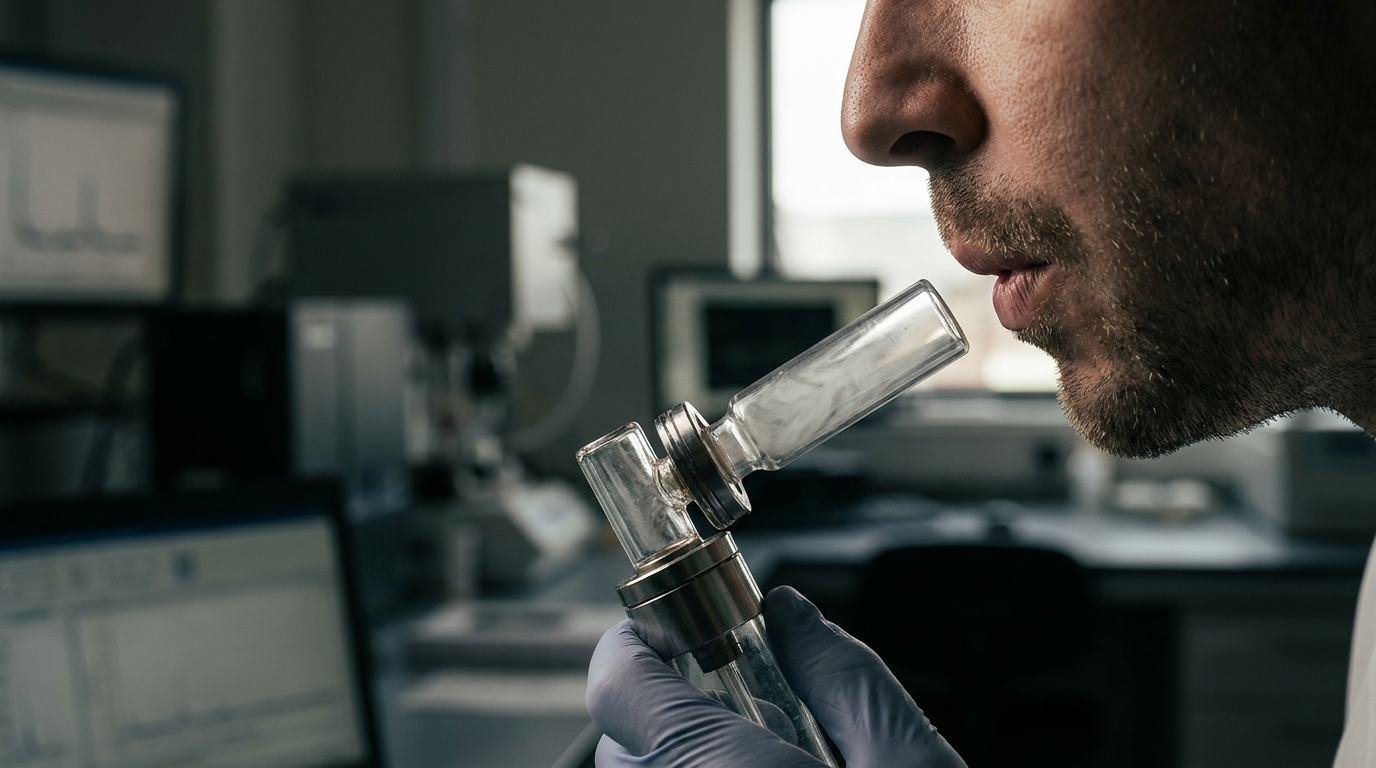
Take a breath. Hold it for a second, then exhale slowly into your cupped palm and smell what comes back. Most people get something warm and vaguely stale, maybe a little sour, maybe a little nothing. What they are not getting, because the human nose is not remotely sensitive enough, is the full chemical inventory of what just left their lungs: a shifting cloud of hundreds of volatile organic compounds, some metabolic housekeeping products, some oxygen-exchange byproducts, and some molecules that originated nowhere near the respiratory system. Some of them were made in your colon.
That is the finding now sitting at the center of a landmark 2025 study published in Cell Metabolism[4]. Researchers demonstrated with unusual rigor that gut bacteria — the dense, metabolically furious microbial communities fermenting your food roughly two meters below your chin — directly shape the volatile organic compound profile of your exhaled breath. The colon and the lung are not, biochemically speaking, as far apart as anatomy suggests. There is a gut-to-lung chemical corridor, and microbes are using it to broadcast information about themselves every time you breathe out.
The implications land in two places simultaneously. The first is basic biology: the microbial ecosystem in your gut is not just a local digestive phenomenon. It is chemically systemic in ways we are still mapping. The second is clinical and considerably more exciting to anyone who has ever had a colonoscopy: if your breath carries a microbiome fingerprint, then your breath might eventually replace procedures that currently involve a bowel prep, a hospital gown, and a camera on a very long tube.
Getting from the colon to the lung requires a route, and the route is not romantic. Gut bacteria produce volatile organic compounds — short-chain fatty acids, sulfur derivatives, indoles, phenols, aldehydes, ketones — as metabolic waste products of fermentation. Most people know fermentation as the process behind beer and sourdough. In the colon, it is the same chemistry, executed by trillions of bacteria working on whatever dietary fiber, proteins, and undigested material has made it that far south. The compounds this fermentation produces are small enough to cross the gut epithelium, enter the bloodstream, circulate to the lungs, and diffuse across the alveolar membrane into exhaled air. The whole process is quiet and continuous, invisible to introspection, and it has been happening your entire life.
Why Breath Analysis Took This Long to Take Off
Breath as a diagnostic medium has a long and slightly frustrated scientific history. The idea is elegant: breath is non-invasive, can be collected repeatedly, requires no needles, and comes out of patients on its own schedule. Researchers have known since at least the 1970s that exhaled air contains compounds that vary between sick and healthy individuals. The problem was always the signal-to-noise ratio. Human breath is chemically complex. It carries hundreds of compounds, many of which come from ambient air, diet, oral bacteria, nasal passages, and esophageal reflux rather than from any single systemic source. Separating a microbiome signal from that din required analytical tools and study designs that, until recently, were not good enough or not deployed carefully enough to be convincing.
The 2025 Cell Metabolism study addressed this methodologically, which is a large part of why its findings carry more weight than previous correlative work in the space. The researchers used a combination of high-resolution mass spectrometry and 16S rRNA sequencing to profile both breath volatiles and gut microbial communities in parallel across their study population. Crucially, they controlled for the confounders that have muddied earlier breath research: participants fasted before sampling, ambient air was measured separately, and oral microbiome contributions were accounted for. What remained after that subtraction — the compounds that correlated specifically with gut microbial composition rather than mouth or environment — constituted a robust and reproducible signal. Several volatile compounds, including specific short-chain fatty acids and sulfur-containing metabolites, tracked closely with the relative abundance of particular bacterial taxa in the gut.
“The colon and the lung are not, biochemically speaking, as far apart as anatomy suggests — microbes are using the distance between them to broadcast information every time you exhale.”
Short-chain fatty acids deserve particular attention here because they tend to get framed, in popular science coverage, as simply good for gut health. That framing is accurate but incomplete. Acetate, propionate, and butyrate — the three most abundant — are produced when bacteria ferment dietary fiber. Each is associated with different microbial communities. Butyrate is heavily associated with Firmicutes like Faecalibacterium prausnitzii, a bacterial species considered a marker of gut health because of its anti-inflammatory properties[2]. Propionate is more associated with Bacteroidetes. When these compounds end up in breath, they carry taxonomic information — a chemical fingerprint of who exactly is doing the fermenting. That specificity is what makes the breath signal scientifically interesting rather than just biologically curious.
The Chemistry of Fermentation, Explained By What It Smells Like
Sulfur compounds are the less flattering part of the story, and also among the most diagnostically interesting. Hydrogen sulfide and methanethiol — both gut fermentation byproducts of sulfur-containing amino acid metabolism — have been detected in exhaled breath at concentrations that vary significantly between individuals and that correlate with the composition of sulfur-reducing bacterial communities in the colon. You may recognize these compounds by other names. Hydrogen sulfide is the primary constituent of what flatulence actually smells like; methanethiol is a close relative. In breath, concentrations are far below the olfactory threshold, but mass spectrometry finds them anyway, and their presence or absence appears to carry meaningful information about which bacterial communities are active in the lower gut.
Indoles and phenols round out the picture. These are byproducts of bacterial tryptophan metabolism, and they have a smell that is simultaneously floral and fecal — a duality that explains why, at low concentrations, indole has historically been used in perfumery, and at higher concentrations it is the smell you associate with a poorly ventilated bathroom. The same molecule. The concentration and chemical context are doing all the olfactory work. In breath analysis, indole levels appear to track with the activity of certain Bacteroides and Clostridiales species, offering another thread in the diagnostic tapestry. If the goal is to differentiate between a gut with healthy microbial diversity and one that has been disrupted by disease, dysbiosis, or antibiotic use, these volatile markers collectively offer a partial but real-time chemical census.
What Disease Smells Like, From the Inside
The clinical potential becomes sharper when you look at what happens to breath volatiles in conditions already associated with gut microbiome disruption. Inflammatory bowel disease — both Crohn's and ulcerative colitis — involves substantial shifts in microbial community composition, and these shifts appear to produce measurable changes in the breath volatile profile. Patients with active IBD show elevated levels of certain aldehydes and reduced levels of some short-chain fatty acid derivatives relative to healthy controls. Whether breath-based markers can reliably distinguish Crohn's from ulcerative colitis, or track disease activity over time, is an active and competitive area of research.
Colorectal cancer is the higher-stakes target. This is a disease where early detection dramatically improves outcomes and where screening rates remain low in part because colonoscopy is perceived — correctly — as unpleasant, expensive, and logistically demanding. There is already an approved stool-based DNA test[1] that works on a non-invasive sample, and its uptake has been higher than colonoscopy among screening-eligible adults who were previously declining the procedure. A breath test sits even further down the convenience spectrum: no bowel prep, no sample collection, no logistics. Several research groups are working toward this, and while a validated clinical breath test for colorectal cancer is not yet approved, the 2025 findings provide mechanistic support for what was previously more of a hypothesis. If cancer-associated microbial dysbiosis produces a detectable and specific breath signature, the diagnostic pipeline becomes easier to justify investing in.
“Several volatile compounds tracked closely with the relative abundance of particular bacterial taxa in the gut — meaning your breath is not just air; it is a partial microbial census, running continuously.”
The Problem With Building a Breathalyzer for Your Microbiome
There is a reason this hasn't already replaced the colonoscope. Breath is genuinely, stubbornly complicated as an analyte. The oral microbiome alone produces its own suite of volatile compounds, many of which overlap with gut-derived ones. Oral bacteria break down proteins into sulfur compounds and amines at impressive speed, which is why breath smells worse in the morning after hours of bacterial activity on a sleeping, non-salivating tongue. Separating oral from gut contributions requires careful methodology, and in clinical field conditions rather than controlled research environments, that separation becomes harder. Diet adds another variable: cruciferous vegetables raise sulfur compound levels, high-protein meals shift amino acid fermentation products, and alcohol metabolism produces acetaldehyde that swamps more subtle signals.
Lung disease and metabolic conditions introduce their own confounders. People with diabetes exhale elevated acetone[3], a ketone produced when fat metabolism accelerates in the absence of sufficient insulin. People with kidney disease exhale elevated ammonia and trimethylamine. People with certain liver conditions exhale dimethyl sulfide at detectable levels. These are all metabolic signals worth caring about clinically, but they overlap with the volatile space that gut microbiome researchers are trying to use, which means a diagnostic tool would need to model all of these sources simultaneously to avoid false positives. That is a machine learning problem as much as a chemistry problem, and several groups are working on it using exactly that framing: training models on large multivariate breath datasets to classify gut microbiome states the way image recognition classifies objects.
Your Microbiome Has Always Been Louder Than You Knew
Zoom out from the diagnostic applications and the underlying biology is strange enough to sit with on its own terms. The gut microbiome — roughly a kilogram of bacteria, archaea, fungi, and viruses living in the lower gastrointestinal tract — is not biologically contained to the gut. It communicates through metabolites, through immune signaling, through the enteric nervous system, and apparently through the bloodstream and lungs in the form of volatile organic compounds that end up in the air around you. The microbiome has always been more systemic than its anatomical address implies. Research in the past decade has linked gut microbial composition to neurological conditions, mood disorders, autoimmune disease, and cardiovascular risk — all findings that require the microbiome to exert influence well beyond the colon wall. The breath finding fits that pattern and makes it literal: the microbiome is not just influencing remote systems. It is exhaling through you.
There is also something worth noting about what this means for the microbiome's individuality. Gut microbial communities are highly personal. Identical twins who have lived apart for years diverge substantially in microbial composition. Diet, geography, antibiotic history, early childhood environment, and dozens of other factors shape who lives in your colon and in what proportions. If breath volatile profiles track microbial composition, then they may also be surprisingly individual — not enough to replace a fingerprint, but enough that two people breathing in the same room are exhaling genuinely different chemical signatures. We have always known that people smell different to each other. The mechanism has historically been attributed to skin bacteria and sweat composition. The gut, it turns out, may be contributing more to the olfactory identity of a person than anyone previously accounted for.
“The microbiome is not just influencing remote systems — it is exhaling through you, continuously and chemically, whether you are aware of it or not.”
The practical diagnostic future is probably a decade away from the clinic, maybe closer if the machine learning approaches and instrument miniaturization move quickly. But the science underneath the ambition is now considerably more solid than it was. A breath test that reflects gut health non-invasively would change screening economics substantially — not because colonoscopies are going away, but because a high-sensitivity, low-burden triage tool that catches high-risk individuals early has obvious value. What is interesting right now, before any of that materializes, is the simpler and more unsettling fact: you have been exhaling a microbial readout your entire life. Every conversation, every quiet room, every moment of rest — your colon has been running its mouth. Scientists finally have instruments sensitive enough to listen.
References
- A Practical Overview of the Stool DNA Test for Colorectal Cancer Screening (pmc.ncbi.nlm.nih.gov)
Describes the FDA-approved stool-based DNA test for colorectal cancer screening, providing context for comparing breath testing as an alternative non-invasive screening approach. - Faecalibacterium prausnitzii is an anti-inflammatory commensal bacterium identified by gut microbiota analysis of Crohn disease patients (pnas.org)
Establishes Faecalibacterium prausnitzii as a marker of gut health due to its anti-inflammatory properties, supporting the article's discussion of butyrate-producing bacteria. - Sensing Technologies for Detection of Acetone in Human Breath for Diabetes Diagnosis and Monitoring (pmc.ncbi.nlm.nih.gov)
- The gut microbiota shapes the human and murine breath volatilome (doi.org)
Landmark 2025 Cell Metabolism study demonstrating that gut bacteria directly shape volatile organic compounds in exhaled breath using high-resolution mass spectrometry and 16S rRNA sequencing.
About Phoebe Lark
Phoebe Lark writes about the biology and chemistry your body and home would rather you didn't examine too closely — odors, fluids, microbes, parasites, infestations, and the quietly industrious rot happening on and around you right now. She follows disgust down to the mechanism underneath, where the gross thing almost always turns out to be a system doing exactly what it evolved to do.
More like this

Decomposition Has a Smell for Every Stage — And Science Is Finally Mapping It
The odor rising from a decomposing body isn't a single stench — it's a shifting chemical record written by bacteria, and forensic scientists are learning to read it like a clock.

The Microbes in Your Gut Are Deciding What Your Skin Does Next
A 2025 review confirmed the gut-skin axis runs in both directions — and the signaling mechanism is stranger, more specific, and more actionable than the probiotic aisle ever let on.

Indoor Mold's Real Threat Isn't the Stain — It's the Air Around It
A new method for detecting airborne mycotoxins confirms what the stain on your wall can't tell you: the toxic part already left.