A Parasite in 30–60% of Human Brains Is Making People More Impulsive. We've Been Ignoring This.
Toxoplasma gondii has been quietly altering human behavior for millennia — and the mechanism it uses is more precise, and stranger, than anyone wants to admit.
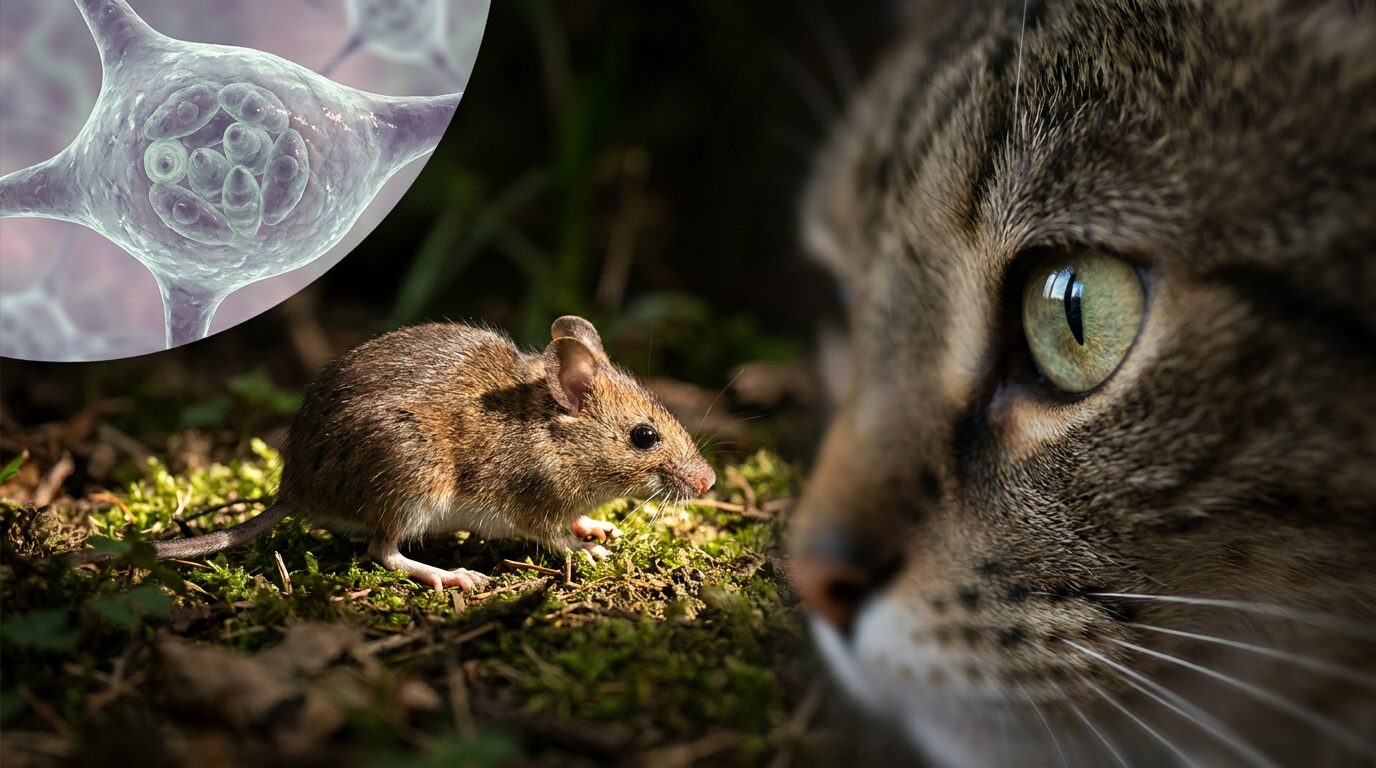
Consider an ordinary afternoon. You change a cat's litter box, wash your hands imperfectly, then later touch your mouth without thinking. It is the kind of micro-event that vanishes into the background noise of daily life. But for roughly one in three people on Earth, that small moment — or one like it, years or decades ago — may have been the entry point for a protozoan parasite that is still living in their brain right now. Not metaphorically living. Physically living. Walled off inside cysts no larger than a few micrometers, persisting inside neurons and other cells, waiting for conditions that may never come, altering chemistry in ways that researchers are only beginning to map.
Toxoplasma gondii is among the most successful parasites on the planet, infecting an estimated two to three billion people worldwide — somewhere between 30 and 60 percent of the global human population depending on geography and diet. In most healthy adults, the initial infection passes without noticeable symptoms, which is precisely what makes it such an effective squatter. The immune system walls it off. The person feels nothing. And then, for decades, the parasite simply stays.
For a long time, the consensus in medicine was that chronic, latent toxoplasmosis in immunocompetent adults was essentially inert — a biological footnote, a cyst in the brain that did nothing worth worrying about unless the immune system collapsed. That view has been eroding steadily for about two decades. And in 2025, new findings added sharper edges to what researchers had long suspected: studies examining behavioral correlates of latent Toxoplasma infection in human populations confirmed statistically significant links between T. gondii seropositivity and elevated impulsivity, sexual risk-taking, and aggression in human carriers. This is not fringe science. It is a replication-supported behavioral signal attached to a parasite that may already be living in a third of the people you know.
The mechanism that makes this possible is the part that should make you stop and read more carefully. Toxoplasma does not alter behavior by accident. It does it through specific, documented biochemical pathways — some of which appear to involve the actual production of dopamine and the upregulation of enzymes in the brain's own chemistry. For a single-celled organism, this is an extraordinary capability. And for us, it raises questions that medicine has been slow to sit with: what does it mean that a parasite may be quietly nudging the behavior of billions of people, and that we have largely treated this as a footnote?
What Toxoplasma Actually Does to a Mouse
To understand what might be happening in human brains, you have to start with the organism's actual evolutionary agenda. Toxoplasma gondii can infect almost any warm-blooded animal, but it can only sexually reproduce inside the intestinal lining of a cat. This creates a problem: the parasite needs to get from its intermediate host — a mouse, a rat, a bird, a sheep, a human — back into a cat. Its solution, developed over millions of years, is behavioral manipulation. Infected rodents lose their innate fear of cat urine, a fear that is normally hardwired and nearly impossible to extinguish. Research from the University of California and other institutions studying Toxoplasma-induced behavioral changes in rodents has shown that infected mice do not merely become less afraid of cats — some develop what appears to be a fatal attraction to cat odor[1]. The parasite creates the conditions for its own transmission by altering the host's response to a specific sensory cue.
The mechanism behind this is localized and precise. Toxoplasma cysts cluster preferentially in the amygdala, the brain structure most responsible for fear processing and threat response. Within the amygdala and surrounding tissue, the parasite expresses an enzyme called tyrosine hydroxylase — the rate-limiting enzyme in dopamine synthesis[2]. This means T. gondii is not simply disrupting neural circuits by mechanical presence. It is actively participating in neurochemistry, nudging dopamine production in specific brain regions associated with reward, arousal, and fear. For a single-celled organism, this is a remarkable biochemical maneuver. The cyst is not just hiding in the brain; it is running a low-level chemical intervention.
“Toxoplasma does not alter behavior by accident — it carries the enzyme that makes dopamine, and it uses it.”
The Human Data, and Why It Has Been Hard to Dismiss
The difficulty with studying behavioral effects in humans is that you cannot run the controlled experiment you would with rodents. You cannot infect a group of people with T. gondii, wait a year, and observe what changes. Instead, researchers rely on serological studies — comparing behavioral and psychological measures between people who test positive for T. gondii antibodies (meaning they have been infected) and those who test negative. This design has real limitations: people who already engage in riskier behaviors might be more likely to be exposed to the parasite in the first place, through undercooked meat or contact with cats in specific environments. Causality is genuinely hard to establish.
And yet the signal keeps appearing. Work by Jaroslav Flegr at Charles University in Prague, conducted across multiple studies over more than two decades, showed that T. gondii-positive individuals scored differently on personality measures — men trending toward higher suspicion, lower rule-following, and higher risk tolerance, women toward higher warmth and risk-taking in different registers. These are not huge effect sizes, but they are consistent, replicated across populations, and hard to explain away as pure artifact. More recently, a 2019 study examining Toxoplasma seropositivity and entrepreneurial behavior[3] found that infected individuals were statistically more likely to have started businesses and more likely to have majored in business-related fields — a finding that reframed impulsivity as something with real-world behavioral signatures. The 2025 confirmation of links to impulsivity, sexual risk-taking, and aggression lands in a literature that has been building its case for years.
The aggression link is perhaps the most striking. Research published examining Toxoplasma infection and diagnosed intermittent explosive disorder[4] found that infected individuals were significantly more likely to have the disorder and scored higher on impulsivity and aggression measures even when accounting for other variables. Intermittent explosive disorder involves repeated, sudden episodes of impulsive aggression disproportionate to the situation — the kind of anger that flares and confuses even the person experiencing it. Whether T. gondii causes this or is associated with it through some third factor remains an open question, but the parasite's known dopaminergic effects in brain tissue give the association a plausible mechanistic skeleton.
The Parasite's Preferred Neighborhoods
One of the more unsettling details in T. gondii's biology is that it is not diffusely distributed in the brain. The cysts have preferences. They concentrate in areas including the amygdala, the prefrontal cortex, and the striatum — exactly the regions most involved in impulse control, threat appraisal, reward-seeking, and behavioral inhibition. The prefrontal cortex governs the brakes. The striatum is heavily wired into dopaminergic reward circuits. The amygdala reads danger. These are not peripheral structures. They are the core machinery of how a person decides whether to take a risk, how they respond to a threat, and whether they pause before acting. A parasite whose cysts concentrate in these neighborhoods, and which produces dopamine-synthesis enzymes, is positioned to do meaningful neurochemical work.
“The cysts prefer the amygdala, the prefrontal cortex, and the striatum — the exact architecture of impulse, fear, and reward.”
It is worth being precise about what this does and does not mean. The cysts are not sending signals. They are not controlling thoughts. The changes T. gondii appears to induce are subtle shifts in the background chemistry of behavior — not hijacked cognition, but a slightly different tuning of the instruments. The infected person is still fully themselves, still making their own choices, still shaped far more by genetics, experience, and environment than by anything a protozoan cyst is doing. But the analogy that keeps appearing in this research is worth sitting with: even small, chronic shifts in dopamine tone in reward-related circuits can produce detectable changes in how impulsive a person is, how much risk feels tolerable, and how quickly anger bypasses deliberation. Toxoplasma may not be steering the car. But there is evidence it has its hand on the dial.
How a Billion People Got Infected Without Noticing
The transmission routes for Toxoplasma are prosaic almost to the point of comedy. Cat feces containing oocysts — the environmentally hardy egg-like form of the parasite — can contaminate soil and water. Undercooked meat, particularly pork, lamb, and venison, is the dominant transmission route in many countries, because the parasite forms tissue cysts in the muscles of infected animals. You can also pick it up through unwashed produce grown in contaminated soil, through garden dirt, or through inadequate hand hygiene after handling raw meat. A pregnant woman who acquires the infection for the first time during pregnancy can transmit it to the fetus, which is the scenario medicine has always taken seriously, since congenital toxoplasmosis can cause severe neurological damage. But for the vast majority of infections, which occur in already-born adults with functional immune systems, the moment of infection is silent and usually leaves no trace a person would notice.
Prevalence varies dramatically by geography and food culture. In France, where steak tartare and undercooked lamb have historically been dietary staples, historical seroprevalence estimates have run as high as 50 to 80 percent of the population. In the United States, estimates generally fall between 10 and 20 percent, having declined over recent decades as meat handling and freezing practices improved — freezing kills tissue cysts. In some parts of sub-Saharan Africa and Latin America, rates above 60 percent have been documented. The parasite's global reach is a function of how ordinary its transmission routes are, and how completely asymptomatic the chronic phase has been assumed to be. The assumption of inertness made the infection invisible in every way that mattered for public conversation.
Why We Have Treated This as a Footnote
There is something almost sociologically interesting about how slowly this research has moved into mainstream medical concern. The behavioral effects of T. gondii in rodents have been well-documented since the 1990s. The first serious human behavioral studies appeared in the early 2000s. The dopamine-synthesis enzyme data — the mechanistic smoking gun — has been available and replicated for years. And yet latent toxoplasmosis in healthy adults remains largely outside the frame of clinical concern, rarely screened for outside pregnancy, rarely discussed in the context of mental health or behavioral health, and treated in most public health frameworks as a solved problem rather than an open one.
Part of this is justified epistemic caution. The behavioral associations are real but the effect sizes are modest, the causality is genuinely uncertain, and clinical medicine reasonably prioritizes interventions with clear, proportionate benefits. There is also no treatment for latent T. gondii infection — the drugs used against acute toxoplasmosis don't penetrate cysts effectively, and treating a chronic infection that produces no acute symptoms in most people is a hard case to make. The harder part is the conceptual discomfort of a finding that implicates a parasite in human behavior at population scale. Medicine is comfortable with pathogens that cause discrete diseases with clear symptoms. A pathogen that might subtly shift the distribution of impulsivity, risk-tolerance, and anger across billions of people doesn't fit cleanly into any existing framework for what infections are supposed to do.
“A pathogen that shifts the distribution of impulsivity across billions of people doesn't fit cleanly into any framework for what infections are supposed to do.”
What This Actually Changes
The honest answer is that latent Toxoplasma infection probably does not change what any specific individual should do on Monday morning. There is no intervention, no screening protocol, and no treatment that currently follows from knowing you are seropositive. If you are immunocompetent, the standard advice remains unchanged: practice good meat handling, take sensible precautions if you are pregnant, wear gloves while gardening. The behavioral effects, even if real, are population-level signals that sit somewhere in the background of who you already are, not a diagnosis that explains your choices.
But there are questions this research opens that are worth keeping open. If a common, largely asymptomatic infection can produce detectable shifts in impulsivity and aggression at population scale, then a large portion of human behavior that gets attributed purely to personality, upbringing, or circumstance may have a microbial substrate that medicine has barely begun to account for. The broader field of research into how the microbiome and infectious agents influence brain and behavior has been building this case from multiple directions, and T. gondii is among its most concrete examples. What makes the Toxoplasma story strange enough to stay with is not that it proves parasites control us — it doesn't. It is that a single-celled organism, with no nervous system of its own, evolved a biochemical strategy precise enough to tweak dopamine synthesis in specific mammalian brain structures, and it did this in service of getting itself eaten by a cat. That is the part that should stay strange. The world outside is vast, complicated, and full of other organisms with their own agendas. Some of them found their way into the brain a long time ago and have been working quietly ever since.
References
- Behavioral changes induced by Toxoplasma infection of rodents are highly specific to aversion of cat odors (pmc.ncbi.nlm.nih.gov)
Demonstrates that Toxoplasma infection in rodents causes loss of innate fear of cat urine and attraction to cat odor, supporting the parasite's behavioral manipulation mechanism. - The Neurotropic Parasite Toxoplasma Gondii Increases Dopamine Metabolism (journals.plos.org)
Establishes that Toxoplasma gondii expresses tyrosine hydroxylase, the rate-limiting enzyme in dopamine synthesis, in infected host brain tissue. - Risky business: linkingToxoplasma gondiiinfection and entrepreneurship behaviours across individuals and countries (royalsocietypublishing.org)
Provides 2019 study data linking Toxoplasma seropositivity to entrepreneurial behavior and business field selection. - Toxoplasma gondii Infection: Relationship With Aggression in Psychiatric Subjects (psychiatrist.com)
Shows that T. gondii-infected individuals are significantly more likely to have intermittent explosive disorder and score higher on impulsivity and aggression measures.
About Aris Thorne
Aris Thorne is a microbiologist who writes about the hidden mechanics of ordinary life: the microbes running your home, the chemistry unfolding in food and water, the physics built into familiar objects, and the biological systems quietly keeping the human body alive. His work follows science from kitchens, bathrooms, dust, soil, and city air into wounds, immune responses, infections, medicines, cells, and other worlds. He is most interested in the moment something familiar stops looking simple and reveals the living machinery underneath.
More like this
Your Brain Now Contains a Spoonful of Plastic. We Don't Know What It's Doing.
A landmark study found microplastics concentrating in human brain tissue at startling levels — and the question of what they're doing there may be the most important unanswered problem in modern medicine.
The Microbes in Your Gut Are Deciding What Your Skin Does Next
A 2025 review confirmed the gut-skin axis runs in both directions — and the signaling mechanism is stranger, more specific, and more actionable than the probiotic aisle ever let on.
Anxiety Isn't One Disease — And a Massive Genetic Study Just Proved It
The biggest genome-wide study of anxiety disorders ever conducted found 58 genetic risk variants — and that number is the most honest thing science has said about this condition in decades.