When You Cut Yourself, Your Gut Microbiome Changes. Here's the Exact Mechanism.
Researchers traced a single molecular signal from broken skin all the way to the colon, and what it does to gut bacteria there is not what anyone expected.
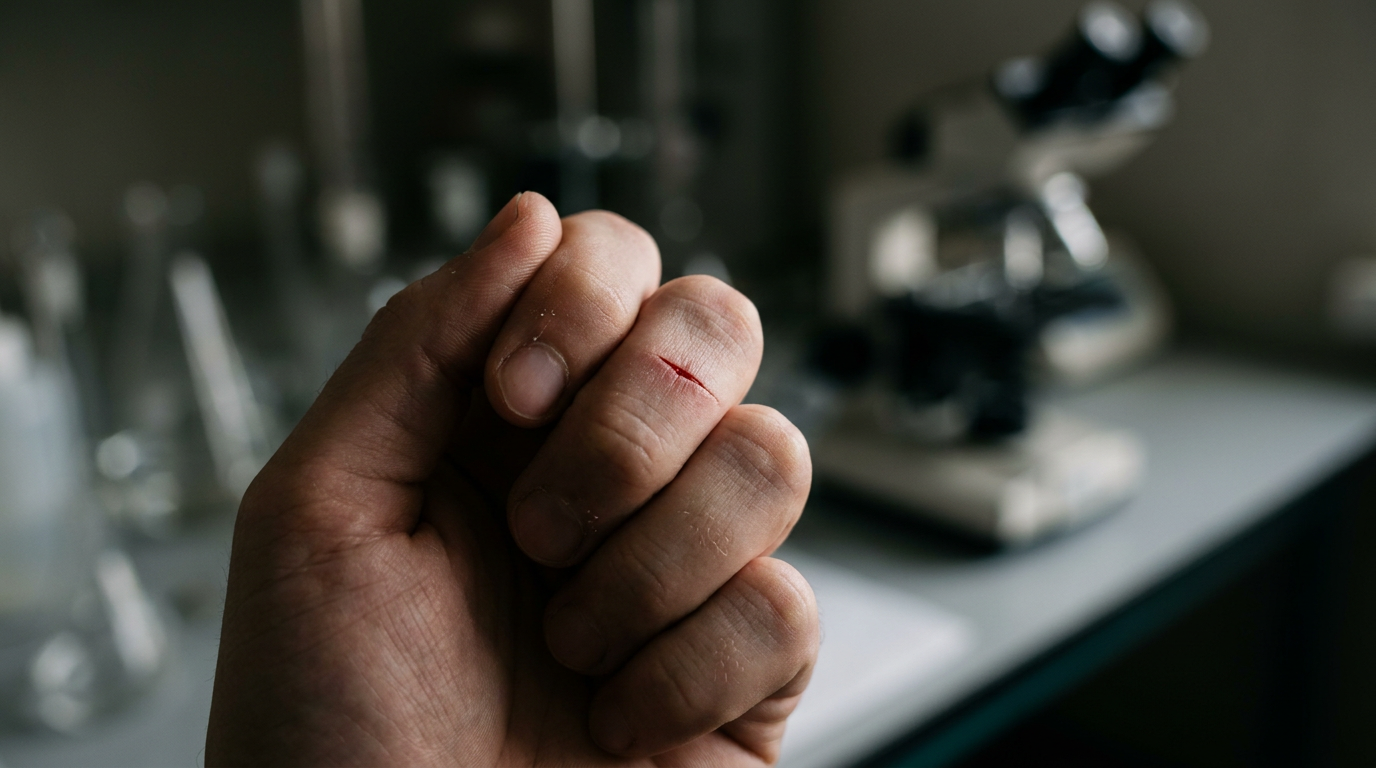
There is a version of biology most of us carry around without thinking too hard about it: the skin is the wall, the gut is the interior, and the two systems attend to their own business unless something catastrophic forces them to coordinate. A wound heals. Digestion continues. These events are filed in different drawers. It is a tidy model, and according to a study published in Nature Communications[1], it is substantially wrong.
The finding begins with a molecule called hyaluronan. You may have encountered the word in skincare marketing, where it typically refers to hyaluronic acid — a compound praised for retaining moisture. That is the commercial version of a far stranger story. In living tissue, hyaluronan is a large structural polysaccharide woven into the extracellular matrix: the dense, gel-like scaffolding that gives skin its architecture and resilience. It is abundant, stable, and largely inert — until the skin breaks.
When tissue is wounded, the extracellular matrix is physically disrupted. Enzymes released during the early inflammatory response begin to degrade intact hyaluronan into smaller fragments. Those fragments are not passive debris. They are damage-associated molecular patterns — DAMPs, in the literature's shorthand — molecular distress signals that alert the immune system to the presence of injury. They travel. And according to this research, some of them travel farther than expected, far enough to reach the colon, where they encounter the microbiome and, measurably, change it.
What that change looks like, how it is triggered, and what it means for the trillions of organisms that spend their entire existence in your large intestine — that is the part the file does not resolve neatly, and that is precisely what makes it worth sitting with.
The Extracellular Matrix Is Not Passive Infrastructure
To understand why a skin wound would affect gut bacteria, you have to revise the way most people picture connective tissue. Textbook diagrams tend to show it as filler — the structural stuff between the interesting parts. In reality, the extracellular matrix is an active signaling environment. It stores growth factors, regulates cell migration, and encodes information about the physical state of the tissue through its own structural integrity. When it is intact, it is mostly quiet. When it is torn, it becomes loud.
Hyaluronan is one of the main components of this matrix, and its behavior under injury is well-documented at the wound site itself. High-molecular-weight hyaluronan[5] — the long, intact polymer — suppresses inflammation and promotes tissue organization. Low-molecular-weight hyaluronan fragments — produced when injury triggers the release of hyaluronidases and reactive oxygen species — do the opposite. They bind to pattern-recognition receptors, particularly TLR4 and CD44, and activate inflammatory cascades. This is not a malfunction. It is the alarm system working as designed. The problem, or the complication, is that the alarm signal does not stay local.
“The extracellular matrix, when torn, does not just break — it broadcasts.”
Hyaluronan fragments have been found in circulation following cutaneous injury. They clear through lymphatic drainage and, from there, enter the bloodstream. The liver clears most of them. But not, it appears, all of them — and the gut, with its enormous surface area and its constant sampling of the bloodstream's chemical environment, is positioned to receive whatever the liver does not catch.
What the Colon Receives
The colon is not a passive container. Its mucosal lining is one of the most immunologically active surfaces in the body, densely populated with immune cells, studded with pattern-recognition receptors, and in constant negotiation with hundreds of bacterial species. The relationship is calibrated. Commensal bacteria — the residents we want — have evolved to suppress inflammatory signaling at the mucosal surface. Pathobionts — opportunists that are tolerated at low numbers but damaging in excess — are held in check partly by that same immune tone.
When hyaluronan fragments arrive at the colonic mucosa, they bind to TLR4 and CD44 receptors expressed on epithelial and immune cells there — the same receptors they activate at the wound site. This triggers a localized shift in the mucosal immune environment: an uptick in inflammatory signaling in a tissue that is ordinarily calibrated to suppress it. The bacterial community does not experience this shift abstractly. It experiences it through changes in what the mucosa produces, secretes, and tolerates. Mucin composition changes. Antimicrobial peptide profiles shift. The physical and chemical properties of the surface the bacteria are living against are quietly altered — and different species are differently positioned to exploit or suffer those alterations.
The researchers found that following skin wounding in their experimental model, the relative abundance of certain bacterial taxa in the colon changed in a pattern consistent with immune-mediated dysbiosis: a shift away from the bacterial composition associated with a healthy, well-regulated mucosal environment. The taxa that expanded were not random. They were organisms with a documented tolerance for inflammatory conditions — bacteria that, in other contexts, are associated with gut inflammation, increased gut permeability, and compromised barrier function.
The Immune System as a Long-Distance Telephone Line
“The gut microbiome did not know there was a wound. It only knew what the immune signal told it — and immune signals, it turns out, do not stay in their lanes.”
This is the part of the mechanism that deserves the most attention, because it reframes something that has been treated as a local event. The immune response to wounding is systemic by design. That is not a bug. When the body detects tissue damage, it prepares multiple organ systems simultaneously for the possibility of infection, hemorrhage, and repair. Cytokine signals dispatched from a wound site in the forearm reach the liver, the spleen, the bone marrow, and the gut within a clinically relevant timeframe. The gut has always been a downstream recipient of this systemic alarm. What was less appreciated was that DAMPs like hyaluronan fragments could serve as a direct molecular courier — not just a general alarm but a specific signal with receptor targets in the colonic mucosa.
CD44, one of the main receptors for hyaluronan fragments, is expressed throughout the gastrointestinal tract on both epithelial and immune cells. Its presence there was already known; its role in sensing systemic injury signals was not clearly mapped. The study's contribution is tracing a chain of consequence with enough resolution to identify the specific receptor interaction that translates a skin injury into a changed gut environment. That is not a minor update to the model. It is a new branch in the diagram.
It also raises a question that the paper does not claim to answer: if a single cutaneous wound can measurably shift colonic microbial composition, what does repeated wounding do? What does chronic inflammatory skin disease[3] — psoriasis, eczema, epidermolysis bullosa — do to gut microbial balance over months and years of sustained matrix degradation? There are already clinical observations suggesting elevated rates of inflammatory bowel disease in patients with certain chronic skin conditions[2]. The mechanism now described offers a plausible molecular explanation for an association that has, until recently, been difficult to account for.
What the Microbiome Actually Does With the Signal
Here it is worth being precise about what was and was not shown. The study established that skin wounding, via hyaluronan fragment release, triggers a receptor-mediated immune shift at the colonic mucosa, and that this shift corresponds to altered bacterial composition in the colon. What it did not establish — and what is not yet known — is the full functional consequence of that altered composition on the host. Dysbiosis, as a label, covers a wide range of severity. The shift documented here might be transient and clinically silent in an otherwise healthy individual. It might be more consequential in an immunocompromised host, a patient already experiencing gut inflammation, or someone with a microbiome already under pressure from antibiotics, diet, or disease.
What is documented is the mechanism. What is speculated — reasonably, on the basis of existing microbiome literature — is that a gut community with elevated representation of inflammatory-tolerant pathobionts and reduced representation of short-chain fatty acid-producing commensals would have downstream effects on mucosal integrity, immune calibration, and potentially even systemic inflammatory tone. Short-chain fatty acids like butyrate, produced primarily by Firmicutes and certain other commensal species, are not incidental metabolites. They are the main energy source for colonocytes[4] and a key regulatory input for the mucosal immune system. If wounding suppresses the bacteria that produce them, the gut lining receives less of a molecule it depends on. That is a concrete functional gap, not a theoretical one — though whether a single wound creates a gap of meaningful size remains an open question.
The Skin-Gut Axis Is Becoming a Research Area, Not an Analogy
The gut-brain axis has been a subject of mainstream science coverage for over a decade. The gut-lung axis has received attention in the context of respiratory infection and microbiome research. The skin-gut axis is younger as a formal research area, but it is acquiring the kind of mechanistic specificity that moves a field from association to causation. The hyaluronan finding is part of that movement. It does not stand alone. Other documented pathways include shared immune cell trafficking between skin and gut, microbially derived metabolites that influence skin barrier function, and evidence that the microbial communities of the two organs influence each other's composition through systemic signals — though the precise mechanisms vary and many remain under active investigation.
What is interesting about the hyaluronan pathway specifically is its directionality and its precision. Most proposed skin-gut interactions are bidirectional and diffuse — involving broad immune modulation, circulating metabolites, or shared T cell populations. The wound-to-colon signal traced in this study moves in one direction, from a specific molecular event at the skin to a specific receptor interaction in the gut, producing a measurable change in bacterial composition. That level of resolution gives researchers something to test further, to inhibit pharmacologically, and to look for in clinical populations where skin and gut diseases co-occur.
“The skin is not just a barrier. It is, apparently, a sender.”
There is also a practical implication that has not been widely discussed outside the research context. Surgical wounds are, by definition, cutaneous wounds — often large ones, sustained under conditions of elevated systemic stress, frequently followed by antibiotics that further pressure the microbiome. If wound-derived hyaluronan fragments predictably shift gut bacterial composition in the direction documented here, then the gut dysbiosis that commonly follows major surgery might have a direct structural explanation — not just the antibiotics, not just the anesthesia, not just the diet change, but the wound itself as a molecular event with documented downstream consequences. Whether that shift is modifiable — through hyaluronidase inhibition, through receptor-targeted therapies, through pre- or probiotic preparation — is a question the study opens without resolving.
The Gap the Paper Leaves
The research was conducted in an animal model. That is not a dismissal — animal models have generated mechanistic insights that translated faithfully into human biology with significant frequency — but it is an honest limitation that the study's authors acknowledge. The receptor targets are conserved in humans. The molecular pathway is plausible. The clinical associations between skin and gut disease exist in the human literature. But the direct demonstration of wound-derived hyaluronan fragments reaching the human colon and shifting the human microbiome in a measurable, receptor-dependent way has not yet been done. That experiment is harder. It requires human wound models, controlled microbiome sampling across time, and careful separation of the hyaluronan signal from the many other variables that change when a body sustains an injury.
What remains, when you set the caveats alongside the findings, is a mechanism that is specific enough to take seriously and incomplete enough to require more work. A molecule your skin releases when it tears travels to your gut. Your gut's bacteria notice, in the only way bacteria can notice anything — by changing which ones thrive in the new environment. That chain of consequence runs through your body every time you sustain an injury significant enough to degrade the matrix, and until recently, no one had traced the whole length of it. Now someone has traced most of it. The last section of the path is still being mapped.
References
- Dermal injury drives a skin to gut axis that disrupts the intestinal microbiome and intestinal immune homeostasis in mice (nature.com)
Reports the core finding that skin wounding triggers hyaluronan fragment release, which travels to the colon and alters bacterial composition via immune signaling. - jamanetwork.com (jamanetwork.com)
Provides clinical evidence of elevated inflammatory bowel disease rates in patients with chronic skin conditions, supporting the plausibility of the skin-gut mechanism. - Psoriasis and inflammatory bowel disease: links and risks (pmc.ncbi.nlm.nih.gov)
Establishes genetic and epidemiologic links between chronic skin conditions like psoriasis and inflammatory bowel disease, supporting the article's clinical observation of their association. - Short Chain Fatty Acids (SCFAs)-Mediated Gut Epithelial and Immune Regulation and Its Relevance for Inflammatory Bowel Diseases (frontiersin.org)
Establishes that short-chain fatty acid-producing bacteria are reduced in inflammatory bowel disease and are critical for intestinal homeostasis. - Tissue integrity signals communicated by high-molecular weight hyaluronan and the resolution of inflammation (pmc.ncbi.nlm.nih.gov)
Establishes that high-molecular-weight hyaluronan suppresses inflammation while low-molecular-weight fragments activate inflammatory cascades through TLR4 and CD44 receptors.
About Silas Crane
Silas Crane writes from the edges of the record: cold cases, cryptids, declassified files, strange disappearances, forensic science, fringe science, mysterious illnesses, eerie technologies, serial killers, cults, state experiments, UAPs, and claims that cannot be cleanly proved or dismissed. His work also examines crime, deviance, corruption, policing, punishment, and the institutions that decide which harms are investigated, sensationalized, ignored, or allowed to continue. A documentarian at heart, he builds unease from verifiable detail and is always drawn back to the gap the file cannot close.
More like this
The Microbes in Your Gut Are Deciding What Your Skin Does Next
A 2025 review confirmed the gut-skin axis runs in both directions — and the signaling mechanism is stranger, more specific, and more actionable than the probiotic aisle ever let on.
The Brain's Immune System Is Supposed to Protect You. With Age, It Starts Working Against You.
Microglia — the brain's resident immune cells — spend a lifetime learning to protect you, then gradually flip into a state that erodes the very circuits they were built to defend.
Why Candida in Your Gut Can Suddenly Turn Deadly
Fungi have always been part of your gut's ecosystem — but a wave of drug-resistant strains is revealing just how little medicine understood them.