The Brain's Immune System Is Supposed to Protect You. With Age, It Starts Working Against You.
Microglia — the brain's resident immune cells — spend a lifetime learning to protect you, then gradually flip into a state that erodes the very circuits they were built to defend.
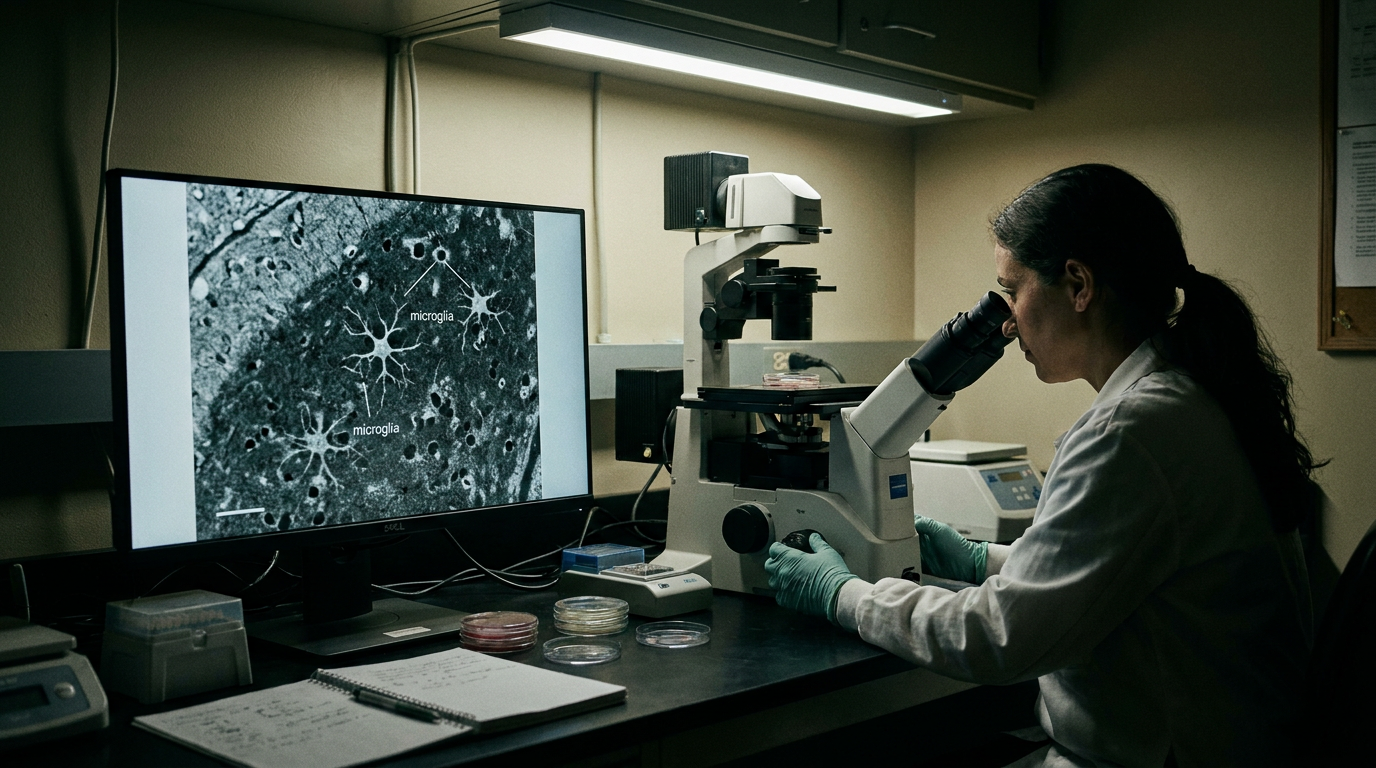
For most of your life, a population of cells you have never heard of has been doing some of the most important maintenance work in your brain. They patrol constantly, sampling tissue, clearing debris, pruning synaptic connections that are no longer pulling their weight, and mounting rapid responses to injury or infection. They are not neurons. They are not what most people mean when they imagine brain cells at all. They are microglia — the brain's resident immune cells — and they make up roughly ten to fifteen percent of all cells in the central nervous system.
For decades, neuroscience treated microglia mostly as a supporting detail, the cleanup crew that activates during obvious injury or disease and then stands down. That picture has changed substantially. What researchers are now mapping, with particular urgency in the field of aging neuroscience, is a subtler and more troubling story: microglia do not simply activate and resolve cleanly in older brains. Instead, they drift, gradually and sometimes irreversibly, into a state of chronic low-grade readiness — a condition sometimes called microglial priming, or more precisely, a shift toward sustained neuroinflammation — that stops looking like defense and starts looking like damage.
This matters enormously for cognitive aging, because the damage that accumulates is not abstract. It erodes synaptic density — the sheer number and quality of connections between neurons. It degrades hippocampal function, the region most associated with forming and consolidating new memories. And it does this slowly, below the threshold of any clinical test you would take at a routine physical, years or even decades before anyone would consider attaching a diagnostic label. By the time the loss is visible, much of it has already happened.
New research published in Frontiers in Aging Neuroscience has been tightening the mechanistic picture of exactly how this shift unfolds — what triggers it at the molecular level, which brain regions are most vulnerable, and whether the progression is as inevitable as it has long seemed. The findings are not cause for panic. But they do reframe what brain aging actually is, and they do it in a way that has real implications for how we think about protecting cognitive function across a lifetime.
What Microglia Are Supposed to Do
To understand the problem, you need a reasonably clear picture of what healthy microglial function looks like. In their homeostatic state — the state that dominates throughout early adulthood — microglia extend long, branching processes through the surrounding tissue, monitoring the local environment with what researchers describe as a constant, restless surveillance. When they detect cellular debris, misfolded proteins, pathogens, or signals of synaptic stress, they respond with targeted interventions: engulfing and clearing waste, modulating local inflammation, and releasing signaling molecules that regulate the activity of neighboring neurons and astrocytes.
One of the more striking functions microglia perform during development, and continue performing in adulthood, is synaptic pruning. The brain produces far more synaptic connections than it needs, and microglia help sculpt the final architecture by tagging and eliminating weaker or redundant synapses. In youth, this is essential for building efficient neural circuits. The mechanism involves complement proteins — part of the broader immune cascade[1] — that essentially flag certain synapses for removal. It is a precise, regulated process, calibrated to improve the signal-to-noise ratio of neural communication. The same process, running too hot or without adequate restraint in an aging brain, becomes a liability.
“The same cellular machinery that sharpens the young brain's circuitry can, decades later, begin trimming connections the brain cannot afford to lose.”
The Shift That Aging Triggers
Microglial priming is not a sudden transformation. It accumulates through a combination of internal cellular changes and shifts in the brain's broader environment. At the cellular level, microglia in aged brains show telltale signs of a state that is neither fully resting nor fully activated — something between the two that is poorly suited for either clean surveillance or clean resolution. Their morphology changes: processes become shorter and less elaborate, reducing the coverage area each cell can effectively monitor. Their gene expression profiles shift toward pro-inflammatory signaling patterns, even in the absence of obvious injury or infection.
A key part of what drives this shift appears to be the accumulation of cellular senescence signals over time. As the brain ages, a subset of microglia enter a senescent state — they lose proliferative capacity and begin secreting what researchers call the senescence-associated secretory phenotype, or SASP[2], a cocktail of pro-inflammatory cytokines including interleukin-6, interleukin-1-beta, and tumor necrosis factor-alpha. These cytokines do not stay local. They spread through the extracellular environment, altering the behavior of neighboring microglia that were not yet senescent, nudging the entire population toward heightened reactivity. The brain, in effect, begins to inflame itself from the inside out, without any external pathogen driving the process.
There is also a crucial change in how aged microglia process signals from the rest of the body. The brain is separated from systemic circulation by the blood-brain barrier, but it is not impervious to peripheral immune signals. As systemic low-grade inflammation increases with age — driven partly by gut dysbiosis, visceral adiposity, and declining immune regulation — aged microglia become sensitized to these signals in a way that younger microglia are not. A relatively minor peripheral inflammatory insult, the kind a healthy immune system handles without much drama, can trigger a disproportionate neuroinflammatory response in an older brain. The thermostat, effectively, has been reset to a lower threshold.
Where the Damage Lands
Not all brain regions are equally vulnerable to chronic microglial activation. The hippocampus, which plays a central role in episodic memory and spatial navigation, appears to be disproportionately affected. This is partly because the hippocampus is one of the few regions that retains significant neuroplasticity throughout adulthood — it is a site of adult neurogenesis in the dentate gyrus, and it remains heavily dependent on the maintenance of dense, well-regulated synaptic networks. When primed microglia amplify the complement-mediated pruning signal inappropriately, hippocampal synapses are among the first casualties.
The prefrontal cortex, which governs executive function, working memory, and cognitive flexibility, is also implicated, though through somewhat different mechanisms. Chronic neuroinflammation disrupts long-range white matter connectivity — the integrity of the axonal pathways that allow prefrontal networks to coordinate activity across distant brain regions. The effect is not dramatic in any single moment. It registers as a gradual slowing of processing speed, reduced ability to hold multiple pieces of information in working memory simultaneously, and diminished capacity for tasks that require rapid cognitive shifting. These are not the catastrophic memory failures that laypeople associate with dementia. They are the subtler losses that people begin attributing to stress or distraction or simply getting older — which is, of course, the problem.
“The early losses are not the dramatic ones. They are the ones people chalk up to stress, distraction, or simply getting older — which is precisely why they go unaddressed.”
There is also accumulating evidence that chronically activated microglia impair glymphatic clearance — the brain's waste-removal system that operates primarily during deep sleep. The glymphatic system depends on the movement of cerebrospinal fluid through channels formed by astrocytic endfeet, and its function is already vulnerable to sleep disruption and aging independently. Microglial-mediated neuroinflammation appears to further compromise this system, reducing the brain's ability to clear amyloid-beta and tau proteins. This creates a feedback loop with real consequences: impaired clearance allows these proteins to accumulate, and their accumulation triggers further microglial activation. Each step in the cycle makes the next one more likely.
How Far the Research Has Actually Gotten
It is worth being honest about where the science stands, because neuroimmunology is a field that moves fast and generates claims that sometimes outrun the evidence. The mechanistic picture described above is well-supported at the cellular and molecular level, much of it established in rodent models and increasingly corroborated by postmortem human brain studies and advanced neuroimaging techniques. What remains harder to characterize precisely is the timeline and degree of individual variation in humans — how much the trajectory differs across people, which genetic or environmental factors accelerate or slow the shift, and at what point microglial dysfunction crosses from subclinical nuisance into clinically meaningful cognitive impairment.
Single-cell RNA sequencing has been transformative here[4]. It allows researchers to profile the gene expression state of individual microglia, rather than averaging across the entire population, which had previously obscured the heterogeneity within what was assumed to be a fairly uniform cell type. What this work has revealed is that aged brain tissue contains a far more diverse — and more troubled — array of microglial states than younger tissue, including a distinct subpopulation of disease-associated microglia, or DAM, that cluster around amyloid plaques and show a gene expression signature quite different from homeostatic microglia. Whether DAM are ultimately protective, harmful, or contextually both depending on disease stage remains an active area of debate. That ambiguity is not a failure of the research; it reflects the real complexity of a system that does not resolve cleanly into heroes and villains.
What is clearer is the upstream question of what accelerates the shift toward priming. Chronic sleep restriction, metabolic dysfunction, insulin resistance, physical inactivity, and social isolation have all been associated with elevated markers of neuroinflammation in both animal models and human studies. This does not mean these factors are the sole drivers of microglial aging, and it does not mean correcting them fully reverses the process. But it does suggest that the rate of microglial dysfunction is not purely genetically determined — that lifestyle factors interact meaningfully with the underlying biology.
What This Changes About How We Think About Prevention
The framing that tends to dominate public conversation about dementia and cognitive decline is still mostly structural: plaques, tangles, neuronal death. That framing is not wrong, but it is increasingly incomplete, and it has contributed to a prevention conversation that focuses almost entirely on what is happening to neurons rather than what is happening to the immune environment those neurons live in. The microglial research suggests the question needs to be broader. Protecting cognitive aging is not only about preserving neurons; it is about maintaining the conditions under which the brain's immune surveillance stays regulated and proportionate.
This points in practical directions that will be familiar, but deserve to be understood differently than they usually are. Exercise is among the better-studied microglial modulators we have. Aerobic exercise has been shown to reduce peripheral inflammation, promote the release of anti-inflammatory myokines[3], and in animal models, attenuate microglial activation in the hippocampus. The mechanism is not fully characterized, but the evidence that sustained physical activity has neuroimmune consequences — not just vascular and metabolic ones — is real. Sleep, similarly, is not just about rest or memory consolidation in isolation; it is a period during which microglial surveillance and glymphatic clearance both run more efficiently, and chronic disruption of sleep architecture plausibly feeds the priming process over time.
Researchers are also beginning to look directly at the possibility of pharmacological or biological interventions that target microglial state rather than downstream amyloid or tau accumulation. This includes investigation of compounds that inhibit specific cytokine signaling pathways and approaches that aim to selectively clear senescent microglia from aged tissue — a strategy loosely analogous to the senolytic research being done in peripheral aging biology. None of these are ready for clinical application, and the history of failed Alzheimer's drug trials should make anyone appropriately cautious about predicting translation timelines. But the targeting logic is better grounded mechanistically than many prior approaches.
“Protecting the aging brain is not only about preserving neurons. It is about maintaining the conditions under which the immune system that surrounds them stays calibrated enough not to become the threat.”
The Slow Burn Is Not Invisible Anymore
One of the more useful shifts this research enables is moving the conversation about cognitive aging away from inevitability and toward process. The brain does not simply age. Its immune environment ages, shifts, and in some people, destabilizes — and that process has a biological shape, identifiable stages, and modifiable inputs. It is too early to claim that any intervention reliably halts microglial priming in humans. The longitudinal data we need, tracking neuroimmune markers over years in living people, is still being built. But the mechanistic case for taking neuroinflammation seriously as a driver of everyday cognitive change — not just as a footnote to dementia pathology — is now substantial enough that it should change how both researchers and thoughtful laypeople understand what brain health actually requires. The slow burn has been happening all along. What is new is that we can finally see the fire.
References
- Complement and microglia mediate early synapse loss in Alzheimer mouse models (science.org)
Describes complement proteins as part of the immune cascade that flags synapses for removal during microglial pruning. - Microglia in Brain Aging and Age-Related Diseases: Friends or Foes? (pmc.ncbi.nlm.nih.gov)
Defines senescence-associated secretory phenotype (SASP) and explains how senescent microglia secrete pro-inflammatory cytokines that drive neuroinflammation with age. - Physical Exercise Inhibits Inflammation and Microglial Activation (pmc.ncbi.nlm.nih.gov)
Establishes that exercise modulates microglial activation and reduces neuroinflammation through multiple mechanisms. - Single cell RNA sequencing of human microglia uncovers a subset associated with Alzheimer’s disease (nature.com)
Demonstrates that single-cell RNA sequencing reveals age-related changes in microglial transcriptomes and links specific microglial subsets to tau and amyloid pathology.
About Marcus Okafor
Marcus Okafor covers general wellness, brain health, cognitive aging, sleep, and the biology of staying sharp across a lifetime. His work traces how the body and mind maintains, loses, and sometimes rebuilds — from the nitty gritty science of your bones — to the strange frontiers of the glymphatic system flushing toxins overnight — to the way imagined conflict primes the same stress circuitry as the real thing.
More like this

Chronic Loneliness Rewires the Brain — And the Damage Is Not Metaphorical
Prolonged social isolation doesn't just feel bad; it triggers a cascade of stress signaling and neuroinflammation that measurably reshapes the aging brain.
Lifting Weights Does Something to Your Brain That Running Simply Can't
New expert analysis confirms that aerobic and resistance training drive distinct changes in brain structure and chemistry — meaning the exercise routine most people follow may be protecting only half of what matters.

Your Body Clock Is a Better Dementia Predictor Than Your Sleep Hours
A major study found that people with fragmented circadian rhythms had 2.4 times the dementia risk — and the mechanism points to something sleep duration alone can't fix.