Why Candida in Your Gut Can Suddenly Turn Deadly
Fungi have always been part of your gut's ecosystem — but a wave of drug-resistant strains is revealing just how little medicine understood them.
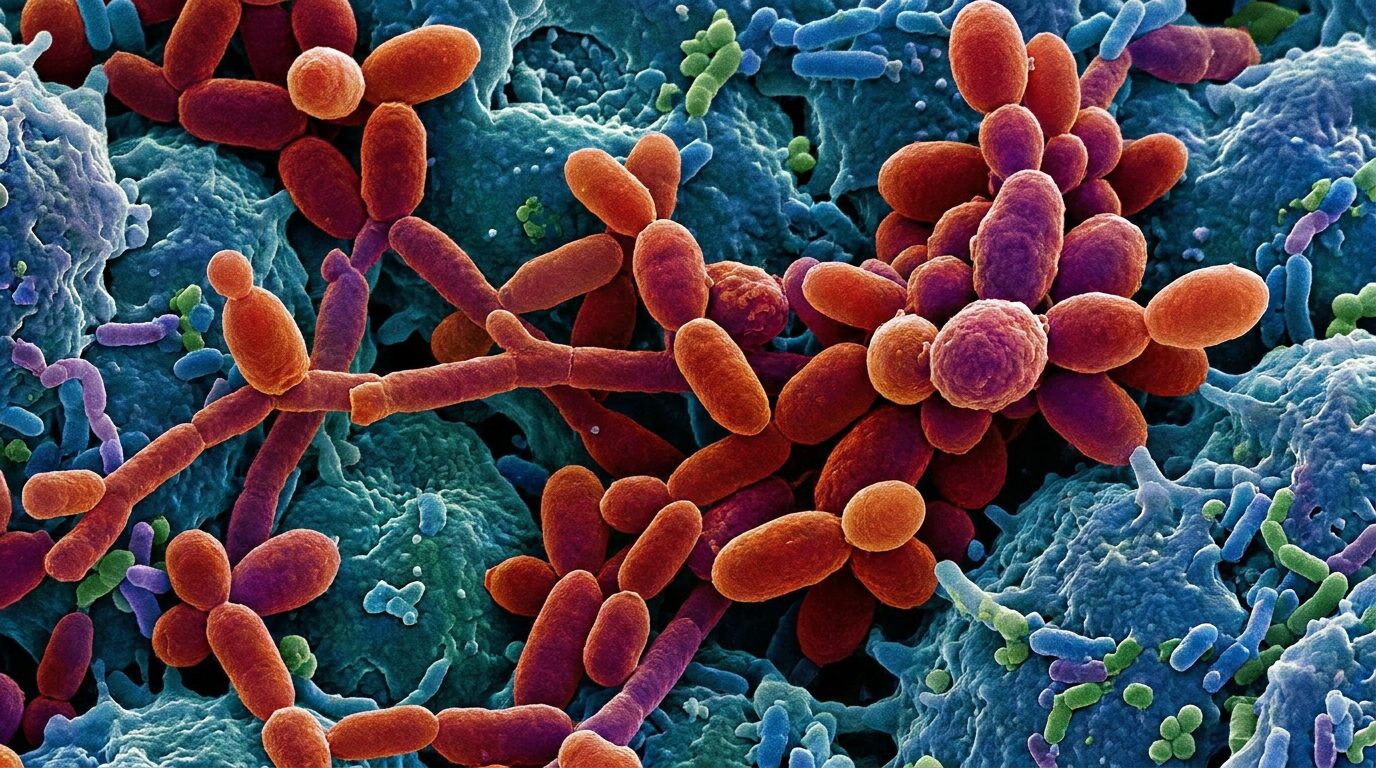
Somewhere in your gastrointestinal tract right now, there are fungi. Not many, relative to the bacteria that dominate the scene, but present — part of the biological furniture. Candida species, in particular, have lived alongside human gut bacteria for as long as medicine has thought to look. As CDC surveillance data confirm, "Candida spp. are a normal component of the gastrointestinal microbiome and can colonize the skin." That sentence sounds reassuring until you follow it to the next one: Candida can also cause the most frequent health care–associated bloodstream infection in the United States.
The gap between harmless resident and lethal invader is narrower than most people assume, and the conditions that push Candida across that line — disrupted bacterial communities, immunocompromised tissue, catheters and ventilators that bypass the body's usual barriers — have become more common, not less. Into that gap has stepped a relative newcomer: Candida auris, a species first identified less than two decades ago, which combines the yeast's old trick of colonizing bodies quietly with a new and troubling ability to resist the drugs designed to kill it.
Understanding what is happening inside that shift requires looking at fungi not as a monolithic threat but as ecological actors — organisms that read environmental conditions, exploit niches, and respond to chemical pressure exactly the way bacteria do when antibiotics enter the picture. The story is less about a monster in the microbiome and more about a very old tenant learning a very new trick.
The Resident That Can Turn
The reason Candida species can shift from benign colonist to invasive pathogen has everything to do with the conditions that normally hold them in check. A healthy gut is a crowded ecosystem — bacteria competing for nutrients and surface area, immune signals maintaining a working truce, epithelial cells forming a physical barrier that fungi cannot easily cross. Disrupt enough of those constraints simultaneously and the balance tips. The bacteria that kept Candida's population modest are gone. The immune surveillance that would catch early invasion is compromised. The physical barriers that normally seal the gut lining from the bloodstream are breached by a catheter, a surgery, or tissue damage from critical illness.
The most invasive form, candidemia — Candida in the bloodstream — is not a story about a pathogen storming the gates. It is closer to opportunistic occupation: a microorganism that was already there, held in its niche by conditions that have now changed. CDC surveillance of candidemia found that the mortality rate associated with Candida bloodstream infection climbed during 2020–2021, almost certainly because the COVID-19 pandemic strained health care systems and generated a large population of patients who were critically ill — exactly the conditions that lower the threshold for invasion. The yeast did not change. The environment it was living in did.
“Candida did not change. The environment it was living in did.”
An Emerging Species That Skipped the Script
Candida auris is a different kind of problem. Where other Candida species settled into human ecosystems over centuries, C. auris appeared in clinical records only in 2009 and spread across continents within a decade — not following human migration in the usual slow way, but emerging nearly simultaneously on multiple continents in strains that are genetically distinct from one another. That pattern suggests not a single spreading outbreak but multiple independent emergences, as if the environmental conditions favoring this particular organism appeared in many places at once.
What makes C. auris especially difficult to contain is its habit of colonizing patients who show no symptoms. A person can carry the organism on their skin or in their gut without ever developing an infection — and without knowing they are carrying anything at all. But that silent carriage is not harmless at the population level. The organism persists on surfaces long enough to survive standard hospital cleaning protocols. It can spread from patient to patient via contaminated equipment or the hands of health care workers. In acute care hospitals and long-term acute care facilities, where patients are already immunocompromised and heavily instrumented, that transmission dynamic becomes dangerous fast. According to CDC surveillance for 2022 through 2024, the number of clinical C. auris cases reported to the CDC approximately doubled over that two-year period.
The drug resistance picture complicates matters further. C. auris is frequently resistant to fluconazole, the antifungal most commonly used against Candida infections. A significant proportion of strains show reduced susceptibility to the echinocandins — the next line of defense. Some strains are resistant to drugs from all three major antifungal classes, leaving clinicians with no reliable pharmacological options. A 2016 CDC report documenting the first seven U.S. cases flagged pan-resistance as a critical concern even then. The situation has not simplified since.
Why Antibiotics Are Part of the Fungal Problem
There is an underappreciated irony in the antifungal resistance story: the rise of bacterial antibiotic resistance and the rise of opportunistic fungal infection are connected at the microbiome level. Heavy antibiotic use clears bacterial populations from the gut, and those populations are precisely what keeps Candida in check. When the competition disappears, yeast populations expand into the vacated niche. This is not speculation — it is one of the well-established reasons that Candida overgrowth follows broad-spectrum antibiotic courses, and it is also one of the reasons that high antibiotic prescribing rates are a public health concern that extends beyond bacterial resistance alone. Efforts to monitor antibiotic prescribing and reduce overuse carry fungal implications that rarely make it into the public-facing rationale.
The parallel is worth sitting with: medicine spent decades treating antibiotics as the answer to bacterial infection without fully accounting for what removing bacteria does to the ecosystems bacteria inhabit. Antifungal resistance now raises the same question about fungi. If we drive susceptible Candida strains out of a niche with antifungal drugs, what fills it? If resistant strains are already present at low levels in a colonized patient, treatment can select for them the same way antibiotics select for resistant bacteria — not because the organism planned anything, but because the drug removed its competition and left the survivors to reproduce. Evolution does not require intention. It keeps whatever survives.
What Containment Actually Requires
The challenge of containing C. auris in health care settings is both a microbiology problem and a logistics problem. Identifying a colonized patient requires active surveillance — testing patients on admission, tracking contacts, and maintaining that vigilance across institutional handoffs when a patient moves from an acute care hospital to a long-term facility to a skilled nursing home. Each transfer is an opportunity for the organism to move somewhere new with less robust surveillance infrastructure. CDC guidance on containment responses reflects how labor-intensive this tracking is: it requires coordinated action across institutions that often have different capacities, different electronic systems, and different levels of infection control staffing.
The testing side has its own constraints. Accurately identifying C. auris requires laboratory methods that not all clinical labs have in place, and standard commercial yeast identification panels have historically misidentified it as other Candida species. Expanding that capacity — building the laboratory infrastructure to identify C. auris reliably and to test antifungal susceptibility quickly — is part of the public health agenda that the CDC has consistently flagged. As the agency put it in its most recent surveillance summary, "public health coordination at federal, state, and local levels is critical to limit further spread and to address emerging antifungal drug resistance." The sentence describes a gap as much as a plan.
“"Public health coordination at federal, state, and local levels is critical to limit further spread and to address emerging antifungal drug resistance." — CDC MMWR”
A Gap in the Fungal Map
Part of what makes the current moment in antifungal medicine feel genuinely new is the recognition of how much was simply not tracked before. Superficial fungal infections — the ones affecting skin, nails, and mucous membranes rather than the bloodstream — are so common that they rarely attract the surveillance attention directed at systemic infections. But a 2024 CDC report on topical antifungal prescribing framed routine topical antifungal use as a meaningful surveillance target, on the grounds that drug-resistant superficial infections have now been detected in the United States and that understanding how these drugs are currently being used is a prerequisite for responding to resistance as it emerges. That framing — treating topical antifungal prescribing as an early-warning system — reflects the same thinking that reorganized bacterial antibiotic stewardship. It is a recognition that resistance does not appear from nowhere; it appears in populations already being treated.
The mycobiome — the fungal component of the human microbiome — has been systematically understudied relative to the bacterial microbiome. Much of what medicine knows about gut fungi comes from studies that were primarily designed to study bacteria and noted the fungal presence incidentally. The mechanisms by which gut Candida populations influence inflammation, immune tone, or susceptibility to infection are still being worked out. The links are biologically plausible — fungi interact with the same immune receptors that bacteria do, and the gut epithelial surface where Candida colonizes is also where immune education happens — but the specific pathways, and how much they vary across individuals, remain active research questions rather than settled answers. Those who follow the science of the gut microbiome will recognize the pattern: early signals pointing at a complex system that medicine is only beginning to map.
What is not speculative is the trajectory of resistance. C. auris doubled its clinical case count in two years. Resistant superficial infections have arrived in the United States. The antifungal pipeline is thin — far thinner than the antibacterial pipeline — in part because fungal cells are eukaryotes, more similar to human cells than bacteria are, which makes it harder to design drugs that kill the fungus without damaging the host. The yeast has always been there, quiet and unremarkable in the gut ecology. What is changing is our relationship to the tools we thought we had to keep it there.
References
- A 2016 CDC report documenting the first seven U.S. cases (tools.cdc.gov)
Flagged pan-resistance to multiple antifungal drug classes as a critical concern in the first seven documented U.S. cases. - a 2024 CDC report on topical antifungal prescribing (tools.cdc.gov)
- CDC guidance on containment responses (tools.cdc.gov)
Outlines labor-intensive containment requirements including active surveillance, patient tracking, and coordinated institutional responses. - CDC surveillance data confirm (tools.cdc.gov)
Establishes that Candida species are normal gut microbiome components and the leading cause of healthcare-associated bloodstream infections. - monitor antibiotic prescribing and reduce overuse (tools.cdc.gov)
Supports CDC efforts to monitor and reduce antibiotic prescribing, which has fungal implications beyond bacterial resistance. - tools.cdc.gov (tools.cdc.gov)
Documents that clinical C. auris cases approximately doubled between 2022 and 2024, showing rapid emergence.
About Aris Thorne
Aris Thorne is a microbiologist who writes about the hidden mechanics of ordinary life: the microbes running your home, the chemistry unfolding in food and water, the physics built into familiar objects, and the biological systems quietly keeping the human body alive. His work follows science from kitchens, bathrooms, dust, soil, and city air into wounds, immune responses, infections, medicines, cells, and other worlds. He is most interested in the moment something familiar stops looking simple and reveals the living machinery underneath.
More like this
Your House Dust Is a Microbial City. Your Cleaning Products Are Reshaping It.
The chemicals in your cleaning products don't kill your home's microbial community — they reorganize it, and the survivors are keeping score.
When You Cut Yourself, Your Gut Microbiome Changes. Here's the Exact Mechanism.
Researchers traced a single molecular signal from broken skin all the way to the colon, and what it does to gut bacteria there is not what anyone expected.
The Microbes in Your Gut Are Deciding What Your Skin Does Next
A 2025 review confirmed the gut-skin axis runs in both directions — and the signaling mechanism is stranger, more specific, and more actionable than the probiotic aisle ever let on.