Lifting Weights Does Something to Your Brain That Running Simply Can't
New expert analysis confirms that aerobic and resistance training drive distinct changes in brain structure and chemistry — meaning the exercise routine most people follow may be protecting only half of what matters.
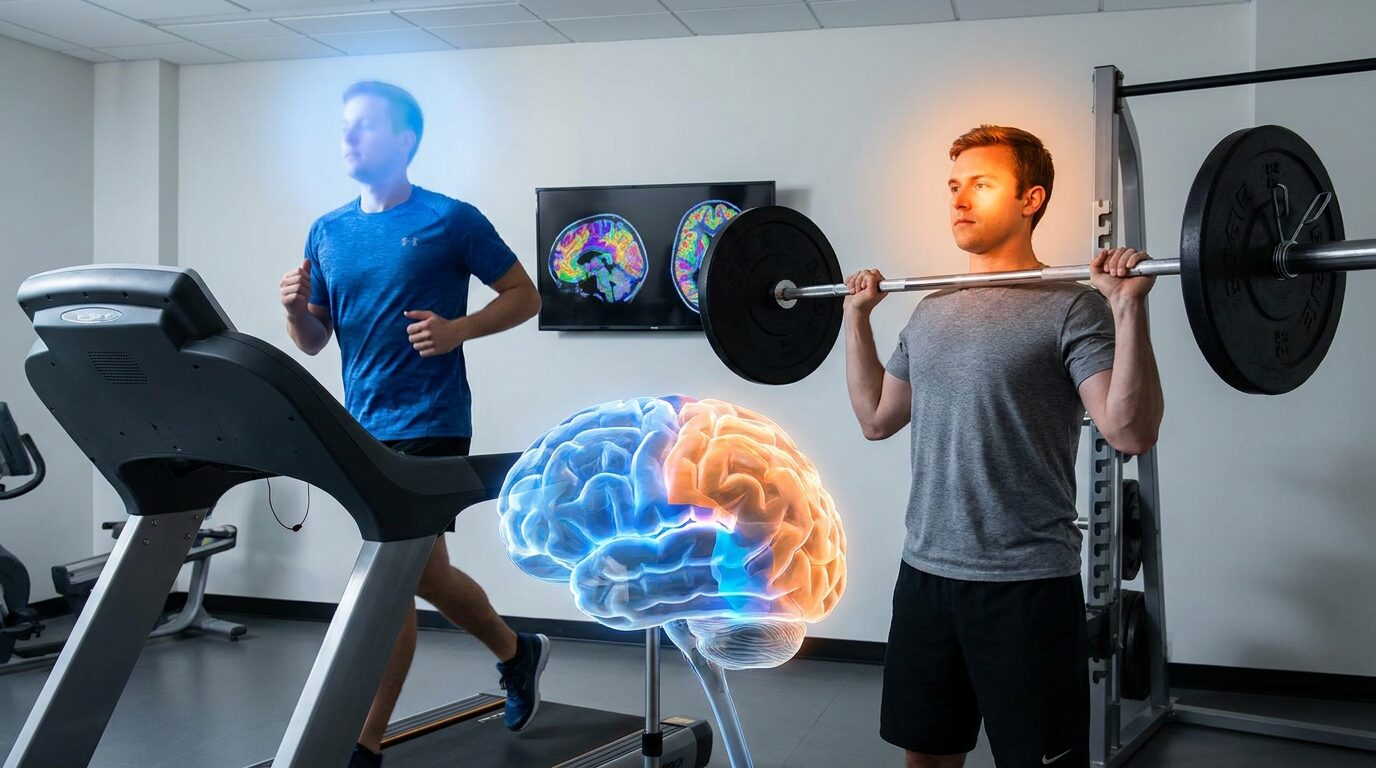
For most of the past two decades, if you asked a neuroscientist how exercise protects the aging brain, the answer you got back was essentially aerobic. Run. Cycle. Swim. Get the heart rate up, keep it there, do it regularly. The evidence behind that recommendation was — and still is — substantial. Aerobic exercise increases blood flow to the brain, stimulates the production of brain-derived neurotrophic factor (BDNF), and has been linked repeatedly to greater hippocampal volume, which matters because the hippocampus is where new memories are formed and where early Alzheimer's-related atrophy tends to appear first. That is not a weak finding. It has held up across decades of animal models, observational cohorts, and randomized trials. Aerobic exercise is genuinely good for the brain.
But a growing body of research — distilled in a 2025 expert review published in PMC — makes a case that should change how most people think about brain-protective exercise. The case is not that aerobic exercise is overrated. It is that resistance training drives a meaningfully different set of adaptations in the brain, changes that aerobic work does not reliably produce, and that the two modalities are not interchangeable. The brain you build from running and the brain you build from lifting are not the same brain.
This is worth slowing down on, because the popular framing tends to lump all exercise into a single bin labeled "good for you." That framing is not wrong, exactly, but it is imprecise in a way that costs people something real. If resistance training produces distinct effects on white matter integrity, prefrontal gray matter, and inflammatory signaling — effects that aerobic training does not consistently replicate — then a person who only runs is leaving part of the brain-protection story on the table. And conversely, a person who only lifts is missing the hippocampal and cardiovascular benefits that aerobic work provides. The emerging picture is not either-or. It is a genuine both-and, with reasons behind it.
The mechanisms behind each modality are distinct enough that it helps to treat them separately before asking how they interact. Doing that reveals something more interesting than a simple ranking of which exercise is better for the brain. It reveals that aerobic and resistance training are hitting different targets — and that the targets each one hits happen to be exactly what the other tends to miss.
What Aerobic Exercise Actually Does to Brain Structure
The hippocampal story is the most replicated finding in exercise neuroscience, and it is worth stating precisely rather than gesturing at it broadly. Aerobic exercise — sustained, rhythmic, cardiovascular effort — reliably elevates BDNF, a protein that supports neuronal survival, synaptic plasticity, and the formation of new neurons in the dentate gyrus, the hippocampal subregion most associated with pattern separation and new memory encoding. This is one of the few places in the adult brain where neurogenesis demonstrably continues, and it is exquisitely sensitive to both aerobic exercise and its absence. Landmark randomized trials in older adults have found that a year of moderate aerobic training was associated with a roughly two percent increase in hippocampal volume[1] — enough to functionally reverse about one to two years of age-related atrophy. That effect size is not dramatic, but it is real, and it is in exactly the region where losing ground matters most for memory. If you're curious about how those memories then get consolidated and stored, the process is more competitive and unstable than most people realize.
Aerobic exercise also improves cerebral blood flow and vascular health more broadly, which matters because white matter — the brain's long-distance axonal wiring — is particularly vulnerable to vascular insufficiency. Small vessel disease is a major driver of white matter hyperintensities, those patches of damage visible on MRI that accumulate quietly over years and erode processing speed, executive function, and, eventually, overall cognitive capacity. By supporting vascular function, aerobic training provides at least indirect protection to white matter. But the protection is primarily cardiovascular in origin, not structural. It preserves the supply lines. What resistance training appears to do is something closer to reinforcing the wires themselves.
The Resistance Training Signal Is Different
Resistance training generates a different physiological signature. The acute stress of loading muscles — particularly the mechanical tension and metabolic demand of progressive resistance work — triggers a cascade that includes elevated insulin-like growth factor 1 (IGF-1), reduced neuroinflammatory markers, and, in several imaging studies, measurable changes in prefrontal and parietal gray matter. The prefrontal cortex is the brain's most metabolically expensive and age-sensitive region. It governs working memory, attention, inhibitory control, and planning — the functions collectively grouped under executive function, and the ones that tend to erode earliest and most consequentially in aging. Research in older adults with mild cognitive impairment has found that regular resistance training was associated with improved executive performance and, in some cohorts, with preserved or increased volume in prefrontal regions[3] where aerobic training produced weaker or no comparable effects.
“The brain you build from running and the brain you build from lifting are not the same brain.”
White matter integrity is where the resistance training finding gets particularly striking. Diffusion tensor imaging — a technique that measures the structural coherence of axonal tracts — has shown that resistance training is associated with less white matter lesion progression in older adults[2] compared to stretching or balance controls. The proposed mechanism involves IGF-1 and other myokines (signaling molecules secreted by working muscle) crossing the blood-brain barrier and supporting oligodendrocyte function. Oligodendrocytes are the cells that produce myelin, the insulating sheath around axons that determines how quickly and reliably signals travel across the brain. Myelin degradation is a core feature of brain aging. If resistance training helps preserve the cells responsible for maintaining that insulation, the functional consequence is significant: faster, more reliable neural communication across the networks that aging tends to fragment.
There is also an inflammatory angle. Chronic low-grade neuroinflammation is increasingly recognized as a contributor to cognitive decline, independent of amyloid and tau pathology. Resistance exercise has been shown to reduce circulating markers of systemic inflammation — including interleukin-6 in its chronic resting-state form and TNF-alpha — more robustly than aerobic work in some comparative trials. Because neuroinflammation and systemic inflammation are interrelated, this creates a plausible pathway through which lifting weights could reduce one of the upstream drivers of cognitive aging that is not fully addressed by cardiovascular exercise alone.
The Interplay With Sleep and Glymphatic Clearance
Any honest account of brain maintenance has to mention sleep, because what exercise does during the day interacts directly with what the brain does at night. The glymphatic system — the brain's waste-clearance network, which operates primarily during slow-wave sleep — is responsible for flushing out metabolic byproducts that accumulate during waking hours, including the amyloid-beta and tau proteins implicated in Alzheimer's pathology. That nightly clearance process is fragile, and a lot of common modern behaviors disrupt it. Both aerobic and resistance exercise improve sleep quality and slow-wave depth, which is relevant because better sleep architecture means more efficient glymphatic clearance. This is not a minor synergy. It is a reason why the exercise-brain relationship extends well beyond the gym, into the hours when the brain is doing structural maintenance work that no supplement or intervention has yet come close to replicating.
“Resistance training appears to reinforce the wires themselves — not just the supply lines that keep them alive.”
The relationship between exercise timing, circadian alignment, and cognitive aging is also worth flagging, even if the evidence is not yet definitive. Circadian disruption has emerged as a meaningful dementia risk factor in longitudinal data, which puts a new kind of weight on when and how consistently exercise is performed — not just whether it is performed at all. Early data suggest that morning exercise may be more effective at reinforcing circadian rhythms, but this remains an active research area rather than an established recommendation.
The Dose, the Mix, and What the Evidence Actually Supports
Precision here matters more than enthusiasm. The research on resistance training and brain health, while genuinely promising, is not as mature or as voluminous as the aerobic literature. Many of the relevant trials are relatively small, differ in the training protocols used (machine versus free weights, load versus repetition schemes, supervised versus unsupervised), and measure outcomes that are not always directly comparable across studies. Effect sizes in white matter and prefrontal gray matter from resistance training are real in the available data, but they need replication at scale before they rise to the same level of confidence as the hippocampal-aerobic effect. Calling the resistance training findings established would overstate the case. Calling them promising and mechanistically coherent would be accurate.
What the 2025 PMC review synthesizes is essentially a two-target model: aerobic exercise preferentially supports hippocampal volume, BDNF, and cerebrovascular health; resistance training preferentially supports white matter integrity, prefrontal structure, IGF-1 signaling, and neuroinflammatory control. Neither target is optional. The hippocampus is where memory is formed. The prefrontal cortex and the white matter networks connecting it to the rest of the brain are where thinking, planning, and cognitive control happen. Aging hits both. An exercise program that addresses only one of these targets is, by definition, leaving the other exposed.
For practical purposes, the evidence does not yet specify an optimal dose or ratio of aerobic to resistance work for cognitive outcomes. The general shape of a brain-protective routine that emerges from the literature is consistent with existing public health recommendations — roughly 150 minutes of moderate aerobic activity per week combined with two or more sessions of progressive resistance training — but this is not a precision prescription backed by controlled dose-response data in cognitive aging specifically. It is a reasonable extrapolation from what is known. The phrase "progressive" is worth emphasizing, because resistance work that does not increase load over time provides diminishing physiological stimulus. The brain, like the muscle, adapts to demands placed on it. Static, comfortable routines may not sustain the same signaling benefits as training that continues to challenge the system.
Why This Changes the Conversation About Brain-Protective Exercise
“An exercise program that addresses only one of these targets is, by definition, leaving the other exposed.”
The public conversation about exercise and brain health has been dominated by running for so long that resistance training often gets treated as the body's project, not the brain's. That framing needs updating. Muscle is not just an engine. It is an endocrine organ that secretes signals — myokines including BDNF, irisin, and IGF-1 — that act on brain tissue directly. When that signaling is absent, or when it is never developed because someone has spent their entire exercise life in aerobic modalities only, the brain misses something that cardiovascular exercise does not supply. This does not require abandoning running. It requires running alongside something else.
The honest version of this story also resists overclaiming. Neither modality prevents dementia. Neither guarantees cognitive preservation. What the evidence supports is a meaningful reduction in modifiable risk — through vascular health, neuroinflammation, neurotrophic signaling, white matter maintenance, and sleep quality — that compounds over years and decades, not weeks. The brain does not respond to exercise the way a bruise responds to ice. The changes are slow, structural, and probabilistic. They show up in population data and MRI studies before they show up in any individual's subjective experience. But they are real, and the directionality is consistent enough to act on. The question for most people is no longer whether to exercise. It is whether they are exercising in a way that covers both targets — and for most people running three times a week with no bar in sight, the answer is probably no.
References
- Exercise training increases size of hippocampus and improves memory (pnas.org)
Provides the landmark trial data showing one year of aerobic training increased hippocampal volume by roughly two percent in older adults. - Resistance Training Maintains White Matter and Physical Function in Older Women with Cerebral Small Vessel Disease: An Exploratory Analysis of a Randomized Controlled Trial (pmc.ncbi.nlm.nih.gov)
Documents that resistance training was associated with reduced white matter lesion progression in older adults compared to stretching or balance controls. - Resistance training protects the hippocampus and precuneus against atrophy and benefits white matter integrity in older adults with mild cognitive impairment (pubmed.ncbi.nlm.nih.gov)
Provides evidence that resistance training in older adults with mild cognitive impairment improved executive performance and preserved prefrontal brain volume.
About Marcus Okafor
Marcus Okafor covers general wellness, brain health, cognitive aging, sleep, and the biology of staying sharp across a lifetime. His work traces how the body and mind maintains, loses, and sometimes rebuilds — from the nitty gritty science of your bones — to the strange frontiers of the glymphatic system flushing toxins overnight — to the way imagined conflict primes the same stress circuitry as the real thing.
More like this

The Brain's Immune System Is Supposed to Protect You. With Age, It Starts Working Against You.
Microglia — the brain's resident immune cells — spend a lifetime learning to protect you, then gradually flip into a state that erodes the very circuits they were built to defend.

Chronic Loneliness Rewires the Brain — And the Damage Is Not Metaphorical
Prolonged social isolation doesn't just feel bad; it triggers a cascade of stress signaling and neuroinflammation that measurably reshapes the aging brain.

Your Ears Are Going Quiet. Your Brain Is Already Paying the Price.
Untreated hearing loss doesn't just leave you straining to hear — it quietly reshapes the brain in ways that look a lot like early dementia.