Inhibitory Control
Inhibitory control is the brain's ability to pause and suppress impulsive urges, like stopping yourself from checking a phone vend during work. It's the mental 'brake' that lets you override automatic reactions to stay focused on goals.
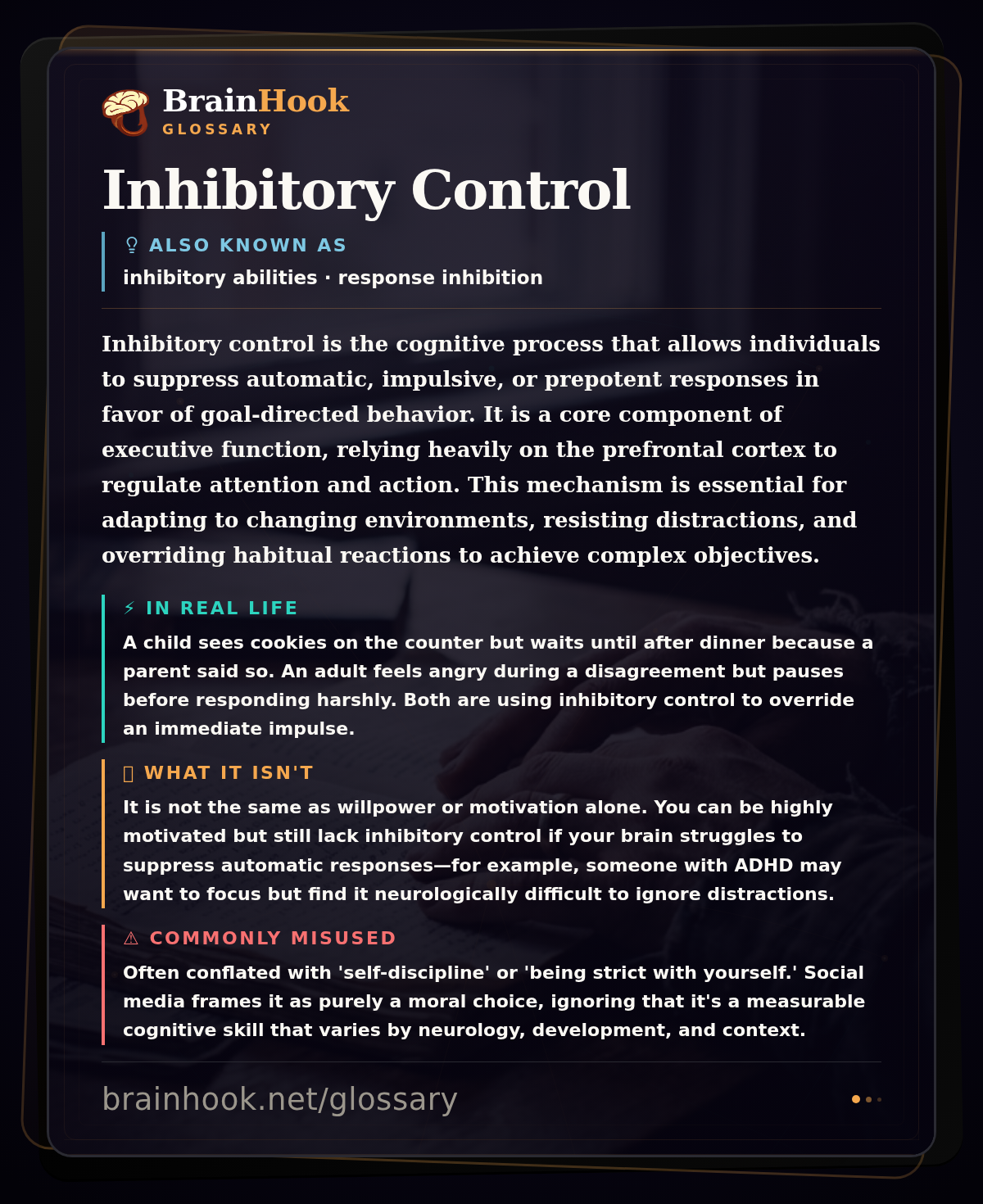
Inhibitory control is the cognitive process that allows individuals to suppress automatic, impulsive, or prepotent responses in favor of goal-directed behavior. It is a core component of executive function, relying heavily on the prefrontal cortex to regulate attention and action. This mechanism is essential for adapting to changing environments, resisting distractions, and overriding habitual reactions to achieve complex objectives.
What this means in real life
A child sees cookies on the counter but waits until after dinner because a parent said so. An adult feels angry during a disagreement but pauses before responding harshly. Both are using inhibitory control to override an immediate impulse.
What it isn’t
It is not the same as willpower or motivation alone. You can be highly motivated but still lack inhibitory control if your brain struggles to suppress automatic responses—for example, someone with ADHD may want to focus but find it neurologically difficult to ignore distractions.
Commonly misused online
Often conflated with 'self-discipline' or 'being strict with yourself.' Social media frames it as purely a moral choice, ignoring that it's a measurable cognitive skill that varies by neurology, development, and context.