Slow-wave Sleep
Slow-wave sleep (SWS) is the deep, delta-brain-wave phase of rest where memory consolidation and physical repair happen most intensely; it marks stages 3 and 4 of non-REM sleep.
Not to be confused with: Slow Oscillation
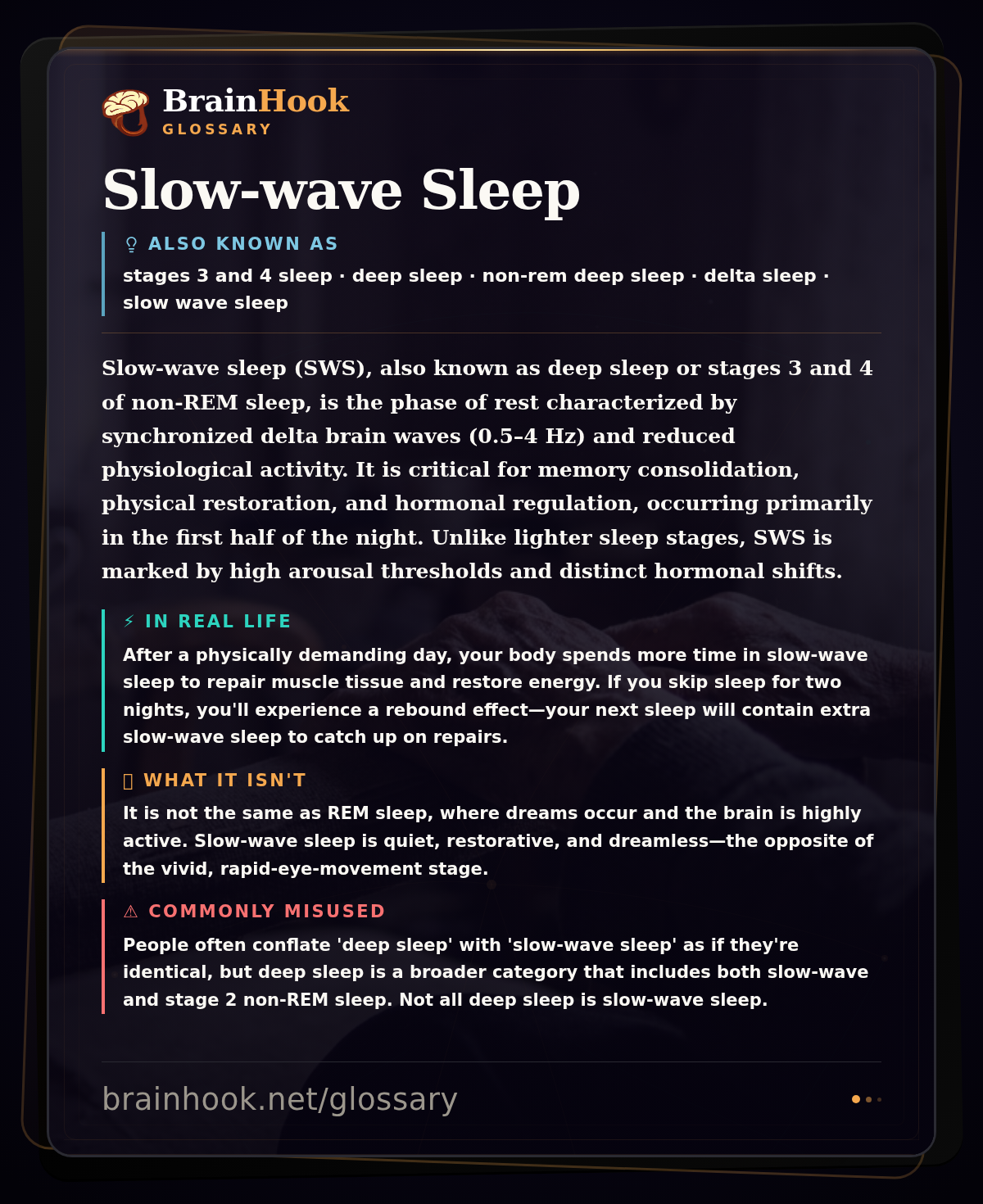
Slow-wave sleep (SWS), also known as deep sleep or stages 3 and 4 of non-REM sleep, is the phase of rest characterized by synchronized delta brain waves (0.5–4 Hz) and reduced physiological activity. It is critical for memory consolidation, physical restoration, and hormonal regulation, occurring primarily in the first half of the night. Unlike lighter sleep stages, SWS is marked by high arousal thresholds and distinct hormonal shifts.
What this means in real life
After a physically demanding day, your body spends more time in slow-wave sleep to repair muscle tissue and restore energy. If you skip sleep for two nights, you'll experience a rebound effect—your next sleep will contain extra slow-wave sleep to catch up on repairs.
What it isn’t
It is not the same as REM sleep, where dreams occur and the brain is highly active. Slow-wave sleep is quiet, restorative, and dreamless—the opposite of the vivid, rapid-eye-movement stage.
Commonly misused online
People often conflate 'deep sleep' with 'slow-wave sleep' as if they're identical, but deep sleep is a broader category that includes both slow-wave and stage 2 non-REM sleep. Not all deep sleep is slow-wave sleep.
Based on 2 reference sources, including NIH material. Last verified July 12, 2026.