Synaptic Plasticity
The brain's ability to strengthen or weaken neural connections based on experience, supporting motor adaptation, memory formation, and the growth of new neurons.
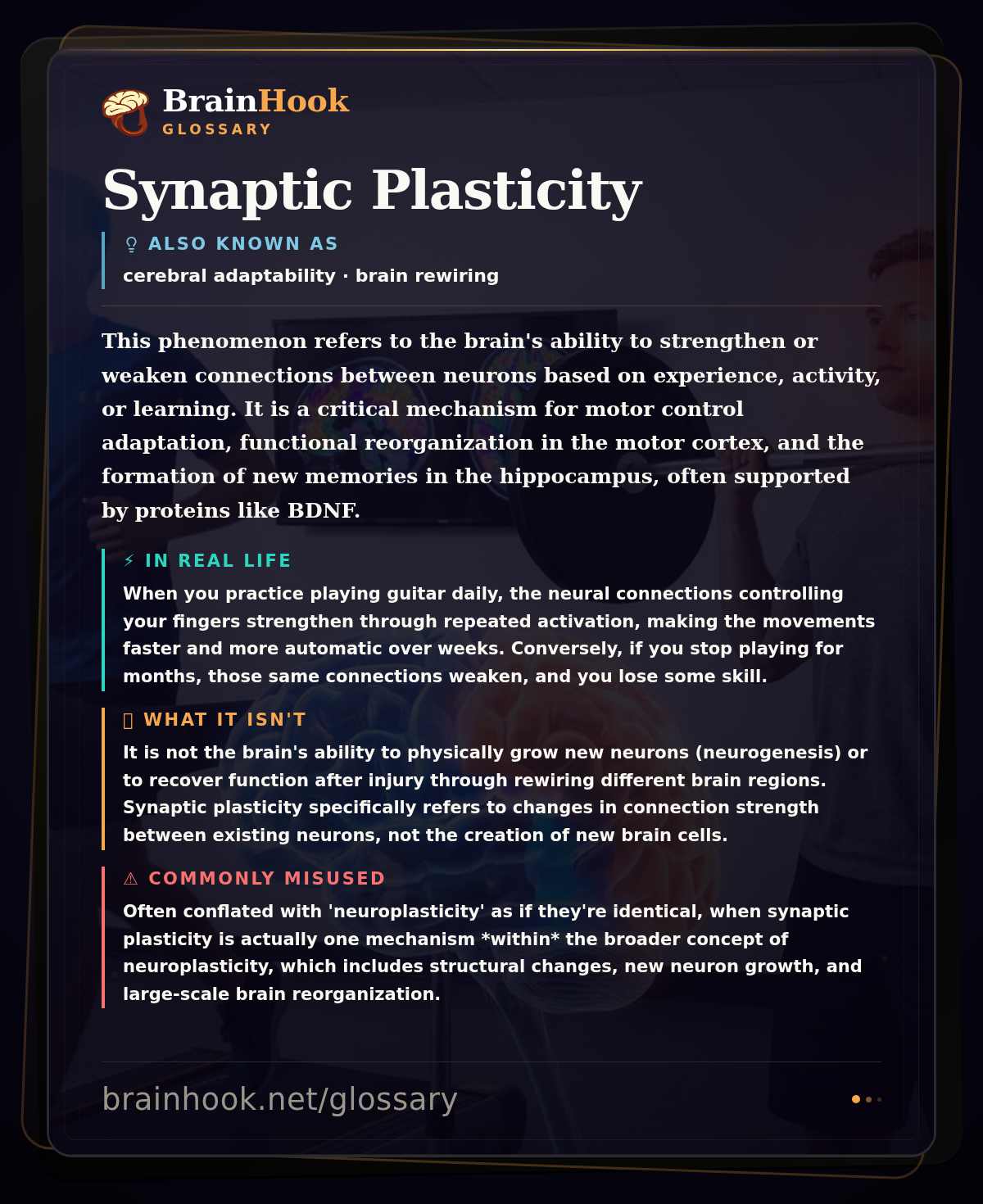
This phenomenon refers to the brain's ability to strengthen or weaken connections between neurons based on experience, activity, or learning. It is a critical mechanism for motor control adaptation, functional reorganization in the motor cortex, and the formation of new memories in the hippocampus, often supported by proteins like BDNF.
What this means in real life
When you practice playing guitar daily, the neural connections controlling your fingers strengthen through repeated activation, making the movements faster and more automatic over weeks. Conversely, if you stop playing for months, those same connections weaken, and you lose some skill.
What it isn’t
It is not the brain's ability to physically grow new neurons (neurogenesis) or to recover function after injury through rewiring different brain regions. Synaptic plasticity specifically refers to changes in connection strength between existing neurons, not the creation of new brain cells.
Commonly misused online
Often conflated with 'neuroplasticity' as if they're identical, when synaptic plasticity is actually one mechanism *within* the broader concept of neuroplasticity, which includes structural changes, new neuron growth, and large-scale brain reorganization.
Based on 2 reference sources, including primary sources. Last verified July 11, 2026.