Cognitive Control
In this context, cognitive control is the brain's ability to resist the urge to scroll through short videos and instead focus on academic tasks, acting as a neural shield against distraction.
Not to be confused with: Executive Function
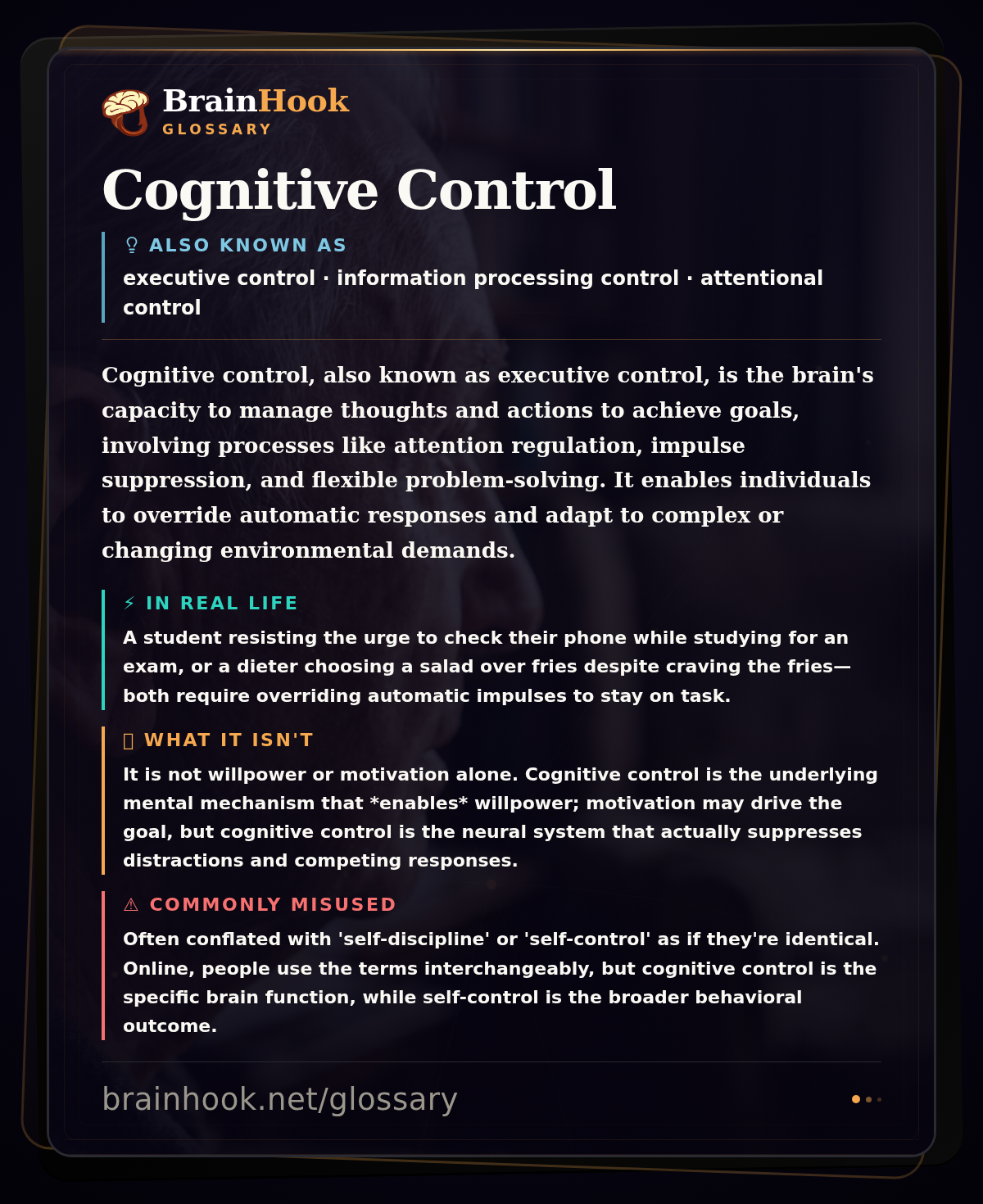
Cognitive control, also known as executive control, is the brain's capacity to manage thoughts and actions to achieve goals, involving processes like attention regulation, impulse suppression, and flexible problem-solving. It enables individuals to override automatic responses and adapt to complex or changing environmental demands.
What this means in real life
A student resisting the urge to check their phone while studying for an exam, or a dieter choosing a salad over fries despite craving the fries—both require overriding automatic impulses to stay on task.
What it isn’t
It is not willpower or motivation alone. Cognitive control is the underlying mental mechanism that *enables* willpower; motivation may drive the goal, but cognitive control is the neural system that actually suppresses distractions and competing responses.
Commonly misused online
Often conflated with 'self-discipline' or 'self-control' as if they're identical. Online, people use the terms interchangeably, but cognitive control is the specific brain function, while self-control is the broader behavioral outcome.