The Kimchi in Your Fridge Is Running a Living Ecosystem That Shifts with the Seasons
A new study reveals that fermented food microbiomes don't drift gradually — they snap between distinct ecological states, and the season your kimchi was made might matter more than your recipe.
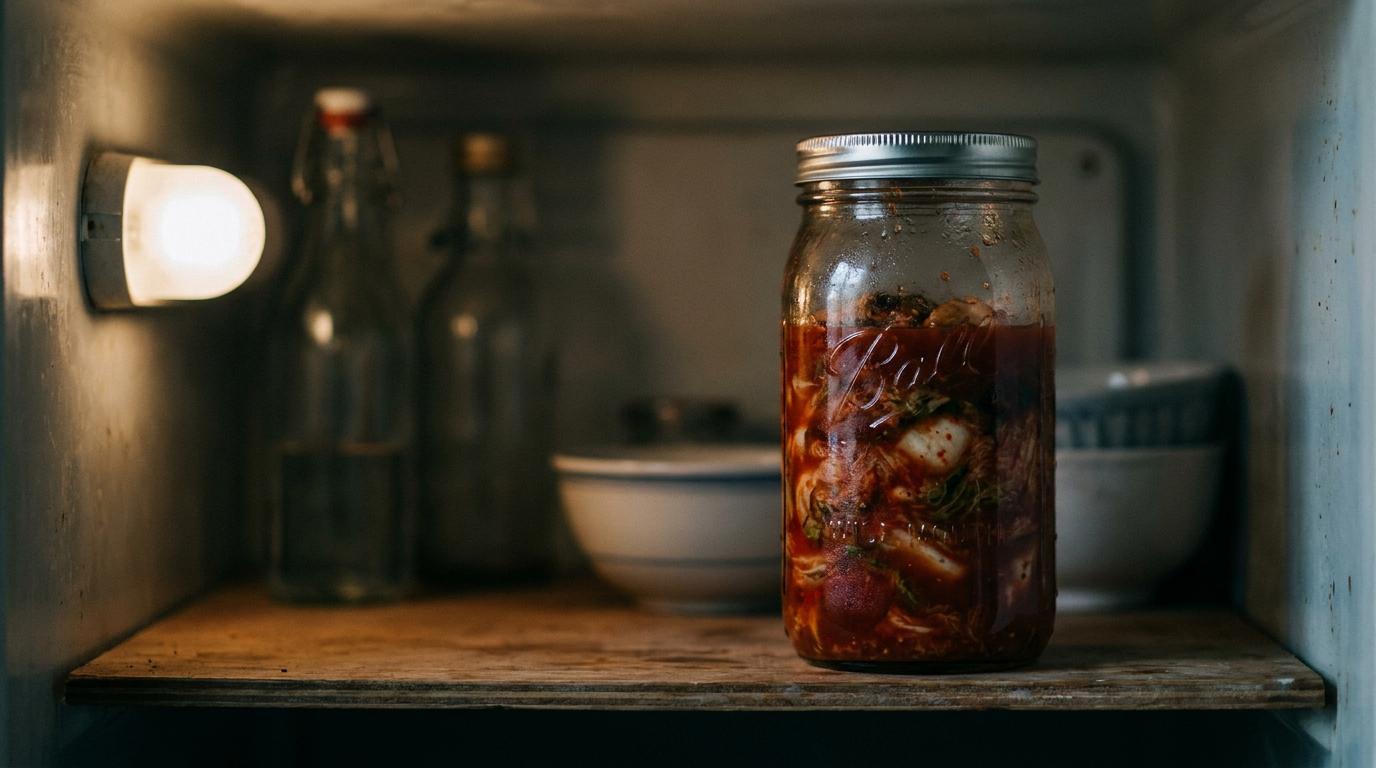
Pull a jar of kimchi from the back of your fridge, the one that's been sitting there for a few months getting sharper and more pungent with each passing week, and you're holding something that defies its own stillness. The jar is sealed. The temperature barely fluctuates. Nothing obviously changes from the outside. And yet inside, hundreds of bacterial species are jostling for position, some dying off entirely as the acidity climbs, others surging into dominance as conditions shift. That orange brine is not a preserved food in the way a tin of beans is a preserved food. It is a managed succession, a living community in the slow, deliberate process of becoming something else.
Fermented foods have always occupied a strange category in the kitchen — somewhere between cooking and biology, between recipe and accident. Every home fermenter knows that two batches made from the same ingredients can taste entirely different, and most chalk this up to water chemistry, salt ratios, temperature variability, or the vague metaphysics of a good fermentation hand. What a 2025 study in Nature Communications on seasonal fermented food microbiome ecology[1] revealed was something more structural: the microbial communities inside fermented vegetables don't just vary capriciously. They organize into distinct ecological states, almost like phases, and those phases track the seasons with a regularity that no recipe adjustment can fully explain.
That finding changes what fermented food even is. It suggests that your jar of kimchi, your crock of sauerkraut, your jar of fermented beets is not primarily a product of what you put into it. It is, in large part, a snapshot of the microbial world around you at the moment you made it — a record of the ambient bacteria on the vegetables, the populations on your hands, the invisible census of organisms floating through your kitchen air. The recipe specifies the substrate. The season supplies the microbial starting conditions. And from there, ecology takes over.
This is the part that tends to stop people: you did not inoculate your kimchi. You did not add a starter culture or introduce a specific strain. You salted some vegetables, packed them into a jar, and let the bacteria already living on the cabbage leaves and daikon radish do the work. Which means the organisms running that fermentation came from somewhere — from the field, from the farmer's hands, from the soil microbiome clinging to root vegetables, from the ambient air in the processing space. And all of those sources shift with the calendar in ways that fermentation science is only now beginning to map.
Succession, Not Stability
To understand what's really happening in a jar of kimchi, it helps to think less like a cook and more like an ecologist watching a forest regenerate after a fire. Traditional fermented vegetable fermentation follows a recognizable succession pattern. In the early hours, the jar belongs to whoever was there first: a chaotic mix of environmental bacteria from the vegetable surface, including aerobic species, Gram-negative coliforms, and various opportunists. This is a noisy, unstable phase, and it does not last long. The Leuconostoc species move in quickly, producing carbon dioxide and lactic acid from sugars in the vegetables, and that acidification begins purging the competition. By the time a kimchi jar has been fermenting for a day or two, the Leuconostoc population is already reshaping the environment against itself, creating conditions that will eventually favor Lactobacillus species — particularly Lactobacillus sakei and Lactobacillus plantarum — which tolerate higher acidity and lower oxygen more readily.
This succession is broadly predictable. What the 2025 Nature Communications research added was the recognition that the specific species populating each stage, the timing of transitions, and the final stable state the community settles into are not fixed by the recipe. They vary significantly with season. Winter ferments tended to develop distinct microbial assemblages compared to summer ferments, even when made from the same vegetables with the same salt concentration. The communities weren't just slightly different — they clustered into what the researchers identified as discrete ecological states, stable configurations that resemble what ecologists call alternative stable states in broader ecosystems. The same logic that governs whether a lake stays clear or tips into algal bloom dominance appears to operate inside a kimchi jar.
“Your jar of kimchi is not primarily a product of what you put into it — it is a snapshot of the microbial world around you at the moment you made it.”
Where the Seasonal Signal Comes From
The mechanism driving seasonal variation in fermented food microbiomes is not one thing but several, layered together. The most direct pathway runs through the vegetables themselves. Cabbage and radish are not sterile objects. They carry complex surface microbiomes shaped by the soil they grew in, the irrigation water used, the ambient air temperature during growth, and the populations of insects and soil organisms that made contact with them. All of this varies with season. The phyllosphere — the community of microbes living on leaf surfaces — shifts dramatically between growing periods, and those organisms are the first recruits in any wild fermentation.
Temperature exerts a second, independent influence. Even inside a fridge, the ambient kitchen temperature during the initial fermentation window matters. Fermentation is often begun at room temperature before moving to cold storage, and that early window is when the foundational community establishes itself. In summer, warmer starting temperatures accelerate early microbial activity, potentially allowing different species to gain a foothold before the pH drops low enough to begin selecting more strongly for acid-tolerant strains. In winter, cooler conditions slow initial metabolism, which effectively extends the competitive window and may allow slower-growing species more time to establish. The result is not simply faster or slower fermentation — it is a different competitive landscape, producing a different community by the time the jar is sealed and stored.
There is also a human microbiome component that most home fermenters never think about. Your hands are not neutral tools. They carry their own microbial passengers — largely dominated by Staphylococcus, Cutibacterium, and Corynebacterium species in ordinary conditions, but variable depending on the season, your skin's hydration state, recent exposures, and the broader environmental microbiome in your home. When you pack vegetables into a crock by hand, you are contributing organisms to that community. Research into how the body's microbial environment responds to disruption and environmental change has increasingly emphasized how intimately human skin microbiomes track seasonal and environmental conditions — which means your contribution to the ferment is not static either.
The Concept of Ecological States in a Jar
“The same logic that governs whether a lake stays clear or tips into algal bloom dominance appears to operate inside a kimchi jar.”
The concept of alternative stable states comes from macroecology, where it was developed to explain why certain ecosystems can exist in radically different configurations under apparently identical external conditions. A shallow lake can support either a clear-water regime with abundant aquatic plants or a turbid, phytoplankton-dominated regime, and both are self-reinforcing — once established, each actively resists the other. The tipping point between them is not always a dramatic external shock; sometimes a small push to an already-stressed system is enough to flip it to the alternative state, from which it is difficult to return.
The 2025 research suggests something analogous is happening at microbial scale inside fermented foods. The community that establishes itself in the early fermentation window creates conditions — particular pH trajectories, specific metabolite profiles, competitive exclusion dynamics — that favor certain successional outcomes over others. Once the community is heading toward one ecological state, it tends to stay on that trajectory. The starting conditions, including which organisms were most abundant on the raw vegetables and in the ambient environment at the time of preparation, act as an initial push that shapes which attractor state the ferment moves toward. This is why two kimchi batches made identically in January and July may end up tasting, smelling, and testing as genuinely distinct products at four weeks of fermentation — not because the recipe varied, but because the microbial initialization was different.
For the lactic acid bacteria driving fermentation, the ecological currency is acid tolerance and competitive exclusion. Lactic acid bacteria produce lactic acid as a metabolic byproduct of fermenting sugars, and that same acid begins selecting against less tolerant competitors. This is the mechanism that makes traditional fermented vegetables shelf-stable without refrigeration: the community engineers its own preservation chemistry. But which specific Lactobacillus strains ultimately dominate, and in what ratios, influences the flavor compounds produced, the texture of the vegetables, and the aromatic volatiles released. A community dominated by Lactobacillus plantarum will produce a different flavor signature than one in which Lactobacillus brevis or Leuconostoc mesenteroides retains a larger share. These are not marginal differences in taste. They are the difference between kimchi that tastes bright and clean versus kimchi with a richer, more complex, almost funky depth.
What Fermenters Have Always Known, Without Knowing Why
Across fermentation traditions spanning thousands of years, the relationship between season and outcome has been understood at the level of practice long before it was understood at the level of mechanism. Korean kimjang, the traditional communal kimchi-making done in late autumn[3], is not simply a cultural calendar event. It reflects accumulated knowledge that autumn kimchi — made from cabbage harvested in cooler weather, packed in cool conditions — ferments more predictably and stores better through winter. Japanese miso is categorized in part by the season of its production. European cheesemaking traditions specify seasonal milk, not just because summer and winter milk differ in fat composition, but because the ambient microbial environment surrounding the cheese cave and the cows themselves changes with the season, and experienced cheesemakers have long known it affects what grows on the rind. These traditions were empirical microbiology before the tools to explain them existed.
What is striking about the 2025 findings is that they give a structural explanation for variation that artisan producers have described qualitatively for generations. The seasonal microbial state concept does not invalidate traditional practice — it confirms it, and reveals that the intuitions baked into fermentation culture were tracking something real. The timing of fermentation was not arbitrary cultural preference. It was an optimization strategy for community composition, arrived at through centuries of trial and error, that modern sequencing tools can now read directly.
Why This Matters Beyond the Kitchen
“The timing of fermentation was not arbitrary cultural preference — it was an optimization strategy for microbial community composition, arrived at through centuries of trial and error.”
The implications fan outward from the kimchi jar in directions that are worth following carefully. Fermented foods are increasingly positioned in public health and clinical research as meaningful contributors to gut microbial diversity, with research into fermented food consumption and microbiome modulation[2] suggesting that their regular consumption shifts gut community composition toward greater richness. But if the microbial content of those foods varies systematically by season and ecological state, then the specific effects of eating fermented foods may be more variable than a standardized nutritional label would suggest. A winter kimchi and a summer kimchi are not microbiologically equivalent, even if they come from the same recipe. The gut microbiome, as we understand it increasingly well, is not a static organ — it is itself a dynamic ecological community, sensitive to the inputs it receives. The seasonality of fermented food microbiomes means the inputs themselves are seasonal.
There is also a broader relevance for food production and safety. Industrial fermentation typically works by inoculating a substrate with defined starter cultures, bypassing the ecological lottery of wild fermentation entirely. This produces consistency. It also eliminates the microbial complexity that distinguishes artisan fermented foods from factory-made ones, and it sidesteps the ecological dynamics that the 2025 research illuminates. Wild ferments are, from a safety perspective, riskier when made carelessly — sufficient salinity and acidity are the critical controls that keep pathogenic organisms from establishing themselves during the critical early window. But they are also where the microbial richness lives, and where the seasonal signal persists. Understanding the ecological states that wild ferments move through could help producers understand when their process is heading toward a desirable outcome versus one that needs intervention.
Meanwhile, research on how the gut microbiome responds to physiological stress and environmental change has been converging on a picture of the gut as a system that tracks the world around us more closely than we tend to assume. The idea that what we eat carries microbial information about the environment in which it was made — including the season, the soil, the regional microbiome — is part of a larger emerging framework in which the human gut is understood not as an isolated internal organ but as something partially continuous with the external microbial environment. We do not consume bacteria from fermented foods passively. We import ecological information and let it interact with the community already resident in our digestive tract.
The jar on your shelf does not look like an ecosystem under active management. It looks like lunch. But sealed inside that glass are the traces of a particular season's microbes, the legacy of specific competitive dynamics between organisms too small to see, the product of a succession that played out over weeks according to ecological rules developed across billions of years of bacterial evolution. When you open it, you are not just opening kimchi. You are reading a microbial record of the world at the moment it was made — which is more information than any label is designed to carry.
References
- Fermented foods affect the seasonal stability of gut bacteria in an Indian rural population (nature.com)
Provides the 2025 Nature Communications study data showing fermented food microbiomes organize into distinct seasonal ecological states rather than varying gradually. - Gut-microbiota-targeted diets modulate human immune status (doi.org)
- Kimjang, making and sharing kimchi in the Republic of Korea - UNESCO Intangible Cultural Heritage (ich.unesco.org)
Establishes that kimjang, traditional Korean kimchi-making, follows a yearly seasonal cycle tied to natural rhythms.
About Aris Thorne
Aris Thorne is a microbiologist who writes about the hidden mechanics of ordinary life: the microbes running your home, the chemistry unfolding in food and water, the physics built into familiar objects, and the biological systems quietly keeping the human body alive. His work follows science from kitchens, bathrooms, dust, soil, and city air into wounds, immune responses, infections, medicines, cells, and other worlds. He is most interested in the moment something familiar stops looking simple and reveals the living machinery underneath.
More like this
Your House Dust Is a Microbial City. Your Cleaning Products Are Reshaping It.
The chemicals in your cleaning products don't kill your home's microbial community — they reorganize it, and the survivors are keeping score.
Decomposition Has a Smell for Every Stage — And Science Is Finally Mapping It
The odor rising from a decomposing body isn't a single stench — it's a shifting chemical record written by bacteria, and forensic scientists are learning to read it like a clock.
The Forest Still Looks Green. That's the Problem.
Research on Southwest US woodlands reveals that trees can lose the hydraulic and carbon reserves that keep them alive long before their canopy shows a single yellow leaf — meaning the forests we think we're watching die may already be past saving.