Ecological Succession
The gradual, predictable shift where one group of species replaces another in a habitat, moving from pioneer settlers to a stable, mature ecosystem over time.
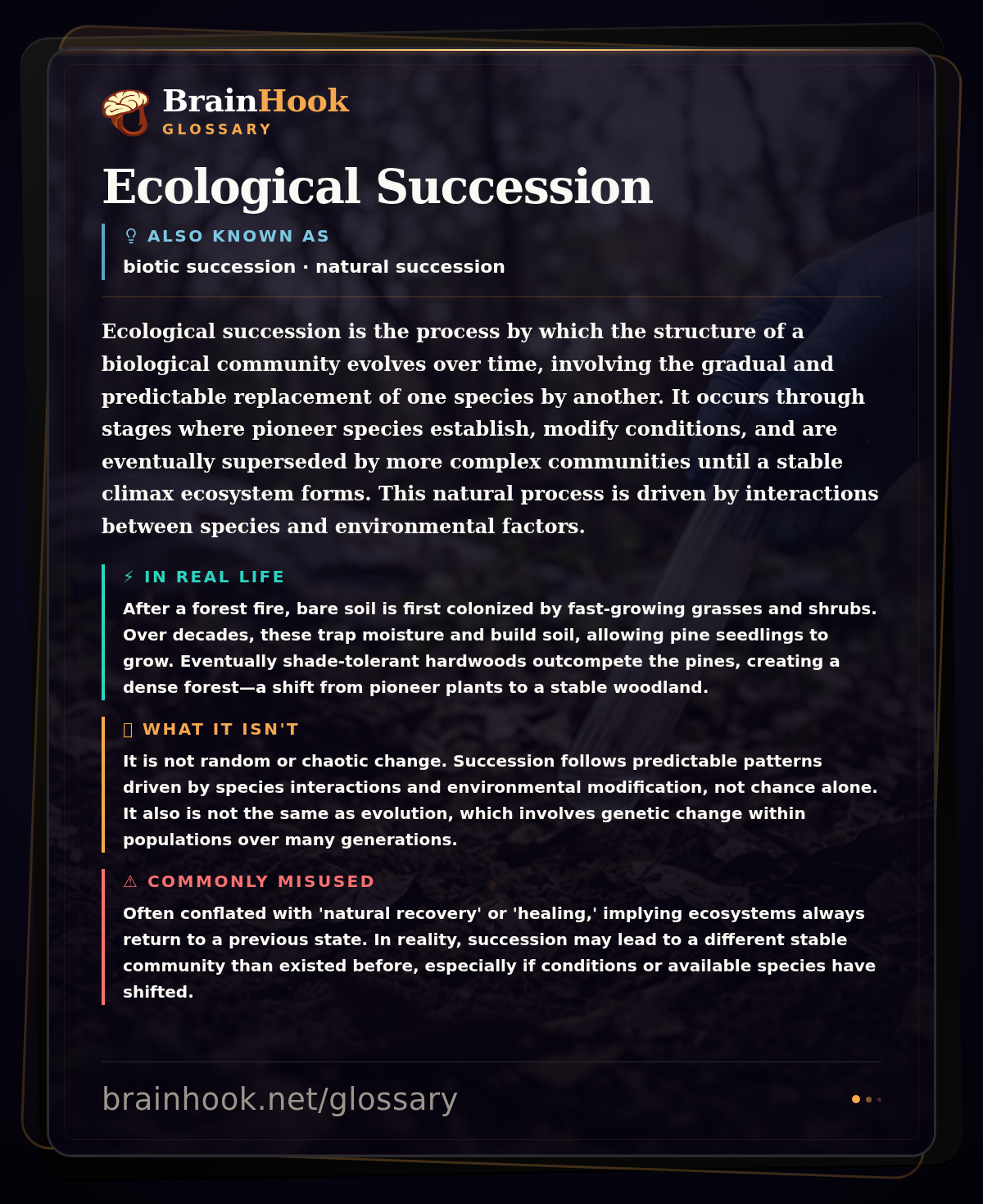
Ecological succession is the process by which the structure of a biological community evolves over time, involving the gradual and predictable replacement of one species by another. It occurs through stages where pioneer species establish, modify conditions, and are eventually superseded by more complex communities until a stable climax ecosystem forms. This natural process is driven by interactions between species and environmental factors.
What this means in real life
After a forest fire, bare soil is first colonized by fast-growing grasses and shrubs. Over decades, these trap moisture and build soil, allowing pine seedlings to grow. Eventually shade-tolerant hardwoods outcompete the pines, creating a dense forest—a shift from pioneer plants to a stable woodland.
What it isn’t
It is not random or chaotic change. Succession follows predictable patterns driven by species interactions and environmental modification, not chance alone. It also is not the same as evolution, which involves genetic change within populations over many generations.
Commonly misused online
Often conflated with 'natural recovery' or 'healing,' implying ecosystems always return to a previous state. In reality, succession may lead to a different stable community than existed before, especially if conditions or available species have shifted.