Decomposition Has a Smell for Every Stage — And Science Is Finally Mapping It
The odor rising from a decomposing body isn't a single stench — it's a shifting chemical record written by bacteria, and forensic scientists are learning to read it like a clock.
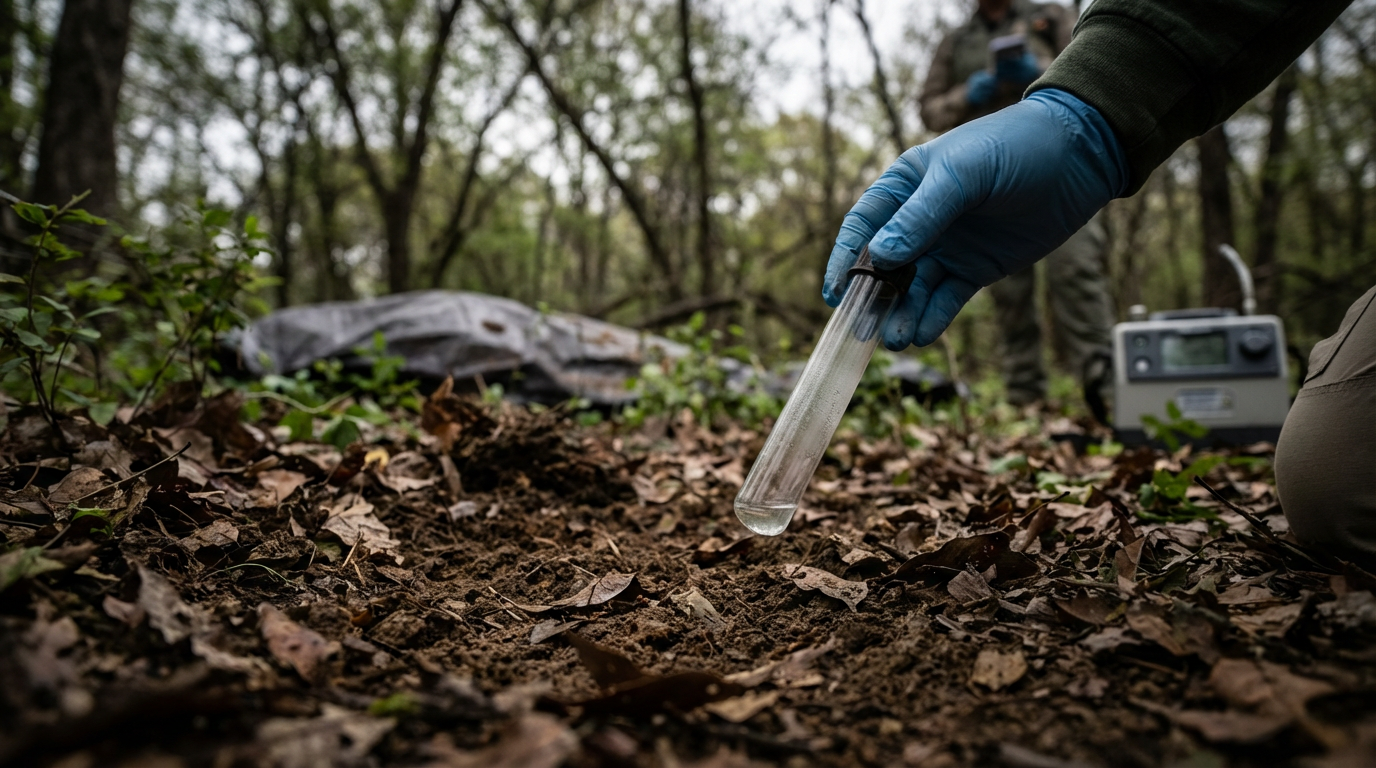
There is a moment, well known to forensic investigators, search-and-rescue teams, and anyone who has worked around death professionally, when the smell changes. Not just intensifies — changes. The early hours after death produce one kind of air. A few days later, something fundamentally different is happening in the chemistry of the space. A week out, it is different again. What seems, to the uninitiated, like a single overwhelming assault on the senses is actually a sequence: a shifting, chemically specific progression driven not by the body alone, but by the microbial communities colonizing and transforming it.
That distinction matters more than it might seem. The smell of decomposition has long been treated as a blunt instrument in forensic investigation — useful for detection, terrible for precision. Cadaver dogs can locate remains with stunning sensitivity, but they cannot tell you how long the body has been there. Human noses can confirm that something died, but offer nothing resembling a timestamp. In the past decade, researchers working at the intersection of forensic taphonomy and postmortem microbiology have begun to map the volatile organic compounds (VOCs) released at each stage of decomposition with enough specificity to suggest something previously impossible: that the smell of death might eventually be used to estimate time since death, identify environmental conditions at the scene, and even characterize the microbial communities responsible for each chemical phase.
This is not, in other words, just a more precise account of something revolting. It is the beginning of a forensic tool built from odor itself — from the specific molecular exhaust produced by specific bacteria doing specific biochemical work on specific tissues at specific times. The mechanism is beautiful in a deeply uncomfortable way. Decomposition, it turns out, is not chaos. It is an orderly succession of microbial communities, each with a characteristic chemistry, each leaving a volatile signature in the air above the remains.
Understanding why requires starting with what the body actually is, chemically, at the moment of death. And then watching what happens to it when the microbes arrive.
The Body as a Resource: What Microbes Inherit
At the moment of death, the immune system stops. That sentence sounds simple, but its implications for the body's microbial landscape are enormous. Living humans carry an estimated 38 trillion microbial cells[3], concentrated heavily in the gut but distributed across skin, mucous membranes, lungs, and elsewhere. While alive, the host actively contains these populations — barrier function, immune surveillance, antimicrobial peptides, and the structural integrity of tissue all work to keep microbes where they belong and out of where they do not. Death removes all of that constraint simultaneously. The gut bacteria, which had been operating in a carefully regulated environment, now face no resistance. They begin moving through the intestinal wall within hours.
This translocation is the opening act of what forensic microbiologists call the thanatomicrobiome[1] — the community of microbes that colonize and transform a body after death. It is not random. Research into postmortem microbial succession has found that the species composition of the thanatomicrobiome follows a broadly predictable pattern, beginning with the anaerobic bacteria already present in the gut — Clostridium species, Bacteroidetes, and their relatives — and expanding outward as the chemical environment of the tissues changes. As oxygen is depleted and the body's pH drops due to fermentation, the community shifts. New species find conditions favorable that would not have been before. Old species produce metabolites that reshape the substrate and make room for what comes next. It is ecological succession, running on a dead body.
“Decomposition is not chaos. It is an orderly succession of microbial communities, each with a characteristic chemistry, each leaving a volatile signature in the air.”
Each of those bacterial communities produces a distinct set of volatile organic compounds as metabolic byproducts of what they are eating and how. Putrescine and cadaverine[4] — the diamines whose names are, for once, exactly right — are produced early, primarily by bacterial decarboxylation of the amino acids ornithine and lysine. They are responsible for the distinctive sweet-rotten odor associated with fresh decomposition. Hydrogen sulfide, methanethiol, and dimethyl disulfide come from sulfur-containing amino acid breakdown, mostly from anaerobic bacteria working on proteins. Indole and skatole, products of tryptophan metabolism, add a fecal register to the chemical profile. Short-chain fatty acids accumulate as lipids break down. Each of these is not just a smell. Each is a fingerprint of a specific biochemical process being carried out by a specific class of organism.
Mapping the Smell: What Forensic VOC Research Has Found
The systematic effort to map VOC profiles against decomposition stages is relatively recent, but it has been gathering momentum. Researchers using solid-phase microextraction and gas chromatography-mass spectrometry — the tools that allow you to separate a complex chemical vapor into its molecular components and identify each one — have analyzed air samples taken from above decomposing remains at controlled intervals. The methodology is exactly as unglamorous as it sounds: outdoor research facilities, sometimes called "body farms,"[2] allow forensic scientists to study human and animal decomposition under natural conditions, sampling the air repeatedly as the process unfolds. What they find is a moving target that is, crucially, a consistent moving target.
Early-stage decomposition, in the first days after death, is chemically dominated by the initial microbial surge: high concentrations of sulfur compounds, the early diamines, and alcohols produced by fermentative metabolism. The profile at this stage is volatile and relatively complex — a lot of chemistry happening quickly as the gut bacteria spread and the most accessible substrates are consumed. As decomposition moves into active decay, the VOC profile shifts substantially. Lipid breakdown products become more prominent. The sulfur compounds that dominated earlier begin to be metabolized by other bacteria, which reduces their concentration even as the overall smell arguably intensifies to a human nose. By the late stages — skeletonization in warm, exposed conditions — the VOC profile thins out. Dry tissue and bone produce little off-gassing. The chemistry winds down in the same orderly way it escalated.
What is forensically significant about this pattern is not any single compound but the ratios between compounds, and the presence or absence of specific molecules at specific windows of time. No one compound reliably marks a given stage in isolation; temperature, humidity, burial depth, insect access, and the initial microbial composition of the individual all modulate the timeline. But the underlying sequence — which microbial communities dominate, which substrates they preferentially consume, and therefore which volatiles they generate — appears to be robust enough that researchers have proposed ratio-based models for postmortem interval estimation. The goal is essentially a chemical clock, calibrated against known decomposition stages.
Why Cadaver Dogs Know, and What They're Actually Smelling
Before any of this research existed in its current form, cadaver dogs were already demonstrating, behaviorally, that decomposition produces identifiable scent signatures. Dogs trained to locate human remains can alert on buried bones years old, on remains submerged in water, and on locations where a body was present but has since been moved — what investigators call "negative scent," the chemical residue left behind in soil and material. The dogs are not, as popular explanation sometimes has it, smelling death in some generic sense. They are detecting specific volatile compounds, probably a characteristic constellation of them, that their training has associated with human decomposition. The precise molecular targets of cadaver dog detection have been an active area of research, partly because identifying them could improve training compounds and partly because they might narrow down what a VOC-based forensic tool would need to measure.
“A cadaver dog isn't smelling death in some generic sense — it's detecting a specific constellation of volatile compounds that its training has associated with human decomposition.”
Some of the strongest candidates include a subset of sulfur-containing volatiles that are particularly stable and that human remains produce in combinations not replicated by animal decomposition or soil chemistry — which would help explain why well-trained dogs can discriminate human remains from other decomposing biological material. The research is ongoing and complicated by the individual variability in decomposition chemistry, but the direction is clear: the odor of human remains is compositionally specific, not just intense, and the dogs have been exploiting that specificity for decades before the analytical chemistry caught up.
The Environmental Modifiers: Why the Same Death Smells Different
Temperature is the most powerful single variable. Warmer conditions accelerate microbial metabolism dramatically, compressing the decomposition timeline and pushing through bacterial succession faster. A body decomposing in summer heat outdoors follows a radically different VOC timeline than the same body in a cold basement. The chemistry is qualitatively similar but quantitatively shifted — the same playlist, running at different speeds. This is one of the central challenges in building a chemical clock for forensic use: the model has to account for accumulated thermal units, not just time elapsed, because microbial activity is fundamentally temperature-dependent.
Burial changes things further. Underground, anaerobic conditions are established more quickly and insects — which would otherwise introduce their own microbial contributions through egg-laying and larval activity — are excluded or delayed. The insect microbiome is its own variable. Blowflies arriving at remains bring bacteria on their bodies and in their digestive tracts that become part of the decomposition community, adding new metabolic pathways and new volatiles to the profile. Submerged remains produce a different chemical environment again: saponification, the conversion of body fat to adipocere, a soapy waxy substance, produces a distinctive odor profile that VOC analysis has characterized separately. Each environment essentially remixes the decomposition chemistry while leaving the underlying microbial logic intact.
What researchers are building, across these variables, is not a single formula but a framework — a model robust enough to incorporate environmental context and still yield forensically useful estimates. It is genuinely difficult science, and the honest assessment from the field is that VOC-based postmortem interval estimation is promising but not yet standardized for courtroom use. The chemical signatures are real. The patterns are consistent. The precision required for forensic evidence is still being worked toward.
What the Smell Is Actually Telling You
Disgust at the smell of decomposition is not a cultural artifact or a squeamishness failure. It is a calibrated threat-detection system. The volatile compounds that smell worst to humans — the sulfur compounds, the diamines, the microbial metabolites of putrefaction — are real biochemical markers of pathogen risk. Consuming or coming into close contact with tissue in active bacterial decomposition carries genuine infection hazard. The revulsion response exists because ancestors who had it survived situations that others did not. The olfactory alarm is tracking something real.
“The volatile compounds that smell worst to humans are real biochemical markers of pathogen risk — the revulsion response exists because ancestors who had it survived situations that others did not.”
What forensic VOC research adds to that picture is resolution. The alarm is not just saying "danger" in a binary sense. It is, apparently, conveying layered chemical information that cadaver dogs can parse precisely, that trained human investigators learn to interpret contextually, and that analytical chemistry can now begin to read systematically. The smell of death has always been information. Scientists are finally building the translation key.
The Clock That Smells
The long-term forensic ambition here is a sensor — an electronic nose or a portable mass spectrometry system — that could be brought to a scene, sample the air, and return a chemical profile that an algorithm could match against a database of known decomposition signatures. The technology for each component of that pipeline already exists. Gas chromatography-mass spectrometry systems have been miniaturized substantially. Machine learning classification of complex chemical profiles is an active research area in other contexts, from food science to explosives detection. The scientific gap is the database itself: enough systematically collected, environmentally controlled VOC data across decomposition stages, remains types, and environmental conditions to train a model with forensic-grade reliability.
Body farm facilities, tightly controlled decomposition research programs, and collaborative efforts in forensic microbiology and analytical chemistry are working to fill that gap. The pace is slow — it is painstaking, unglamorous, and expensive research — but the conceptual clarity is sharp. Every decomposing body is producing a chemical record of what its microbes are doing, when they arrived, and what conditions they have been operating in. That record is volatile in the literal sense: it disperses into the air and eventually dissipates. But while it lasts, it is precise, consistent, and now increasingly legible. The body has always been telling a story through its smell. Science is finally learning to listen.
References
- Human Thanatomicrobiome Succession and Time Since Death (nature.com)
Defines the thanatomicrobiome as the postmortem microbial community undergoing successional shifts in composition throughout decomposition. - outdoor research facilities, sometimes called "body farms," (fbi.gov)
Describes body farms as outdoor research facilities where forensic scientists study decomposition under natural conditions with repeated air sampling. - Revised Estimates for the Number of Human and Bacteria Cells in the Body (journals.plos.org)
Provides the estimate of 38 trillion microbial cells living in the human body at the moment of death. - Putrescine and cadaverine (acs.org)
Explains that putrescine and cadaverine are produced by bacterial decarboxylation of amino acids and create the sweet-rotten odor of early decomposition.
About Phoebe Lark
Phoebe Lark writes about the biology and chemistry your body and home would rather you didn't examine too closely — odors, fluids, microbes, parasites, infestations, and the quietly industrious rot happening on and around you right now. She follows disgust down to the mechanism underneath, where the gross thing almost always turns out to be a system doing exactly what it evolved to do.
More like this
Your Breath Is a Readout of Your Gut Microbiome. Scientists Just Proved It.
A 2025 Cell Metabolism study confirmed what scientists suspected for years: the microbial fermentation churning through your gut is chemically leaking into your breath — and that volatile signature might be the future of gut diagnostics.
The Slime You Scrubbed Off the Drain Came Back. That's the Point.
New research shows that household cleaning kills the bacteria inside a biofilm while leaving its scaffold intact — which means the colony doesn't die, it just takes a short nap.
Your Blood Tells Time. Scientists Are Learning to Read It.
A bloodstain isn't just evidence of violence — it's a chemical clock quietly ticking through a sequence of molecular changes, and new spectroscopic techniques are finally precise enough to read it.