Your House Dust Is a Microbial City. Your Cleaning Products Are Reshaping It.
The chemicals in your cleaning products don't kill your home's microbial community — they reorganize it, and the survivors are keeping score.
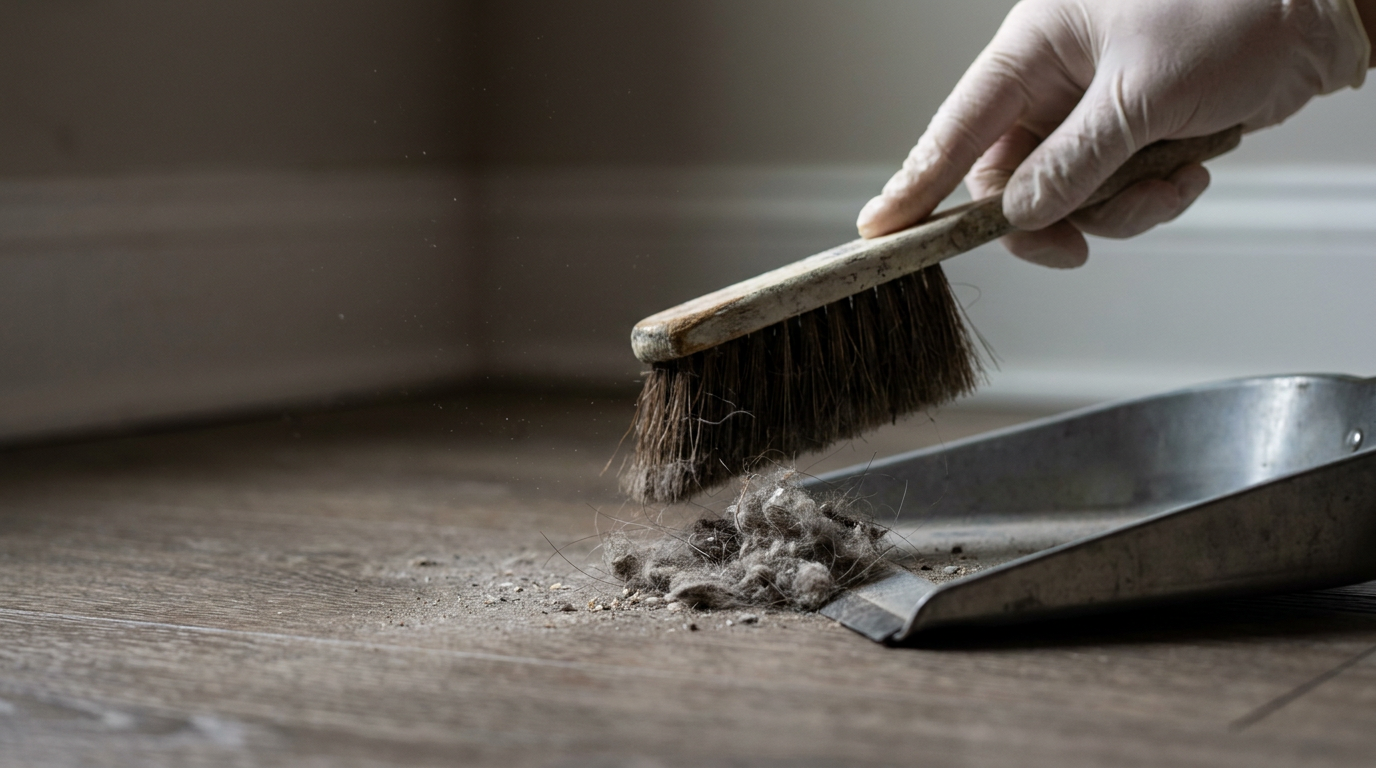
Pick up a pinch of house dust from the corner where your baseboard meets the floor. It looks like nothing — a gray smear of fiber and dander, barely worth acknowledging before you sweep it out the door. But under a microscope, that pinch contains something closer to a census. Thousands of bacterial species. Fungal spores. Shed skin cells. Fragments of synthetic fiber. Particles of whatever came in on your shoes, rose from your cooking, or drifted off your body overnight. House dust is not detritus. It is a compressed record of everything living in, moving through, and chemically happening inside your home. And it turns out you have been doing something to it every time you clean.
A study published in April 2025 in the journal Microbiome[5] mapped the microbial communities inside household dust with unusual precision and found something that changes the way you have to think about domestic hygiene. The antibacterial chemicals and pharmaceutical compounds present in ordinary cleaning products — triclosan in soaps, parabens in personal care products, endocrine-disrupting compounds from plasticizers and detergents — are not sitting inert in your dustpan. They are actively restructuring which bacteria survive on your floors, your shelves, and your windowsills. And as they do, they are accelerating the movement of antibiotic-resistance genes between the microbes that remain.
This is not a story about surface contamination or whether you should scrub harder. It is a story about selection pressure — the same invisible force that drove the evolution of every organism on earth — operating inside your living room, running on the chemistry you are pouring into your mop bucket. The floor you sweep is not a passive surface. It is a habitat, and you have been engineering it.
To understand what that means, you have to start with what house dust actually is and why it holds so much biological information in the first place. Dust is not random. It is stratified, locally produced, and surprisingly stable. The microbial community in a bedroom corner shares more with that bedroom's human inhabitants than with the kitchen three meters away. Your skin sheds roughly 30,000 to 40,000 cells an hour, and each one carries a small hitchhiking population of Staphylococcus, Corynebacterium, and Cutibacterium — the bacteria that colonize human skin. Pets contribute Pasteurella and Moraxella from their mouths and coats. Outdoor air brings Pseudomonas and Bacillus in through open windows. What settles on the floor is, essentially, a composite organism — a slow accumulation of every biological signature in the household, compressed into a thin gray layer.
The Chemistry That Never Quite Leaves
Triclosan is a good place to start, because it has been everywhere and because its behavior inside microbial communities is well documented. It is a broad-spectrum antimicrobial that has appeared in hand soaps, dish liquids, toothpastes, cutting boards, and clothing — so widely used that, despite being restricted in some consumer products in recent years[4], it continues to turn up in household dust, human urine, and breast milk at measurable concentrations. Triclosan works by inhibiting an enzyme called enoyl-ACP reductase[2], which bacteria need to synthesize fatty acids for their cell membranes. Block that enzyme, and the bacterium cannot maintain its structure. It dies. That is the intended mechanism — and it works, as far as it goes.
The problem emerges at sublethal concentrations. Dust is not a liquid medium where a disinfectant disperses evenly. It is a complex, particulate environment where chemical gradients are uneven and exposure is inconsistent. Some microbes in a dust community encounter enough triclosan to be killed. Others encounter just enough to be stressed. And in bacteria under stress, something predictable happens: the SOS response activates[3]. This is a tightly regulated DNA-repair system that bacteria have carried for billions of years, and one of its consequences is a dramatic upregulation of horizontal gene transfer — the process by which bacteria share genetic material directly with one another, passing plasmids hand to hand, so to speak, outside of ordinary reproduction.
“At sublethal concentrations, triclosan does not kill the community. It teaches it how to survive.”
Horizontal gene transfer is how antibiotic resistance spreads most efficiently in the real world — not through the slow accumulation of mutations, but through the rapid sharing of pre-built resistance cassettes encoded on mobile genetic elements called plasmids and transposons. A bacterium that has never seen an antibiotic can acquire full resistance to one in a single transfer event. When triclosan stresses a microbial community and triggers elevated gene-transfer rates, it is, in effect, accelerating the speed at which those resistance packages move through the population. The 2025 Microbiome study found elevated concentrations of mobile genetic elements carrying resistance genes in dust samples from homes with higher measured levels of antibacterial cleaning chemicals — a correlation that points directly at this mechanism.
Parabens, Endocrine Disruptors, and the Art of Shifting a Population
Triclosan is the most studied, but it is not the only chemical reshaping the dust microbiome. Parabens — the preservatives used in lotions, shampoos, and cosmetics — are antifungal and mildly antibacterial, and they accumulate in settled dust through volatilization and contact. Endocrine-disrupting compounds like bisphenol A, phthalates from plastic packaging, and quaternary ammonium compounds from surface sprays add another layer. These chemicals do not all kill bacteria through the same mechanism. Some disrupt membrane integrity. Some interfere with quorum sensing — the chemical signaling bacteria use to coordinate group behavior. Some alter the nutrient availability in the dust matrix itself, shifting which metabolisms can thrive in a given environment. What they share is the capacity to change who wins and who loses in the competition for space and resources on your floor.
That competitive shift matters in ways that reach beyond the dust itself. The bacteria that survive high-chemical environments tend to share certain traits: robust efflux pumps that physically push toxins out of the cell, modified cell membrane compositions that reduce chemical permeability, and — critically — elevated rates of gene exchange. These are precisely the traits that also make bacteria more likely to acquire, harbor, and spread antibiotic resistance. When you select for chemically tolerant microbes, you are inadvertently selecting for microbes that are harder to kill with clinical antibiotics. The community that emerges from a heavily cleaned home is not simply smaller. It is, on average, tougher.
What the Survivors Actually Look Like
The 2025 study used metagenomics — whole-community genetic sequencing — to profile the bacteria in dust samples from dozens of households, cross-referenced against measured chemical loads from the same homes. In homes with low antibacterial chemical concentrations, the dust communities were diverse: heavy with skin commensals like Cutibacterium and Corynebacterium, laced with environmental bacteria from soil and outdoor air, low in pathogens. In homes with high chemical loads, that diversity contracted. The communities were dominated by a narrower set of genera — Staphylococcus and Enterococcus featured prominently — that are better known in clinical settings than in healthy households. And those communities carried significantly higher densities of resistance genes, particularly genes encoding resistance to beta-lactam antibiotics, tetracyclines, and fluoroquinolones.
“The home with the cleanest floors may be cultivating the most clinically concerning bacteria.”
Staphylococcus aureus and Enterococcus faecalis are not exotic hospital pathogens that have no business in a living room. They live on human skin and in the gut routinely, usually without causing harm. But they are also among the most prolific accumulators of antibiotic resistance in clinical environments, and they are excellent at horizontal gene transfer. When they dominate a dust community because chemical pressure has eliminated most of their competition, they are positioned to acquire and redistribute resistance genes with relative efficiency — and to deposit those genes back onto the people moving through the space. Dust is inhaled. Dust is tracked through the house on bare feet. Children and toddlers are in direct, repeated contact with the floor. The gap between what lives in house dust and what gets into bodies is much smaller than most people assume.
The Hygiene Hypothesis Gets a New Dimension
Microbial ecologists have known for years that indoor environments have their own characteristic microbiomes, and that those microbiomes matter for human health in ways that extend beyond infection risk. The hygiene hypothesis — the idea that reduced microbial exposure in early life contributes to elevated rates of allergy, asthma, and autoimmune disorders — has been argued largely on immunological grounds. Diverse early microbial exposure trains the immune system to distinguish between harmless environmental signals and genuine threats. Reduce that diversity and the calibration drifts. But the new research adds a second, more concrete dimension to this framing: it is not only that a less diverse indoor microbiome trains the immune system badly. It is that a chemically pressured indoor microbiome actively concentrates and spreads antibiotic resistance in a space you live inside.
This sits alongside a large and growing body of research into the built environment microbiome[1] — the study of the microbial communities that colonize and characterize the spaces humans build and inhabit. Hospitals, schools, offices, transit systems, and homes all have distinct microbial signatures, and those signatures are shaped by everything from building materials and ventilation to occupant behavior and — now clearly — cleaning chemistry. Research groups have shown that buildings with better ventilation and higher occupancy diversity tend to have more diverse, more ecologically stable microbial communities. Buildings that are aggressively disinfected tend to have communities that are smaller, less diverse, and over time, more resistant.
The Cleaning Aisle Was Never Neutral
None of this means you should stop cleaning your home. Reducing pathogen load, removing allergens, and maintaining basic hygiene have clear and well-established benefits. The useful takeaway is narrower and more precise: not all cleaning is equivalent, and the chemistry you choose has downstream consequences for the microbial ecosystem you share your home with. Triclosan-containing products offer no clinically proven advantage over ordinary soap and water for most household purposes, which is why public health regulators have increasingly moved to limit their use — but they continue to appear in products under various formulations, and their residues persist in household environments long after you stop using them. Parabens and quaternary ammonium compounds are similarly widespread, similarly persistent, and similarly understudied in the context of indoor microbial ecology.
The mechanistic picture now emerging from dust microbiome research suggests that the ideal approach to cleaning is targeted rather than broad-spectrum — soap and water for most surfaces, stronger antimicrobials reserved for genuinely high-risk situations like food preparation areas and illness recovery. Formulations that rely on physical disruption of microbial cells — soap's lipid-disrupting action, isopropyl alcohol at high concentrations — are metabolically harder for bacteria to develop resistance to than enzyme-targeting chemicals like triclosan. They work differently, leave different residues, and exert different selective pressure on the surviving community.
“Soap does not teach bacteria anything. Triclosan gives them a lesson they remember.”
The bigger shift is perceptual. The floor is not a contaminated surface waiting to be neutralized. It is a habitat under constant negotiation, where the bacteria living in the dust interact with the chemicals in the air and on surfaces, trade genetic information with one another, and collectively determine what kind of microbial environment the people in the house are exposed to every day. Cleaning changes that environment. The question that the 2025 Microbiome study forces into view is not whether to clean but which tools shift the community toward health and which ones quietly build something more dangerous in the corner where no one is looking.
What Dust Is Actually Telling You
There is something almost counterintuitive about the conclusion this research points toward. The houses that feel most sterile — the ones that smell of bleach and antibacterial spray, the ones with floors clean enough to eat from — may be the ones running the most intense selection pressure on their microbial communities. And the communities emerging from that pressure are not neutral absences of bacteria. They are populations filtered for resilience, chemical tolerance, and genetic mobility. Meanwhile, a home with a messier, more diverse dust community — tracking in more outdoor microbes, sustaining more ecological competition on the floor — may be maintaining a microbial landscape that is harder for any single resistant strain to dominate.
It is an uncomfortable thought, designed to rattle the part of your brain that has been trained since childhood to equate clean with safe. But microbial ecology has a long history of overturning exactly that equation. The same logic that explains why a diverse gut microbiome resists colonization by pathogens — ecological crowding, competition for metabolic niches, the simple mathematics of diversity making it harder for any one species to take over — applies to the thin gray layer accumulating under your couch. Diversity is a defense mechanism. Disrupting it with broad-spectrum chemistry is not making your home safer. It is simplifying a system that ran more smoothly when it was complex. The dust in the corner has been trying to tell you this. It is only now that we have learned how to read it.
References
- Biological and Chemical Processes that Lead to Textile Malodour Development (pmc.ncbi.nlm.nih.gov)
- Mechanism of Triclosan Inhibition of Bacterial Fatty Acid Synthesis (sciencedirect.com)
Explains triclosan's mechanism of action by inhibiting the enoyl-ACP reductase enzyme bacteria need for cell membrane fatty acid synthesis. - SOS response promotes horizontal dissemination of antibiotic resistance genes (nature.com)
Establishes the bacterial SOS response mechanism that upregulates horizontal gene transfer when bacteria are stressed by sublethal antimicrobial exposure. - Triclosan | US EPA (epa.gov)
Documents triclosan's long history as a pesticide and its continued use despite recent restrictions in some consumer products. - House dust microbiome differentiation and phage-mediated antibiotic resistance and virulence dissemination in the presence of endocrine-disrupting chemicals and pharmaceuticals (microbiomejournal.biomedcentral.com)
Provides the April 2025 metagenomics study data showing dust microbiome composition shifts and elevated resistance genes in high-chemical homes.
About Aris Thorne
Aris Thorne is a microbiologist who writes about the hidden mechanics of ordinary life: the microbes running your home, the chemistry unfolding in food and water, the physics built into familiar objects, and the biological systems quietly keeping the human body alive. His work follows science from kitchens, bathrooms, dust, soil, and city air into wounds, immune responses, infections, medicines, cells, and other worlds. He is most interested in the moment something familiar stops looking simple and reveals the living machinery underneath.
More like this
The Slime You Scrubbed Off the Drain Came Back. That's the Point.
New research shows that household cleaning kills the bacteria inside a biofilm while leaving its scaffold intact — which means the colony doesn't die, it just takes a short nap.
Your Gym Clothes Smell Worse the More You Wash Them — Here's the Chemistry
Synthetic athletic fabric doesn't just trap body odor — it selectively breeds the bacteria responsible for it, turning every wash cycle into a missed opportunity.
The Dust in Your Home Is a Living Ecosystem — And It's Shaped by Your Shoes
The dust floating through your living room isn't just dead skin and lint — it's a biological record of everywhere your shoes have been, and the science of how it got there is stranger than you'd expect.