Your Blood Tells Time. Scientists Are Learning to Read It.
A bloodstain isn't just evidence of violence — it's a chemical clock quietly ticking through a sequence of molecular changes, and new spectroscopic techniques are finally precise enough to read it.
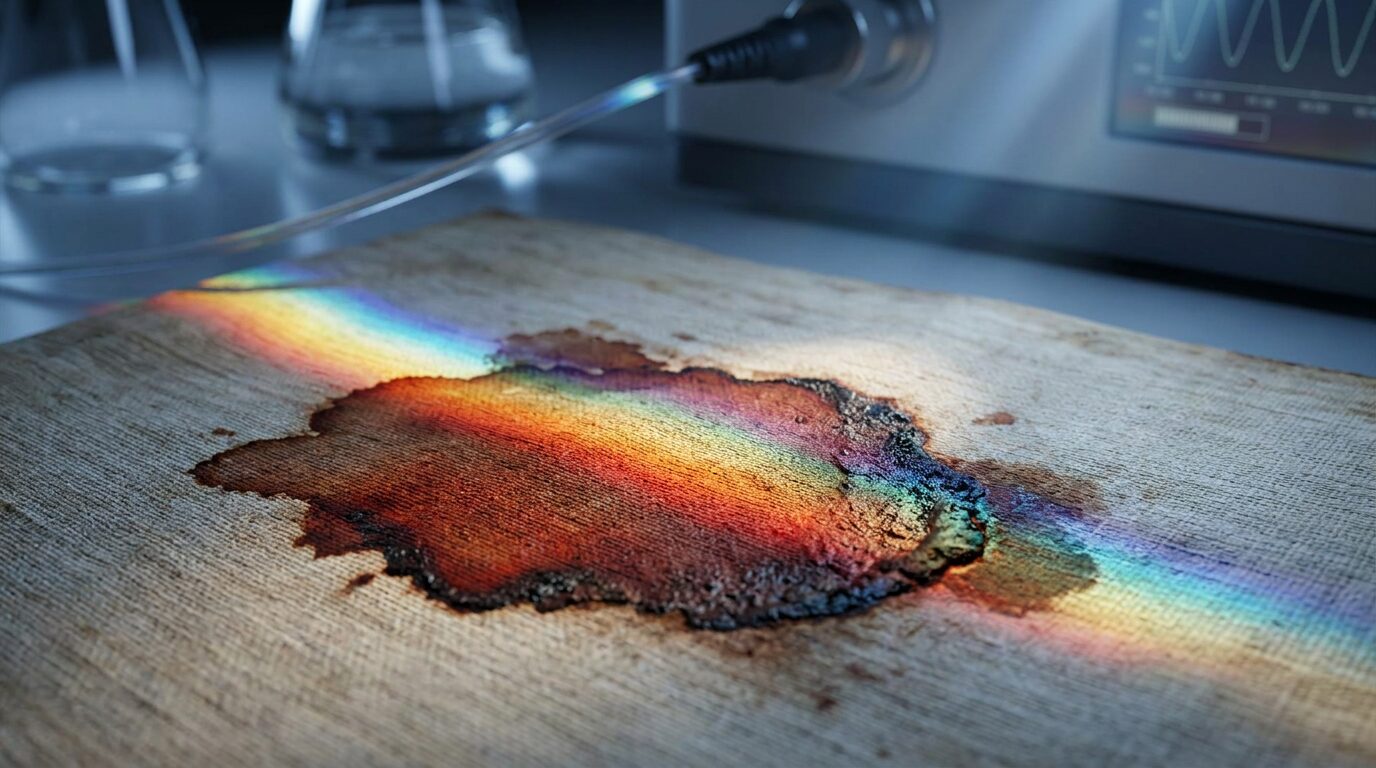
The color tells you something, even if you don't know the language. Fresh blood is a vivid oxblood red, almost startling in its brightness. Leave it to dry for hours and it begins to brown. Wait days and it deepens toward a rusty mahogany. A week or more and it can look nearly black, a dark crust with little obvious relationship to what it once was. This color shift isn't random, and it isn't just drying. It's a directed chemical sequence, driven by the oxidation of hemoglobin, the protein that carries oxygen through the bloodstream. Upon exiting the body, bloodstains transit from bright red to dark brown — attributed to the oxidation of oxy-hemoglobin to met-hemoglobin and hemichrome. Each of those compounds absorbs and reflects light at slightly different wavelengths, which means that a dried bloodstain, looked at with the right instrument, is broadcasting the time of its own deposition — a molecular timestamp hiding in plain sight.
For decades, forensic investigators could observe this progression but not reliably quantify it. The naked eye sees "old" or "fresh." Courts need more than that. What's changed in the last several years is the application of vibrational spectroscopy — particularly attenuated total reflectance Fourier transform infrared spectroscopy, or ATR-FTIR[3], and near-infrared reflectance (NIR) spectroscopy — to the problem of bloodstain dating. These techniques work by bouncing specific wavelengths of light off a sample and reading exactly which frequencies are absorbed. Because different molecules absorb different frequencies, the result is something like a fingerprint of a stain's chemical composition. ATR FT-IR spectroscopy provides a detailed molecular fingerprint that can be analyzed to determine how the blood's composition changes over time. Run that fingerprint through the right statistical model, and you get an estimate of age. Not a guess — a prediction with measurable error.
This matters enormously, because the gap it fills has quietly distorted crime-scene timelines for generations. Knowing whose blood was found has long been tractable — first by blood typing, then by DNA profiling (and the genealogical databases that extended DNA's reach into previously unsolvable cases). Knowing when that blood was deposited has remained, until very recently, largely a matter of impression and educated guesswork.
The Chemistry of Aging Blood
To understand why spectroscopy works here, you have to understand what happens to hemoglobin after blood leaves the body. Inside a living circulatory system, hemoglobin is a tightly managed molecule. Only about 1% of oxy-hemoglobin auto-oxidizes into met-hemoglobin inside a healthy body, and the reductase protein cytochrome b5 continuously converts it back. Outside the body, blood saturates immediately with atmospheric oxygen — but cytochrome b5 is no longer available to reverse the conversion of oxy-hemoglobin to met-hemoglobin. The reduction machinery shuts down, and oxidation runs unchecked. Met-hemoglobin then denatures into hemichrome, as amino acids — primarily histidine — covalently bind to the central iron atoms, rendering the heme group completely inactive. This conversion to hemichrome occurs slowly, with rates dependent on external factors such as humidity.
This oxidation cascade is not chaotic. Research has found that the chemical composition of a bloodstain with age — the hemoglobin reaction kinetics — under controlled circumstances shows a distinct time-dependent behavior, with a unique combination of the three hemoglobin derivatives at each moment in time. Oxy-hemoglobin, met-hemoglobin, and hemichrome are present in ratios that shift predictably. Map those ratios and you map the stain's age. The complication — the reason this has taken so long to become forensically useful — is that temperature and humidity both alter the rate of conversion. While the oxidation of oxyhemoglobin is humidity-independent, the transition from methemoglobin to hemichrome is humidity-dependent, with higher humidity leading to more methemoglobin formation. Environmental variables don't invalidate the clock; they mean investigators must account for conditions when calibrating it.
What the Instruments Can Now Do
The spectroscopic approaches work differently depending on which part of the light spectrum they exploit, but their logic is the same: shine light, read the absorption profile, compare it against a trained reference model, and produce a time estimate. NIR spectroscopy, which operates in the 700–2500 nanometer range, was among the earlier methods validated for this purpose. Using NIR reflectance spectroscopy, bloodstains can be distinguished from other substances with 100% sensitivity and 100% specificity[4], and their ages can be estimated non-destructively. A bloodstain aged over a period of one month at ambient temperatures undergoes detectable spectral changes. Water loss is the major contributor to change during the first hour of aging; after that, characteristic bands due to proteins appear in the 1800–2500 nm region, and a new band appears that can be used for predicting stain age.
ATR-FTIR spectroscopy — which uses an infrared beam to probe molecular vibrations at a crystal surface — has since shown comparable or stronger performance, particularly for longer aging windows. ATR-FTIR combined with advanced chemometric methods was used to determine the age of indoor and outdoor bloodstains up to 107 days, with the bloodstain storage conditions mimicking crime scene scenarios as closely as possible. Two partial least squares regression models exhibited good performance for external validation, with high R² values of 0.94 and 0.96[3] for indoor and outdoor conditions, respectively. A study by researchers at the University of Murcia pushed this further still: analyzing 960 bloodstains on various surfaces[2] both indoors and outdoors to develop predictive models, over a period of 212 days, focusing on white cotton fabric, cellulose paper, filter paper, and glass. These aren't narrow laboratory conditions — they represent the material landscape of a real crime scene. And the models built from them are designed to hold up when the stain is on something other than a pristine white tile.
Research from the Institute of Forensic Science in Chandigarh developed models for age estimation using bloodstains aged from 1 to 175 days. Multiple linear regression and partial least squares regression models showed excellent age estimation on unknown bloodstain samples, with errors of approximately 3 and 4 days[1] respectively — reported as the lowest errors achieved so far. That margin, a few days over a multi-month window, is the kind of precision that can shift an alibi from plausible to broken, or save an innocent person from a timeline that never fit them. Crucially, conventional bloodstain analyses are often labor-intensive and can alter or destroy the evidence, limiting subsequent tests. The shift to non-destructive testing methods offers rapid bloodstain dating without compromising the integrity of the sample for further analyses. That matters: a stain aged by a spectrometer can still yield DNA afterward.
“A few days of margin over a multi-month window is the kind of precision that can shift an alibi from plausible to broken — or save an innocent person from a timeline that never fit them.”
The Problem These Tools Are Being Built to Solve
The forensic stakes are not hypothetical. Blood evidence has shaped verdicts — sometimes badly — for as long as courts have admitted it. Bloodstain pattern analysis rests on the belief that blood drops, spatters, and trails are repositories of information that can reverse-engineer crimes. Many practitioners are law enforcement officers, not scientists — but their testimony lends a sense of scientific certainty to circumstantial cases, and it can be a powerful tool in the hands of prosecutors. The problem is that "pattern analysis" has historically been as much interpretive art as it is science, leaving enormous room for examiner bias. It tells investigators something about trajectory and force. It has never had a reliable answer to the simplest question of all: when?
That gap has real human costs. A bloodstain present at a scene might have been deposited days before a crime. It might have been deposited during the crime itself. These are not equivalent facts, but without a method for dating the stain, the distinction has often collapsed in the courtroom — leaving the physical presence of blood to imply simultaneity that no one could actually prove. The broader forensic reliability crisis is documented: a study examining 732 wrongful convictions classified by the National Registry of Exonerations as involving "False or Misleading Forensic Evidence" found that forensic error contributed to outcomes across more than 1,300 forensic examinations. As forensic labs continue to face systemic pressure, the push toward methods with quantifiable, reproducible error rates is not just scientific progress — it's a structural correction.
Limits, Variables, and What Comes Next
Even with all of the approaches implemented so far, there is currently no single validated method being used by forensic practitioners to determine the time since deposition of bloodstains. That's the honest status report: the science is convincing and maturing rapidly, but it hasn't yet made the journey from peer-reviewed journals into standardized courtroom-ready protocols. The environmental variable problem remains the central challenge. The same stain, laid on concrete in a heated apartment versus on denim left in a cold garage, will age along different curves. A spectroscopic model trained mostly on controlled indoor conditions may misread a stain that spent two weeks in a humid basement. Researchers are building models that account for substrate, temperature, and moisture — but each added variable demands a larger calibration dataset and complicates the uncertainty window presented to a jury.
What is also accelerating this work is the development of portable instrumentation. Spectrometers are being built smaller and smaller while retaining the capabilities of their larger counterparts. Near-infrared, mid-infrared, and Raman spectroscopy devices are all being miniaturized, enabling analysis to be conducted on-site. A handheld spectrometer at the crime scene, reading a stain in place and returning a time estimate before the stain is ever lifted — that is where several research groups are pointing. The goal is a portable optical instrument capable of predicting the age of stains found at crime scenes: a device that would measure optical signals reflected from a stain and use previously determined calibration data to predict its age. Given what the field has accomplished on stationary benchtop instruments, this doesn't sound like science fiction anymore.
“The hardest question blood evidence has ever faced isn't whose — DNA answered that. It's when. And that answer, for the first time, is starting to come.”
There is also a backward-looking dimension to this technology that deserves to be named plainly. If bloodstain dating becomes validated and standardized, it will eventually be applied to archived evidence from cases already decided — cold cases reopened, old evidence re-examined with instruments that didn't exist when the original trial was held. That's exactly what happened when DNA databases began illuminating cases no one expected to solve, and what novel forensic techniques continue to do for evidence preserved in archives. In some of those old cases, the timing of blood deposition was exactly the question the jury couldn't answer — the question that determined the verdict. A stain sitting in an evidence locker, sealed in a plastic bag and forgotten, may still be ticking. It has been recording its own molecular history this whole time, waiting for a spectrometer that speaks its language.
References
- Bloodstain age estimation through infrared spectroscopy and Chemometric models (sciencedirect.com)
Reports multiple linear and partial least squares regression models achieved age estimation errors of approximately 3–4 days, the lowest reported so far. - Estimation of human bloodstains time since deposition using ATR-FTIR spectroscopy and chemometrics in simulated crime conditions (sciencedirect.com)
Analyzed 960 bloodstains on multiple surfaces over 212 days to develop predictive models for real crime-scene material conditions. - Estimation of the age of human bloodstains under the simulated indoor and outdoor crime scene conditions by ATR-FTIR spectroscopy (nature.com)
Shows ATR-FTIR spectroscopy with chemometric methods can date indoor and outdoor bloodstains up to 107 days with R² values of 0.94–0.96. - Identification and age estimation of blood stains on colored backgrounds by near infrared spectroscopy (sciencedirect.com)
Demonstrates NIR reflectance spectroscopy can identify bloodstains with 100% sensitivity and specificity and estimate age non-destructively.
About Aris Thorne
Aris Thorne is a microbiologist who writes about the hidden mechanics of ordinary life: the microbes running your home, the chemistry unfolding in food and water, the physics built into familiar objects, and the biological systems quietly keeping the human body alive. His work follows science from kitchens, bathrooms, dust, soil, and city air into wounds, immune responses, infections, medicines, cells, and other worlds. He is most interested in the moment something familiar stops looking simple and reveals the living machinery underneath.
More like this
Forensic Science Just Recovered Fingerprints From a Fired Bullet. That Changes Everything.
A mild electrical current and a chemical bath just unlocked fingerprints from fired bullet casings — and the implications for cold cases and wrongful convictions are only beginning to surface.
Decomposition Has a Smell for Every Stage — And Science Is Finally Mapping It
The odor rising from a decomposing body isn't a single stench — it's a shifting chemical record written by bacteria, and forensic scientists are learning to read it like a clock.
The DNA Face on the Wanted Poster Might Not Look Like Anyone
DNA phenotyping can predict hair color and ancestry with real precision — but the face shape pinned to a tip line is educated guesswork, and once a rendering goes public, it starts doing work the science never authorized.