Your Houseplants Are Running a Chemistry Lab While You Sleep
Certain houseplants are nearly impossible to kill — and a handful are running surprisingly real biochemical processes that affect the air, microbes, and possibly the mind around them.
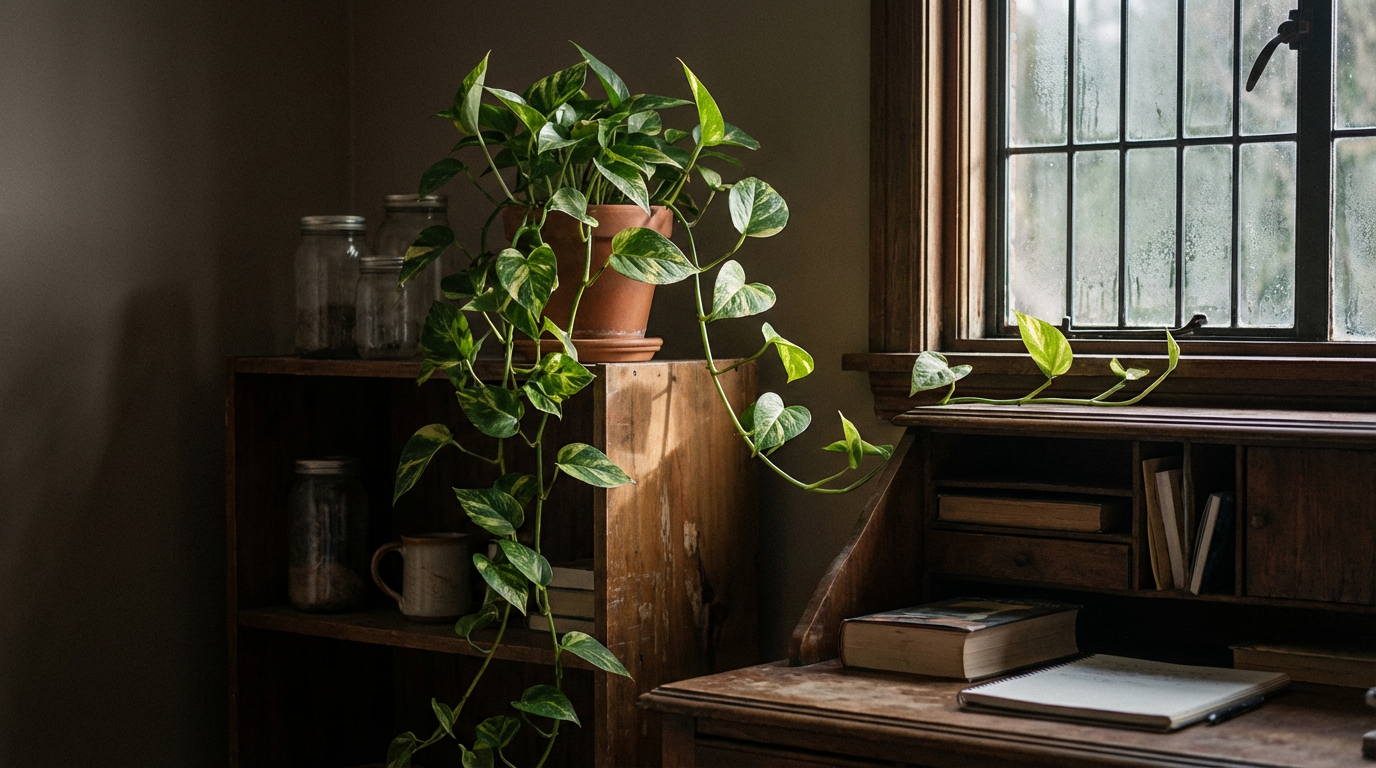
There is a pothos on the shelf above your desk, or there was one, before it got too little water and then too much. Maybe it is still there, improbably alive, its vines trailing toward the window like they know something you do not. Pothos plants have a reputation for surviving neglect that borders on myth, and the reputation is mostly earned. But the interesting question is not just which plants survive the rhythms of ordinary human inattention. It is what any of them are actually doing while they sit there on the sill, looking decorative and vaguely virtuous.
The popular story about houseplants goes something like this: they clean your air, they calm your nervous system, they make you healthier and happier. That story is partly true and partly overbuilt on a single famous NASA study from 1989[1] that tested plants inside sealed chambers — conditions that bear almost no resemblance to a normally ventilated apartment. The truth underneath the hype is more nuanced and, in some ways, more interesting. Some plants are running genuine biochemistry that affects your immediate environment in measurable ways. Others are mostly just alive, which is still worth something, but for different reasons than you might think.
Plants interact with their surroundings through a set of mechanisms that operate continuously and mostly invisibly: transpiration, which releases water vapor from leaf surfaces; gas exchange through tiny pores called stomata; root-zone microbial activity in the soil; and, in some species, the production of secondary compounds — volatile chemicals released into the air as part of stress responses, growth signaling, or defense. These are not metaphors. They are real processes with real chemical outputs. Whether those outputs reach a concentration that meaningfully affects human health in a normally sized room with open windows is a separate, more contested question.
So two honest questions are worth separating: which plants are genuinely easy to keep alive, and which ones have legitimate biological effects worth knowing about? The answers overlap in places and diverge in others. Starting with survival is the right move, because a dead plant is doing none of the above.
The Unkillables: What Makes Certain Plants Survive Neglect
The pothos — Epipremnum aureum — earns its reputation not through toughness exactly, but through metabolic flexibility. It tolerates low light because it can shift its photosynthetic strategy when photon availability drops, extracting energy from light levels that would stop most tropical plants dead. It tolerates irregular watering because its stems and leaves store water with reasonable efficiency, and because its roots are remarkably tolerant of both drying out and brief saturation. What it cannot tolerate is sustained root rot from chronic overwatering, which is actually the most common way to kill plants that are supposed to be unkillable. The pothos does not die from neglect. It dies from kindness, misapplied.
Snake plants — Dracaena trifasciata, recently reclassified from Sansevieria — use a different survival strategy called Crassulacean Acid Metabolism, or CAM photosynthesis. Most plants open their stomata during the day to take in carbon dioxide for photosynthesis, which necessarily costs them water through evaporation. CAM plants reverse this timing. They open their stomata at night, fix carbon dioxide into organic acids for storage, then close up during the day and run their photosynthesis from that stored carbon. It is an elegant trade: lose less water by breathing at night. In practical terms, this means a snake plant in a dry apartment with irregular watering is running exactly the kind of physiology it evolved to run. It is not struggling. It is comfortable.
“A snake plant does not tolerate drought. It was built for it — its whole photosynthetic calendar is designed around not wasting water.”
ZZ plants — Zamioculcas zamiifolia — take storage to an architectural extreme. Their thick rhizomes, the bulb-like structures just beneath the soil, are dense with water and starch reserves. Even if you removed every leaf and left the pot bare on a shelf, the rhizome would still carry enough material to regenerate. The leaves are also coated with a waxy cuticle that dramatically reduces transpirational water loss. In their native habitat of eastern Africa, ZZ plants evolved through seasonal drought cycles that made this kind of biological austerity necessary. Your apartment is almost certainly less extreme than a Tanzanian dry season, which explains why ZZ plants seem to thrive on what amounts to complete indifference.
Spider plants, peace lilies, and cast iron plants — the name alone is a survival claim — round out the reliable tier. Peace lilies are slightly more demanding about humidity and will dramatically droop when thirsty, which turns out to be useful: they communicate distress visibly and recover almost completely once watered, making them forgiving of intermittent neglect as long as you respond to the signal. Cast iron plants grow slowly and want almost nothing, which is the botanical equivalent of a very low metabolic rate — they simply ask less of the world, and the world is happy to oblige.
What Plants Actually Do to the Air Around You
The NASA clean air study tested whether plants could remove volatile organic compounds — VOCs like benzene, formaldehyde, and trichloroethylene — from sealed chamber environments. They could. Pothos, peace lily, snake plant, and several others showed measurable reductions in VOC concentrations over time. But the subsequent question — how many plants would you need in a normal room to achieve similar effects — was answered by later research, and the answer is uncomfortable for plant enthusiasts: somewhere between ten and one thousand plants per square meter of floor space[4], depending on the compound and the ventilation rate. An ordinary apartment ventilates and dilutes pollutants far faster than a small collection of houseplants can sequester them.
This does not mean the air-purification claim is entirely fiction. It means it is conditional. In a low-ventilation space with a meaningful plant density — a room tightly packed with greenery, or a space with poor air circulation — plant-driven VOC removal can become a real factor. More practically, what plants reliably do is add humidity through transpiration. A large-leafed tropical plant like a monstera can transpire hundreds of milliliters of water vapor per day, which in a dry, heated apartment in winter is not nothing. That humidity affects skin, sinuses, and respiratory comfort in ways that are physiologically real and do not require any claims about air purification to justify.
Where the air chemistry gets genuinely interesting is in phytoncides — volatile organic compounds that plants produce as antimicrobial and antifungal defenses. Conifer trees produce them in quantity; that sharp, resinous smell in a pine forest is largely phytoncides in the air. Certain houseplants produce them too, including some species of eucalyptus and lavender, though at lower concentrations than a dense forest understory. Research into forest bathing — shinrin-yoku in Japanese practice — has found correlations between time spent in phytoncide-rich environments and reductions in cortisol levels, blood pressure, and markers of immune activity like natural killer cell counts. Translating this to a pot of lavender on a windowsill requires some epistemic caution. But the mechanism is real, and the direction of the effect seems consistent.
The Soil Is Doing More Than You Think
“The interesting biology of a houseplant is not always in the leaves — some of the most active chemistry is happening in the few centimeters of soil around the roots.”
Potting soil is not inert. A healthy pot of houseplant soil hosts a microbial community — bacteria, fungi, protozoa, and in larger containers, nematodes — that is orders of magnitude denser than the air above it. The root zone, called the rhizosphere, is especially active: plant roots release sugars, amino acids, and other exudates that feed bacteria and fungi, and those microorganisms in turn break down organic matter into forms the plant can absorb. It is a metabolic partnership that has been running for hundreds of millions of years, and it continues on your windowsill.
One bacterium that has attracted serious research attention is Mycobacterium vaccae, a soil-dwelling microbe commonly found in healthy garden and potting soils. Studies in animals have found that exposure to this bacterium — through skin contact or inhalation of soil particles — triggers immune responses that appear to influence serotonin metabolism in the brain[2], reducing stress-related behavior and improving learning performance. The effect in humans is not yet as clearly documented, and the concentrations involved in casual gardening or handling houseplant soil are uncertain. But the finding points toward a genuinely interesting possibility: that part of what people report feeling when they tend plants and handle soil is a mild, microbially-mediated neurochemical effect. Not metaphor. Actual immunological signaling.
This also, incidentally, suggests that the psychological benefit often attributed to houseplant ownership may not be purely cognitive — not only the pleasure of caring for something living, or the visual softness of greenery in a room, but a direct biological channel through the microbiome and immune system that affects mood and stress response. The plants are not just sitting there being pretty. They are hosting chemistry.
Which Plants Have the Strongest Legitimate Claims
Aloe vera is one of the most studied plants in this context, and it earns its reputation more cleanly than most. The clear gel inside its leaves contains compounds including acemannan, a polysaccharide, along with anthraquinones, glucomannans, and a suite of vitamins and minerals. When applied topically, aloe gel measurably accelerates wound healing, reduces transepidermal water loss in burned skin, and exhibits anti-inflammatory activity through inhibition of prostaglandin synthesis — the same general pathway that ibuprofen works on, though through a different mechanism. These are pharmacological effects with good experimental support. Aloe is also nearly unkillable if you do not overwater it; as a succulent, it stores water in the thick flesh of its leaves and wants to dry out completely between waterings. A neglected aloe in a bright window is essentially self-maintaining.
Lavender — Lavandula angustifolia — produces linalool and linalyl acetate as its primary volatile compounds, and both have been studied in pharmacological contexts. Inhalation of linalool has shown anxiolytic effects in animal models[3], and human studies using oral lavender extract have found reductions in anxiety scores with a safety profile that compares reasonably well to low-dose benzodiazepines. Growing lavender indoors is more demanding than growing pothos; it wants bright direct light and excellent drainage, and it will sulk and eventually rot in low light or wet soil. But for a south-facing windowsill, it is manageable, and it is one of the few houseplants where the aromatic effect on the immediate environment has meaningful biochemical grounding rather than wishful thinking.
Peace lily makes an interesting case because it combines genuine survival reliability with the most substantiated VOC-removal data from the NASA work and subsequent replications. It also flowers indoors without artificial intervention, which most houseplants will not do in low-light conditions. The caveat: peace lily is toxic to cats and dogs, containing calcium oxalate crystals that cause oral irritation, excessive drooling, and gastrointestinal distress if ingested. It is not a plant for households with animals who investigate plants with their mouths, which describes most cats. Spider plants, by contrast, are nontoxic, nearly as easy to keep, reproduce enthusiastically by sending out runners with plantlets attached, and were among the NASA performers for formaldehyde removal.
What You Actually Get from a Plant in the Room
“The case for houseplants does not need to be inflated — the real effects are quiet, incremental, and genuine, which is more than can be said for a lot of things people put in their homes.”
There is good evidence, separate from air chemistry, that visual exposure to plants and natural forms reduces physiological stress markers. The mechanism proposed involves the default mode network and attentional restoration — essentially, that natural visual stimuli make fewer demands on directed attention than built environments do, allowing the cognitive systems involved in sustained focus to recover. Studies measuring cortisol, heart rate, and self-reported stress consistently find modest but real reductions associated with plant presence in workspaces and hospital rooms. The effect is not dramatic. It is the kind of thing that compounds quietly over days and weeks rather than arriving like a drug response.
The honest picture, assembled from what the research actually shows, looks like this: houseplants transpire humidity, host microbial communities with plausible neurological effects, produce volatile compounds that have measurable biological activity at sufficient concentration, remove VOCs at rates that matter in low-ventilation high-density conditions, and reliably produce the kind of attentional and aesthetic environment associated with reduced stress. None of these effects is dramatic in isolation. Collectively, they add up to a room that is quietly, incrementally different from a room without them — not cleaner in the headline sense, but chemically and biologically more active in ways that lean toward human benefit.
Start with a pothos if you want something that will survive your worst stretches of inattention. Add a snake plant if you want the CAM photosynthesis running silently at night. Put an aloe somewhere it will get real sun, and actually use the gel when you burn yourself on the oven rack. And if you have a bright south window and no cats with exploratory tendencies, try lavender — not because it will transform your air into something medicinal, but because the linalool it releases into the room is doing something real, something you can smell and that your nervous system is quietly responding to, whether you register it consciously or not. The plant on the sill is not a decoration wearing a health claim. It is a living chemistry system that happens to also look nice, and the two things are not as separate as they appear.
References
- A Study of Interior Landscape Plants for Indoor Air Pollution Abatement (ntrs.nasa.gov)
The 1989 NASA study that tested plants' ability to remove volatile organic compounds in sealed chambers, establishing the foundation for popular houseplant air-purification claims. - Acute Administration of the Nonpathogenic, Saprophytic Bacterium, Mycobacterium vaccae, Induces Activation of Serotonergic Neurons in the Dorsal Raphe Nucleus and Antidepressant-Like Behavior in Association with Mild Hypothermia (pmc.ncbi.nlm.nih.gov)
Shows that Mycobacterium vaccae exposure activates serotonergic neurons in the brain and produces antidepressant-like behavioral effects in mice. - Linalool Odor-Induced Anxiolytic Effects in Mice (pmc.ncbi.nlm.nih.gov)
Demonstrates that linalool odor from lavender produces anxiety-reducing effects in mice through the olfactory system. - Potted plants do not improve indoor air quality: a review and analysis of reported VOC removal efficiencies (nature.com)
Provides the estimate that ten to one thousand plants per square meter are needed to achieve meaningful VOC removal in normally ventilated spaces.
About Aris Thorne
Aris Thorne is a microbiologist who writes about the hidden mechanics of ordinary life: the microbes running your home, the chemistry unfolding in food and water, the physics built into familiar objects, and the biological systems quietly keeping the human body alive. His work follows science from kitchens, bathrooms, dust, soil, and city air into wounds, immune responses, infections, medicines, cells, and other worlds. He is most interested in the moment something familiar stops looking simple and reveals the living machinery underneath.
More like this
The Hidden Physics Inside Your Home That Decides Which Plants Survive
Two identical plants, two different homes, two completely different fates — the answer lives in the light, air, and microbial chemistry you can't see.
Indoor Mold's Real Threat Isn't the Stain — It's the Air Around It
A new method for detecting airborne mycotoxins confirms what the stain on your wall can't tell you: the toxic part already left.
The Slime You Scrubbed Off the Drain Came Back. That's the Point.
New research shows that household cleaning kills the bacteria inside a biofilm while leaving its scaffold intact — which means the colony doesn't die, it just takes a short nap.