The Slime You Scrubbed Off the Drain Came Back. That's the Point.
New research shows that household cleaning kills the bacteria inside a biofilm while leaving its scaffold intact — which means the colony doesn't die, it just takes a short nap.
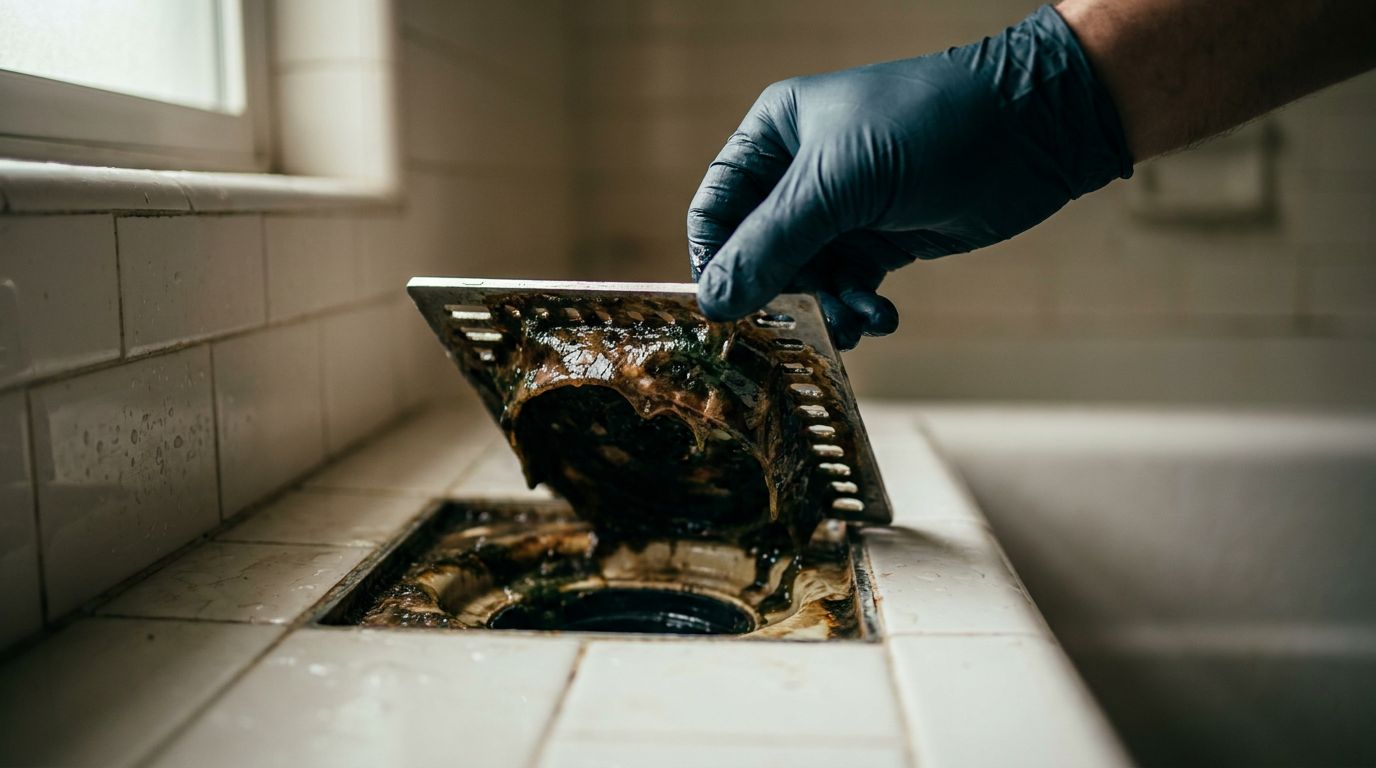
Reach into your shower drain and pull out whatever is caught on the grate. That dark, slick film coating the plastic — the one that feels faintly greasy and smells of damp rot and something you cannot quite name — is not dirt in any ordinary sense. It is not grime carried in on your feet or soap residue that hardened in the heat. It is alive, architecturally sophisticated, and it has been managing your cleaning attempts for longer than you have been paying attention.
That film is a biofilm: a structured microbial community locked inside a self-produced matrix of proteins, polysaccharides, lipids, and extracellular DNA that the organisms manufacture specifically to hold their city together. Biofilms are not random accumulations of individual bacteria. They are organized, layered, chemically coordinated systems with distinct zones, protected interior populations, and enough structural redundancy to survive conditions that would kill the same bacteria floating free in water. Your immune system has a hard time clearing them. Antibiotics have a hard time penetrating them. And, as new 2025 research from the University of Illinois[1] makes newly uncomfortable, your cleaning routine largely cannot clear them either.
The Illinois team's central finding is worth sitting with for a moment. When they killed the bacteria inside a biofilm while leaving its extracellular polymeric scaffold intact — the structural framework the colony had previously built — surviving cells or arriving newcomers could repopulate the architecture within approximately twenty-four hours. The scaffold acted as ready-made infrastructure: channels, anchor points, and protective enclosures already optimized for microbial habitation. Destroy the inhabitants but spare the building, and you have not solved the problem. You have set it a short deadline.
This matters because it describes, almost precisely, what most household cleaning products do. Bleach, most disinfectants, and the mechanical agitation of scrubbing are reasonably effective at killing surface-exposed microbes. They are much less effective at degrading the extracellular polymeric substance — the EPS — that constitutes a biofilm's physical body. Kill the cells, leave the matrix, and you have not removed the biofilm. You have vacated it. The slime that comes back the next day is not a fresh arrival. It is a recolonization of a structure that never left.
What a Biofilm Actually Is (And Why Your Brain Has Been Miscategorizing It)
Most people think of bacterial contamination as a density problem. More bacteria equals dirtier surface, fewer equals cleaner. Biofilms are the reason this model is wrong. A biofilm is not a bacterial population that happened to land in one place. It is a bacterial society that collectively decided to stay, and then built the infrastructure to make staying easy. Formation begins when free-floating planktonic bacteria detect a surface and begin attaching, first loosely, then irreversibly. As the community grows, it secretes its EPS matrix — a gel-like substance made primarily of exopolysaccharides but often including proteins and extracellular DNA — which serves simultaneously as glue, protective armor, and a communication medium through which the colony regulates its own behavior via quorum sensing, the chemical signaling system bacteria use to coordinate gene expression based on population density[2].
“The biofilm is not a mess that accumulated on your drain. It is a structure the drain's microbial residents engineered specifically so they could not be moved.”
Inside a mature biofilm, bacteria in the protected interior zones can be orders of magnitude more resistant to antimicrobials than their planktonic counterparts. The EPS acts as a diffusion barrier, slowing or chemically neutralizing biocides before they penetrate to the colony's core. Some zones within the biofilm are oxygen-depleted, which creates metabolically dormant subpopulations — sometimes called persister cells — that simply do not respond to antibiotics or disinfectants that target active cell processes. Biofilm biology is also the reason why chronic wound infections are so difficult to treat, why hospital-associated infections cluster around catheters and implants, and why the skin-barrier breakdown that allows infection to propagate can be particularly dangerous when biofilm-forming species are involved. The household version is less medically acute but operates on the same principles.
The species you typically find in a shower or kitchen drain biofilm include Pseudomonas, Sphingomonas, Methylobacterium, Candida species, and any number of other organisms that thrive in warm, humid, nutritionally varied environments. Skin cells, hair, soap residue, food particles, and body oils all serve as carbon and nitrogen sources. The biofilm community is rarely uniform: different species colonize different layers, perform different metabolic functions, and collectively produce the sulfurous, amine-tinged odor characteristic of drain smell — a chemical consequence of microbial metabolism producing volatile compounds including hydrogen sulfide, dimethyl disulfide, and short-chain fatty acids.
The Scaffold Problem: Why Killing the Bacteria Is the Easy Part
Here is the mechanistic crux of what the Illinois research illuminates. A biofilm's EPS is not a passive byproduct. It is an active engineering project the colony maintains and continuously updates. But once built, that scaffold has physical durability that extends well beyond the lifetime of the cells that produced it. The polysaccharide chains do not simply dissolve when the cells die. They retain their three-dimensional structure — their channels, their layered architecture, their surface adhesion chemistry. When most common disinfectants contact a biofilm, they penetrate the outermost layers, killing exposed bacteria. The EPS itself is largely unaffected, because chlorine-based disinfectants are far better at disrupting bacterial cell membranes and metabolic enzymes than they are at hydrolyzing complex polysaccharide matrices.
What remains after that chemical assault is an intact furnished habitat. Any bacteria that survived in deep or dormant zones of the original colony are now the seed population. And because the structural scaffold is still there — providing surface chemistry that promotes adhesion, physical channels that support nutrient flow, and protein components that can facilitate gene transfer — that seed population does not need to build from scratch. It reoccupies. Planktonic bacteria arriving from other surfaces in the drain, on your hands, from the water supply, find the scaffold equally welcoming. Research on biofilm resilience and EPS-mediated regrowth has been accumulating for years, but the Illinois team's timeline — functional recolonization in approximately a day — makes concrete just how compressed that window is, and how routinely cleaning schedules miss it.
“Disinfectant kills the tenants but leaves the apartment wired, furnished, and ready for new arrivals.”
The mechanical approach — scrubbing — does somewhat better, but not because it is necessarily more bactericidal. Physical disruption can break the EPS matrix apart and remove chunks of it from the surface, which is categorically different from merely killing cells within it. The problem is that most household scrubbing does not deliver the sustained, abrasive force needed to clear a mature, adhered biofilm from irregular surfaces like drain grates, pipe walls, or the grout lines around a sink basin. Scrubbing the visible surface of a drain grate while leaving the inside of the drain pipe untouched is, biologically, roughly like raking the front step while leaving the interior of the house intact.
The Chemistry of Drain Smell Is a Metabolic Ledger
The odor rising from a drain biofilm is not simply a sign that the biofilm is there. It is a record of what it has been eating. Sulfur-containing compounds, particularly hydrogen sulfide and its organic relatives, come from anaerobic bacteria in the biofilm's oxygen-depleted interior metabolizing sulfur-containing amino acids from hair and skin protein. Trimethylamine and other volatile amines arise from the bacterial breakdown of nitrogen-containing organic matter. Dimethyl disulfide, which has a faint cabbagey-sulfurous character, appears as a metabolic byproduct in several biofilm-forming species. Collectively, these compounds create the layered, swampy unpleasantness that most people recognize as drain smell — and they are produced continuously as long as the biofilm is actively metabolizing.
When you clean a drain and the smell returns within a day or two, it is not because the drain got contaminated again from outside. It is because the biofilm's metabolic processes resumed once its surviving population recovered. The smell is the biofilm working. And because the EPS scaffold accelerates that recovery — because the colony does not have to reconstruct its infrastructure, only repopulate it — the return of the odor is almost perfectly timed to track the recolonization dynamics the Illinois research identified. The smell is the biofilm clocking back in.
What 'Clean' Actually Means When the Scaffold Survives
The Illinois findings are part of a broader reorientation in biofilm research toward targeting the EPS matrix directly, rather than treating the bacteria inside it as the primary problem. Several approaches are under active investigation. Enzymes — particularly DNases, which degrade extracellular DNA, and polysaccharide-degrading enzymes like dispersin B — can break down EPS components and physically disrupt the scaffold in ways that biocides cannot. Studies on enzymatic disruption of biofilm matrix components have shown that this approach can dramatically improve the efficacy of subsequent antibiotic or disinfectant treatment, precisely because it removes the structural protection that allows bacteria to survive chemical assault. Some formulations under development combine an enzyme pre-treatment with a conventional biocide — dissolving the scaffold first, then killing the now-exposed bacteria.
Quorum sensing inhibition is another avenue. Because biofilm formation is triggered and regulated by chemical signaling between bacteria, compounds that interfere with those signals can prevent or disrupt biofilm formation at the organizational level. Some natural compounds — including certain furanones derived from marine algae, and components found in plant extracts — have demonstrated quorum-sensing-inhibitory properties in laboratory settings, though translating this into reliable consumer products has proven complicated. The bacteria, unsurprisingly, are good at adapting.
There is also the physical surface design angle. Research on surface microstructure and biofilm adhesion has established that the texture and chemistry of a material at the microscale has enormous influence over whether and how quickly biofilms establish. Surfaces mimicking the nanotopography of shark skin, for instance, dramatically reduce initial bacterial adhesion, not by being toxic to bacteria but by offering an architecture poorly suited to anchoring. Some next-generation medical device coatings and, increasingly, plumbing materials are being designed with this in mind. The drain itself, not the chemicals poured down it, as the intervention.
“The most durable advance in drain hygiene may not come in a spray bottle — it may come from the surface geometry of the drain itself.”
The Part Where Disgust Is Doing Something Useful
It is worth noting that drain biofilms are not, in most domestic contexts, a significant health risk for healthy people. The organisms typically dominant in shower and kitchen drain biofilms are environmental species rather than primary pathogens, and for immunocompetent adults, routine exposure is not a medical emergency. The exception is in healthcare settings, where biofilm-forming pathogens like Pseudomonas aeruginosa, Staphylococcus aureus, and various Candida species on medical equipment or in water systems do pose genuine clinical risk — which is a large part of why biofilm behavior in clinical environments has attracted so much research funding. Understanding how biofilms survive disinfection in hospitals is not an abstract puzzle. It is a mortality question.
For the rest of us, the Illinois findings reframe what the disgust response to a slimy drain is actually tracking. The revulsion is not irrational theater. It is an evolved signal that there is a persistent, organized biological presence on a surface associated with waste and decay — exactly the category of thing pathogen-avoidance systems were calibrated to flag. The brain does not distinguish between a generally safe household biofilm and a medically dangerous one; it reads the EPS matrix, the odor compounds, the visible film, and correctly identifies the category of thing even if it cannot determine the species. Disgust, as usual, is doing more real biological work than it gets credit for.
What changes, now that the scaffold mechanism is clearer, is what you should actually want from a cleaning intervention. The goal is not to see a clean-looking surface — biofilm-cleared surfaces and scaffold-intact surfaces can look identical immediately after treatment. The goal is to disrupt the EPS, either mechanically or enzymatically, to a degree that forces the colony to rebuild its architecture from nothing rather than simply restaff it. That takes longer. The colony is more vulnerable during that period. The smell stays away longer. The difference between a clean drain and a briefly inconvenienced one is a matter of polymer chemistry, not product scent or surface shine, and no one selling you drain cleaner has historically had much incentive to explain that.
References
- Biofilm comes back: Controlling regrowth by mitigating the cell-matrix interaction (doi.org)
Provides the 2025 University of Illinois study showing biofilm bacteria repopulate intact scaffolds within twenty-four hours after disinfection. - How Quorum Sensing Works (asm.org)
Explains quorum sensing as the chemical signaling system bacteria use to coordinate gene expression based on population density within biofilms.
About Phoebe Lark
Phoebe Lark writes about the biology and chemistry your body and home would rather you didn't examine too closely — odors, fluids, microbes, parasites, infestations, and the quietly industrious rot happening on and around you right now. She follows disgust down to the mechanism underneath, where the gross thing almost always turns out to be a system doing exactly what it evolved to do.
More like this
Your House Dust Is a Microbial City. Your Cleaning Products Are Reshaping It.
The chemicals in your cleaning products don't kill your home's microbial community — they reorganize it, and the survivors are keeping score.
Decomposition Has a Smell for Every Stage — And Science Is Finally Mapping It
The odor rising from a decomposing body isn't a single stench — it's a shifting chemical record written by bacteria, and forensic scientists are learning to read it like a clock.
Your Gym Clothes Smell Worse the More You Wash Them — Here's the Chemistry
Synthetic athletic fabric doesn't just trap body odor — it selectively breeds the bacteria responsible for it, turning every wash cycle into a missed opportunity.