The Hidden Physics Inside Your Home That Decides Which Plants Survive
Two identical plants, two different homes, two completely different fates — the answer lives in the light, air, and microbial chemistry you can't see.
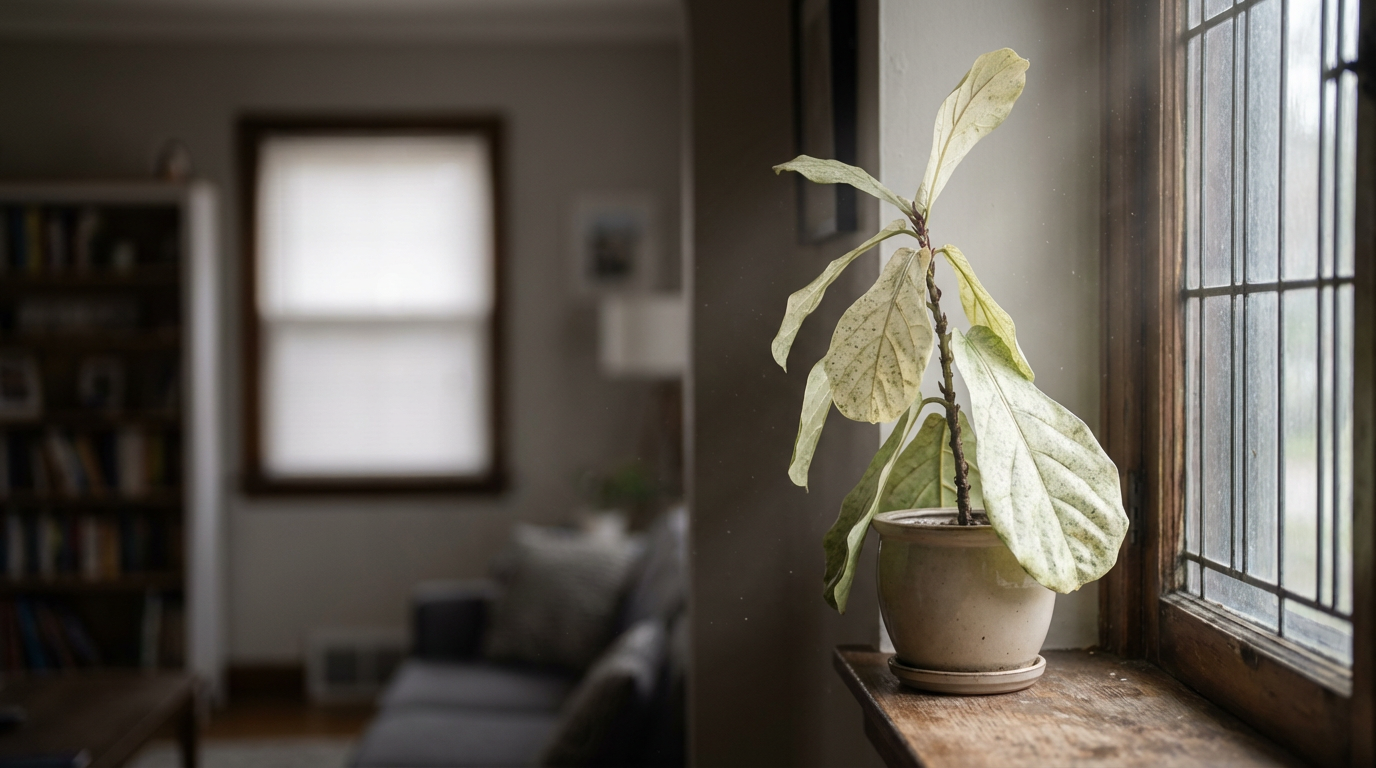
You bought the same plant your friend has. Same species, same pot size, roughly the same spot near a window. Hers is glossy and dense, producing new leaves every few weeks. Yours goes pale and sulks, drops a leaf here and there, and eventually either stalls completely or quietly dies. You followed the same watering schedule. You used the same soil. And yet.
The frustrating part is that the plant is not malfunctioning. It is doing exactly what it evolved to do: reading its environment with extraordinary precision and adjusting its physiology accordingly. The problem is that home environments, even ones that look identical to the naked eye, are wildly different at the level a plant actually experiences — in light quality, humidity gradients, soil chemistry, air movement, root-zone temperature, and the microbial communities living in the potting mix. Two living rooms, separated by a few miles and a different heating system, might as well be different continents from a fiddle-leaf fig's point of view.
Plants sense through their entire bodies. Leaves track light direction and intensity through photoreceptors called phototropins and phytochromes. Roots probe soil moisture and mineral gradients through specialized tip cells. Stomata — the microscopic pores on the underside of leaves — open and close in response to humidity, CO2 concentration, and vapor-pressure deficit, the difference between how much water is in the air and how much the air could theoretically hold. A plant is not a passive decoration. It is a continuous act of environmental measurement, perpetually negotiating with its surroundings.
Understanding why one home works and another doesn't means understanding what plants are actually measuring — and then realizing that most of what they measure, we barely notice at all.
Light Is Not Just Light
When someone says their apartment gets "good light," they usually mean it feels bright in there. But the brightness a human eye registers and the light energy a plant can use for photosynthesis are not the same thing. Human eyes are tuned to perceive roughly 380 to 700 nanometers of the electromagnetic spectrum, centered on green wavelengths around 555 nanometers — which is conveniently where the sun puts most of its visible output. Chlorophyll, the molecule plants use to capture light energy and drive the Calvin cycle, absorbs strongly in the red range around 660 to 700 nanometers and in the blue range around 430 to 450 nanometers. Green light, the color we see most vividly, is largely reflected back — which is why plants look green.
The practical consequence is that a room that feels bright to you might be delivering very little of the wavelengths a plant can actually use. South-facing windows in the Northern Hemisphere admit direct sun, which is spectrally rich across the full range. East- and west-facing windows get direct morning or afternoon light respectively but for fewer hours. North-facing windows admit only indirect, diffuse light — lower intensity and often skewed toward green and yellow wavelengths that chlorophyll cannot absorb efficiently. Add a sheer curtain, and you can cut photosynthetically active radiation (PAR)[3] by 30 to 50 percent without dimming the room enough to notice. Add a few feet of distance from the window, and light intensity drops further still, following an inverse square relationship: double the distance, quarter the light.
It gets more complicated with seasonal variation. A south-facing window that floods the room in winter, when the sun sits low in the sky, becomes far less effective in summer when the sun is high and the direct angle is gone. The plant your friend keeps near her window in Portland, Oregon, where cloud cover is frequent but the angle of light is relatively consistent year-round, may respond very differently than its twin in Phoenix, Arizona, where summer sun is brutal and high, glass-filtered, and may scorch leaves adapted to lower-intensity conditions. Latitude, season, glass type, tinting, and room depth all fold together to create a light environment that has almost nothing to do with how bright the place feels when you walk in.
“A room that feels bright to you might be delivering almost none of the wavelengths a plant can actually use.”
The Humidity Problem Nobody Talks About
Most houseplant care guides mention humidity in a vague, gestural way — mist tropical plants, keep succulents dry, put a pebble tray under your ferns. What they rarely explain is the mechanism driving the problem, which is vapor-pressure deficit, or VPD. This is the gap between the water vapor currently in the air and the maximum water vapor the air could hold at that temperature. Warm air holds more moisture than cool air, so the same absolute humidity feels drier as temperature rises.
When VPD is high — when the air is warm and dry — plants open their stomata to fix carbon dioxide for photosynthesis but lose water vapor rapidly through the same openings. The leaf may be losing water faster than the roots can supply it, triggering a stress response. The plant partially closes its stomata to reduce transpiration, which also reduces photosynthesis, slowing growth. In chronic conditions, leaf edges brown and curl — not from thirst in the way we imagine it, but from a physical water-balance failure at the leaf surface. A home heated by forced-air heating in winter can drop indoor relative humidity to 20 to 30 percent, levels equivalent to some desert climates. A home heated by radiant heat or in a humid climate might stay at 50 to 60 percent. The same Calathea placed in both rooms is living in functionally different biomes.
Air movement compounds the effect. A vent blowing heated air across a plant accelerates evaporation from the leaf surface, driving VPD higher and stressing the plant even if the room's average humidity seems adequate. Conversely, still, humid air around a plant's canopy creates a slightly more favorable microclimate. This is why grouping plants together can genuinely help — their collective transpiration raises local humidity in the air between them. It is not folk wisdom. It is basic fluid dynamics meeting plant physiology.
What Lives in the Pot
Potting mix is not just a substrate. It is a habitat, and what lives in it matters enormously to what the plant above it can do. Fresh, sterile commercial potting mixes start with a defined texture — usually a blend of peat moss or coco coir for water retention, perlite or bark for aeration, and sometimes a slow-release fertilizer charge. But within weeks of being placed in a home environment, that mix begins to be colonized. Fungal spores and bacteria settle in from the air, from the water, from the gardener's hands. The microbial community that develops — and whether it is beneficial, neutral, or suppressive to root health — depends on factors specific to that home: the mineral content of the tap water, how often the soil dries between waterings, what other plants are nearby, and whether the pot sits in a drafty or still location.
“Potting mix is not just a substrate. It is a habitat, and what lives in it decides as much about the plant's health as anything above the soil line.”
Mycorrhizal fungi are among the most important potential residents. These fungi form a physical alliance with plant roots — threading their hyphae through root cells and extending far beyond the root zone into the soil, dramatically expanding the effective surface area available for mineral and water uptake. In exchange, the plant feeds them photosynthate, essentially sugar. The relationship is ancient, with fossil evidence stretching back around 400 million years[1], and most terrestrial plants evolved in the presence of these partners. Many commercial potting mixes do not contain them, and establishing a beneficial mycorrhizal community in a pot depends on inoculation — either intentional or by chance — and on maintaining the conditions the fungi need to survive.
Tap water chemistry adds another layer. Chloramine and chlorine, added by municipal water treatment, can suppress certain soil bacteria when they accumulate over time. High mineral content — hard water — gradually deposits calcium and magnesium carbonates into the soil, shifting pH upward toward alkaline conditions that lock out iron, manganese, and other micronutrients even when they are technically present in the mix. A plant's leaves may yellow from iron deficiency not because iron is absent, but because the root-zone pH has made it chemically inaccessible. The same plant, watered with filtered or rain-collected water, in slightly acidic potting mix, would extract iron without difficulty.
Root Zone Temperature and the Physiology of Cold Feet
There is a variable in indoor growing that almost no care guide addresses: the temperature at the pot's base. The air temperature in a room tells you relatively little about what a root system is experiencing. Pots placed on stone or tile floors conduct heat away efficiently — those surfaces are thermal sinks, pulling warmth out through the pot's base and keeping the root zone significantly cooler than the ambient room temperature, sometimes by five to ten degrees. Pots placed on wooden surfaces or plant stands retain heat better. A terracotta pot on a cold concrete windowsill in winter can have a root-zone temperature that qualitatively different from what the thermometer on the wall reads.
This matters because root metabolic processes — nutrient uptake, water absorption[4], the activity of the microbes in the soil — are all temperature-dependent. Many tropical houseplants, which evolved near the equator where soil temperatures stay warm year-round, have root systems that become sluggish and inefficient below about 15 to 18 degrees Celsius. When roots get cold, ion-channel proteins in root cell membranes that facilitate nutrient uptake slow their activity. The plant above ground may look warm and fine, sitting in a heated room, while its root system is functionally underperforming and unable to supply what the leaves are demanding. The result looks like overwatering or nutrient deficiency — limp, yellowing leaves, poor growth — when the actual cause is thermal suppression happening silently in the pot.
The Invisible Variable: Accumulated Stress and Recovery Windows
Individual conditions matter, but plants also carry a cumulative physiological history that shapes how they respond to their current environment. A plant subjected to repeated drought cycles develops abscisic acid signaling patterns[2] that keep stomata more cautiously closed even after watering resumes — a drought memory of sorts, mediated by epigenetic changes in gene expression that persist for weeks. A plant that has experienced root rot caused by Pythium or Phytophthora, two common water-mold pathogens that thrive in waterlogged soil, may have a reduced and damaged root system that limits water and nutrient uptake long after the overwatering stops and the fungal pressure eases. The visible plant looks like it should be recovering. The invisible root architecture is still compromised.
This is why a plant can arrive in a good home and fail anyway — not because the home is wrong, but because the plant was already carrying damage from where it was before. Nursery and garden-center conditions vary enormously, and plants can experience significant stress during shipping, acclimation to commercial greenhouse lighting, or improper storage before sale. The fresh, healthy-looking plant on the shelf may already have a suppressed root microbiome, a stressed stomatal response, or early fungal infection in its soil. Meanwhile, the plant that has lived in the same home for two years has had time to acclimate its physiology to that specific light regime, humidity, watering rhythm, and soil community. The environment hasn't just been accommodating it — it has been shaping it.
“The environment hasn't just been accommodating a thriving plant — it has been slowly sculpting it, conditioning its physiology to fit that exact room.”
Reading Your Home Like a Plant Would
None of this means houseplant success is mysterious or reserved for people with the right natural gifts. It means the variables that actually matter are more specific, and more measurable, than the broad guidance most people operate on. A cheap light meter — or even a smartphone app running on the phone's light sensor — can reveal the actual photosynthetically active radiation reaching a windowsill across different times of day and different seasons. A hygrometer measuring relative humidity and temperature can identify whether your heating system is desiccating the room or keeping it reasonable. You can let tap water sit overnight to off-gas chlorine, or use filtered water, or collect rainwater if you have access to it. You can lift a pot off a cold floor with a simple stand and meaningfully change the root zone temperature without buying anything complicated.
Matching plant to environment honestly — rather than aspirationally — also helps. A sun-starved apartment with dry forced-air heat is not the right home for a moisture-loving Calathea or a light-hungry fruiting fig. But it may be a perfectly adequate home for a ZZ plant, which evolved in seasonally dry East African environments and built a rhizome storage structure specifically to survive long intervals without water or optimal light. That is not a consolation prize. It is ecology: the right organism in the right niche, using its tools well.
The plant on your windowsill is not ornamental in the way a vase is ornamental. It is a living instrument, measuring your home's light spectrum, vapor pressure, soil chemistry, and thermal profile in real time, and converting what it finds into growth, stress, or slow decline. When it fails, it is usually telling you something precise and true about the specific, invisible environment you have built around it — something the room looks nothing like, from where you're standing, but the plant has read exactly right.
References
- An arbuscular mycorrhiza from the 407‐million‐year‐old Windyfield Chert identified through advanced fluorescence and Raman imaging (doi.org)
Provides fossil evidence that mycorrhizal fungi partnerships with plant roots date back approximately 400 million years. - Somatic drought stress memory affects leaf morpho-physiological traits of plants via epigenetic mechanisms and phytohormonal signalling (sciencedirect.com)
Provides scientific basis for understanding how plants physiologically respond to drought stress through hormone signaling mechanisms. - Photosynthetically active radiation (en.wikipedia.org)
Defines photosynthetically active radiation (PAR) as the 400–700 nanometer light spectrum plants use for photosynthesis. - Raising root zone temperature improves plant productivity and metabolites in hydroponic lettuce production (frontiersin.org)
Demonstrates that root zone temperature affects plant nutrient uptake and water absorption in hydroponic systems.
About Aris Thorne
Aris Thorne is a microbiologist who writes about the hidden mechanics of ordinary life: the microbes running your home, the chemistry unfolding in food and water, the physics built into familiar objects, and the biological systems quietly keeping the human body alive. His work follows science from kitchens, bathrooms, dust, soil, and city air into wounds, immune responses, infections, medicines, cells, and other worlds. He is most interested in the moment something familiar stops looking simple and reveals the living machinery underneath.
More like this
Your Houseplants Are Running a Chemistry Lab While You Sleep
Certain houseplants are nearly impossible to kill — and a handful are running surprisingly real biochemical processes that affect the air, microbes, and possibly the mind around them.
The Forest Still Looks Green. That's the Problem.
Research on Southwest US woodlands reveals that trees can lose the hydraulic and carbon reserves that keep them alive long before their canopy shows a single yellow leaf — meaning the forests we think we're watching die may already be past saving.
The Amazon Has a Specific Temperature Limit. Scientists Just Found It.
A new study puts a precise number on the Amazon's tipping point — and what happens just past it rewrites what we thought we knew about rainforest resilience.