When Your Brain Zones Out, It's Secretly Trying to Sleep
New research reveals that the blank moments after a bad night aren't attention failures — they're your brain triggering actual sleep episodes while you're still technically awake.

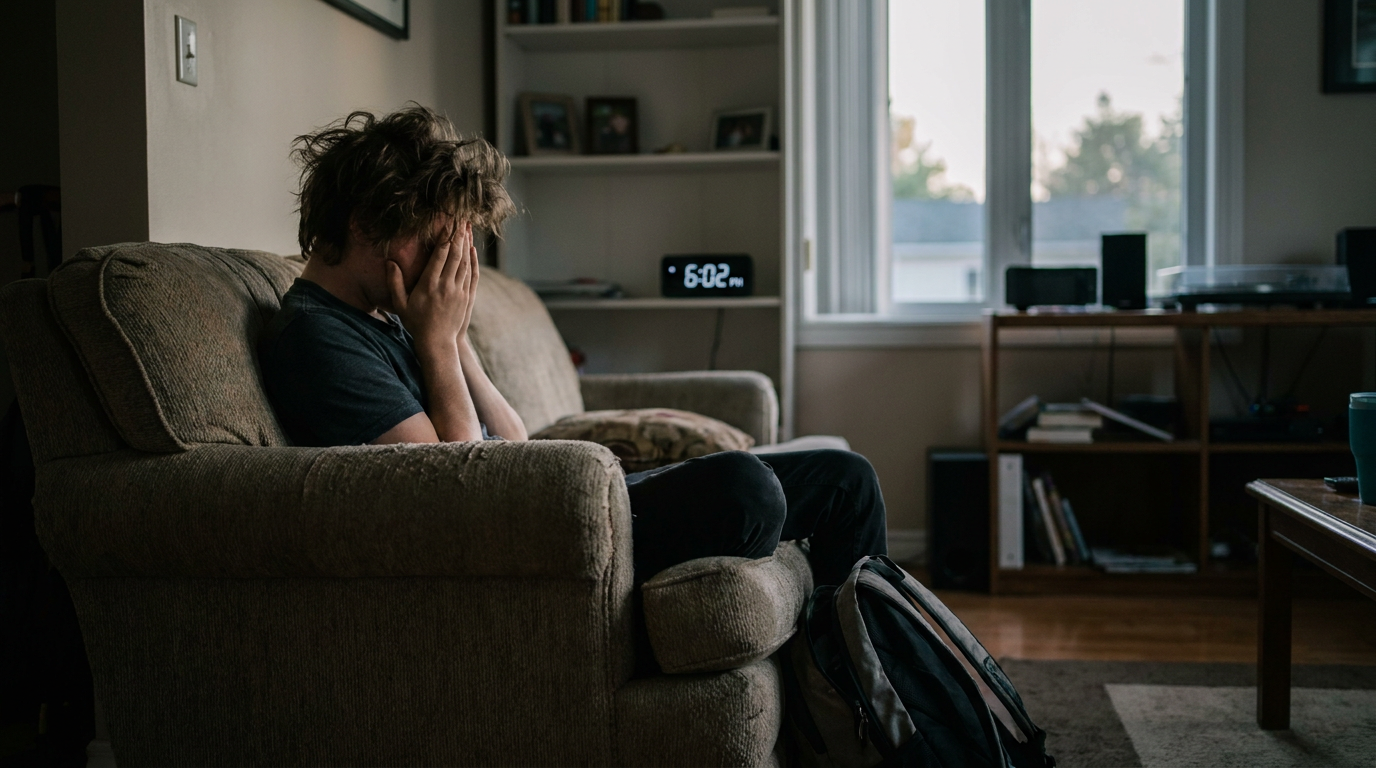
You are reading an email. Then, without any transition you can account for, you are not reading it anymore. The words are still in front of you. Your eyes may still be moving across them. But you are somewhere else — nowhere specific, just absent — and when you land back in the room, you have the strange experience of returning from a place you didn't know you'd gone. You reread the same sentence. You check the time and find that a few seconds have passed, or maybe a few minutes, and the gap sits there in your memory like a missing stair.
Most people file this under tiredness, which is reasonable. You didn't sleep well, you're running low, your focus is slipping. The explanation feels complete enough to move on. But what's actually happening in your brain during those lapses is stranger and more specific than a general dimming of cognitive resources — and a 2025 study from MIT, published in Nature Neuroscience[2], has given the mechanism a shape that is hard to unlearn once you've understood it.
Attention lapses after sleep deprivation, the researchers found, are not random misfires. They are brief, brain-wide episodes that closely resemble sleep itself — complete with the characteristic slow neural rhythms of sleep onset and, critically, pulses of cerebrospinal fluid flushing through the brain in patterns typically seen only during actual sleep. Your brain, under enough pressure from accumulated sleeplessness, begins borrowing moments of sleep mid-wakefulness. It is not asking permission. It is not waiting for a convenient time. It is doing what it apparently needs to do, right in the middle of your afternoon, whether you are aware of it or not.
This reframes something a lot of people experience as a personal failing — the zoning out, the blank stare, the sudden awareness that you have been gone — into a physiological event with a discoverable mechanism. It does not make the lapses less disruptive. It does not make sleep deprivation less dangerous, particularly behind a wheel or in a high-stakes work situation. But it does change what is actually happening, and that matters for how we understand tiredness, attention, and why no amount of concentration or caffeine fully closes the gap when sleep debt gets serious enough.
What Sleep Actually Does to the Brain (That Waking Can't Replicate)
To understand why the brain might stage a covert sleep episode in the middle of wakefulness, it helps to understand what sleep is doing that's so urgent it apparently can't be deferred. Sleep is not passive rest. It is metabolically active, highly organized, and doing things the waking brain cannot do — or at least cannot do at the same scale or efficiency. One of the most significant discoveries of the last decade in neuroscience concerns the glymphatic system[4], a fluid clearance network that runs through the brain and becomes dramatically more active during sleep. Cerebrospinal fluid moves through channels around blood vessels, flushing out metabolic waste products that accumulate during wakefulness — including proteins associated with neurodegenerative disease. The system does not shut down when you're awake, but it operates at a fraction of its sleeping capacity.
During sleep, especially deep slow-wave sleep, neural activity becomes synchronized in large, slow oscillations. These waves have a hydraulic effect: as neurons quiet in rhythmic bursts, blood volume in the brain briefly drops, and cerebrospinal fluid rushes in to fill the space, carrying waste products out with it. It's a cleansing cycle, and it requires the particular choreography of sleeping neural activity to run at full capacity. This is one of the reasons chronic poor sleep is consistently linked to elevated dementia risk — not just because of missed restoration time, but because the clearing mechanism that removes potentially damaging proteins isn't running properly.
“Your brain doesn't drift when you're exhausted — it briefly becomes a sleeping brain, complete with the fluid dynamics to prove it.”
What the MIT research suggests is that when sleep pressure builds high enough, the brain appears to trigger localized or brief global versions of this process mid-wakefulness — the slow oscillations, the fluid dynamics, the neural quiet — almost as if it's running an emergency maintenance cycle it cannot afford to postpone. The result, from the outside, is what looks like a lapse in attention. From the inside, it's the particular experience of having briefly not been there.
Why Zoning Out Feels Different From Just Being Distracted
There is a meaningful subjective difference between distraction and the kind of lapse that happens when you're running on bad sleep, and most people who've experienced both know it intuitively even if they've never had the language for it. Distraction has a trace. You know you were thinking about something else — your attention snagged on a noise, a memory, a worry, and you followed it. The mind-wandering associated with ordinary distraction involves active, if unfocused, cognition. The default mode network, which governs self-referential thought and internal narrative, is busy. You were somewhere, just not where you were supposed to be.
Sleep-deprived lapses feel different. They feel less like wandering and more like a cut in the film — a moment where nothing was happening, followed by the awareness that time passed. People often describe them as a sudden return rather than a drift back. You didn't travel anywhere and come home; you simply weren't, and then you were again. That phenomenological difference — the absence of any mental content during the lapse — is consistent with what the MIT data shows at the neural level. This isn't the brain doing something else. It's the brain briefly doing something sleep-like instead, and sleep-like in this context means a suppression of the alert, information-processing activity that constitutes your moment-to-moment experience of being awake.
This also helps explain something that's frustrating for sleep-deprived people who are trying to push through: the lapses are not reliably controllable through effort. You can fight ordinary distraction by returning your attention to the task, and this works reasonably well because the distracted brain is still active, still responsive to redirecting. But if the lapse is a brief state change — a sudden shift in neural dynamics closer to sleep — then willpower runs into a physiological wall. You can't concentration your way out of your brain temporarily shutting down its waking architecture. You can hold on between lapses, but you cannot reliably prevent them once sleep pressure is high enough.
The Disappearing Feeling Has a Name Now
“Sleep debt doesn't make you foggy — it makes your brain stage unauthorized rest breaks in the middle of your life.”
Researchers who study vigilance and attention have long recognized a phenomenon sometimes called microsleep — very brief episodes, often lasting just a few seconds, where someone who appears awake transitions into a sleep-like neural state. These have been documented in drowsy drivers and shift workers[3] for decades, and they are associated with significant accident risk precisely because the person experiencing one typically has no awareness of it happening. What the MIT findings add is a more detailed picture of the brain-wide mechanism involved, particularly the cerebrospinal fluid dynamics, and they connect it explicitly to the subjective experience of attention lapses that occur in less extreme cases of sleep loss — not just the person who's been awake for 24 hours, but the person who slept six hours instead of eight for a week.
That population is large. A substantial portion of adults in most developed countries are routinely getting less sleep than their biology appears to require, and they are doing so in environments that demand continuous attention — driving, managing complex tasks, making consequential decisions, caring for other people. The lapses they experience tend to get attributed to stress, aging, distraction, or personal discipline problems. Understanding them as a specific neural phenomenon, one that involves the same fluid mechanics the brain uses during actual sleep, doesn't immediately change the practical reality — you still need to sleep more — but it does clarify that the brain is not being vaguely sluggish. It is doing something targeted and identifiable, and the fact that it's doing it mid-wakefulness is a signal worth taking seriously.
Why Caffeine Helps But Can't Fix This
Caffeine works, more or less, by blocking adenosine receptors[1]. Adenosine is a chemical that accumulates in the brain throughout the day and builds sleep pressure — the longer you've been awake, the more adenosine has built up, and the stronger the drive to sleep. Caffeine doesn't eliminate adenosine; it just temporarily prevents it from binding to the receptors that register its accumulating presence. When the caffeine clears, the adenosine is still there, and sleep pressure resumes, often with a noticeable drop in alertness. This is why coffee works and then, later, doesn't, and why the caffeine crash is real rather than psychosomatic.
What caffeine cannot do is replicate or substitute for the processes that sleep actually completes. It can suppress the feeling of sleepiness. It cannot run the glymphatic clearing cycle. It cannot trigger the slow-wave oscillations that appear to be associated with the restorative fluid dynamics in question. So while it will help you feel more alert and may reduce the frequency of lapses by dampening some of the sleep pressure signal, it does not address the underlying deficit. The brain still needs the maintenance window. If it's deprived of it long enough, it appears to start taking it anyway, in pieces, between tasks, in the middle of conversations, while you are reading an email you will have to read again.
There is some irony in this. People often reach for caffeine precisely when lapses are worst — late in a long day, after a string of short nights — and while it provides real, temporary help, it can also mask the severity of the sleep pressure enough that they continue to underestimate it. The lapses don't disappear; they just feel less alarming, which can be its own problem. The brain doing unauthorized sleep episodes while you're driving or operating machinery is not less dangerous because you feel somewhat more awake. It may be more dangerous, because the subjective signal that you need to stop is quieter.
What This Means in Ordinary Terms
“The blank moments aren't you failing to pay attention — they're the brain's maintenance crew showing up without an appointment.”
It's worth sitting with what this research actually says about the everyday experience of being underslept — not the acute, dramatic version where you're nodding off in meetings, but the chronic, low-grade version that most people have normalized. The slowness at the start of a task. The re-reading. The awareness that you finished something but can't quite locate what you thought about while doing it. The conversations where you tracked the first half and then lost the thread without noticing. The feeling of having been present all day while also feeling strangely uninhabited.
These experiences now have a candidate mechanism: the brain is not just running slower, it is periodically switching states, briefly adopting the neural signature of sleep and then returning to wakefulness, over and over, in ways that disrupt continuity of attention and experience. The subjective result is not so much exhaustion — though that's also there — as a kind of intermittent absence. Which is precisely how people tend to describe being chronically sleep-deprived when they try to find words for it. Not tired, exactly. Just not quite there.
Knowing this does not make it easier to get more sleep in a life that is full of competing pressures. It does not solve the infant, the deadline, the anxiety that keeps you awake staring at the ceiling at 3 a.m. But it does change the frame from a vague, personal inadequacy — why can't I focus, why do I keep losing the thread — to a physical process with a discoverable logic. Your brain is not failing. It is doing something quite specific: trying to take care of itself in the only windows it can find, regardless of what you have scheduled, regardless of whether you have given it permission. The disappearances are not random. They are, in their way, the most organized thing your exhausted brain is doing.
References
- Adenosine, caffeine, and performance: from cognitive neuroscience of sleep to sleep pharmacogenetics (pubmed.ncbi.nlm.nih.gov)
Explains caffeine's mechanism of blocking adenosine receptors to affect cognitive performance and sleep-wake regulation. - Attentional failures after sleep deprivation are locked to joint neurovascular, pupil and cerebrospinal fluid flow dynamics (nature.com)
Provides the 2025 MIT study data showing attention lapses after sleep deprivation involve cerebrospinal fluid dynamics and neural patterns resembling sleep onset. - High risk of near-crash driving events following night-shift work (pnas.org)
Documents microsleep episodes in drowsy drivers and shift workers, establishing the long-recognized phenomenon of brief sleep-like states during wakefulness. - This is your brain without sleep (news.mit.edu)
Describes the glymphatic system's role in flushing brain waste during sleep and how cerebrospinal fluid flows during attention lapses in sleep-deprived people.
About Leanne Ward
Leanne Ward writes about burnout, spirals, numbness, avoidance, coping, overload, and the quiet mechanics of getting through the day when your mind is not cooperating. Her work focuses on lived mental health with honesty, nuance, and zero appetite for fake healing slogans.
More like this

What Happens to Your Brain During One Sleepless Night—And Why Recovery Sleep Doesn't Fully Erase It
Brain scans after total sleep deprivation show measurable aging — but the reversal hiding inside one recovery night reveals something stranger about what chronic poor sleep quietly accumulates.

Your Brain Has a Drain, and It Only Opens When You're Asleep
While you're unconscious, a hidden plumbing system floods your brain with fluid and hauls away the toxic waste that builds up while you think — and scientists are only beginning to understand what happens when it can't.
Overstimulation Doesn't Peak When Things Get Loud. It Peaks at 6 PM.
A new study tracked sensory overload across real weeks in real people, and what it found reframes the moment you think you fell apart.