Your Gym Clothes Smell Worse the More You Wash Them — Here's the Chemistry
Synthetic athletic fabric doesn't just trap body odor — it selectively breeds the bacteria responsible for it, turning every wash cycle into a missed opportunity.
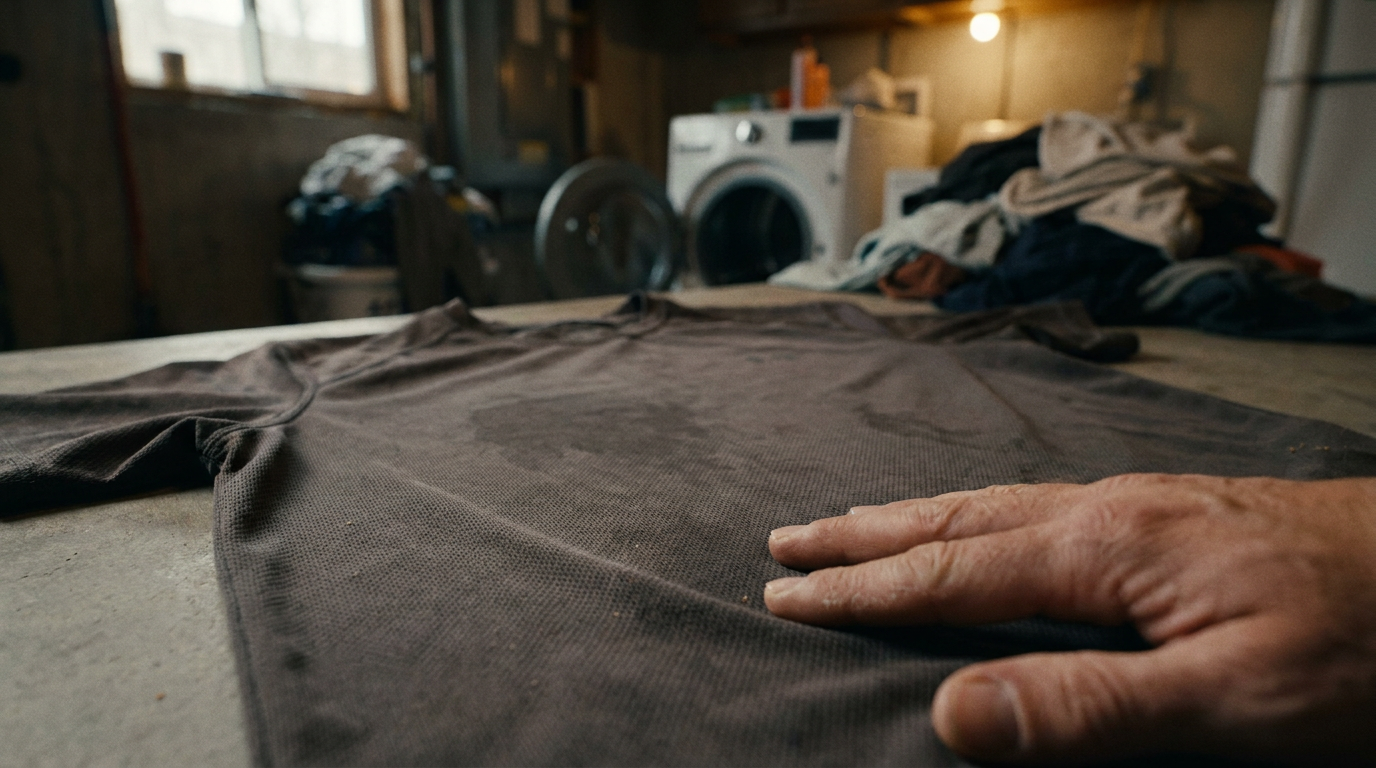
Pull a freshly laundered gym shirt out of the dryer, give it a cautious sniff, and it smells fine — a little laundry-detergent optimistic, maybe even faintly floral. Wear it for twenty minutes of actual effort and something sour and specific comes crawling back out of the fabric. Not new sweat. Something older. A smell that has survived the wash cycle, biding its time in the fibers, waiting for the right conditions to bloom again.
This is not a hygiene failure. You are not doing laundry wrong in any obvious sense. What you are experiencing is a chemistry problem dressed up as a cleanliness problem, and the distinction matters enormously because the solution is completely different. The smell is coming back because it never left — and the reason it never left has to do with the molecular architecture of synthetic fabric, the specific appetites of skin bacteria, and the conditions that ordinary washing machines reliably get wrong.
Athletic wear is almost universally made from polyester, nylon, or polyester-elastane blends, and these materials are genuinely excellent at what they were engineered to do: wick moisture, resist stretch, dry quickly, hold shape across hundreds of wears. They are also, from an odor chemistry standpoint, nearly perfectly designed to trap the compounds that make body odor smell like body odor, shelter the microbes producing those compounds from the mechanical and chemical forces of a standard wash, and then release everything back into the air the moment a warm, damp body slides inside.
Every garment in your sports bag is running a quiet experiment in textile microbiology. The results are not in your favor.
What Body Odor Actually Is
It is worth being precise about what you are smelling, because body odor is not sweat and sweat is not body odor. Eccrine sweat — the kind produced all over your body to regulate temperature — is mostly water with small amounts of salts, lactic acid, and urea. Fresh eccrine sweat smells like almost nothing. Apocrine sweat, produced in the armpits, groin, and a few other high-drama zones, is richer: proteins, lipids, steroids. Still, even apocrine sweat straight from the gland is largely odorless. The smell is metabolic. It is made by bacteria.
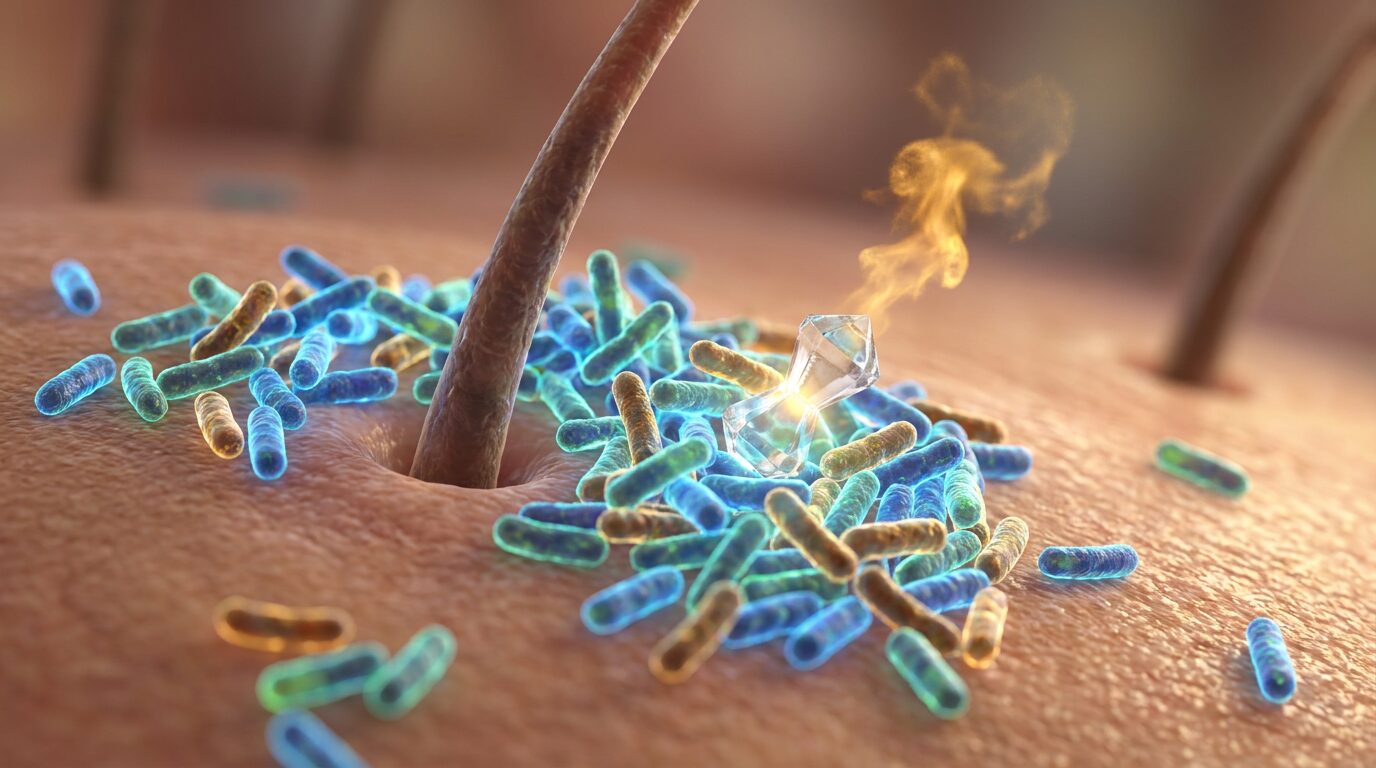
Skin hosts a dense, stable community of microorganisms, and the armpit alone is one of the more interesting ecological niches on the human body — warm, humid, low-light, rich in secretions. The dominant odor producers are Corynebacterium species and Staphylococcus species, along with smaller contributions from Cutibacterium and others depending on the individual. These bacteria digest the proteins and lipids in apocrine sweat, breaking them down into smaller volatile molecules: short-chain fatty acids, sulfur-containing compounds, thioalcohols, steroids. The thioalcohols in particular — compounds like 3-methyl-3-sulfanylhexan-1-ol[3] — are potent at extraordinarily low concentrations. Your nose is a precise instrument for detecting them, because for much of human evolutionary history, detecting the metabolic products of bacterial decomposition near food, water, or wounds was worth caring about.
“The smell that survives your wash cycle was never really a smell — it was a microbial community waiting for you to put the shirt back on.”
The compounds your bacteria produce are not all identical in chemistry, and that difference is central to the laundry problem. Thioalcohols and many of the key odor-active molecules in armpit sweat are non-polar or weakly polar. This matters because water is polar. A standard detergent wash pulls away water-soluble residues efficiently — salts, sugars, some proteins — but non-polar odor compounds have a much stronger affinity for non-polar surfaces. And polyester, as a material built from long hydrocarbon chains, is about as non-polar as fabrics get.
Why Polyester Is Basically a Odor Magnet
Cotton fiber is made of cellulose, a polar, hydrophilic material. It absorbs water readily, which means aqueous detergent solutions can penetrate deeply into the fiber matrix and mobilize what is trapped there. The mechanical action of washing, combined with the surfactants in detergent, does a reasonable job of pulling odor compounds out because the fiber itself is cooperative with the process.
Polyester is built differently. It is a hydrophobic polymer — it resists water rather than absorbing it. During a workout, polyester does not absorb sweat; it moves it along the fiber surface by capillary action, which is precisely why it feels dry against the skin. But that same surface chemistry means that when non-polar volatile compounds land on polyester, they do not sit loosely on the surface. They embed in the fiber matrix. Studies in textile chemistry have shown that polyester binds odor compounds significantly more strongly than cotton[1], and releases them more reluctantly during aqueous washing. Cold water makes this worse. Short cycles make it worse. Overpacking the drum makes it worse. Modern washing machines using low water volumes — efficient by design — make it worse by reducing the dilution and mechanical action that help dislodge bound compounds.
There is also a structural dimension. Synthetic athletic fabrics are engineered with complex microfiber weaves and tight yarn structures that create enormous surface area relative to their volume. That is what makes them so effective at wicking. It is also what gives odor compounds so much fiber surface to bond to, and so many small spaces to hide in where detergent contact is limited. A shirt that is excellent at managing sweat during exercise is, almost by the laws of chemistry, going to be above average at managing odor out of the wash.
The Bacterial Feedback Loop Inside Your Leggings
Here is where it gets more genuinely unsettling. The problem with synthetic athletic wear is not just that it traps odor compounds — it is that it cultivates the specific microbes producing them, and it does so more aggressively than natural fibers.
Several research teams working in textile microbiology have examined which bacterial species preferentially colonize synthetic versus natural fiber athletic wear after exercise. The findings are consistent and a little grim. Polyester and other synthetic fabrics tend to support higher loads of Micrococcaceae[2] — which includes the Micrococcus species that are particularly efficient at producing volatile thioalcohols and other potent odor compounds. Cotton, by comparison, tends to support more diverse communities including higher proportions of Staphylococcus species that produce comparatively milder odor profiles. The material itself is selecting for the smelliest residents.
“Polyester does not just hold odor better than cotton — it preferentially grows the bacteria that are most efficient at producing the worst-smelling compounds.”
Why would fiber type shape bacterial community composition so specifically? The leading explanation involves the surface properties of the fibers again. Synthetic fibers are more hydrophobic, which changes the moisture microenvironment at the fiber surface in ways that favor certain bacterial species. There is also evidence that the sebum — the oily secretion from skin — that embeds in synthetic fibers over repeated wears creates a nutritional reservoir[4] that particularly benefits the bacteria most capable of metabolizing lipids into odor-active volatiles. You wear the shirt, bacteria feast on what the shirt has accumulated, they produce volatile compounds, those compounds embed in the fiber, you wash the shirt inadequately, bacteria survive or recolonize from your skin the next wear, and the cycle reinforces itself.
The washing machine is not breaking this loop. In most cases it is not even interrupting it. Consumer laundry conditions — moderate temperatures, short cycles, standard detergent volumes — leave enough viable bacteria and enough embedded odor substrate in synthetic athletic fabric that the next workout is essentially picking up where the last one left off. After enough cycles of wear and inadequate washing, the fabric develops what researchers in this field call a persistent odor problem: baseline odor even when clean, fast odor re-development during wear, and diminishing returns from additional washing.
The Temperature Problem
Heat kills bacteria and volatilizes bound odor compounds. This is not a secret — it is why hot washes and high-temperature drying work better on odor. The problem is that most athletic wear care labels warn against hot washing and high heat drying, and the warning is not arbitrary. The synthetic fibers, elastane blends, and performance coatings in athletic fabrics degrade with repeated high heat exposure. Elasticity breaks down. Wicking treatments lose effectiveness. The garment becomes less functional while also potentially shrinking. So manufacturers recommend cold or warm washing and low-heat or air drying, which are precisely the conditions least effective at removing entrenched odor.
There are partial workarounds. A dilute white vinegar soak before washing lowers pH and can disrupt some bacterial populations while also helping mobilize some odor compounds from the fiber matrix — the acidity shifts the chemical equilibrium in a direction that aids release. Baking soda added to a wash serves a similar function from the opposite pH direction for different compound classes. Enzyme-based sports detergents are specifically formulated to break down the protein and lipid substrates that bacteria metabolize into odor compounds, which addresses the feedstock rather than just the smell. Longer soaks before washing increase detergent contact time with the fiber matrix. Air drying in direct sunlight adds UV-driven photolysis that genuinely degrades some organic compounds and inhibits some bacteria.
None of these are magic. They are incremental improvements on a chemistry problem that the garment's design actively resists solving. The most effective odor-control strategies for synthetic athletic wear work on the feedstock and the microbial community, not on masking the output. Detergents that smell like lavender are doing nothing to the thioalcohol embedded in your compression tights. They are just adding lavender to the conversation.
What the Garment Industry Knows
The athletic apparel industry is aware of this problem — which is why antimicrobial treatments have been standard across the sportswear sector for years. Silver ions, zinc pyrithione, triclosan, and various proprietary antimicrobial agents have all been incorporated into athletic fabrics, typically by bonding them to fiber surfaces or embedding them in the fiber itself. The mechanism is genuine: silver ions in particular disrupt bacterial cell membranes and inhibit enzymatic activity, and fabrics containing silver-based antimicrobials do show measurably reduced bacterial loads and odor development compared to untreated synthetics.
“Silver-treated fabric smells better not because chemistry is neutralizing the odor — but because it is suppressing the bacteria that manufacture it in the first place.”
The complications are real, though. Antimicrobial treatments wash out over time — typically degrading meaningfully after fifty to one hundred wash cycles, which is fewer than most people assume their athletic gear will last. There are legitimate ecological concerns about silver nanoparticles and other biocides released into wastewater. And there is ongoing research into whether the suppression of skin microbiome-derived bacteria on fabric surfaces has any effects on the broader microbial communities that inhabit skin — the jury is genuinely out on whether routinely sleeping next to, or working out in, antimicrobial-treated fabric has any meaningful effect on skin microbiome composition over time. The industry's solution works, for a while, within limits, with trade-offs that are still being characterized.
The Fabric Is Not Broken — It Is Just Telling the Truth
The more interesting takeaway from all of this is not that your gym kit is failing you. It is that the odor problem is not a defect but a consequence — an emergent property of materials optimized for performance under conditions that happen to also be optimal for bacterial metabolism and odor compound retention. Polyester wicks well because it is hydrophobic. It retains odor for the same reason. Microfiber construction maximizes surface area for moisture management. It maximizes surface area for odor binding by the same geometry. The bacteria producing the smell are doing exactly what bacteria do when you give them warmth, moisture, lipids, and proteins. The washing machine is doing exactly what it was designed to do for cotton clothing developed before high-performance sportswear existed as a category.
The smell that greets you from the gym bag is a system output, not a hygiene failure. It is the convergence of fiber chemistry, bacterial ecology, laundry engineering, and the basic fact that your body is a warm, productive environment for organisms that have been eating human sebum and apocrine secretions for as long as humans have had skin. The gym bag just concentrates the evidence. Understanding why it smells the way it does — mechanistically, specifically, without either panic or false reassurance — is the difference between washing your clothes harder and washing them smarter. The bacteria do not care how much detergent you use. They care about temperature, contact time, and whether you have left them anything to eat.
References
- Biological and Chemical Processes that Lead to Textile Malodour Development (pmc.ncbi.nlm.nih.gov)
Establishes that polyester binds odor compounds significantly more strongly than cotton during washing. - Microbial Odor Profile of Polyester and Cotton Clothes after a Fitness Session (journals.asm.org)
Demonstrates that polyester and synthetic fabrics support higher loads of Micrococcaceae bacteria, which produce particularly potent odor compounds. - Structural basis of malodour precursor transport in the human axilla (elifesciences.org)
Identifies 3-methyl-3-sulfanylhexan-1-ol as a potent thioalcohol odor compound produced by bacterial metabolism in the underarm. - The Bacterial Life Cycle in Textiles is Governed by Fiber Hydrophobicity (journals.asm.org)
Shows that sebum embedded in synthetic fibers creates a nutritional reservoir that benefits bacteria capable of metabolizing lipids into odor-active volatiles.
About Phoebe Lark
Phoebe Lark writes about the biology and chemistry your body and home would rather you didn't examine too closely — odors, fluids, microbes, parasites, infestations, and the quietly industrious rot happening on and around you right now. She follows disgust down to the mechanism underneath, where the gross thing almost always turns out to be a system doing exactly what it evolved to do.
More like this
How One Bacterial Gene Decides Whether You'll Ever Smell
Scientists have now mapped the complete molecular assembly line inside Staphylococcus hominis — and the switch that shuts it off entirely in some people sits not in the bacteria, but in your own DNA.

Your House Dust Is a Microbial City. Your Cleaning Products Are Reshaping It.
The chemicals in your cleaning products don't kill your home's microbial community — they reorganize it, and the survivors are keeping score.

Why Disgusting Smells Outlast Pleasant Ones Every Single Time
The reason a rotting smell colonizes your upholstery while fresh coffee vanishes in minutes has nothing to do with how strong the odor is — it has everything to do with what the molecule actually wants to do.