Florida's Reef Builders Are Functionally Extinct. The Reef Is Still There.
After the 2023 marine heatwave, staghorn and elkhorn corals crossed a threshold scientists call functional extinction — and the reef kept its shape just long enough to hide the damage.
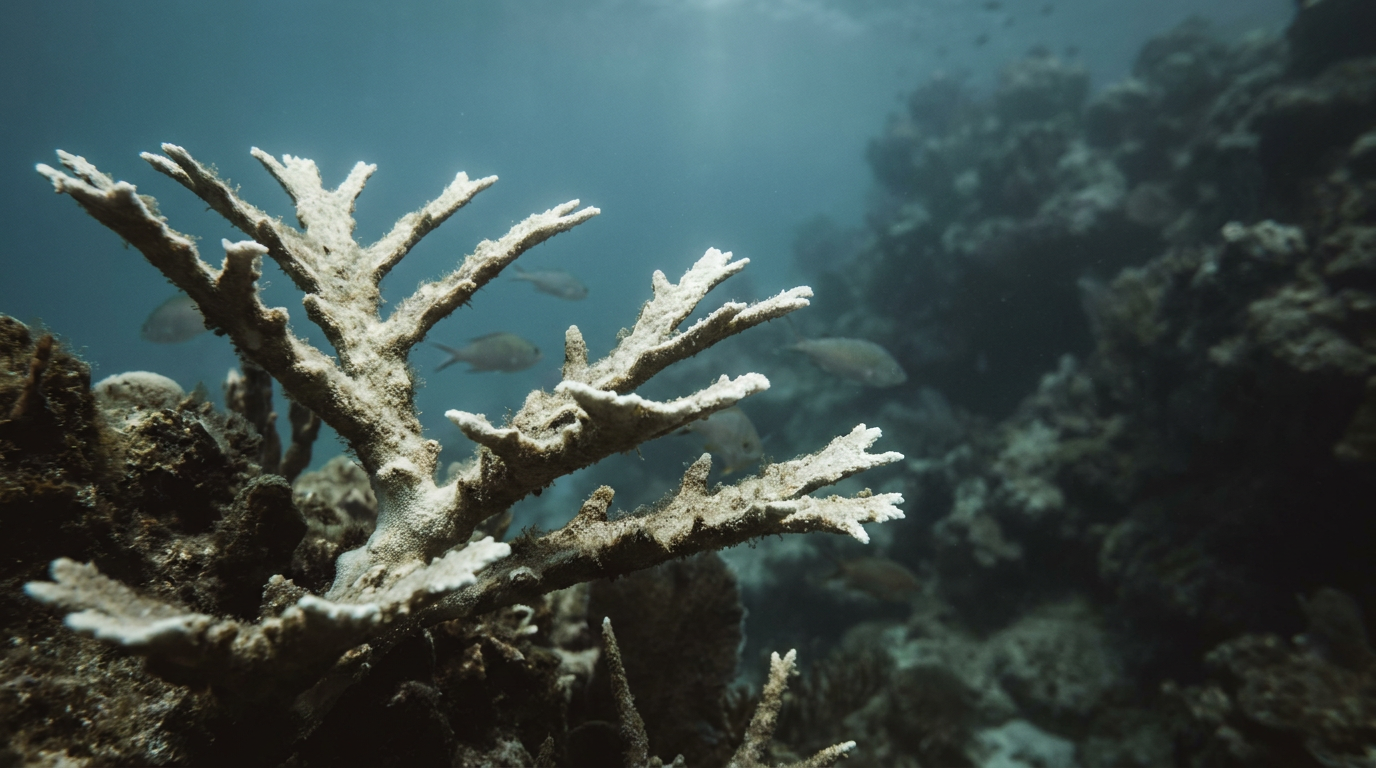
If you had snorkeled Florida's reef tract in the fall of 2023 and didn't know what you were looking at, you might have come back thinking you'd seen a reef. There would have been fish. There would have been structure — branching formations, sloping walls, the general architecture of an underwater ecosystem. Some of that structure might even have been pale in an interesting way, the way bleached wood looks almost beautiful before it rots. What you probably wouldn't have noticed is that you were swimming through something that was becoming a ruin in real time, that the species responsible for building most of what you were seeing had, in ecological terms, just stopped existing.
In 2025, a study published in Science[1] confirmed what coral ecologists had feared since sea surface temperatures in the Florida Keys began shattering records in the summer of 2023. Staghorn coral and elkhorn coral — the two branching Acropora species that once formed the structural backbone of Caribbean reefs and dominated Florida's shallow-water systems for millennia — are now functionally extinct in the wild along Florida's reef tract. Not locally depleted. Not in decline. Functionally extinct, which in ecological language means that the surviving populations are too small, too fragmented, and too isolated from one another to reproduce at rates that would maintain the species' role in the ecosystem. The reef has lost its builders.
The distinction between extinction and functional extinction matters enormously, and it tends to get lost in coverage that reaches for the dramatic over the precise. Individual staghorn and elkhorn corals may still exist — in tanks, in coral nurseries, in the occasional surviving fragment clinging to a rubble field. The species are not gone from the planet. What is gone is their ecological function: the reef-building, the habitat creation, the carbonate accretion that has structured Caribbean and South Florida reefs since the Holocene. The species that shaped this environment for thousands of years is no longer doing the work. The reef it built remains, for now, as a kind of structural memory.
This is the part that should make people stop. Ecological loss is most visible when something disappears entirely — when the forest is gone, the river is dry, the beach is empty. It is far harder to perceive when a system retains its shape while losing the processes that gave it meaning. Florida's reef is still physically present. It still shows up on maps, in dive guides, in promotional tourism materials. It still provides something that looks like habitat. But the Acropora corals that built the reef's branching architecture — that created the complex, three-dimensional structure fish and invertebrates depend on — are no longer part of its living ecology. The reef is holding its shape while the life inside it quietly reorganizes around an absence.
What Staghorn and Elkhorn Actually Did
Staghorn coral and elkhorn coral are not simply pretty features of a reef. They are its primary engineers. In shallow Caribbean and Florida waters, Acropora species historically accounted for the majority of live coral cover and were responsible for the characteristic branching, antler-like architecture that makes tropical reefs so structurally complex. That complexity is not aesthetic. It is functional. The three-dimensional scaffolding created by Acropora branches generates the microhabitats that reef fish use for shelter, spawning, and juvenile development. It creates the hydraulic conditions that move nutrients across the reef. It produces the calcium carbonate structure that allows the reef to grow upward and keep pace with sea level rise — a process called reef accretion that has maintained these ecosystems through past periods of environmental change.
Acropora corals are also fast-growing by coral standards, which made them the dominant reef builders in the first place. Where slower-growing massive corals like brain and star corals take decades to produce significant structure, staghorn and elkhorn could generate substantial reef framework in years. That growth rate also made them more vulnerable — fast-growing tissue requires more energy, which means more dependence on the symbiotic algae called zooxanthellae[3] that live inside coral tissue and provide most of the coral's nutrition through photosynthesis. When water temperatures rise above a coral's thermal tolerance threshold for even a few weeks, those algae are expelled. The coral bleaches, turns white, and without the return of cooler water, it starves.
“The reef is holding its shape while the life inside it quietly reorganizes around an absence.”
Florida's Acropora populations were already in serious trouble before 2023. White band disease swept through[4] Caribbean staghorn and elkhorn populations in the late 1970s and 1980s, reducing their abundance by 90 percent or more across much of their range. Previous bleaching events in 1998, 2005, and 2014 knocked populations back further. By the time the 2023 marine heatwave arrived, Florida's Acropora populations were already operating at the margins of viability — small, fragmented, isolated from one another by degraded habitat and decades of cumulative stress. The 2023 event did not create the crisis. It delivered the final threshold crossing that researchers and managers had been watching approach for years.
The Summer the Ocean Stopped Cooling
In the summer of 2023, sea surface temperatures in the Florida Keys reached levels that had no precedent in the instrumental record. Monitoring buoys in some nearshore areas recorded temperatures above 38 degrees Celsius[2] — warmer than a bathtub, warmer than human body temperature. These were not brief spikes. They were sustained thermal anomalies that lasted weeks, driven by a combination of factors: a strong marine heat wave pattern in the Atlantic, a weak La Niña transition, reduced cloud cover that allowed solar heating to penetrate shallower than normal, and the underlying warming trend that has raised baseline ocean temperatures across the region. The corals had no physiological buffer left. Bleaching began within days. Mortality followed within weeks.
The 2023 event was not just warmer than previous bleaching events. It arrived earlier in the season, before corals had the opportunity to begin their typical late-summer stress period with reserves intact. It was also spatially extensive, covering the entirety of the Florida reef tract from the upper Keys through the Dry Tortugas, leaving few geographic refuges where temperature stress was meaningfully lower. Coral restoration programs that had spent years propagating Acropora fragments in underwater nurseries — and had achieved genuine success in outplanting thousands of coral fragments to restored reef sites — watched those outplanted corals bleach and die alongside wild populations. The restoration pipeline that was intended to help recover the species absorbed the same thermal shock as the patients it was trying to treat.
Functional Extinction as a Concept and a Condition
Functional extinction is an uncomfortable term precisely because it demands more careful thinking than simple extinction does. When a species goes extinct, its absence is eventually legible — the niche goes unfilled, the ecosystem reorganizes, the loss becomes visible over time. Functional extinction occupies a harder-to-read middle state. The species is still technically present in the world. Some individuals survive. Conservation programs may be actively working to protect and propagate them. But the population is no longer large enough, dense enough, or well-distributed enough to sustain its ecological role. The species exists. Its function does not.
“The restoration pipeline that was intended to help recover the species absorbed the same thermal shock as the patients it was trying to treat.”
For corals, the relevant function is reproduction as much as growth. Acropora species reproduce both asexually — through fragmentation, when branches break off and reattach — and sexually, through broadcast spawning events in which corals release eggs and sperm into the water column simultaneously. Sexual reproduction requires that spawning individuals be close enough in space for fertilization to occur, and that population density be sufficient to make those encounters likely. When populations fall below a certain threshold — when surviving colonies are too sparse, too far apart, too small to contribute meaningful gamete loads to the water column — sexual reproduction effectively ceases. The population can no longer replenish itself. It can only age and diminish. That is the condition Florida's staghorn and elkhorn populations have now crossed into.
This has downstream consequences that extend well beyond the corals themselves. Reefs are not static structures. They are in constant biological negotiation between growth and erosion — carbonate produced by living corals and the organisms that bind reef structure, versus carbonate removed by biological erosion from boring sponges, sea urchins, parrotfish, and the physical forces of waves and storm surge. When net carbonate production exceeds erosion, reefs grow. When the balance tips the other way, reefs shrink. The loss of the primary architects of carbonate production in Florida's system doesn't just leave a gap in biodiversity. It shifts the entire accretion budget of the reef toward net erosion. The structure that exists will slowly be dismantled by the same biological and physical forces that healthy reef growth used to outpace.
What Stays After the Builders Leave
A reef without its primary builders doesn't disappear overnight. The existing carbonate skeleton — centuries of accumulated calcium carbonate structure — is physically durable in the short term. Fish species that depend on reef habitat will continue to use it. Slower-growing corals like brain, star, and fire corals will continue to grow in the spaces that Acropora once dominated, though they produce different structural forms and grow orders of magnitude more slowly. The reef will look, to a casual eye, like a reef. What it will increasingly lack is the branching, high-surface-area architecture that generates the most habitat complexity, the most hydraulic diversity, and the most structural relief above the reef surface. The complexity that makes a reef ecologically productive — rather than just physically present — is precisely the complexity that Acropora built.
Over years and decades, bioerosion will begin to win. Storm damage that a healthy reef with active carbonate production would outgrow will instead compound. The structural integrity of the reef will decline incrementally — not dramatically, not in ways that photograph easily, but measurably, in the kind of metrics that reef ecologists track in long-term monitoring plots: decreasing rugosity, loss of vertical relief, reduced overhang, shallowing of interstitial spaces. The habitat will grow simpler. The fish communities that depend on structural complexity — the juvenile snappers hiding in Acropora branches, the reef fish that require the hydraulic shelter of high-relief structure to feed and spawn — will find less of what they need. Abundance will shift. Diversity will thin.
The Repair Problem
Coral restoration in Florida has been one of the more ambitious conservation efforts in American marine ecology — and also one of the more poignant. Programs operated by universities, government agencies, and private organizations spent more than a decade growing Acropora fragments in underwater nurseries and outplanting them to degraded reef sites, with genuine measurable success in some locations. The science of coral gardening advanced significantly during this period, and researchers developed methods for selecting heat-tolerant genotypes, propagating them rapidly, and outplanting them in ways that improved survival rates. Some of those advances survived 2023 and remain the foundation of whatever comes next.
But restoration cannot currently outpace the thermal conditions that destroyed what it was restoring. This is not a failure of the science or the effort — it is a collision between the scale of what restoration can produce and the scale of what marine heat waves can remove. Nursery programs that had outplanted tens of thousands of coral fragments over years watched a single summer reduce that work to rubble. The limiting factor for Florida's reef is not the availability of restoration techniques. It is the trajectory of ocean temperatures. Selective breeding and assisted evolution programs are underway to develop more thermally tolerant Acropora strains, and there is genuine science behind the possibility that some lineages could survive conditions that killed their predecessors. But the window in which that work can be tested is narrowing as baseline ocean temperatures continue to rise.
“The limiting factor for Florida's reef is not the availability of restoration techniques. It is the trajectory of ocean temperatures.”
Reading the Silence in a Reef That Still Looks Whole
There is a particular difficulty in communicating ecological loss when the physical evidence is still standing. A clear-cut forest announces itself. A drained wetland is unmistakable. A reef that has lost its primary builders but retained its calcium carbonate skeleton will, for some time, continue to look like a reef to anyone who doesn't know what they are looking at, or what to measure, or what used to be there. This is the ecological version of a building that has lost its load-bearing structure but hasn't yet fallen — the shape persists while the integrity drains away.
What makes the Florida situation scientifically important beyond its regional tragedy is what it demonstrates about the relationship between climate thresholds and ecological tipping points. The Acropora corals of Florida's reef did not decline gradually in proportion to rising temperatures. They survived — depleted and stressed — through decades of cumulative pressure, then crossed into functional extinction during a single anomalous season. The system absorbed the pressure until it couldn't, and then the threshold arrived not as a slope but as a cliff edge. The reef was impaired for forty years before it lost its builders in a single summer. The loss looked sudden. It wasn't. It was the delayed accounting of every bleaching event, every disease outbreak, every degree of warming that didn't quite kill but weakened a little more, until 2023 arrived and there was nothing left to spend.
References
- Heat-driven functional extinction of Caribbean Acropora corals from Florida’s Coral Reef (science.org)
Provides the 2025 study confirming staghorn and elkhorn corals are functionally extinct in Florida's reef tract after 2023. - Impacts of the 2023 Marine Heatwave in the Florida Keys: Detection and Analysis of a Mass Coral Bleaching Event Using Spaceborne Remote Sensing Imagery (pmc.ncbi.nlm.nih.gov)
Provides the specific temperature measurement of above 38 degrees Celsius recorded in Florida Keys nearshore areas during the 2023 marine heatwave. - What is coral bleaching? (oceanservice.noaa.gov)
Explains that zooxanthellae are symbiotic algae in coral tissue providing nutrition through photosynthesis, supporting the article's mechanism of bleaching. - White Band Disease - Coral Disease & Health Consortium (cdhc.noaa.gov)
Documents white band disease reducing Caribbean staghorn and elkhorn populations by 90 percent in the late 1970s and 1980s.
About Sable Pike
Sable Pike writes about habitat loss, ecosystem strain, species decline, climate disruption, and the quiet unraveling of natural systems people once assumed were permanent — and the way that unraveling reaches into economies, politics, and daily life. Her work brings emotional weight to ecological change without sacrificing scientific rigor.
More like this
The Caribbean Reef That Was Growing Is Now Dissolving
A new study found that the 2023 marine heatwave flipped most Caribbean reefs from growth to erosion years ahead of schedule — and the reefs with the most coral paid the steepest price.
84% of the World's Coral Reefs Burned. Now We're Calling It Over.
The fourth global bleaching event is officially over — but the pause before the next one may already be too short for survival to matter.
The Coral Reef Restoration Plan Can't Keep up. The Math Proves It.
Restoration science has gotten genuinely good at growing coral — which makes the numbers showing it can't possibly save reefs at scale even harder to look at.