84% of the World's Coral Reefs Burned. Now We're Calling It Over.
The fourth global bleaching event is officially over — but the pause before the next one may already be too short for survival to matter.
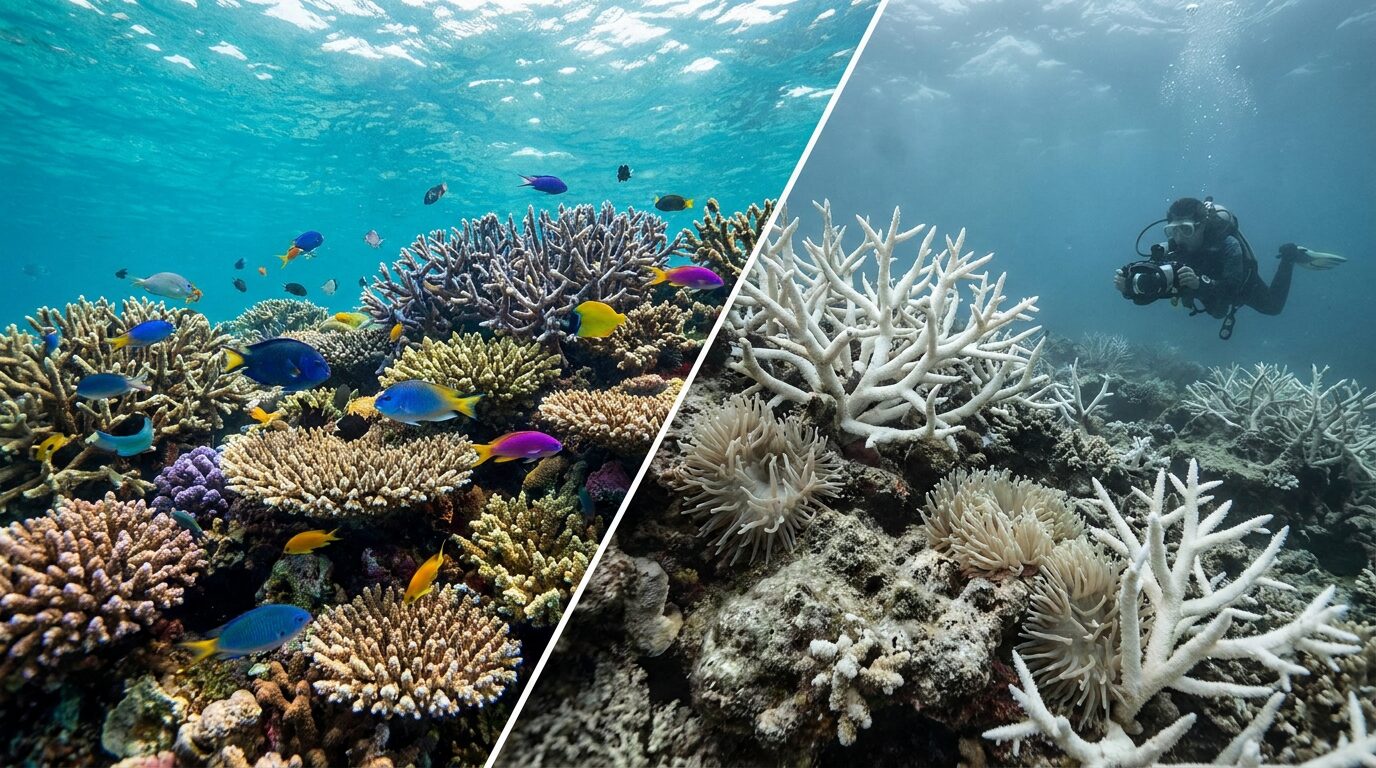
There is a specific cruelty to the word "over." In mid-2025, NOAA's Coral Reef Watch announced[4] that the fourth global coral bleaching event had likely ended — from early 2023 to mid-2025, bleaching-level heat stress impacted 84% of the world's coral reef area[4] in all three coral reef-containing ocean basins: Pacific, Atlantic, and Indian. The previous record, set during the 2014–2017 event, was 68%. Before that, 37%. Before that, 21%. Each successive event has been larger, hotter, and structurally more devastating than the last. And now this one is "over," which sounds like relief, until you understand what over actually means.
It means the heat has eased. It does not mean the reefs have healed. It does not mean the corals that bleached have recovered, or regained their symbiotic algae, or rebuilt the calcium carbonate architecture that fish and invertebrates depend on. It means the ocean thermometer has briefly dropped below the trigger point — and that somewhere on the timeline ahead, it will rise again. "We are now in the era where reefs will bleach on a near-annual basis," said Derek Manzello, coordinator of NOAA's Coral Reef Watch, "which means defining when global events begin and end is becoming increasingly difficult." That sentence contains a more honest account of the situation than any headline about an event ending.
The question scientists have been pressing for years is not whether corals can bleach and survive. Many can, at least once, at least when conditions allow. The question is whether the interval between events has become too short for survival to translate into recovery — and whether a reef that "survived" a bleaching event but has no time to rebuild before the next one is, in any meaningful ecological sense, still a functioning reef.
The Math That Doesn't Work
Coral reefs can recover from bleaching. That has been true, under the right conditions, and it is important not to lose sight of it. But recovery is slow, and it requires time. Full recovery of coral assemblages generally takes from 10 to 15 years for the fastest-growing species, and far longer for the full complement of life histories and morphologies of older assemblages. The branching Acropora corals that form the reef's structural scaffolding — the ones that give it vertical complexity and shelter for hundreds of species — are both the most bleaching-susceptible and among the slowest to return at scale.
Against that biological clock, set the accelerating pace of events. In a landmark 2018 paper in Science, Hughes and colleagues found that tropical reef systems are transitioning to a new era in which the interval between recurrent bouts of coral bleaching is too short for a full recovery of mature assemblages. Analyzing bleaching records at 100 globally distributed reef locations from 1980 to 2016[3], they found that the median return time between pairs of severe bleaching events has diminished steadily since 1980 and is now only [six] years. Six years, against a recovery window that demands ten to fifteen. That gap was already a problem before the fourth global event arrived and ran for two and a half years straight.
And conditions are not getting longer — they are getting shorter. Even the most conservative estimates suggest mass coral bleaching could occur annually on the majority of coral reefs worldwide by 2050, according to NOAA's Coral Reef Watch. By 2080, coral bleaching is likely to start on most reefs in spring, rather than late summer, with year-round bleaching risk anticipated to be high for some low-latitude reefs regardless of global efforts to mitigate greenhouse gases, according to a study published in Science Advances[1]. The window is not just closing. In some places it is already gone.
“Six years to recover. Ten to fifteen years needed. That gap was already a problem before the fourth global event ran for two and a half years straight.”
What Recovery Actually Looks Like
Part of what distorts public understanding of bleaching is the word "recovery" itself. A coral that has regained color is not necessarily a coral that has regained function. When heat drives out the symbiotic algae — the zooxanthellae that supply the coral's primary energy source — the animal is left starving. If temperatures drop quickly enough, the coral can take the algae back in, regain its pigment, and look, from the surface, like nothing happened. But this is where "recovery" can be deceptive. A coral that has regained color might still be operating at reduced performance for months. Its calcification rate is suppressed. Its disease resistance is compromised. Its reproductive output is reduced. It has returned to the frame of a living organism without yet returning to full ecological participation.
Reefs hit by severe bleaching move through a period of sustained instability. After a bleaching event, reefs typically experience energy shortage inside surviving corals, increased disease susceptibility, shifts in symbiont partnerships, and intense competition on the reef surface. Dead coral skeleton begins to erode. Over time, dead coral skeleton breaks down through bioerosion and physical storm damage. The reef surface can shift from complex three-dimensional architecture to flatter rubble fields. That matters because structure is habitat. Lose the structure and you often lose fish diversity, nursery areas, and the reef's ability to buffer waves. The reef may still appear to be there, photographed from a boat. It is not doing what it was doing before.
Research from Brazil's Southwestern Atlantic reefs makes this concrete. Mass bleaching events are growing in duration and intensity, and besides causing extensive mortality, the progressively shorter time between events disrupts the ability of reefs to recover. In a study published in Marine Biology, researchers found that three years after a severe bleaching event, the affected coral assemblages showed no increase in coral cover at either the assemblage or species level. With the anticipated effects of the 2023–24 El Niño in the southern hemisphere, still-unrecovered Southwestern Atlantic reefs now face a substantial challenge. That study was published in 2024. The fourth global event was already underway when it appeared in print.
The Community That Bleaching Leaves Behind
What bleaching selects for, over successive events, is not simply survivor corals. It is a different reef. The heat stress that kills the most susceptible species — those fast-growing, architecturally complex Acropora colonies that dominate high-diversity reefs — tends to spare the more robust, slow-growing, massive forms. After the 2016 bleaching in northwestern Australia, researchers tracking one subtidal site found that the coral community shifted from being dominated by branching Acropora corals with a competitive life history strategy to opportunistic, weedy Pocillopora corals, a shift that likely has implications for the functioning and stress resilience of the resulting community. A Pocillopora-dominant reef is still a reef. It is not the same reef. It supports fewer species, provides less structural complexity, grows more slowly, and may be less capable of sustaining the food web and coastal protection functions that people actually depend on.
This is the subtler form of loss that is hardest to communicate: not the dramatic die-off photographs, but the gradual flattening of ecological character. The reef is present. Its diversity is thinning. Its relationships are shifting. The species that once signaled its health — the staghorn and elkhorn corals that built structure for centuries — are being replaced by whatever can survive long enough to reproduce between heat events. As the Caribbean reef system has been demonstrating for years, the loss of structural architects isn't an aesthetic problem. It reshapes everything that reef once organized.
The Threshold Question
There is a real scientific debate about whether some corals are acclimatizing faster than expected — developing heat tolerance through symbiont switching, through genetic filtering across generations, through physiological plasticity. Increasingly frequent marine heatwaves are devastating coral reefs. Corals that survive these extreme events must rapidly recover if they are to withstand subsequent events, and long-term survival in the face of rising ocean temperatures may hinge on recovery capacity and acclimatory gains in heat tolerance over an individual's lifespan. There is some evidence this is happening. Melanie McField, marine researcher at Healthy Reefs for Healthy People, has stated that the repeated heatwaves responsible for the bleaching event caused more robust species of coral to be impacted, and that the repeated heatwaves would prevent coral recovery — a warning that even the previously resilient are now in the heat's path. Meanwhile, despite the massive scale of the fourth event, not all coral reef areas bleached even when exposed to high ocean temperatures, and scientists are looking into these locations to understand what factors may have contributed to their ability to resist bleaching.
These pockets of resistance matter enormously. They are the places where restoration math has any hope of working, where genetic material for heat-tolerant strains can be preserved, where reef function might persist as a seed for wider recovery if temperatures ever stabilize. But they are refugia, not a rebound. The question of whether coral acclimatization can keep pace with the rate of ocean warming is, at current emissions trajectories, likely answered by the scale of what just happened: 84% of the world's reefs stressed in two and a half years, in all three major ocean basins, simultaneously.
“These pockets of resistance are refugia, not a rebound — seeds of recovery that only matter if temperatures ever stabilize.”
What Comes After "Over"
The expected emergence of El Niño in the next few months will result in increased ocean temperatures that could bring a return to widespread coral bleaching, NOAA noted in the same announcement that declared the fourth event ended. NOAA's four-month coral bleaching outlook already shows a high risk to coral reefs throughout much of the north Pacific Ocean, including Hawaiʻi, as well as Florida and the Caribbean later this summer. The gap between the end of the fourth event and the possible beginning of a fifth is being measured not in years but in months. If that comes to pass, it would test the meaning of "recovery window" entirely — not as a concept to be studied, but as an interval that no longer exists.
"We just may never see the heat stress that causes bleaching dropping below the threshold that triggers a global event. So this may be the last one," marine scientist and former NOAA Coral Reef Watch coordinator Dr. Mark Eakin told PBS. Not the last bleaching event. The last event that science can cleanly call a discrete event — with a beginning, an end, and a space in between for something like recovery to occur. What replaces that is a baseline. A new thermal state in which bleaching is not an emergency but a condition. The reefs that remain will be the ones that can exist within it. And the world those reefs can sustain will be smaller, flatter, and quieter than the one we inherited.
References
- Cumulative risk of future bleaching for the world’s coral reefs (science.org)
Projects that mass coral bleaching could occur annually by 2050 and year-round by 2080 on most reefs worldwide. - No coral recovery three years after a major bleaching event in reefs in the Southwestern Atlantic refugium (link.springer.com)
Documents that three years after severe bleaching in Southwestern Atlantic reefs, coral cover showed no recovery at assemblage or species level. - Spatial and temporal patterns of mass bleaching of corals in the Anthropocene (science.org)
Provides the 2018 landmark study finding median return time between severe bleaching events has diminished to six years since 1980. - World’s Fourth Mass Coral Bleaching Event Likely Ended in 2025 (nesdis.noaa.gov)
Confirms the fourth global bleaching event ended mid-2025, affecting 84% of world's coral reef area across all three ocean basins.
About Sable Pike
Sable Pike writes about habitat loss, ecosystem strain, species decline, climate disruption, and the quiet unraveling of natural systems people once assumed were permanent — and the way that unraveling reaches into economies, politics, and daily life. Her work brings emotional weight to ecological change without sacrificing scientific rigor.
More like this
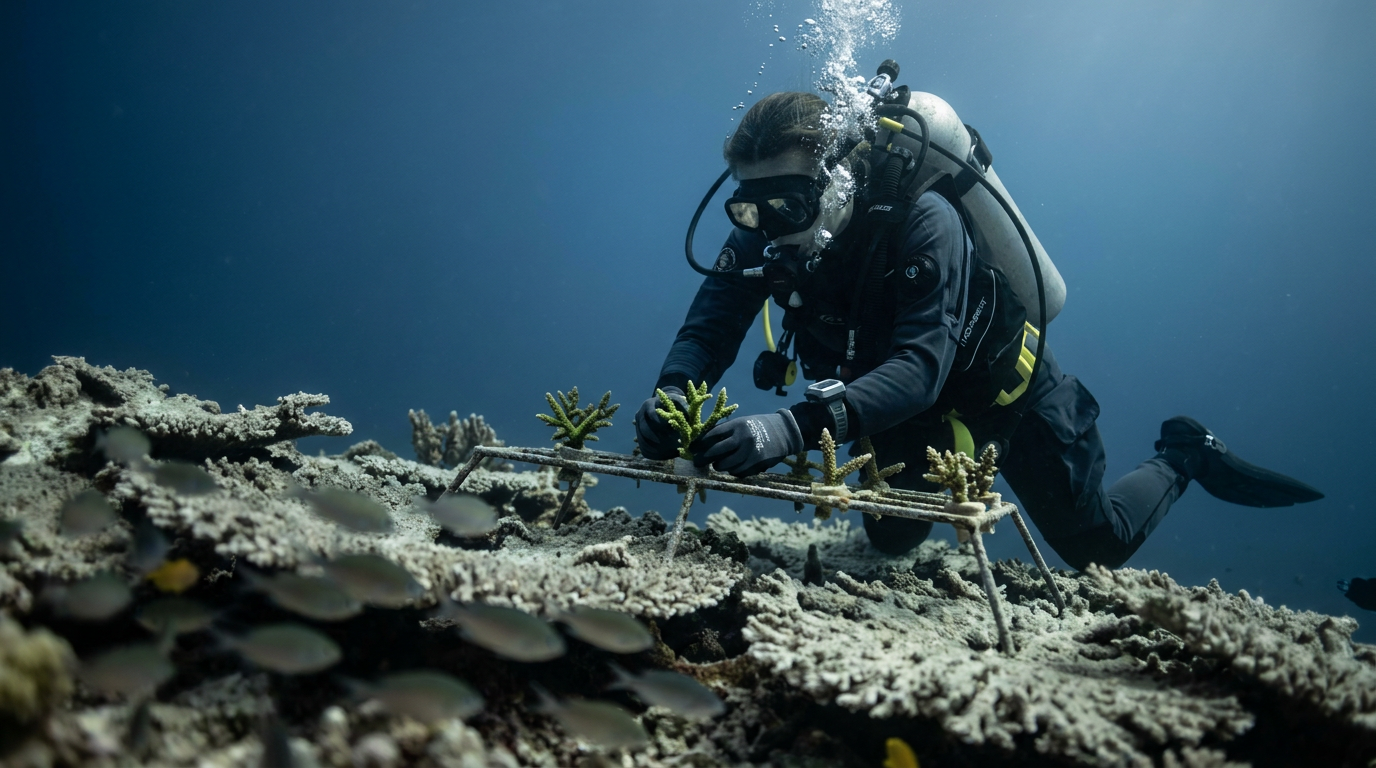
The Coral Reef Restoration Plan Can't Keep up. The Math Proves It.
Restoration science has gotten genuinely good at growing coral — which makes the numbers showing it can't possibly save reefs at scale even harder to look at.
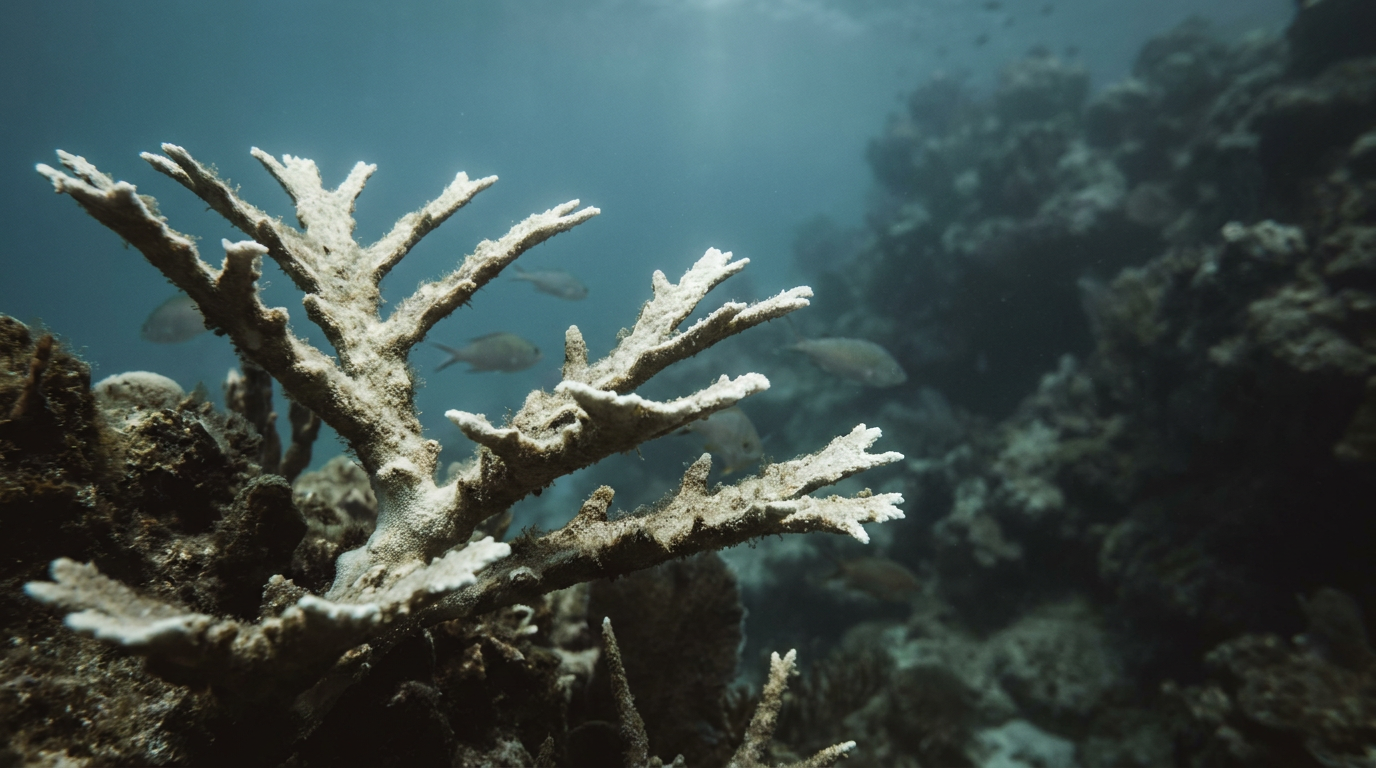
Florida's Reef Builders Are Functionally Extinct. The Reef Is Still There.
After the 2023 marine heatwave, staghorn and elkhorn corals crossed a threshold scientists call functional extinction — and the reef kept its shape just long enough to hide the damage.
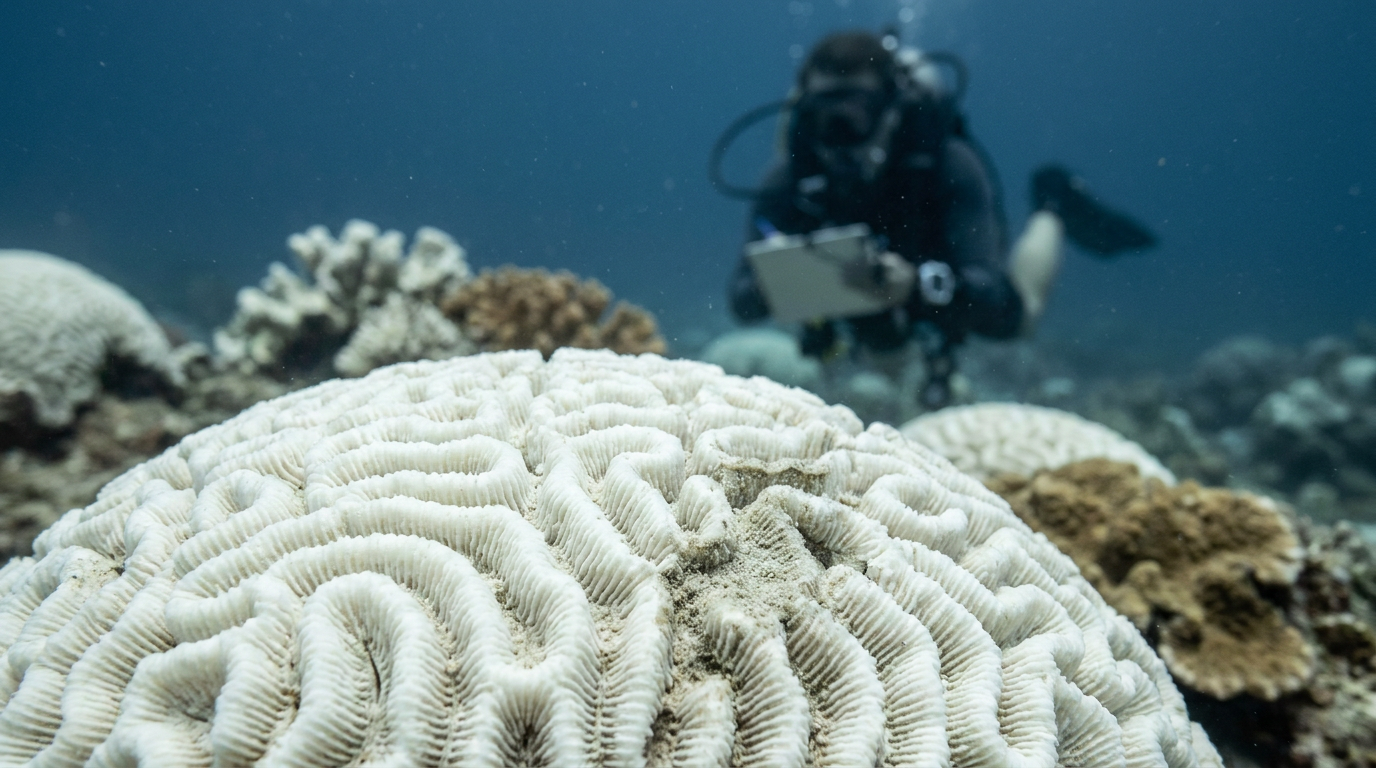
The Caribbean Reef That Was Growing Is Now Dissolving
A new study found that the 2023 marine heatwave flipped most Caribbean reefs from growth to erosion years ahead of schedule — and the reefs with the most coral paid the steepest price.