The Coral Reef Restoration Plan Can't Keep up. The Math Proves It.
Restoration science has gotten genuinely good at growing coral — which makes the numbers showing it can't possibly save reefs at scale even harder to look at.
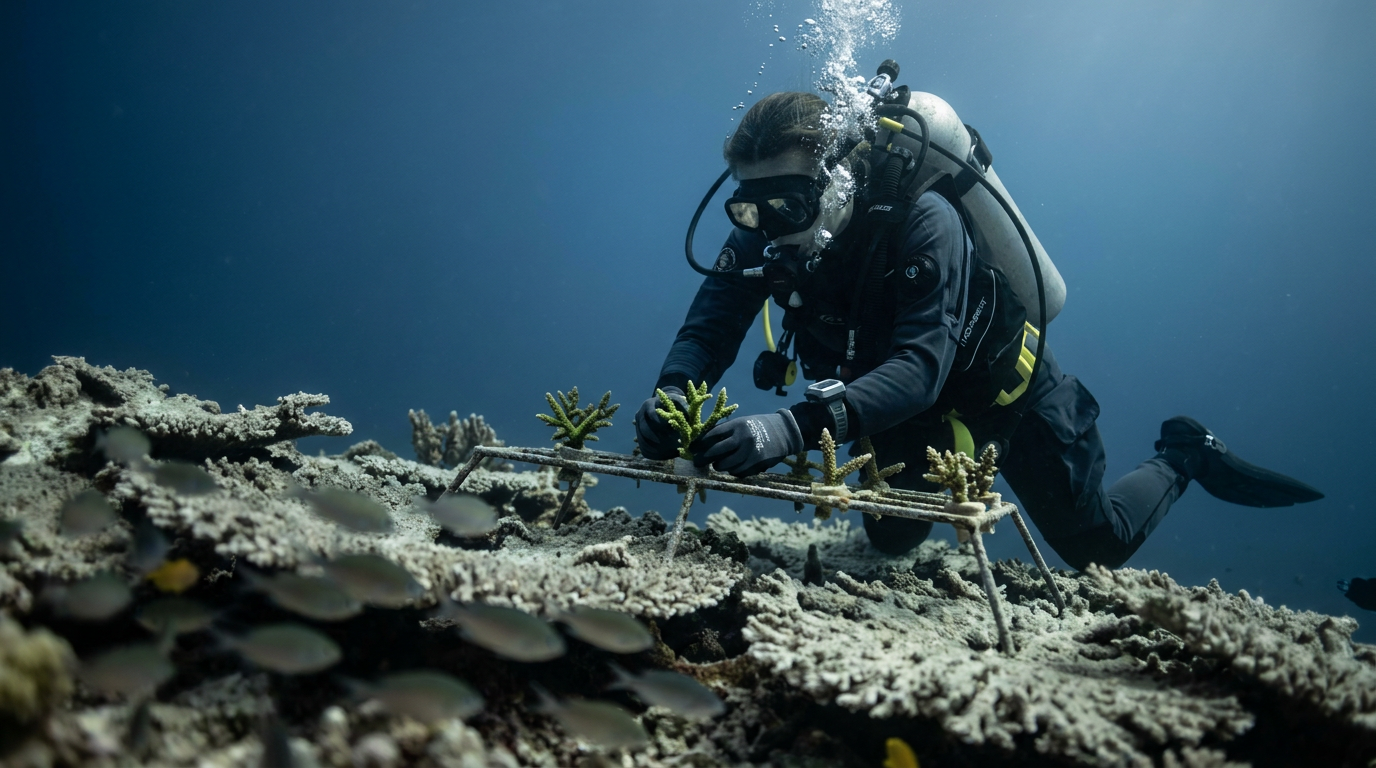
Stand over a healthy coral reef and the first thing you notice is how busy it is. Parrotfish grinding calcium carbonate into white sand. Surgeonfish moving in loose, purposeful schools. Wrasses cleaning parasites from the gills of larger fish that could eat them, and don't. The whole place hums with negotiated relationships, thousands of species locked into routines so finely timed they look choreographed. Then stand over a degraded reef — and what you notice first is the quiet. The structure is still there, the limestone skeletons of what used to live, but the color is gone, bleached white or furred with algae, and the fish have thinned to something approaching absence.
Coral reefs cover less than one percent of the ocean floor. They support roughly a quarter of all marine species[3] at some point in their life cycle. They buffer coastlines from storm surge, generate fishery productivity for hundreds of millions of people, and anchor ecological systems that extend far beyond their physical boundaries. They are also collapsing faster than any serious monitoring program has been able to fully document, and the rate of that collapse is accelerating in ways that have begun to strain even cautious scientific language.
Against this backdrop, coral restoration has grown into a genuine scientific discipline, with nurseries, transplantation protocols, assisted evolution programs, and dedicated field teams working in the Caribbean, the Indo-Pacific, the Red Sea, and the Great Barrier Reef. The work is careful, hard-won, and real. Fragments of heat-tolerant coral are being raised in underwater nurseries, outplanted onto degraded structures, and monitored over years. Some of it survives. Some of it even thrives. The science has improved steadily, and the people doing it are not naive about what they are up against.
But a 2025 analysis published in Nature Ecology & Evolution[2] has put the clearest numbers yet to what many reef ecologists have quietly understood for years: the scale of coral degradation is so catastrophically larger than the scale of any restoration effort that the two curves don't just fail to meet — they aren't really in the same conversation. The paper doesn't argue that restoration is useless. It argues that treating restoration as the primary response to reef loss is a category error, a mismatch between the size of the problem and the size of the tool being applied to it.
What Restoration Actually Does
To understand why the math is so unforgiving, it helps to understand what restoration actually involves. The dominant approach is coral gardening: fragments of living coral are harvested from donor colonies, suspended on tree-like underwater structures where they grow without sediment pressure, then transplanted back onto reef substrate once they reach viable size. The technique has been refined considerably over the past two decades. Growth rates have improved. Survival rates have improved. Programs that once celebrated getting a few hundred corals into the water now measure their outputs in tens of thousands annually.
There are also more experimental approaches. Assisted gene flow involves identifying naturally heat-tolerant coral populations and selectively using their genetic material in nursery stock, attempting to push thermal resilience into the population faster than natural selection can manage alone. Micro-fragmentation, developed largely in aquarium science before migrating to field restoration, accelerates coral growth by cutting fragments to very small sizes and triggering a competitive healing response. Larval seeding bypasses fragmentation entirely, broadcasting fertilized coral larvae directly onto substrate in hopes of establishing new colonies. Each approach has genuine promise. Each has demonstrated real results at the scale of a reef patch.
“The science of growing coral has gotten genuinely good. The ocean is degrading coral faster than the science can answer.”
The problem surfaces when you try to extrapolate from a reef patch to a reef system, and from a reef system to the global reef estate. The Nature Ecology & Evolution analysis did exactly that, modeling the output capacity of restoration programs against documented rates of coral cover loss across major reef regions. The disparity is not marginal. Global coral cover has declined by roughly half since the 1950s[1], with steep acceleration over the past three decades. Bleaching events that once struck every twenty-five to thirty years now return every six[4]. The area of reef experiencing severe thermal stress in any given year has grown dramatically. And the total area of reef that would need active restoration to compensate for ongoing losses runs to millions of hectares — against a global restoration capacity currently measured in hundreds.
The Bleaching Cycle Is the Core Problem
Coral bleaching is not inherently fatal. When water temperature rises above a coral's thermal threshold — usually just one to two degrees Celsius above the local summer maximum, sustained for several weeks — the coral expels the symbiotic algae, called zooxanthellae, that live in its tissue and provide up to ninety percent of its energy through photosynthesis. The coral turns white. If temperatures drop in time, the algae can recolonize and the coral can recover. This happens. It has always happened at some frequency, and reefs have evolved in environments where it occasionally occurs.
What reefs have not evolved for is the current tempo. Recovery from a severe bleaching event takes a minimum of ten to fifteen years under favorable conditions — stable temperatures, low nutrient runoff, reduced storm damage, minimal disease pressure. In that window, coral slowly re-establishes tissue mass, recruits new juvenile corals from the water column, and begins rebuilding the structural complexity that supports fish communities and invertebrate populations. But when the next bleaching event arrives in six years, or four, the reef never gets that window. It is hit while still recovering, or before recovery has meaningfully begun, and the accumulated damage drives coral cover toward thresholds from which the ecological system doesn't easily return.
This is the core pressure that restoration runs into. Outplanted corals, however carefully raised and however well-adapted, are transplanted into an ocean that is warming. The thermal stress that killed or weakened their parent reef is still there, still intensifying. A bleaching event that arrives two years after transplantation doesn't distinguish between nursery-raised coral and wild coral. It applies the same thermal load to both. The heat-tolerance work being done through assisted gene flow may eventually shift that equation, but the timeline for scaling a genetically informed restoration effort is measured in decades, and the timeline of warming is not waiting.
Stressors Don't Queue Politely
Thermal stress is the headline threat, but it interacts with a dense network of other pressures that the analysis also accounts for, and which individually would each be serious problems for reef systems. Nutrient pollution from agricultural runoff and coastal development feeds algae that competes with coral for substrate and light. Sedimentation from eroded land buries juvenile corals and reduces the water clarity that zooxanthellae need for photosynthesis. Overfishing removes the herbivorous fish — parrotfish, surgeonfish, urchins — that graze the algae and keep substrate open for coral recruitment. Ocean acidification, driven by the same atmospheric CO2 loading that is warming the planet, reduces the saturation state of aragonite, the mineral compound corals use to build their skeletons, making calcification slower, more energetically costly, and the resulting structures more fragile.
“Restoration plants coral into an ocean that is still doing everything that killed the reef in the first place.”
These stressors don't queue politely, arriving one at a time for the reef to address in sequence. They compound. A reef already under thermal stress is less resilient to a disease outbreak. A reef weakened by acidification is more vulnerable to storm damage. A reef stripped of its herbivorous fish by overfishing will be colonized by algae that competes with outplanted corals for the same substrate. Restoration programs operating in heavily impacted coastal zones frequently find that survival rates of outplanted coral are dramatically lower than in more pristine or better-protected areas — not because the transplantation technique failed, but because the background conditions in which the coral is expected to survive remain hostile.
This is what makes the restoration math so hard. It isn't only that the volume of degradation exceeds restoration capacity, though it does, by orders of magnitude. It's that restoration capacity is itself reduced by the same conditions driving degradation. You are trying to fill a container that is still draining, and the drain is wider than the pipe you're pouring from.
Where the Work Actually Needs to Happen
The Nature Ecology & Evolution paper is careful not to frame this as a reason to abandon restoration. The authors are explicit: restoration remains valuable. It preserves genetic diversity. It maintains reef structure in areas where thermal stress is lower and local conditions are better managed. It may be essential for bridging reef populations through warming episodes that exceed the tolerance of wild colonies. In smaller, well-chosen locations with strong local protection, outplanting programs can make a real difference to the species composition and functional health of a reef section. None of that is nothing.
But the paper reframes what restoration can and cannot be. It cannot be the mechanism by which reefs are saved at global scale. It cannot compensate for warming oceans. It cannot outpace bleaching cycles that return before recovery is possible. And treating it as the primary solution — which is how restoration is often communicated to the public and, critically, how it sometimes shapes conservation funding priorities — may actually create a dangerous cushion of optimism around a problem that requires much harder interventions to address.
Those interventions live upstream of the reef. Reducing the carbon emissions driving ocean warming and acidification is not a reef-specific intervention, but it is the only intervention that operates at the scale the problem requires. Expanding and enforcing marine protected areas reduces the local stressor load that compounds thermal damage. Addressing coastal runoff and agricultural pollution — politically difficult, economically contested, unglamorous — improves the baseline conditions in which both wild and outplanted corals try to survive. Rebuilding populations of herbivorous fish through better fisheries management costs less per reef-hectare than any active restoration program, and produces reef conditions in which coral can recruit and recover on its own terms.
The Grief in the Gap
There is something genuinely difficult about sitting with this analysis if you have followed reef science for any length of time. The people working in coral nurseries, tending fragments through disease outbreaks and bleaching events, carefully monitoring outplant survival rates in remote reef systems — they are doing hard, skilled, meaningful work. The fact that the mathematics of planetary-scale degradation makes their output look small is not an indictment of them. It is a statement about the size of the force they are working against.
“The gap between what restoration can do and what the ocean requires isn't a failure of science — it's a statement about the scale of what we've put in motion.”
Reef systems operate on timescales that are hard for human institutions to hold in mind. A mature, biodiverse reef represents centuries of accumulated ecological relationship: coral colonies that have grown for hundreds of years, fish communities structured across generations, symbioses refined over evolutionary time. The loss of that accumulated complexity is not something a nursery program can rebuild in a decade. Even under the most optimistic scenarios for restoration technology — faster growth, better heat tolerance, wider deployment, more funding — the rebuilt system would not be the same system that existed before. It would be something simpler, less connected, earlier in its ecological development.
That is worth being clear-eyed about, not because clarity makes it easier to bear, but because clarity is what determines where the effort actually goes. Restoration can protect fragments of what remains and serve as a bridge for reef genetics through the worst of what is coming. It cannot, by itself, reverse what is happening to ocean temperature, ocean chemistry, and the cascading biological consequences of both. The math is not a reason to stop planting coral. It is a reason to understand, without softening, what planting coral alone cannot do.
References
- Global decline in capacity of coral reefs to provide ecosystem services (sciencedirect.com)
Documents that global coral cover has declined by roughly half since the 1950s, establishing the scale of degradation. - Restoration cannot be scaled up globally to save reefs from loss and degradation (nature.com)
Provides 2025 modeling analysis showing restoration output capacity falls catastrophically short of documented global coral cover loss rates. - Shallow Coral Reef Habitat (fisheries.noaa.gov)
Establishes that coral reefs support roughly a quarter of all marine species despite covering less than one percent of ocean floor. - Spatial and temporal patterns of mass bleaching of corals in the Anthropocene (science.org)
Shows bleaching events that once occurred every 25–30 years now return every six years, demonstrating accelerated thermal stress cycle.
About Sable Pike
Sable Pike writes about habitat loss, ecosystem strain, species decline, climate disruption, and the quiet unraveling of natural systems people once assumed were permanent — and the way that unraveling reaches into economies, politics, and daily life. Her work brings emotional weight to ecological change without sacrificing scientific rigor.
More like this
84% of the World's Coral Reefs Burned. Now We're Calling It Over.
The fourth global bleaching event is officially over — but the pause before the next one may already be too short for survival to matter.
Florida's Reef Builders Are Functionally Extinct. The Reef Is Still There.
After the 2023 marine heatwave, staghorn and elkhorn corals crossed a threshold scientists call functional extinction — and the reef kept its shape just long enough to hide the damage.
The Caribbean Reef That Was Growing Is Now Dissolving
A new study found that the 2023 marine heatwave flipped most Caribbean reefs from growth to erosion years ahead of schedule — and the reefs with the most coral paid the steepest price.