The Caribbean Reef That Was Growing Is Now Dissolving
A new study found that the 2023 marine heatwave flipped most Caribbean reefs from growth to erosion years ahead of schedule — and the reefs with the most coral paid the steepest price.
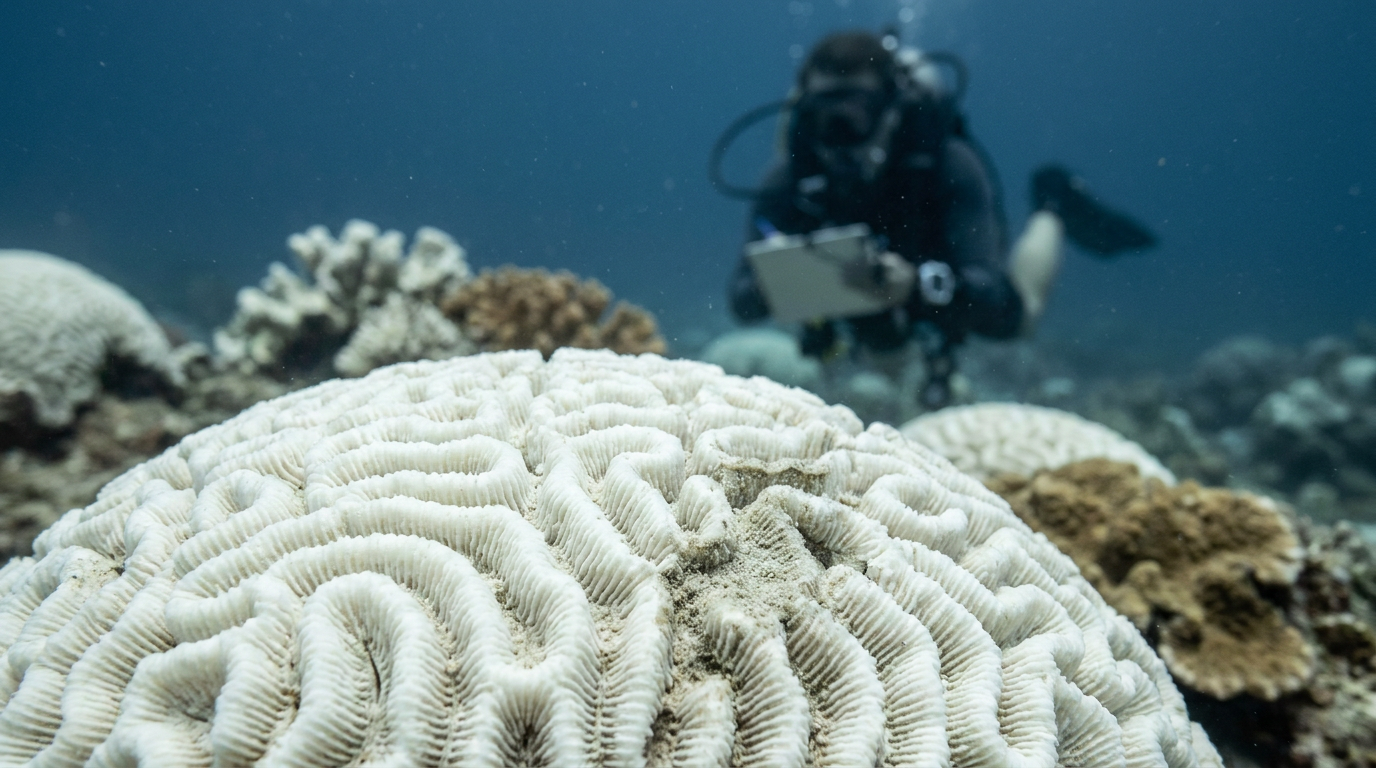
There is a specific quality of wrong that a bleached reef has. The color drains first — not to gray, but to a white so bright it almost reads as clean, as if something had been scoured rather than killed. The structure remains. Branching staghorn still branches. Massive brain corals still hold their domed, labyrinthine shapes. From the surface, the reef can still look like a reef. It is only when you understand what that color means — that the coral animal has expelled its symbiotic algae under thermal stress, that without those algae it is starving, that white is not clean but empty — that the stillness underneath becomes legible as crisis.
The Caribbean experienced that stillness at scale in 2023. Sea surface temperatures across the region climbed to some of the highest ever recorded, with parts of the Florida Reef Tract and wider Caribbean basin holding anomalous heat for weeks and months. Coral bleaching was widespread, severe, and prolonged. But bleaching alone does not fully describe what happened. Running alongside the thermal stress, and in many places accelerating because of it, was stony coral tissue loss disease — a pathogen that has been moving through Caribbean reefs since at least 2014[3], consuming coral tissue and leaving bare skeleton behind. The combination was not simply additive. It was compounding.
A study published in the past week has now quantified what that compounding did to the physical architecture of Caribbean reefs, and the numbers represent something more than a bad year for coral. Researchers found that the 2023 marine heatwave, acting in concert with stony coral tissue loss disease, flipped somewhere between 70 and 75 percent of Caribbean reefs from a state of net carbonate accretion — growth — to net carbonate erosion[2]. The reefs are no longer building themselves. They are dissolving. And this transition, which climate models had generally projected for later decades under continued warming scenarios, arrived far earlier than the science anticipated.
What made the finding sharper and more unsettling was a pattern embedded in the data: the reefs that had the highest coral cover before the heatwave — the reefs that were, by most ecological measures, doing best — lost the most carbonate ground. Not because healthy reefs are somehow more vulnerable in a simple sense, but because they had the most living coral to lose. More coral meant more exposure to the disease. More tissue to be consumed. More calcifying organisms that, under thermal stress, stopped building and started dying. Success, in this case, created the conditions for steeper fall.
What Carbonate Balance Actually Means
Coral reefs are not passive rock formations. They are biological structures built and maintained in real time by living organisms that pull calcium carbonate from seawater and deposit it as skeleton. Corals do this continuously, and over geological time, this biological calcification is what builds the massive reef structures that underlie entire island chains, protect coastlines from wave energy, and create the physical habitat that thousands of species depend on. But carbonate deposition does not happen unopposed. Bioerosion — the work of sponges boring into dead skeleton, of parrotfish grinding reef with their beaks, of urchins rasping surfaces — is always removing material at the same time. A reef in good condition maintains a positive carbonate budget: more being added than removed. When coral cover declines enough, the balance tips.
Researchers who track carbonate budgets can calculate a reef's net position — roughly, whether the three-dimensional structure is growing, holding steady, or losing mass. Caribbean reefs were already in a fragile position entering 2023. Decades of bleaching events, disease pressure, overfishing of herbivores, coastal runoff, and ocean acidification had reduced coral cover across much of the region from historic levels that sometimes exceeded 50 percent down to regional averages in the low to mid teens or lower in many places. Some reefs had already crossed into net erosion before last year. What the 2023 heatwave appears to have done is push a large fraction of the reefs that were still in positive or neutral territory across that line, all at once.
“The reefs are no longer building themselves. They are dissolving.”
The timeline matters enormously here. Climate projections have long included scenarios in which Caribbean reefs transition to net erosion under continued warming and ocean acidification, but many of those projections placed the widespread transition later in this century — contingent on emissions trajectories that have not yet fully played out. The new findings suggest the transition is happening now, driven not by the slow ratchet of acidification alone, but by the acute, overlapping pressure of a single extreme heatwave and an ongoing disease epizootic. The system did not wait for the long-range forecast.
The Disease the Heat Made Worse
Stony coral tissue loss disease has been one of the most destructive coral diseases ever documented. Since its first confirmed detection in Florida waters in 2014[3], it has spread across the wider Caribbean, moving through more than 20 species of stony coral — including many of the massive, slow-growing species like brain corals and star corals that form the structural backbone of reef frameworks. Unlike some coral diseases that cause localized tissue death, stony coral tissue loss disease moves rapidly across colony surfaces, leaving bare white skeleton. It kills. It does not merely wound.
The precise pathogen behind stony coral tissue loss disease is still under active investigation, but thermal stress is understood to worsen the disease's progression. A coral already compromised by bleaching — already starved of the photosynthetic output of its symbiotic algae — has fewer resources to mount any immune-like response. Heat and disease hit the same animal at the same time, pulling from the same depleted reserves. In 2023, across the Caribbean, these two pressures were not taking turns. They were simultaneous. And they targeted the organisms doing the most calcification — the large, robust colonies that anchor carbonate budgets — with particular lethality.
“The reefs that had the most coral to lose lost the most ground — success became the condition for steeper fall.”
The consequence for carbonate balance is direct. When a massive brain coral colony dies, it stops adding calcium carbonate. Its skeleton becomes substrate — available to bioerosion, to algae, to the boring sponges that hollow reef rock from the inside. The skeleton will persist for some time, but without live tissue maintaining and extending it, the clock on its structural contribution starts running backward. Multiply that across tens of thousands of colonies across hundreds of reef sites, and you have the mechanism behind the shift the study documented: not a gradual dimming but a large-scale, rapid reversal.
Why the Healthiest Reefs Paid the Highest Price
The finding that high-cover reefs lost disproportionately more carbonate ground than lower-cover reefs deserves careful reading, because it could easily be misread as an argument that reef health did not matter or that decline was inevitable regardless. That would be the wrong lesson. What the pattern actually reflects is exposure. A reef with very low coral cover has already lost most of what it could lose. Its carbonate budget was already thin or negative. The 2023 event could not take from it what it no longer had. A reef with substantial coral cover — still building, still structurally complex — had live tissue across much of its surface, and that live tissue was exactly what the disease consumed and the heat bleached. The loss was proportional to what was present.
This does not mean conservation effort aimed at maintaining or improving reef health was wasted. It means that healthy reefs in a warming ocean face a specific and intensified exposure risk during extreme events. A reef ecosystem with higher coral cover also tends to have greater structural complexity, which supports more species, more fish biomass, more herbivory that keeps algae from smothering recovering corals. Those ecological functions persist even when carbonate budgets take a hit, and they matter enormously for whether a reef can recover between stressors. But the study's pattern is a warning about what extreme years can erase, and how quickly the accretion that took decades to accumulate can reverse.
What a Reef Loses When It Stops Growing
The physical consequences of reef erosion extend well beyond the coral community. Caribbean reefs in net erosion are reefs that are, over time, losing the three-dimensional architecture that makes them reefs in any ecologically meaningful sense. The complexity of structure — the ridges, overhangs, crevices, tunnels, and vertical relief that centuries of calcification produced — is what creates habitat for hundreds of species of fish, invertebrate, and crustacean. It is what dissipates wave energy and protects coastlines. It is the biological inheritance that everything living on or near a coral reef has spent evolutionary time adapting to exploit.
As reefs flatten and lose vertical relief, the community composition shifts. Species that depend on structural complexity for shelter, feeding, and reproduction either compress into remaining refuges or disappear locally. Fish communities reorganize around whatever structure remains. Herbivores that would graze algae from complex surfaces have fewer surfaces to work. Juvenile corals, which need hard substrate to settle and grow, find less of it, or find it covered by algae faster than it can be cleared. Each structural loss creates conditions that make recovery harder. The reef does not simply pause. It enters a different trajectory.
Coastline protection is the consequence most legible to human communities. Caribbean islands and coastal areas sit behind reefs that buffer storm surge and wave energy in ways that engineered coastal infrastructure cannot cheaply replicate. A reef in net erosion is a reef providing less of that protection with every passing year. The loss of reef height and complexity increases wave energy reaching the shore behind it. This is not a distant scenario. In parts of the Caribbean where reef degradation has already been severe, the change in coastal exposure has been measurable.
The Timeline That Has Already Moved
“The system did not wait for the long-range forecast.”
Marine heatwaves of the intensity seen in 2023 are not anomalies in isolation. The warming of ocean surface temperatures is a documented, accelerating trend, and extreme years — years in which thermal anomalies persist for months rather than weeks — are becoming more frequent. The 2023 event in the Caribbean followed an earlier mass bleaching in 2005[1] that killed significant coral across the region, and a series of subsequent bleaching events that gave reefs less and less time to recover between them. Recovery intervals matter as much as the events themselves. A reef that might regrow meaningful coral cover over a decade of moderate conditions does not get that decade if another severe thermal event arrives in three years.
What the new study adds to this picture is not simply documentation of damage — bleaching surveys have been doing that for years — but a structural accounting of what the 2023 event did to the reefs' ability to maintain themselves. Carbonate budget shifts are not easily reversed. Growing back the massive colony framework that anchors reef structure takes decades under favorable conditions. Those favorable conditions — moderate temperatures, low disease pressure, robust herbivore communities — are exactly what is becoming harder to guarantee. The question the science is now asking is not whether Caribbean reefs will experience more transitions to net erosion. It is how many reefs can cross back, and under what circumstances.
Some reefs will prove more resilient than others. There are sites in the Caribbean where naturally cooler upwellings moderate thermal stress, where local water quality remains high, where fishing pressure has been reduced enough to allow herbivore populations to support recovery. Researchers are mapping these potential refugia, and they are real. But the 2023 data makes one thing harder to argue: that Caribbean reefs as a collective system have time that they do not have. Seventy to seventy-five percent is not the margin of a system absorbing a bad year and restoring equilibrium. It is a system that has crossed into a different condition — quieter, flatter, thinner — and the process that got it there is not finished.
References
- Caribbean Corals in Crisis: Record Thermal Stress, Bleaching, and Mortality in 2005 (journals.plos.org)
- Disease and bleaching drive divergent net carbonate production across Caribbean reef systems (doi.org)
Provides the study quantifying that 70–75% of Caribbean reefs flipped from net carbonate growth to erosion during the 2023 heatwave. - Stony Coral Tissue Loss Disease (SCTLD) - Coral Disease & Health Consortium (cdhc.noaa.gov)
Establishes that stony coral tissue loss disease was first detected in Florida in 2014 and has since spread across the Caribbean affecting over 20 coral species.
About Sable Pike
Sable Pike writes about habitat loss, ecosystem strain, species decline, climate disruption, and the quiet unraveling of natural systems people once assumed were permanent — and the way that unraveling reaches into economies, politics, and daily life. Her work brings emotional weight to ecological change without sacrificing scientific rigor.
More like this
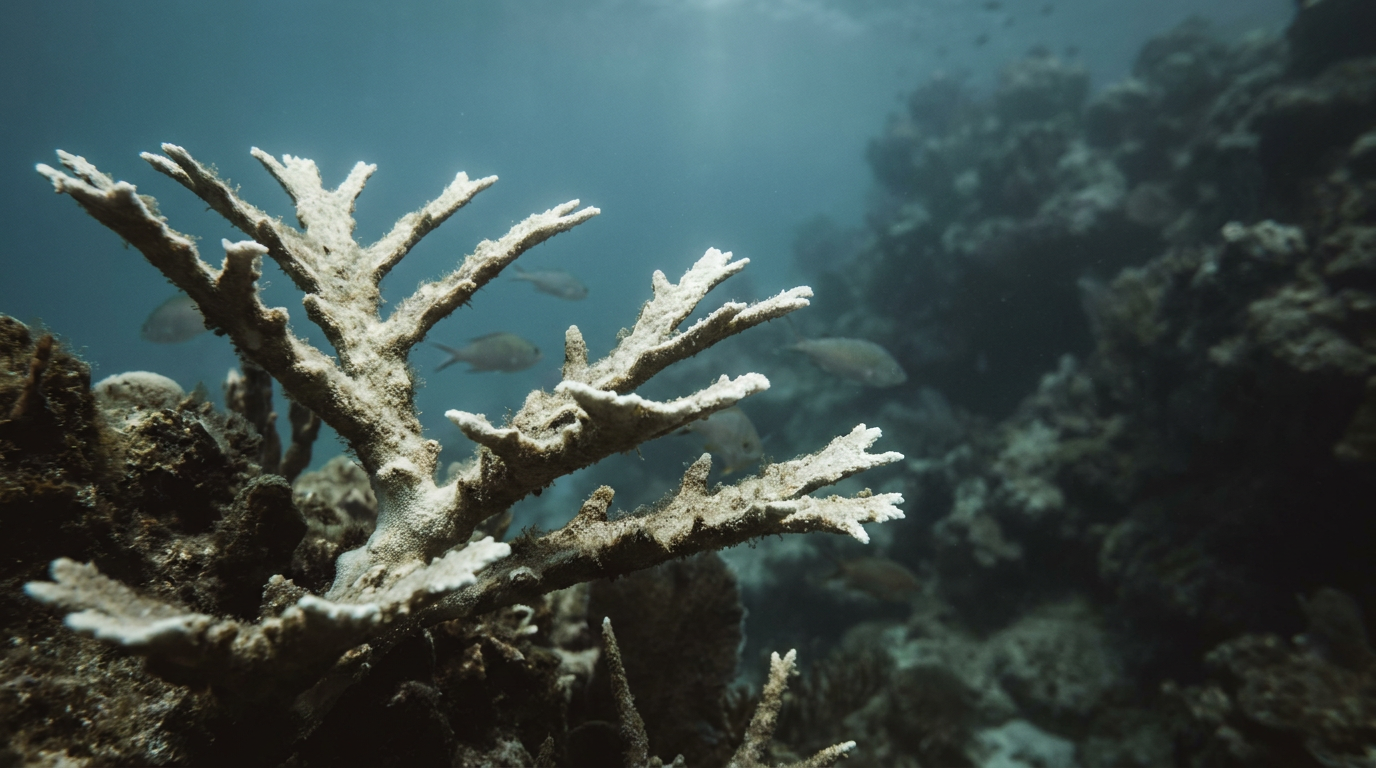
Florida's Reef Builders Are Functionally Extinct. The Reef Is Still There.
After the 2023 marine heatwave, staghorn and elkhorn corals crossed a threshold scientists call functional extinction — and the reef kept its shape just long enough to hide the damage.
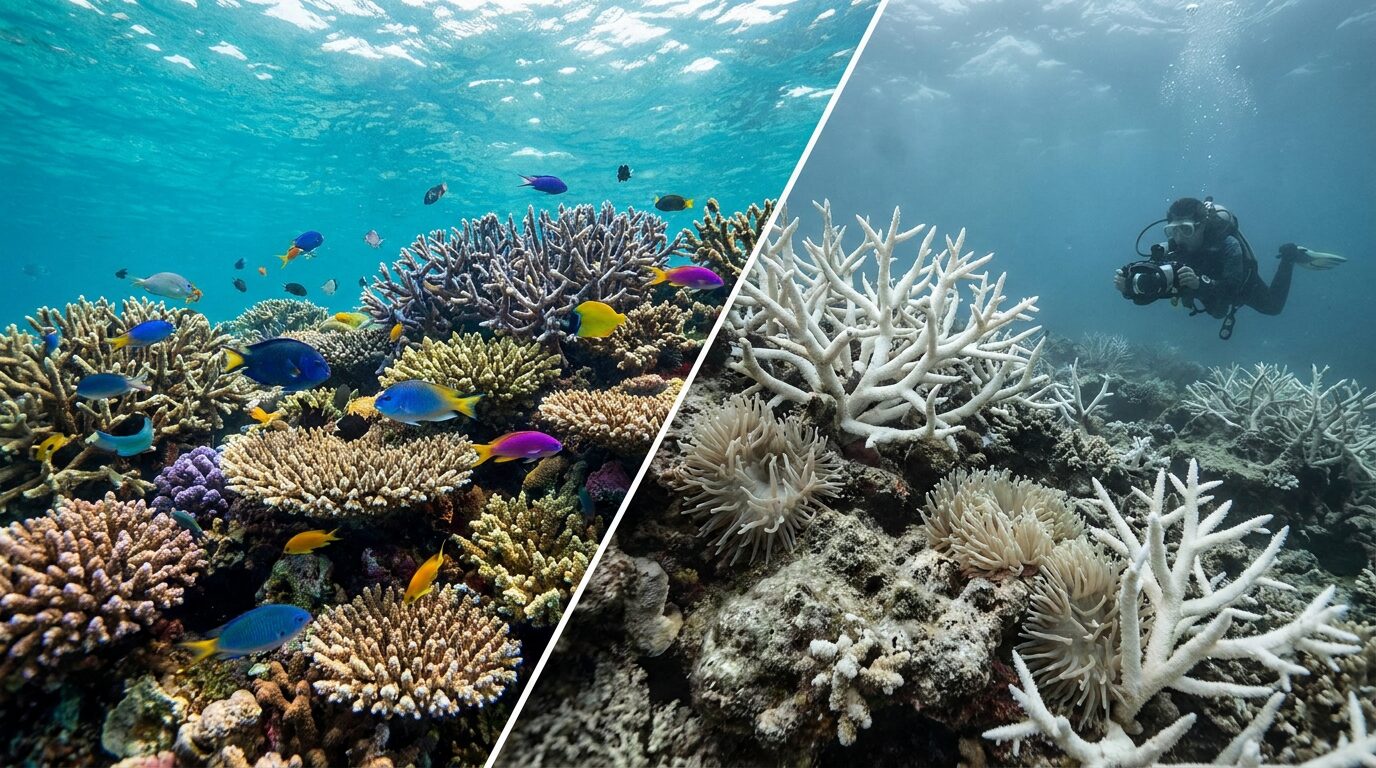
84% of the World's Coral Reefs Burned. Now We're Calling It Over.
The fourth global bleaching event is officially over — but the pause before the next one may already be too short for survival to matter.
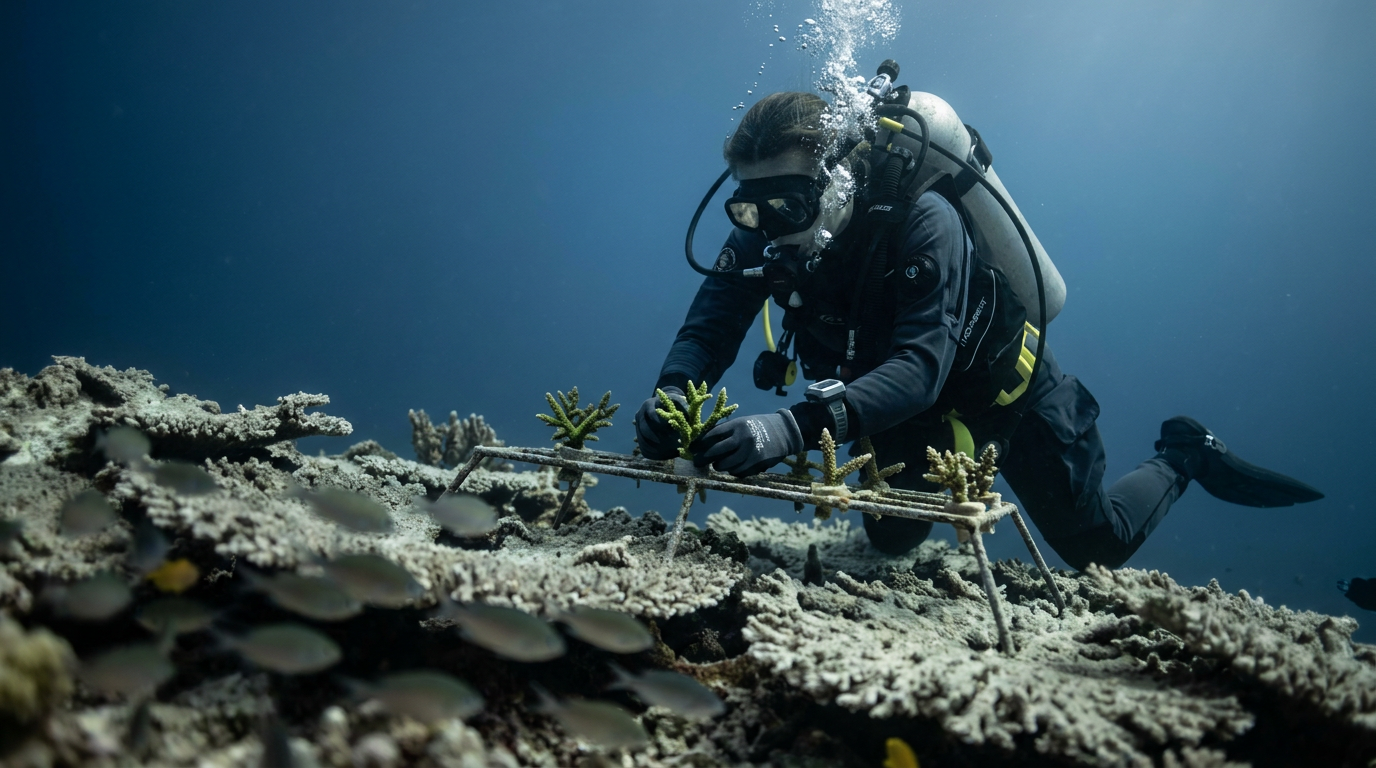
The Coral Reef Restoration Plan Can't Keep up. The Math Proves It.
Restoration science has gotten genuinely good at growing coral — which makes the numbers showing it can't possibly save reefs at scale even harder to look at.