The Amazon Has a Specific Temperature Limit. Scientists Just Found It.
A new study puts a precise number on the Amazon's tipping point — and what happens just past it rewrites what we thought we knew about rainforest resilience.
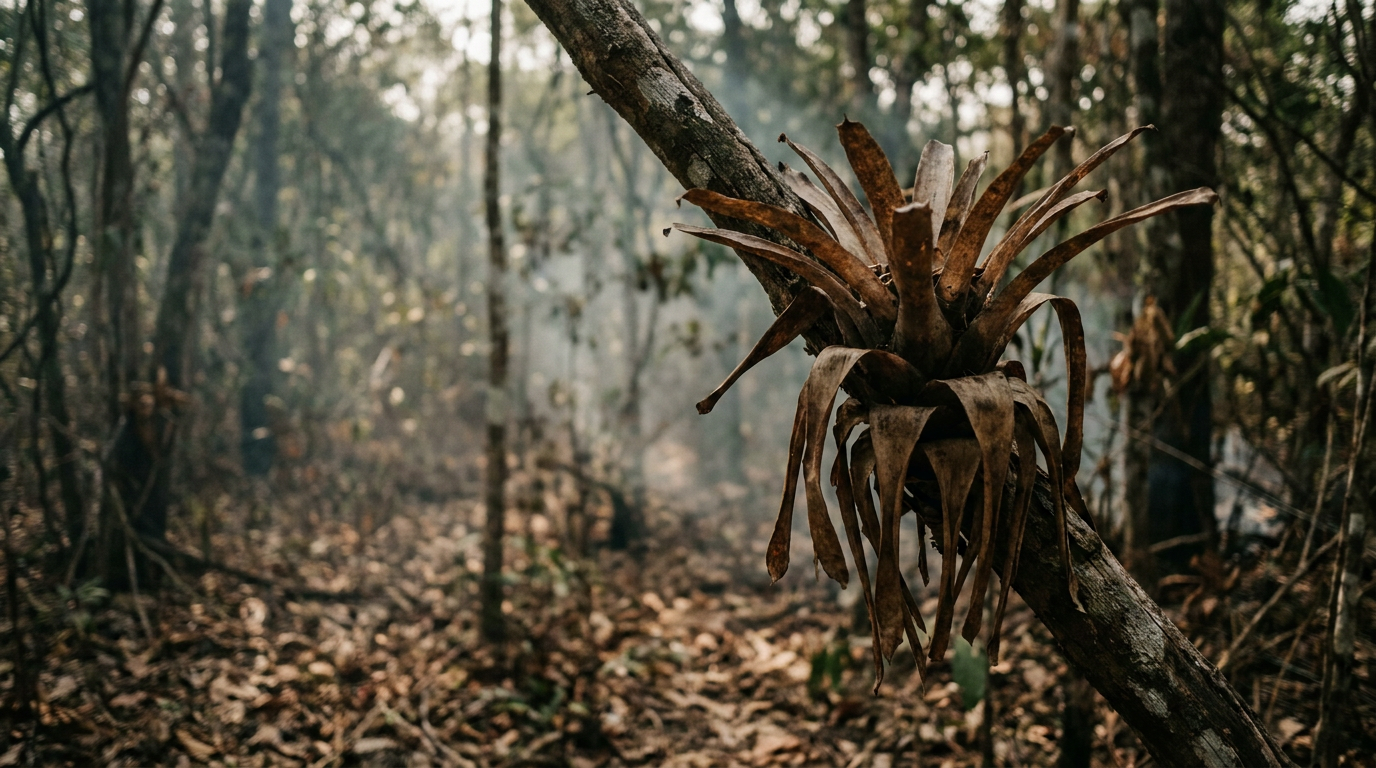
There is a specific way the eastern Amazon announces that something has gone wrong. The canopy thins unevenly, as though certain trees have simply stopped participating. The understory dries. Certain bird species — the ones that depend on dense, humid interior forest — disappear from areas where they once nested reliably. The forest still looks like forest from the highway, or from a satellite pass in a wet month. But the numbers tell a quieter, harder story: areas under persistent drought stress are burning more easily, regrowing more slowly, and locking away less carbon than the intact forest they used to be.
Scientists have known for years that the Amazon is under pressure from two directions at once: deforestation removing trees from the ground up, and climate change altering the moisture and temperature conditions that let those trees grow in the first place. What was harder to know — what remained frustratingly vague even in serious climate science — was whether there was a threshold, a specific point beyond which the system stopped degrading gradually and began to unravel in ways that could not easily reverse. The idea of a tipping point is easy to invoke and surprisingly difficult to locate precisely. Thresholds in complex ecosystems do not announce themselves. They tend to be discovered only after the crossing.
A study published in the Proceedings of the National Academy of Sciences[1] has now given that threshold a number: 2.3 degrees Celsius of global warming above pre-industrial levels. Below that number, Amazon forest decline under continued warming is serious and measurable, but it tracks more or less proportionally with the pressure applied. Above it, the relationship changes. Forest loss accelerates nonlinearly, meaning each additional increment of warming drives disproportionately larger ecological damage than the increment before it. The Amazon, in other words, has a specific temperature at which it stops absorbing pressure and begins amplifying loss.
That number — 2.3°C — sits close enough to the Paris Agreement's 2°C ceiling to matter immediately, and well within the range of projections under current global emissions trajectories. Current policies put warming on track for somewhere between 2.5°C and 3°C[4] by the end of this century. The gap between where we are headed and where the threshold lies is not comfortably wide. It is narrow, and narrowing.
What Nonlinear Actually Means
The word nonlinear gets used frequently in climate science, and it is worth being precise about what it means in this context, because the difference between linear and nonlinear damage is the difference between a bad situation and a system in freefall. Linear damage is proportional: if warming of 1°C causes a certain amount of forest dieback, then 2°C causes roughly twice as much. Nonlinear damage means the relationship breaks down. At some point, the system is no longer scaling with the pressure — it is tipping. A small additional push produces a large, discontinuous response. Ecosystems behave this way when they are approaching what ecologists call a critical transition, a shift from one stable state to another that is very difficult to reverse.
In the Amazon's case, researchers analyzed how forest cover, carbon flux, and vegetation productivity responded to warming across a range of modeled temperature scenarios. The 2.3°C threshold is where the response curve bends sharply. Below that point, the forest shows real strain — productivity declining, tree mortality increasing in drought-prone regions, forest edges retreating — but the system still broadly functions as a forest. Above that point, the interactions that maintain the forest's own climate begin to break down. This is the mechanism that makes the Amazon's tipping point qualitatively different from ordinary habitat loss.
“The Amazon does not just grow in a climate — it makes one.”
The Amazon generates a significant portion of its own rainfall through a process called moisture recycling. Trees draw water from the soil and release it into the atmosphere through transpiration; that atmospheric moisture condenses and falls again further downwind, fed back into the system to sustain the next cycle. In intact Amazonian forest, this moisture recycling sustains rainfall across vast interior areas that would otherwise be too far from the Atlantic to receive sufficient precipitation on their own. When enough forest is removed — whether by chainsaw or by heat stress — the cycle weakens. Rainfall decreases. The remaining forest becomes more vulnerable to drought. More forest dies. Rainfall decreases further. It is a feedback loop, and once triggered, it is not easily interrupted.
The Dieback Cascade
The ecological literature has a term for this self-reinforcing deterioration: savannification. It describes the process by which humid tropical forest transitions to drier, more open vegetation — not the dramatic, photogenic sweep of fire across a landscape, but a slower shift in species composition, microclimate, and hydrology that ultimately produces something that functions more like a dry woodland or savanna than a rainforest. Savannification does not require every tree to die at once. It requires enough trees to die that the conditions sustaining the rest begin to deteriorate. Then the remaining trees are operating in a different environment than the one they evolved for.
The species losses that accompany this transition are not random. They are stratified by ecological specificity. Specialist species — those adapted to the deep humidity, low light intensity, and narrow temperature ranges of intact interior forest — are typically the first to decline. Generalists, edge-tolerant species, and invasive opportunists tend to persist or expand. The result is a forest that may still contain a significant number of species in aggregate, but that has lost the dense trophic web of specialists that made it one of the most biodiverse terrestrial ecosystems on Earth. In Amazonia, specialist species include everything from understory birds with tiny range requirements to mycorrhizal fungi that maintain relationships with specific tree genera. Their disappearance is often invisible to a casual observer and consequential to everything around them.
The consequences radiate outward from the forest itself. The Amazon basin functions as a continental water pump, moving moisture inland and regulating the hydrology of large portions of South America. Agricultural systems in southern Brazil, Bolivia, and parts of Argentina depend on rainfall patterns shaped in part by Amazonian evapotranspiration. A forest in decline is a water pump losing pressure. The downstream effects on cropping systems, river levels, and seasonal flood regimes are measurable and have already begun to appear in regions where deforestation pressure has been highest.
Carbon Math That No Longer Adds Up
“A degraded Amazon does not just stop absorbing carbon — it begins releasing it.”
For decades, intact Amazonian forest has functioned as one of the planet's most significant carbon sinks, absorbing an estimated 1.5 to 2 billion metric tons of carbon dioxide annually. That absorption capacity has already been declining: research published in recent years has found that heavily deforested and drought-stressed portions of the eastern Amazon have shifted from net carbon sinks to net carbon sources[2], releasing more CO₂ through decomposition, fire, and respiration than they take in through photosynthesis. The new PNAS findings add urgency to that trajectory. If warming crosses the 2.3°C threshold and dieback accelerates nonlinearly, the scale of that source shift could dwarf current estimates.
The carbon stored in Amazonian biomass represents centuries of biological accumulation — not just in living wood, but in root systems, leaf litter, and the extraordinarily rich soil organic matter that builds up under continuous closed-canopy forest. When that forest dies or burns, that stored carbon oxidizes and enters the atmosphere. It then contributes to the warming that is driving further forest stress. This is the feature of the tipping point that makes it categorically dangerous rather than merely consequential: a destabilized Amazon does not just stop helping the climate, it starts driving it in the wrong direction. The system that was helping to slow warming becomes a mechanism for accelerating it.
Resilience Is Not Infinite
One of the most persistent misunderstandings about tropical forests is the idea that they are essentially self-restoring — that given time and protection, cleared or degraded land will eventually return to something resembling the original forest. This is partially true, and the exceptions matter enormously. Secondary forest does grow back in areas that are protected from repeated disturbance and retain nearby seed sources, and its recovery can be ecologically meaningful. But the research on Amazon resilience has grown steadily more cautious over the past decade. Detailed studies of forest recovery across the basin have found that resilience — the speed and completeness with which forest returns after disturbance — has been declining across large portions of the Amazon since at least the 1990s[3].
Resilience decline does not look like immediate failure. It looks like a forest that takes longer to recover from a drought than it used to. It looks like a burn scar that stays open for years rather than months. It looks like a section of forest that seems intact but whose internal dynamics — seed dispersal, canopy gap closure, understory regeneration — have slowed below the threshold needed to sustain the system against the next disturbance. The Amazon has been absorbing compounding pressures for long enough that parts of it have less capacity to absorb the next wave than they had for the last one. The 2.3°C finding matters in part because it identifies the point at which that reduced resilience likely becomes catastrophic across the system as a whole, not just in the most degraded margins.
The 0.3-Degree Problem
The difference between the Paris Agreement's aspirational limit of 1.5°C and the 2.3°C threshold described in the PNAS study is 0.8 degrees. The difference between the more commonly cited 2°C ceiling and that threshold is 0.3 degrees — a margin that sounds like precision and functions like a warning. Current warming is already approximately 1.2°C above pre-industrial levels. The remaining distance to the Amazon's breaking point is not a distant abstraction. At present emissions trajectories, it represents a few decades of continued business as usual.
“The tipping point is not in the future — it is close enough to plan around, or fail to.”
What the research makes clear is that the Amazon's fate is not sealed, but it is also not safely insulated from current decisions. The nonlinear threshold at 2.3°C means that staying below 2°C is not merely symbolic — it is functionally different from allowing warming to drift past that number. Reducing deforestation pressure inside the basin also matters, because deforestation and climate stress interact: a forest already fragmented by land clearing has less capacity to resist heat and drought than one that remains spatially intact. The tipping point is not a single switch. It is a product of accumulated pressure from multiple directions, which means it is also susceptible to reduction from multiple directions.
The eastern Amazon is already quieter than it was. The seasonal patterns that ecologists have used for decades to track species and phenology are shifting in ways that produce mismatches — fruiting times out of step with the animals that disperse seeds, migration timings at odds with the insect blooms that fuel them, nesting cycles misaligned with rainfall. These are the early signals of a system working harder than it should have to, against conditions it was not built for. The 2.3°C number gives those signals a context that is harder to look past than the signals alone. It says that what is already visible is not the problem itself, but the approach of a threshold beyond which the problem becomes a different kind of thing entirely.
References
- Amazon forest faces severe decline under the dual pressures of anthropogenic climate change and land-use change (pnas.org)
Published study establishing the 2.3°C warming threshold where Amazon forest loss accelerates nonlinearly. - Amazonia as a carbon source linked to deforestation and climate change (nature.com)
Documents that drought-stressed eastern Amazon regions have shifted from carbon sinks to carbon sources. - Pronounced loss of Amazon rainforest resilience since the early 2000s (nature.com)
Documents Amazon's declining carbon uptake over four decades and shifts to carbon source during major droughts, supporting article's claim about degraded forests releasing carbon. - New Climate Pledges Only Slightly Lower Dangerous Global Warming (unep.org)
Provides the current global warming projection of 2.5–3°C by century's end under existing climate policies.
About Sable Pike
Sable Pike writes about habitat loss, ecosystem strain, species decline, climate disruption, and the quiet unraveling of natural systems people once assumed were permanent — and the way that unraveling reaches into economies, politics, and daily life. Her work brings emotional weight to ecological change without sacrificing scientific rigor.
More like this
The Amazon Makes Its Own Rain. Deforestation Is Breaking That.
The Amazon recycles its own rainfall through vast airborne moisture corridors — and new data shows that eastern deforestation is already strangling the forests furthest downstream.
The Amazon Is Growing a Climate It Has Never Seen Before
Researchers have identified a precise soil-moisture threshold below which Amazon trees don't just wilt — they suffer fatal internal embolisms, and climate models suggest those conditions could persist for five months a year by 2100.
The Forest Still Looks Green. That's the Problem.
Research on Southwest US woodlands reveals that trees can lose the hydraulic and carbon reserves that keep them alive long before their canopy shows a single yellow leaf — meaning the forests we think we're watching die may already be past saving.