Why Disgusting Smells Outlast Pleasant Ones Every Single Time
The reason a rotting smell colonizes your upholstery while fresh coffee vanishes in minutes has nothing to do with how strong the odor is — it has everything to do with what the molecule actually wants to do.
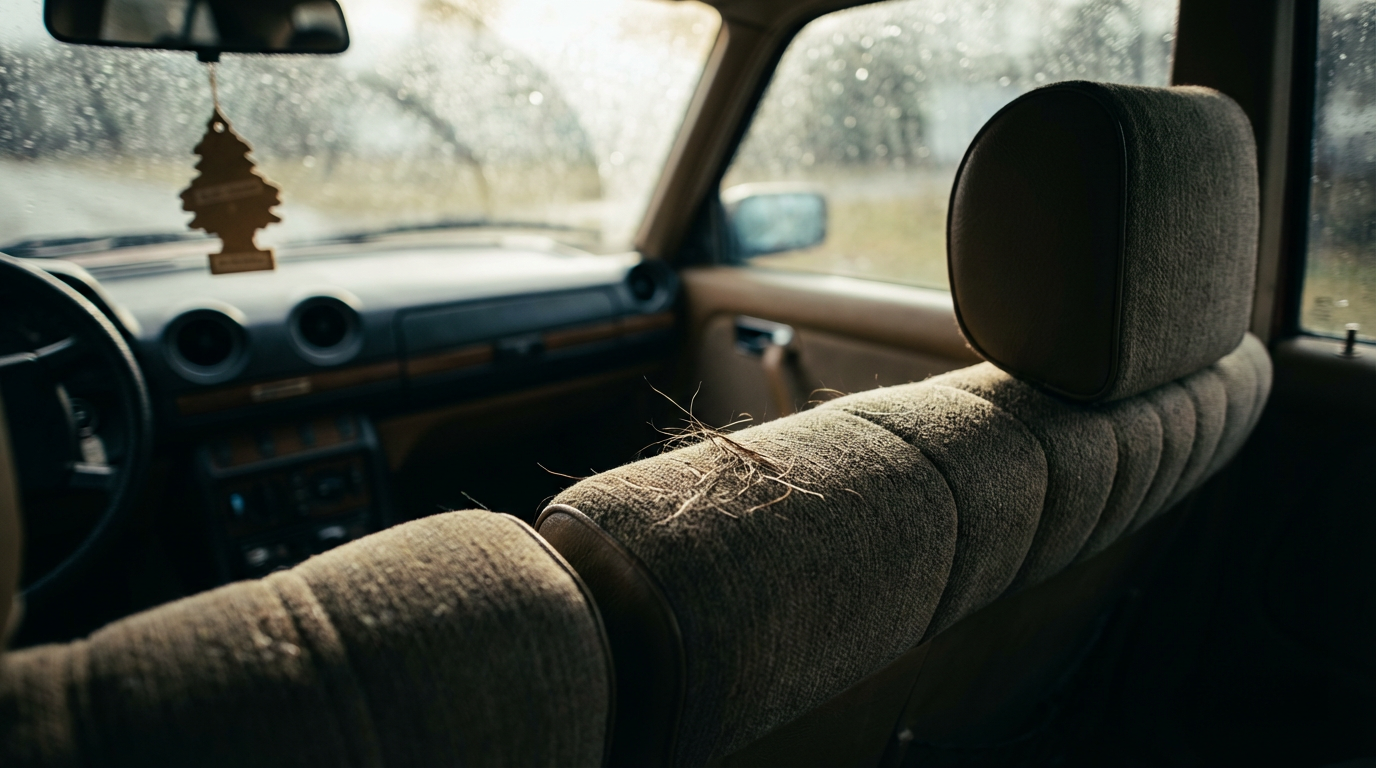
You drove a wet dog somewhere on a Tuesday. It is now the following Thursday, and the car still smells like wet dog. You have tried the windows-down highway run, the air freshener hanging from the rearview mirror, a light spritz of something that claims to neutralize odors. None of it has meaningfully worked. The dog is long gone but it is also, in some real chemical sense, still very much in there with you.
Meanwhile, you spent forty dollars on a cologne that the bottle described as lasting up to eight hours. It lasted forty minutes. A colleague walked past your desk at noon and asked if you were wearing anything. You were. You had applied it generously. It had simply evaporated into the world and moved on, as if it had somewhere better to be.
This asymmetry is not accidental, and it is not about volume or intensity of smell. It is about the physical and chemical behavior of the molecules responsible. How heavy they are, how readily they bond to porous surfaces, how much water they require to persist, and how quickly they partition out of a material and back into the air you breathe. Pleasant smells and disgusting smells do not play by the same rules. Understanding why requires looking at what odor molecules actually are, and what happens to them once they land somewhere.
Odor is not a quality of an object. It is a cloud of volatile organic compounds — molecules small and light enough to leave a surface, travel through air, and reach your olfactory epithelium, where they bind to receptors and get translated by your brain into something recognizable: baked bread, wet dog, your ex's jacket. The critical word is volatile. Every molecule has a different vapor pressure, a different attraction to surfaces, a different relationship with water and temperature. Those differences, summed up over thousands of molecules, are why your car is still haunted.
The Molecular Weight Problem
Fragrance molecules are, by commercial design, engineered to be volatile. Perfumers structure their formulas in what they call notes: top notes that hit fast and leave fast, heart notes that take longer to develop, and base notes that are supposed to anchor the fragrance and give it staying power. The base notes — resins, musks, woods, amber compounds — are heavier molecules with lower vapor pressures. They evaporate slowly, which is why a well-made perfume ideally lingers longer than the first bright citrus burst. But lighter molecules dominate your immediate perception of a scent, and those are gone quickly. What often happens with cheaper formulations is that the lighter, more volatile compounds are not properly balanced against heavier anchors, so the whole thing departs at roughly the same speed. You spray, you smell briefly, you continue with your life unscented.
Wet dog, by contrast, is not a simple molecule. It is a mixture, and a particularly clingy one. When a dog gets wet, water disrupts the sebum and microbial colonies living in its coat. Bacteria and fungi that have been quietly metabolizing skin oils, dead cells, and general dog residue suddenly get turbocharged, releasing a range of volatile compounds: aldehydes, carboxylic acids, and various sulfur-containing molecules, among others. The specific character of wet dog smell — that sharp, slightly musty, animal warmth — comes from this microbial exhaust. Several of those compounds have genuinely low vapor pressures, meaning they evaporate slowly and stay detectable in low concentrations for extended periods. Others are hydrophilic enough to travel with water molecules and absorb readily into porous substrates. Your car's fabric seats, carpet, and headliner are, from a molecular chemistry standpoint, extremely hospitable.
“Porous surfaces do not just absorb smell — they shelter the molecules responsible from the airflow that would otherwise carry them away.”
Why Fabric Is an Odor Vault
The real villain in the wet dog persistence story is not the dog or its bacteria. It is your car's interior. Fabric upholstery, carpet, and foam padding are porous at a scale that matters enormously to a volatile compound. These materials have high surface area relative to their apparent size. A square meter of automotive carpet, when you account for every fiber, every gap between fibers, and every microscopic irregularity in the padding beneath, presents an enormous amount of surface for molecules to adsorb onto — adsorb, not absorb, meaning they cling to the surface rather than dissolving into the bulk material. This clinging is reversible, but slowly. The molecule has to acquire enough energy to detach and re-enter the air. At car interior temperatures, especially in winter or when the car sits in a garage, that process is sluggish. The smell does not go away. It waits.
This is why the window trick mostly fails. Opening windows creates airflow, which removes the molecules that are currently in the air phase, but does nothing to accelerate the desorption of molecules stuck to surfaces. Heat does. Warming the interior of a car drives adsorbed molecules back into the vapor phase faster, which is why you can sometimes get a fresh spike of dog smell on a hot day — you are not experiencing new contamination, you are watching the reservoir briefly off-gas. The molecules are still there, and a summer afternoon in a parking lot gives them enough energy to remind you of that fact.
Compare this to a hard, non-porous surface: glass, tile, sealed metal. Odor molecules that land on these surfaces adsorb much less efficiently and re-enter the air more quickly. This is partly why smells in tiled bathrooms feel transient compared to smells in carpeted bedrooms. The substrate is doing most of the work. When a smell seems to have permanently colonized a space, you are usually dealing with a porous material that has become a slow-release reservoir. Upholstery, mattresses, wooden furniture, drywall, clothing, books — these are all, in varying degrees, odor sponges.
The Role of Water and Microbial Amplification
Wet dog smell is also chemically self-sustaining in a way that cologne is not, because wet dog smell has a biological engine. The bacteria and yeast living in a dog's coat do not stop working when the dog leaves your car. What they leave behind — residual oils, shed cells, microscopic fragments of biological material — provides a substrate for whatever microbes are already living in your car's interior. Your seats are not sterile. They carry a sparse but functional community of bacteria and fungi adapted to the relatively arid, occasionally warm, intermittently nutrient-supplied environment of a car interior. Add dog oils and shed skin, and you give that community a meal. The microbial metabolism that produces the characteristic volatile compounds can then continue, mildly, in the car itself. This is why the smell does not simply fade linearly over time. It persists with a quiet biological stubbornness because it is, in some small way, still being manufactured.
“The smell does not simply fade — it persists with a quiet biological stubbornness because it is, in some small way, still being manufactured.”
This is a pattern that shows up across many of the most tenacious domestic odors. Cigarette smoke persists partly through absorbed nicotine and tar compounds on surfaces — a phenomenon researchers studying thirdhand smoke have documented in detail[3] — but also through ongoing oxidation reactions between those residues and ozone in indoor air, which generates new volatile compounds over time. Cooking smells that soak into kitchen walls do not just sit there passively; fatty acids and other cooking byproducts can continue to oxidize slowly, producing new odor compounds for days or weeks. What looks like a static contamination problem is often a dynamic chemical process. The smell is an event, not a stain.
Why Disgust Smells Last and Pleasant Smells Don't
There is a pattern here that goes beyond coincidence, and it is worth being honest about. The smells that tend to stick around — rot, mildew, animal waste, decay, biological contamination — are often produced by molecules with specific chemical properties that happen to favor persistence. Many putrefaction-associated compounds are amines, small nitrogen-containing molecules with relatively low vapor pressures and a strong tendency to react with and adsorb onto surfaces. Sulfur compounds produced by anaerobic bacteria are similarly tenacious and detectable at extraordinarily low concentrations — your nose can register some sulfur compounds in the parts-per-trillion range[2], which is why even a faint trace of drain smell or rotten egg registers immediately. The biological function of disgust is plausibly a rapid-response avoidance system, and that function is better served by sensitivity to small amounts than by only reacting to large ones.
Floral and citrus fragrance compounds, on the other hand, tend to be lighter esters, terpenes, and aldehydes that evaporate quickly by design — they are often molecules that plants and fruits produce specifically to be released into air, where they signal to pollinators or seed dispersers. They are made to travel, not to stay. There is nothing inherently pleasant about high volatility, but the molecules that humans experience as fresh, clean, or attractive often happen to be the ones that dissipate fastest. Nature did not design citrus peel to haunt a car for three weeks. It designed it to announce itself briefly and efficiently, which is exactly what it does.
This is also why air fresheners perform such a specific kind of futility against genuinely entrenched odors. A freshener works by releasing its own volatile compounds into the air, briefly overwhelming or competing with the odor compounds already there. It does not remove anything. It does not neutralize anything chemically unless it contains a specific reactive ingredient designed to do so, like certain cyclodextrin-based products that can actually trap and encapsulate odor molecules. The standard hanging pine tree is a distraction, not a solution. You are adding a new smell on top of the old one, and the old one, with its reservoir of adsorbed molecules and occasional microbial assistance, will comfortably outlast the pine tree.
Getting the Smell Out: What Actually Works
The only genuine remediation strategy for a porous material that has absorbed odor is to either remove the source, deactivate it chemically, or physically extract the adsorbed molecules. For wet dog specifically, enzyme-based cleaners are the most mechanistically honest option: the enzymes break down the biological substrate — the proteins, lipids, and other organic material that the bacteria have been and will continue feeding on — eliminating the feedstock for ongoing microbial odor production. You are not masking the smell. You are ending the process that generates it. This is also why enzyme cleaners work on cat urine far better than simple detergents: detergents clean the surface, but the urea and uric acid crystals that persist in carpet padding continue providing substrate for bacteria, which continue producing ammonia and other volatile compounds, which continue making you aware of the cat's historical enthusiasm for that particular corner of your living room.
Activated charcoal and baking soda work differently: they are adsorbents themselves, with extremely high surface area that competes with upholstery for the available volatile molecules. Left in a closed space, they pull molecules out of the air phase, which shifts the equilibrium slightly, drawing more molecules off surfaces over time. This works, but slowly, and not for the microbially-sustained component of the smell. Ozone generators are effective but require care — ozone reacts with volatile compounds and breaks them down, but it also reacts with furniture, fabrics, and lungs, and the space needs to be unoccupied during treatment. The people who swear by them for vehicle odor remediation are not wrong about the results. They are just using a fairly aggressive oxidizer in an enclosed space, which is not something to do casually.
“You are not masking the smell. You are ending the process that generates it.”
Your Nose Is Not Neutral Either
One last complication: your nose is not a passive detector. It adapts. Continuous exposure to the same odorant causes olfactory receptors to downregulate their sensitivity to that compound — olfactory adaptation, sometimes called olfactory fatigue[1]. This is why you stop noticing your own home after a few minutes inside, and why you cannot reliably judge whether the smell of dog has faded from your car. You habituate. You climb in, stop noticing the dog, and conclude the smell must be gone. It is not. Your passenger who climbs in fresh from outside can still smell it immediately. This adaptation is faster and more complete for some compounds than others, and it is notably weaker for warning-type odors — which is part of why a hint of gas or sewage remains detectable even after prolonged exposure. Evolution preferred not to let you habituate your way into ignoring biological hazards.
So the asymmetry is real and it is stacked at every level. The molecules that produce revolting smells tend to be heavier, stickier, more reactive with surfaces, produced at lower thresholds of perception, and in many cases actively regenerated by microbial activity. Your nose is disproportionately sensitive to them and, at the same time, adapts to them in a way that makes you a bad judge of whether your own environment still reeks. The pleasant molecules are engineered or evolved to be brief and bright. They announce themselves and leave. The foul ones move in, adsorb into your upholstery, eat whatever biological residue is available, and wait. The dog is gone. The chemistry it left behind is not in any hurry.
References
- Olfactory adaptation: recordings from the human olfactory epithelium (pmc.ncbi.nlm.nih.gov)
- Olfactory Sensitivity for Six Predator Odorants in CD-1 Mice, Human Subjects, and Spider Monkeys (journals.plos.org)
Demonstrates that sulfur compounds are detectable at concentrations below 0.1 parts per million, supporting the article's claim about extreme sensitivity to sulfur odors. - Thirdhand Smoke: New Evidence, Challenges, and Future Directions (pmc.ncbi.nlm.nih.gov)
Documents how tobacco smoke chemicals adhere to surfaces and can be released back into air, paralleling the article's explanation of persistent odor absorption. - Compounds Responsible for the Odor of Dog Hair Coat - WSAVA2002 (vin.com)
Identifies aldehydes, carboxylic acids, and sulfur-containing molecules as the volatile compounds released when dog hair gets wet.
About Phoebe Lark
Phoebe Lark writes about the biology and chemistry your body and home would rather you didn't examine too closely — odors, fluids, microbes, parasites, infestations, and the quietly industrious rot happening on and around you right now. She follows disgust down to the mechanism underneath, where the gross thing almost always turns out to be a system doing exactly what it evolved to do.
More like this
Your Gym Clothes Smell Worse the More You Wash Them — Here's the Chemistry
Synthetic athletic fabric doesn't just trap body odor — it selectively breeds the bacteria responsible for it, turning every wash cycle into a missed opportunity.
Indoor Mold's Real Threat Isn't the Stain — It's the Air Around It
A new method for detecting airborne mycotoxins confirms what the stain on your wall can't tell you: the toxic part already left.
The Atmosphere in Your Kitchen Is More Violent Than You Think
Indoor air quality researchers are discovering that a single pan of sautéed onions can spike ultrafine particle concentrations to levels that would trigger outdoor air quality alerts — and the chemistry happening three feet above your stove is stranger and more consequential than anyone expected.