The DNA Face on the Wanted Poster Might Not Look Like Anyone
DNA phenotyping can predict hair color and ancestry with real precision — but the face shape pinned to a tip line is educated guesswork, and once a rendering goes public, it starts doing work the science never authorized.

In 2017, investigators working a cold case in Columbia, South Carolina released a composite image of an unknown suspect. It was not a sketch. No witness had described this face. No surveillance frame had captured it. The image was generated by a company called Parabon NanoLabs, working entirely from DNA recovered at the crime scene — a process the company markets under the name Snapshot. The rendering showed a face: specific in its contours, lit like a headshot, accompanied by estimated ancestry, skin tone, eye color, hair color, and face shape. It looked, in every practical sense, like a photograph of a real person. It was not.
Parabon was not fabricating anything in the fraudulent sense. Every feature in that image was derived from an actual biological sample. The company's scientists applied real population genetics, real statistical models, real phenotyping pipelines. The problem is not that the method is fake. The problem is that parts of it are considerably more reliable than others, and the final rendering does not visually distinguish between them. A face that presents itself as a coherent whole is built on at least two very different foundations — one that has been rigorously validated, and one that hasn't — and both get equal pixels in the output.
Since Parabon's commercial launch around 2014[4], law enforcement agencies across the United States and elsewhere have ordered hundreds of these renderings. Some have been used in widely distributed press releases. Some have been posted to agency social media accounts alongside tip-line numbers. A handful of cases have seen arrests after the rendering went public — though how much the composite actually contributed, versus investigative legwork that would have happened anyway, is genuinely difficult to trace. What is documentable: once a rendered face is attached to a case, it tends to stay attached.
That staying power is worth examining carefully. Not because DNA phenotyping is pseudoscience — it isn't — but because the gap between what the science can deliver and what the public receives is wide enough to cause harm, and the harm is specific. It looks like a face. It behaves like a lead. And a lead that was always probabilistic, always composite, always population-derived rather than individual-derived, can calcify into something it was never equipped to be.
What the DNA Can Actually Tell You
Forensic DNA phenotyping draws on a well-established branch of genetics: the study of how specific variants — single-nucleotide polymorphisms, or SNPs — correlate with observable physical traits. Skin pigmentation, hair color, and eye color are among the most genetically tractable of human traits. The genetics underlying iris color, for instance, involves a relatively small number of genes, with variants in OCA2 and HERC2 doing much of the predictive work[1]. Independent academic research, including large-scale genome-wide association studies, has confirmed that eye color prediction models can reach accuracy rates above 90 percent for blue and brown, with intermediate colors being harder. Hair color and skin pigmentation predictions are somewhat less precise but still carry genuine forensic utility — enough that Dutch courts began accepting externally validated pigmentation predictions as evidence around 2011.
This is the solid floor. If a crime scene yields usable DNA and the Snapshot pipeline returns a prediction of light skin, brown eyes, and dark hair, that output reflects something real about the statistical distribution of genotypes in human populations. It could legitimately narrow an investigative field. Used as an internal screening tool — one input among many, weighted appropriately — it represents a meaningful advance over nothing.
“The eye color prediction is doing its job. The face shape prediction is doing something else entirely.”
Biogeographic ancestry — the estimation of where a person's genetic lineage traces geographically — is also reasonably robust, though it comes with significant interpretive caveats. Admixed ancestry (which describes the majority of people, particularly in the Americas) is harder to bin neatly, and the categories Parabon uses in its outputs map onto population-genetic clusters that do not correspond cleanly to how race is understood socially or visually. A person who tests as significantly West African and European in ancestry can look many different ways. Collapsing that into a rendered face with a specific skin tone and facial structure is where the interpretation begins to outrun the data.
Where the Model Gets Soft
Face shape is the critical weak point, and it has been called out explicitly in the forensic genetics literature. The architecture of the human face — the relative widths of the nose, jaw, and orbits; the projection of the brow; the distance between cheekbones; the shape of the lips — is a polygenic trait of extraordinary complexity. Hundreds or thousands of genetic variants are thought to contribute, and the individual effect sizes of most are small. Genome-wide association studies for facial morphology have been published[2], and they have identified real associations, but the predictive power of those associations when applied to an individual rather than a population aggregate is substantially limited.
What this means in practice: the face-shape module of a DNA phenotyping tool is essentially outputting a statistically average face for a given ancestry cluster, adjusted by whichever morphological associations have been detected at the population level. It will not reproduce wrinkles, scars, asymmetries, fat distribution, or the thousand small variations that make one person look different from their sibling who shares nearly identical DNA. Identical twins — whose DNA is, for practical forensic purposes, indistinguishable — would produce identical Snapshot renderings. That single fact carries the weight of everything.
Parabon's methodology documentation acknowledges uncertainty. The company provides confidence intervals and disclaimers alongside its outputs, noting that environmental factors and gene-environment interactions can affect appearance, and that the rendering represents a predicted look rather than a photograph. Those caveats are real and honestly stated. The question is what happens to them between the lab report and the press release.
The Distance Between the Report and the Poster
“A probabilistic profile stapled to a tip line has a way of becoming its own kind of evidence — one that was never entered into any record.”
When a police department receives a Snapshot report, it receives a document with appropriate scientific caveats. When that department releases a composite image to local media or posts it to a Facebook page asking for tips, the caveats rarely travel with the image. What travels is the face: a rendered image that reads, visually, as a sketch drawn from witness description. The public's mental model of a composite face is a witness composite. It implies an observer, a memory, a confrontation. The DNA rendering implies none of those things, but it looks identical in form.
This is not a hypothetical problem. Researchers studying eyewitness identification have documented for decades how strongly a prior image — a face seen in a lineup, a photo shown before identification — can contaminate subsequent recognition. The same cognitive machinery is almost certainly engaged when a community has seen a DNA rendering. If investigators later develop a suspect whose superficial features resemble the rendering, the composite does not just describe a lead — it becomes background noise in any subsequent identification process. A witness who saw the posted image may later believe they recognize a face they are actually only matching to a picture.
There is also the question of who gets investigated. Several civil liberties researchers and forensic scientists have raised concerns about how facial composites derived from ancestry estimates interact with existing patterns of police suspicion. If a rendering is coded as consistent with a particular racial presentation — and ancestry-based phenotyping necessarily produces outputs that carry racial signal — the tip line responses and investigative attention it generates will not be racially neutral. A tool that narrows the suspect pool to a particular phenotype, in a system where enforcement attention is already unevenly distributed, could compound existing bias even when the underlying science is applied exactly as designed.
The Validation Question
For a forensic method to be admissible under the Daubert standard used in federal courts[3] — the framework established to keep junk science off the stand — it must meet criteria including testability, peer review, known or potential error rates, and general acceptance in the relevant scientific community. DNA phenotyping occupies an unusual position against these standards. The pigmentation-prediction components have been peer-reviewed and externally validated. The face-shape components have not been validated at the individual-prediction level in the same rigorous way. To date, no published, peer-reviewed study has established an empirically derived error rate for full-face Snapshot renderings compared against photographs of the actual individuals whose DNA was processed.
This means that when composites appear in investigative contexts rather than in a courtroom, they operate in a space that is largely outside the evidentiary scrutiny that would apply if they were presented as trial evidence. An investigative lead has far fewer gatekeeping requirements than testimony. A composite posted publicly is not subject to cross-examination. It does its work before the courtroom ever enters the picture, and the way it shapes the investigation — which tips get followed, which suspects get looked at, which witnesses are shown what photographs — may never be fully reconstructable.
Parabon has pushed back on some of these criticisms by noting that the composites are consistently presented as investigative tools, not identifications, and that investigators are advised accordingly. That framing is legitimate as far as it goes. The company is not responsible for every downstream decision made by every agency that purchases its services. But the form of the output — a rendered human face with specific features — communicates something that the accompanying caveats cannot fully counteract. The face does persuasive work that the scientific report cannot undo.
What Remains in the Record
“The science gave investigators a probability. The rendering gave the public a person. Those are not the same thing, and the distance between them is where the trouble lives.”
Several cold cases have moved after DNA phenotyping. The Golden State Killer investigation used genetic genealogy — a related but distinct technique — to a genuinely celebrated result, and Parabon was involved in that work. Genetic genealogy, which cross-references crime scene DNA against consumer databases to find relatives and work backward toward a suspect, is a different scientific proposition from phenotyping. Its mechanism is direct DNA comparison, not trait prediction. Its track record is more documented and its results more reproducible. The two techniques often get collapsed in coverage, which tends to extend genetic genealogy's credibility to phenotyping by association.
What the field needs, and what has been conspicuously slow to materialize, is a controlled validation study: provide Snapshot with DNA from known individuals, have the tool generate renderings blind, then compare the renderings to photographs. Do this at scale. Publish the error rates. The pigmentation components would likely hold up. The face-shape components would face a harder test. That test would be worth running — not to discredit the entire enterprise, but to give investigators, courts, and the public an honest accounting of which pixels they can trust.
Until that accounting exists, every DNA-derived composite carries an unresolved weight. The eye color might be right. The ancestry signal might be right. The rendered nose, the specific jaw, the particular set of the brow — those are average faces for statistical clusters, not predictions about the person who left that sample on that surface. It is a face drawn not from memory or observation but from inference, probability, and the limits of what the genome actually encodes. Which means the wanted poster may not look like anyone. Or it may happen to look like someone innocent who resembles a statistical mean. The science does not know. The tip line does not know. And the file, when it closes, may not say either.
References
- Association between Variants in the OCA2-HERC2 Region and Blue Eye Colour in HERC2 rs12913832 AA and AG Individuals (pmc.ncbi.nlm.nih.gov)
Demonstrates that OCA2 and HERC2 gene variants are major predictors of eye color, supporting the article's claim that eye color prediction is scientifically robust. - Genome-Wide Association Study Reveals Multiple Loci Influencing Normal Human Facial Morphology (journals.plos.org)
Provides genome-wide association evidence that facial morphology involves real genetic associations, but the article uses it to show these associations have limited predictive power for individuals. - Daubert standard (en.wikipedia.org)
Defines the Daubert standard, the federal framework for admissibility of expert witness testimony that the article references for forensic method validation. - Parabon Snapshot™ Gives Crime Solvers a New Way to Use DNA (parabon-nanolabs.com)
Establishes Parabon's commercial launch of Snapshot DNA phenotyping service in December 2014 after three years of development.
About Silas Crane
Silas Crane writes from the edges of the record: cold cases, cryptids, declassified files, strange disappearances, forensic science, fringe science, mysterious illnesses, eerie technologies, serial killers, cults, state experiments, UAPs, and claims that cannot be cleanly proved or dismissed. His work also examines crime, deviance, corruption, policing, punishment, and the institutions that decide which harms are investigated, sensationalized, ignored, or allowed to continue. A documentarian at heart, he builds unease from verifiable detail and is always drawn back to the gap the file cannot close.
More like this

What Environmental DNA Found (and Didn't) in Loch Ness
Environmental DNA sampling can find a single organism's genetic trace in millions of liters of water — which makes what it didn't find in Loch Ness the more interesting result.
Before 2018, DNA at a Crime Scene Only Helped If You Had a Name. One Database Changed That.
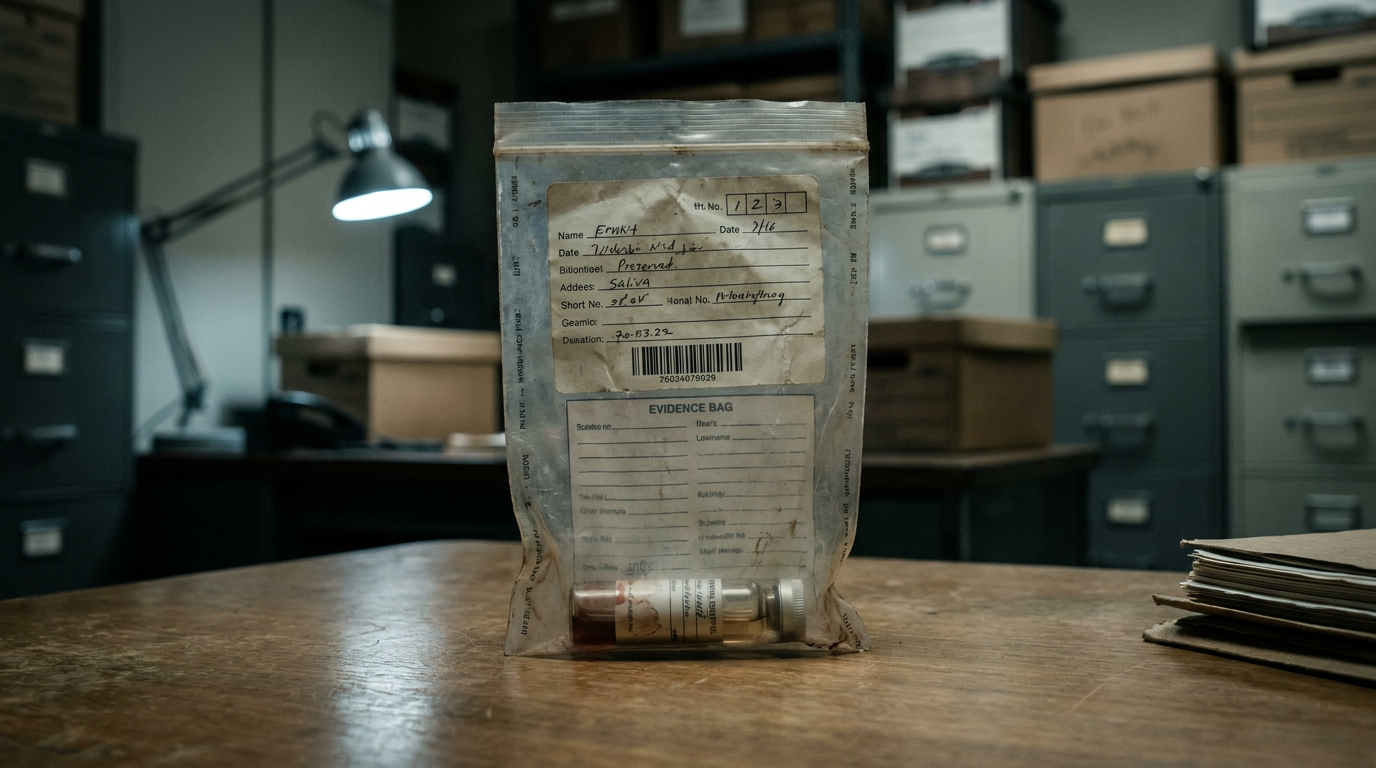
Before 2018, crime-scene DNA could only confirm a suspect you already had. Then investigators ran a killer's genome through a public genealogy database — and the entire logic of forensic identification broke open.
Serial Killers Don't Have a Type. They Have an Imprint.
New analysis of FBI confession transcripts and the world's largest serial killer database suggests victim selection isn't a preference — it's a neurologically reinforced behavioral loop with a traceable origin.