A Star in Andromeda Just Vanished Without Exploding. Scientists Caught It Happening.
For the first time, astronomers assembled a complete before-and-after record of a star collapsing directly into a black hole — and the mechanism behind the silence turns out to be stranger than a supernova.
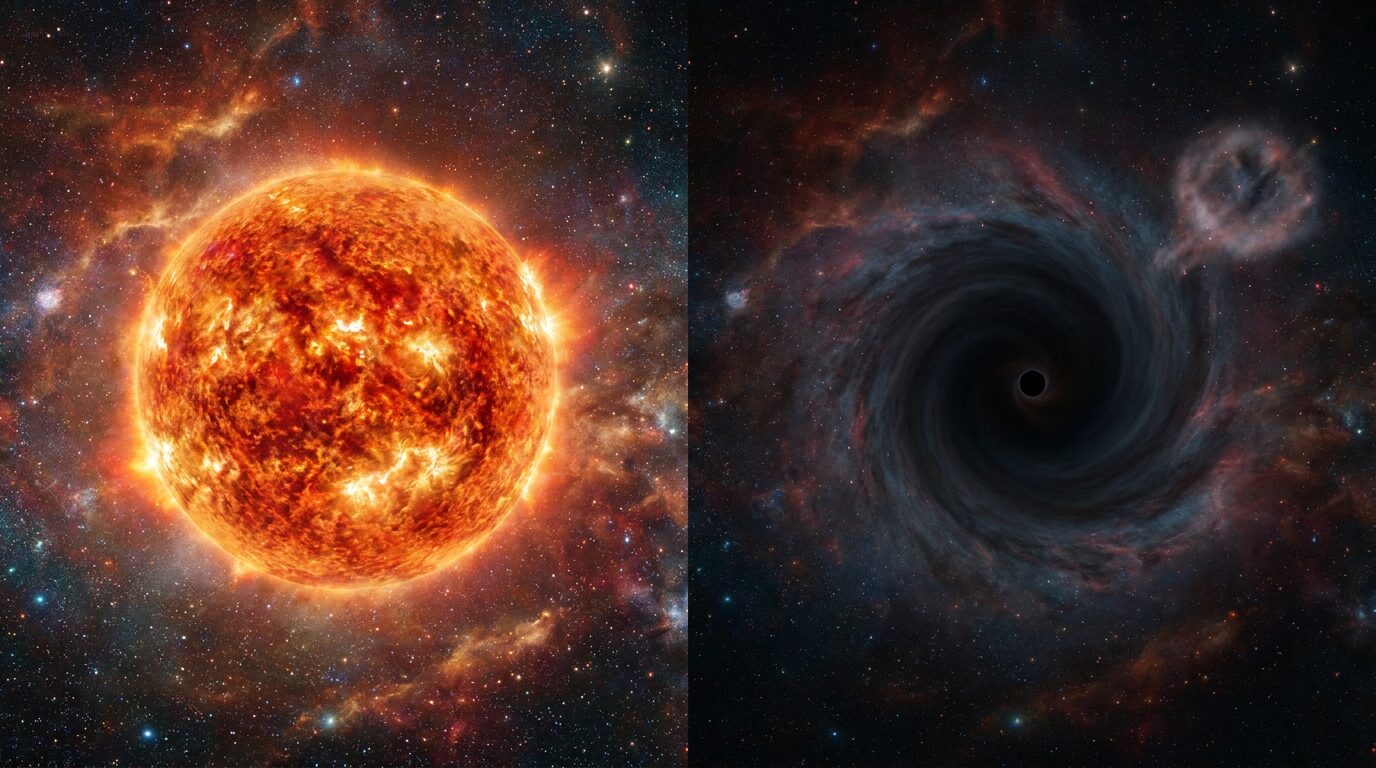
Sometime around the year 963 AD, give or take the light-travel delay across 2.5 million light-years, a massive star in the Andromeda Galaxy ran out of road. It had spent millions of years fusing hydrogen into helium, helium into carbon, carbon into heavier and heavier elements, climbing the nuclear ladder until it reached iron — the element fusion can no longer burn for a profit. At that point, the core had nowhere to go. What happened next is what makes this event unusual: almost nothing visible happened at all. No titanic detonation lit up the local group. No expanding shell of superheated gas rushed outward at thousands of kilometers per second. The star simply dimmed, faded through a brief, peculiar infrared brightening, and then was gone. The light from that disappearance reached Earth's telescopes in the early 2000s, and astronomers — going back through archival data, then watching in real time — have now assembled what may be the most complete observational record of a direct collapse event ever documented.
The analysis, produced by researchers at the Flatiron Institute's Center for Computational Astrophysics and published in Science, draws on decades of photometric monitoring across multiple telescopes and wavelengths. What they found — or rather, what they confirmed was absent — is the supernova. The star, catalogued as a luminous red supergiant in the Andromeda Galaxy (M31), appears to have collapsed its core directly into a black hole without releasing the explosive shockwave that characterizes a conventional stellar death. In the astronomy community, this process goes by a deliberately understated name: a failed supernova.
The distinction matters enormously, and not just as a taxonomic curiosity. A conventional core-collapse supernova is one of the most energetic events in the observable universe — a detonation that can briefly outshine an entire galaxy, scattering the heavy elements cooked inside the star across interstellar space. The dead stars that seeded your bones went out that way: violently, generously, spreading their nuclear output across light-years of gas and dust. A failed supernova does none of that. The star's mass falls inward faster than the explosion can propagate. The shockwave, if it forms at all, stalls. The outer envelope follows the core down, or gets briefly ejected in a weak, faint puff, and then the object that was a star is replaced by an object that emits nothing at all.
For decades, theorists had predicted that some fraction of massive stars should end this way. The question was whether anyone had actually seen it. Several candidate events had been proposed — most notably a 2009 observation of a vanishing red supergiant in NGC 6946, nicknamed N6946-BH1, which remains the strongest prior case — but the Andromeda event is the first for which researchers have pre-collapse luminosity data good enough to characterize the star's mass, evolutionary state, and final brightening in detail. This is not just a detection of something missing. It is a longitudinal portrait of how a star prepares, without knowing it, for a disappearance.
What the Data Actually Shows
The observational record begins with archival photometry — brightness measurements taken by ground-based surveys monitoring M31 for variable stars, novae, and transient events going back into the late 1990s and early 2000s. The target star was identified as a luminous red supergiant: a class of stellar objects that are genuinely enormous, with radii hundreds or even thousands of times that of the Sun, and which sit near the end of their nuclear lives. In the years before its disappearance, the star's brightness behaved roughly as expected for a variable red supergiant — fluctuating on timescales of hundreds of days, as internal convection and pulsation pushed the outer layers in and out.
Then came the anomaly. In the final months before the star's visible-light output dropped away, observers recorded a brief but significant brightening — not the sharp, sustained luminosity spike of a supernova, but a slower infrared flare. This is a crucial distinction. Infrared emission at this stage is consistent with a specific physical mechanism: the star ejecting a shell of its outer envelope just prior to collapse, with that material forming warm dust close to the stellar surface. Dust radiates in infrared. As the star's visible light dimmed and disappeared behind the opaque dust shell, the infrared signal peaked and then faded too — leaving nothing. A 2009–2015 survey of red supergiant disappearances had flagged this kind of pre-collapse dust ejection as a possible observational fingerprint of failed supernovae, and the Andromeda event matches that template closely.
“The star did not vanish without a trace. It left a specific kind of silence — one that has a shape, a duration, and a mechanism behind it.”
The Flatiron team's analysis combined optical data from the Large Binocular Telescope and archival Hubble Space Telescope[2] imaging with infrared measurements from the Spitzer Space Telescope, which was still operational during the relevant window. Spitzer's sensitivity in the 3.6 and 4.5 micron bands was particularly useful for tracking the thermal signature of the dust shell. Cross-referencing multiple wavelengths over multiple epochs allowed the researchers to rule out alternative explanations — an obscuring dust cloud unrelated to the star's death, an extreme variability episode that might resolve back into brightness, or a companion star that might have survived and be contributing residual flux. None of those alternatives holds up across the full dataset. What remains is a star that was there, then briefly hot and dusty, then absent.
Why Some Stars Skip the Explosion
The mechanics of why a massive star's death can fail to become a supernova come down to the behavior of the shockwave that forms when the core collapses. In a successful core-collapse supernova, the inward-falling outer layers rebound off the newly formed neutron star, creating a shockwave that propagates outward and tears the star apart. That shockwave is not self-sustaining on its own — it tends to stall within a fraction of a second as it pushes through increasingly dense infalling material. What revives it, according to the leading theoretical framework, is a flood of neutrinos produced in the collapsing core. Neutrinos interact almost nothing with ordinary matter, but the densities and temperatures involved during core collapse are extreme enough that even a small fraction of neutrino energy deposition can re-energize the stalled shockwave and drive the explosion.
The critical variable appears to be the mass and structure of the core at collapse. Stars above a certain mass threshold — numerical simulations of core collapse suggest the relevant boundary sits somewhere above roughly 25 solar masses for single stars, though metallicity, rotation, and binary history complicate the picture significantly — may produce cores dense enough that even the neutrino-driven revival mechanism cannot overcome the infalling material. The shockwave stalls permanently. The neutron star that forms briefly at the center accretes mass rapidly, crosses the threshold of neutron star stability, and collapses further into a black hole in milliseconds. The outer envelope, stripped of its structural support, falls inward too. What little material gets ejected — the source of that faint infrared flare — may be driven by a brief burst of neutrinos or by the release of gravitational binding energy in the final moments, but it is a fraction of what a real supernova would scatter.
“The shockwave didn't fail slowly. It failed faster than it could tell the rest of the star what was happening.”
What This Means for the Stellar Census
If failed supernovae are a real and recurring endpoint for massive stars, they have consequences that ripple through galactic astronomy in ways that have gone underappreciated. The standard model of galactic chemical evolution assumes that massive stars die as supernovae and donate their heavy-element payload to the interstellar medium. But if a significant fraction of the most massive stars collapse directly — locking their iron, nickel, and heavier nucleosynthesis products inside a black hole rather than scattering them outward — the element budget changes. Estimates from stellar population modeling and direct-collapse rate studies suggest that somewhere between 10 and 30 percent of massive stellar deaths may result in direct collapse, though the uncertainty range is still substantial. Even at the low end, that fraction is large enough to affect predictions about element abundances in galaxies and in the gas clouds that form new stars.
There is also a black hole population consequence. Core-collapse supernovae, when they leave behind compact remnants at all, tend to produce neutron stars — objects roughly 1.4 solar masses crammed into a sphere about 20 kilometers across. Failed supernovae skip the neutron star stage and go directly to a black hole, likely of significantly higher mass. If a sizable fraction of massive stars are dying this way, the universe may be producing more stellar-mass black holes, and more massive ones, than the standard supernova-dominated picture would predict. This has implications for gravitational wave astronomy: the black hole mergers detected by LIGO and Virgo carry mass distributions that encode the history of how those objects formed, and studies connecting LIGO black hole mass distributions to stellar collapse channels are now an active line of research.
The Surveillance Problem
Part of what makes this Andromeda detection so significant is how hard it is to catch. Failed supernovae are, by definition, defined by absence. You need pre-existing observations of the star to confirm it was there, and you need continuous monitoring to confirm it stopped being there — as opposed to simply dimming into a state that your instruments can no longer detect. Andromeda is the ideal target precisely because it is close enough that individual supergiant stars can be resolved in Hubble imaging, and because it has been watched for long enough that archival records contain useful pre-event photometry. Most galaxies are too far away for this kind of case-by-case stellar accounting.
The situation is improving. The Vera C. Rubin Observatory[3], currently in commissioning for its Legacy Survey of Space and Time (LSST), is designed to monitor billions of objects across the sky on nightly to weekly cadences, with enough sensitivity to detect transients in nearby galaxies at a scale no previous survey has matched. If failed supernovae produce the characteristic brief infrared flare seen in the Andromeda event, Rubin's cadence — combined with parallel infrared monitoring from facilities like the Nancy Grace Roman Space Telescope[1] — should be capable of catching several candidates per year within the local group and nearby galaxy clusters. That would transform direct-collapse black hole formation from a theoretical prediction with two or three candidate events into a statistical sample large enough to constrain the physics.
The Silence as Signal
There is something methodologically important about this class of discovery that is easy to understate. Astronomy is built on detecting photons — on receiving signals, parsing their wavelength and timing and intensity, and inferring from them the nature of their source. A star that vanishes is the photon equivalent of a signal going flat. Confirming that the flatness is real, and not an artifact of instrumentation, atmospheric conditions, or data gaps, requires exactly the kind of multi-wavelength, multi-epoch, multi-instrument cross-checking that the Flatiron analysis represents. The approach echoes the painstaking methodology used to verify other classes of transient phenomena — where absence of emission in one band had to be triangulated against detections in others before anyone would commit to a physical interpretation.
“Detecting nothing is harder than detecting something, and requires more evidence, not less.”
What the Andromeda event demonstrates is that the universe's most massive stars do not all follow the same script. The ones we track most easily — the ones that announce their death with a burst of light visible across millions of light-years — are not necessarily the representative sample. The ones that go quietly may be just as common, just as consequential for galactic chemistry and black hole demographics, and far harder to find. Every time a massive star winks out without exploding, it leaves the galaxy a little darker, a little heavier in one place and lighter everywhere else, and the interstellar medium a little less enriched than a standard supernova would have left it. The Andromeda star that vanished around the time the Abbasid Caliphate was at its height has now, a millennium of light-travel time later, given us the clearest look yet at what that silence actually costs.
References
- NASA Completes Nancy Grace Roman Space Telescope Construction (jpl.nasa.gov)
- Hubble Space Telescope (en.wikipedia.org)
Provided archival imaging data from Hubble Space Telescope used by Flatiron team to analyze the star's pre-collapse state. - Action! NSF–DOE Vera C. Rubin Observatory Begins Capturing the Greatest Cosmic Movie Ever Made | Rubin Observatory (rubinobservatory.org)
About Elias Voss
Elias Voss writes about astronomy, space missions, telescope discoveries, and cosmic anomalies - and why it matters to us here on Earth. When the universe's physics reaches down and touches life on our planet, he follows it there too. He specializes in translating dense data into vivid, precise stories without sacrificing accuracy.
More like this
Astronomers Watched a Magnetar Be Born. The Universe Was Blinking.
A supernova's strange, rhythmic afterglow gave astronomers their clearest look yet at the moment one of the universe's most extreme objects switches on.
The Universe's Oldest Supernova Just Rewrote What Stars Could Do at Cosmic Dawn
JWST confirmed a supernova from when the universe was just 730 million years old — and its unsettling resemblance to modern explosions is forcing astronomers to rethink what the earliest stars were even supposed to be.
JWST Found a Planet That Shouldn't Exist — Orbiting a Dead Star, Raining Diamonds
A Jupiter-mass planet orbiting a millisecond pulsar carries a helium-and-carbon atmosphere that no known formation pathway can produce — and the physics of what falls from its sky is stranger still.