The Universe's Oldest Supernova Just Rewrote What Stars Could Do at Cosmic Dawn
JWST confirmed a supernova from when the universe was just 730 million years old — and its unsettling resemblance to modern explosions is forcing astronomers to rethink what the earliest stars were even supposed to be.
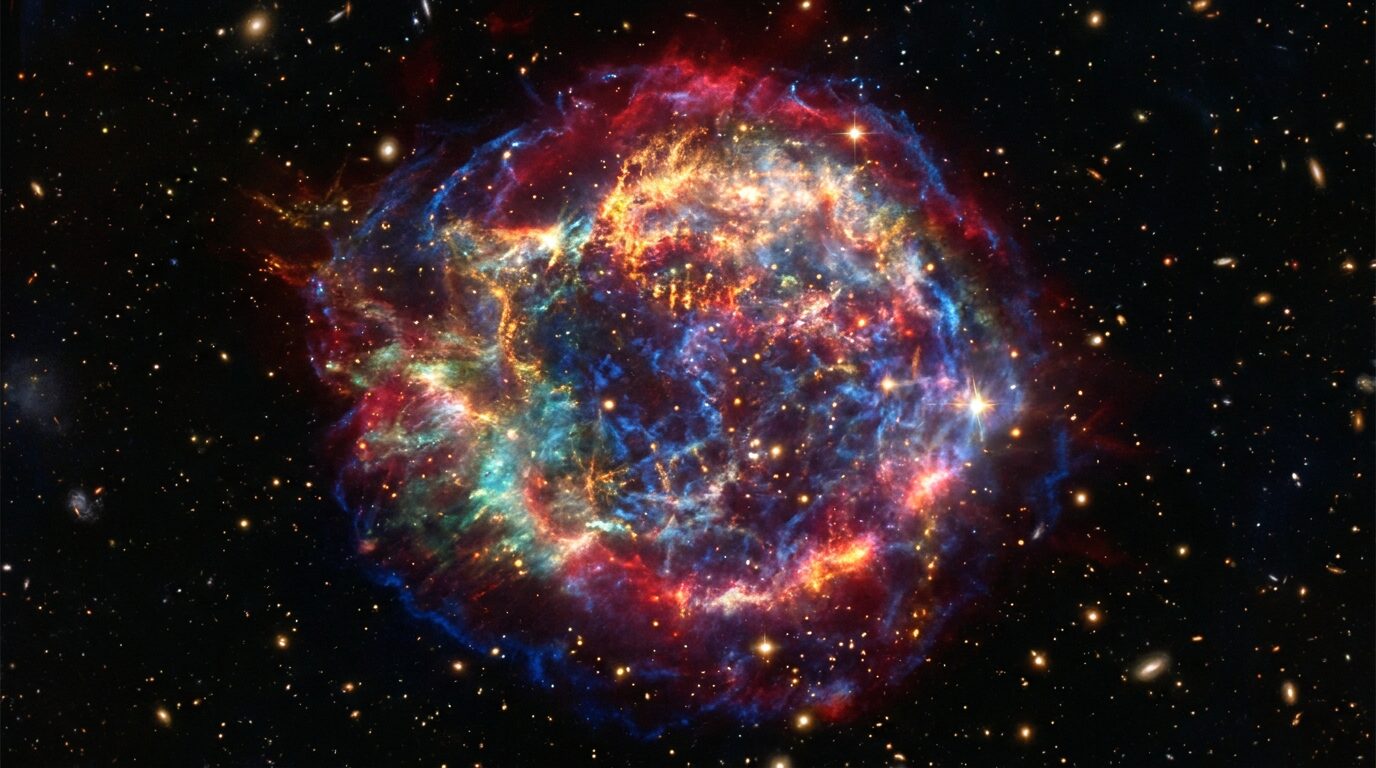
The explosion happened 13 billion years ago, give or take, when the universe was barely 730 million years old — less than six percent of its current age. The light from that event, stretched and dimmed across nearly all of cosmic time, finally landed on a detector array orbiting a gravitational equilibrium point 1.5 million kilometers from Earth[2]. The James Webb Space Telescope caught it, characterized it, and handed astronomers a problem they were not fully expecting: the supernova looked familiar. Not vaguely familiar. Specifically, uncomfortably familiar — the kind of familiar that forces a field to revisit what it thought it already understood.
The detection, confirmed and detailed in work published in Astronomy & Astrophysics in December 2025[4], marks this event as the oldest spectroscopically confirmed supernova on record[1]. That designation alone would be enough to generate serious attention. But the classification problem — what kind of explosion this was, how the data compares to modern supernova templates, and what that comparison implies about stellar physics at cosmic dawn — is where the story becomes genuinely strange. Because if you expected the first stars to die differently than ours do, the evidence is not cooperating.
The early universe was not supposed to be a comfortable place for stellar evolution as we recognize it. The first generation of stars — Population III, in the standard classification — formed from almost purely primordial gas: hydrogen, helium, and trace amounts of lithium. No carbon. No oxygen. No iron. Without heavy elements, which astronomers group under the unglamorous term "metals," the physics of star formation should have been dramatically different. These stars should have been massive beyond most modern examples, short-lived, and prone to explosions that left signatures we might barely recognize from the local universe. The supernova JWST just handed us does not obviously fit that expectation.
That is the observational puzzle. Not a mystery in the paranormal sense — no missing physics, no data that defies detection — but a genuine scientific tension between the theoretical picture of the very early universe and what an instrument is now reading off a 13-billion-year-old flash of light. Understanding why requires understanding what a supernova signature actually tells us, what JWST's infrared sensitivity makes possible that was not possible before, and what it would actually mean if the first massive stars died the same way stars die in our cosmic neighborhood today.
What a Supernova Signature Actually Contains
A supernova is not just a bright event. It is a chemical autobiography. When a massive star exhausts its fuel and its core collapses — or when a white dwarf in a binary system reaches a critical mass threshold and detonates — the explosion illuminates and disperses the star's interior, leaving behind a spectrum that records what elements were present, at what temperatures, expanding at what velocities. Astronomers have spent decades building libraries of these spectral fingerprints, calibrated against nearby events where the data is clean and the source geometry is well understood. The light curve — the way brightness rises and falls over time — adds another layer of diagnostic information. Different explosion mechanisms produce characteristic shapes.
At cosmological distances, this process gets complicated by redshift. The universe's expansion stretches the wavelengths of light, shifting ultraviolet and optical emission into infrared bands by the time it reaches a detector. For objects at redshifts above six or seven — corresponding to the universe's first billion years — ground-based telescopes and even the Hubble Space Telescope were largely blind to the infrared wavelengths that carry the relevant spectral information. JWST was built, in part, to close exactly this gap. Its NIRSpec and NIRCam instruments detect wavelengths that most previous instruments simply could not access cleanly at these distances. What was previously a blurred or absent signal is now a legible spectrum.
“The spectrum of a dying star is a chemical autobiography — and this one, from 13 billion years ago, is written in a language we already know.”
The spectrum recovered from this event appears to show absorption and emission features consistent with elements produced in standard core-collapse or thermonuclear stellar explosions, the same broad categories astronomers use to classify supernovae in the local universe. The light curve behavior, reconstructed from JWST observations across multiple epochs, tracks along familiar templates. This is not a vague resemblance picked out by motivated interpretation — it is a classification that passed the kind of comparative analysis the field uses to sort modern events into known types. The data is not perfect; it never is at these distances. But it is specific enough to constitute a genuine claim.
The Population III Problem
Standard cosmological models predict that the very first stars — Population III — were qualitatively different from anything that came later. In the absence of heavy elements, the gas clouds that formed them could not cool as efficiently, which should have caused them to fragment differently, producing stars that were on average far more massive than anything in today's galaxy. Some models predicted characteristic masses of hundreds of solar masses, with upper ranges extending beyond a thousand. Stars at those scales would die differently: some might have collapsed directly into black holes without a conventional explosion, others might have triggered pair-instability supernovae — a mechanism in which the core becomes so hot that photons spontaneously create electron-positron pairs, robbing the core of radiation pressure and triggering a runaway thermonuclear explosion that obliterates the star entirely, leaving no compact remnant.
Pair-instability supernovae leave distinctive signatures. They are exceptionally luminous. They produce specific elemental ratios — particularly a suppression of certain odd-numbered elements relative to their neighbors on the periodic table — that should appear in whatever absorbs or inherits the ejecta. They have been theorized extensively and searched for aggressively. So far, candidate detections exist but remain contested. No cleanly confirmed pair-instability supernova[3] is on the books from any redshift, early or late. The JWST event at redshift 6.7, corresponding to that 730-million-year mark, is not obviously that. Its signature does not appear to require pair-instability physics to explain.
“Pair-instability supernovae have been theorized for decades and searched for aggressively — the oldest confirmed explosion we have found is not one of them.”
There are several ways to read this. One is that the star behind this explosion, despite living in the early universe, was not a Population III star at all. Even by 730 million years after the Big Bang, some enrichment had occurred — earlier generations of stars had already lived and died and seeded the surrounding medium with at least some heavy elements. A star formed from modestly enriched gas would cool and fragment more like modern stars do, producing a mass range more similar to today's stellar populations, dying via a mechanism we recognize. The supernova would look modern because the star was, in a meaningful physical sense, somewhat modern.
Another reading: the Population III mass distribution was never as extreme as the most aggressive models suggested. Simulations of early star formation have evolved considerably over the past two decades, with some recent work favoring a broader mass range that includes stars comparable in scale to those forming today. If that is correct, then conventional core-collapse supernovae — the kind that leave neutron stars behind, the kind described in every astrophysics textbook — were always plausible outcomes in the early universe. In that case, the JWST detection is not surprising. It is a confirmation that stellar physics, at its core, does not care about cosmic age.
Why JWST Changes the Detection Calculus
Before JWST, supernova astronomy at these redshifts was constrained to photometric detection — measuring brightness in broad wavelength bands without the spectral resolution needed to confirm what type of event had occurred or what elements were present. Candidates were flagged but rarely classified with confidence. The instrument's sensitivity and wavelength coverage changes what is achievable. A supernova at redshift 6.7 that would have appeared as a faint, ambiguous brightness variation to previous instruments is now, in principle, something that can be read. The spectrum can be taken. The light curve can be sampled across multiple visits. Classification becomes possible rather than speculative.
This has implications beyond this single event. JWST is now actively surveying for transient phenomena — events that appear, brighten, and fade — at cosmological distances. The pipeline for detecting, flagging, and following up on supernova candidates in the early universe is operational. The expectation is that this detection will not remain singular for long. As more events accumulate, the statistical picture will sharpen. If all confirmed supernovae from the first billion years look like modern ones, that pattern becomes evidence for something. If the sample eventually reveals outliers — events that deviate sharply from local templates, with light curves or spectral features that modern libraries cannot match — that would be evidence for something different. Right now, with one confirmed event, neither conclusion is safe.
What the Chemistry of Cosmic Dawn Actually Tells Us
One of the most consequential things a supernova does, from the perspective of cosmic history, is spread elements. The heavy elements produced in a massive star's core and dispersed by its explosion become the raw material for the next generation of stars, planets, and eventually everything else. The pattern of elemental abundances in old stars — stars that formed early and retained the chemical imprint of the generation before them — carries a record of what kind of supernovae enriched their birth clouds. Astronomers call this field chemical evolution, and it is one of the primary observational handles on what early stellar populations actually looked like.
The most metal-poor stars we can observe in the Milky Way and its satellite galaxies are, in effect, fossils. Their chemical abundances encode the ejecta of the earliest supernovae, filtered through subsequent stellar generations. The patterns in these abundances have been used to argue for and against various early supernova mechanisms — including pair-instability events — for years. The direct detection of an early supernova via JWST does not immediately resolve these chemical arguments, but it gives the field a contemporaneous data point rather than an archaeological one. If the spectral classification holds up under further scrutiny, it connects the theoretical framework of chemical evolution to an actual observed event at the relevant cosmic epoch.
The Texture of an Unresolved Question
“Unexplained does not mean inexplicable — but a 13-billion-year-old explosion that looks exactly like a modern one is not a closed case, either.”
It would be easy to write this story as a triumph of modern instrumentation and leave it there. JWST looked far back in time, found the oldest confirmed supernova, classified it, published the result. That is a real achievement and should be recognized as one. But the classification carries a tension that is worth sitting with. If the explosion looks like a modern core-collapse supernova, then either the star was not a true Population III object, or the Population III category is less exotic than decades of theory suggested, or we are seeing the edge case of a mass distribution that peaked elsewhere and produced this kind of event rarely. Any of those interpretations rewrites something. None of them closes the question of what the very first stars actually looked like and how they actually died.
The hunt for a cleanly confirmed Population III supernova — a genuinely exotic explosion from a genuinely metal-free star — remains open. The JWST discovery at redshift 6.7 is an extraordinary data point, the oldest of its kind by a significant margin. But its ordinariness, if confirmed, is itself information. The early universe may have been producing massive stars that died in recognizable ways earlier than models comfortably predicted. Or the census of early supernova types is simply not large enough yet to show us the outliers we are theoretically expecting. Thirteen billion years of light travel time later, a detector finally sharp enough to read the signal, and the answer it returns is: we have seen this before. Whether that is reassuring or unsettling depends entirely on what you expected cosmic dawn to look like.
References
- NASA’s Webb Identifies Earliest Supernova to Date, Shows Host Galaxy - NASA Science (science.nasa.gov)
Confirms JWST's detection of a supernova at 730 million years after the Big Bang and identifies its faint host galaxy. - Orbit - NASA Science (science.nasa.gov)
Specifies JWST's orbital location at 1.5 million kilometers from Earth at the second Lagrange point. - Pair-instability evolution and explosions in massive stars (arxiv.org)
Establishes that no cleanly confirmed pair-instability supernova has been detected at any redshift, providing context for why the JWST event is not obviously one. - JWST reveals a supernova following a gamma-ray burst at z ≃ 7.3 (aanda.org)
Publishes the December 2025 peer-reviewed study confirming and detailing the oldest spectroscopically confirmed supernova discovery.
About Rowan Ellery
Rowan Ellery writes about anomalies, unexplained sightings, strange signals, and the uneasy border between observation, misinterpretation, and genuine mystery. Their work focuses on keeping curiosity alive without letting evidence dissolve into folklore.
More like this
Ghosts of the First Stars: What Ancient, Metal-Poor Suns Are Telling Us About the Universe's Earliest Chemistry
A small population of stars in the Milky Way's outer halo carries chemical signatures from before the universe knew how to make iron — and what spectrometers are finding in them is forcing a rethink of how fast the early cosmos grew complex.
The Universe's First Stars Were 10,000 Times the Size of the Sun. We Just Found the Ash.
A nitrogen fingerprint in an ancient galaxy suggests the universe's first stars were so massive that no modern physics textbook accounted for them — and their collapse seeded everything that came after.
A Star in Andromeda Just Vanished Without Exploding. Scientists Caught It Happening.
For the first time, astronomers assembled a complete before-and-after record of a star collapsing directly into a black hole — and the mechanism behind the silence turns out to be stranger than a supernova.