JWST Found a Planet That Shouldn't Exist — Orbiting a Dead Star, Raining Diamonds
A Jupiter-mass planet orbiting a millisecond pulsar carries a helium-and-carbon atmosphere that no known formation pathway can produce — and the physics of what falls from its sky is stranger still.
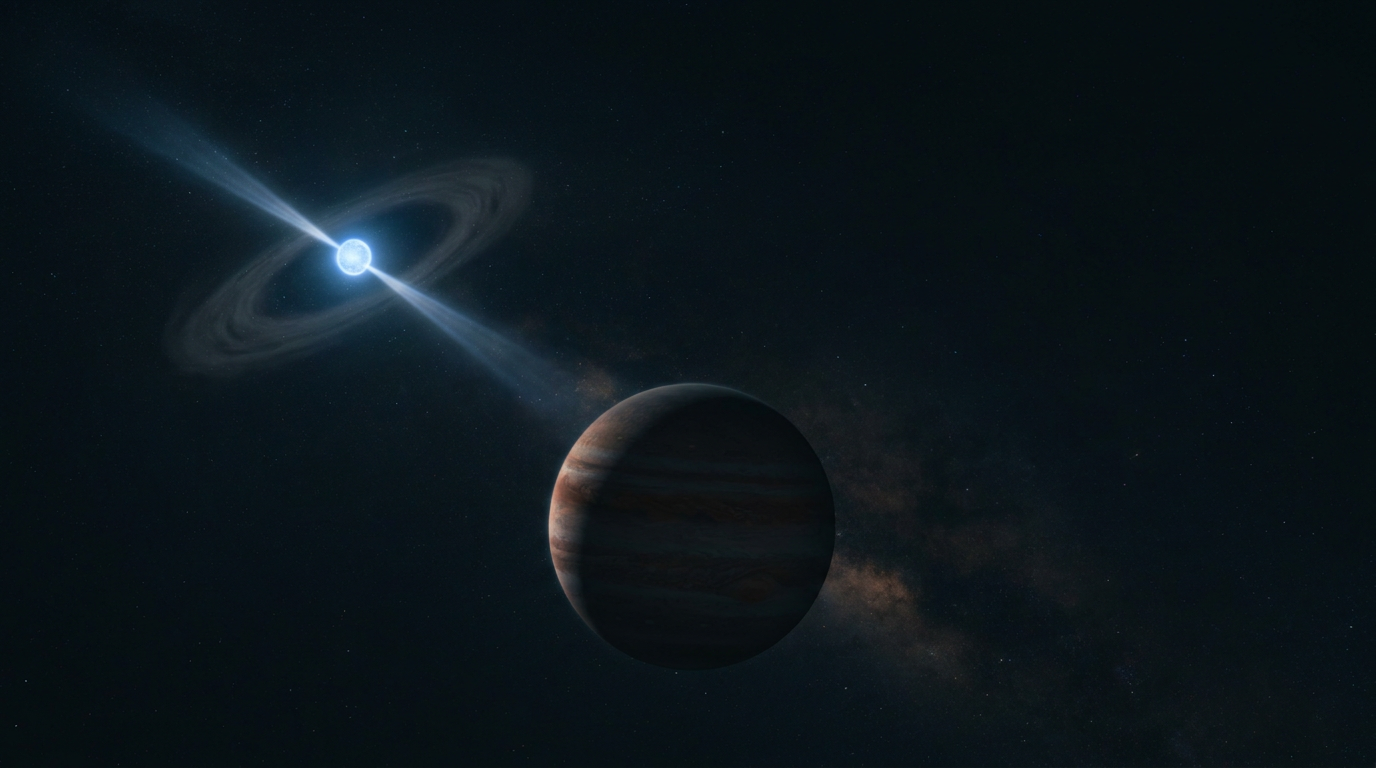
Pulsars are not forgiving environments. A millisecond pulsar — a neutron star spinning hundreds of times per second, its magnetic field churning out beams of X-ray and gamma radiation powerful enough to strip electrons from atoms at range — is about as hostile a neighborhood as the galaxy produces. It is the residue of a star that tore itself apart in a core-collapse supernova, a detonation energetic enough to briefly outshine entire galaxies. That anything orbits a millisecond pulsar at all is already a small structural miracle. That something the mass of Jupiter does, close enough for its atmosphere to be irradiated continuously, is the kind of finding that ends up reshaping what planetary science thinks it knows about itself.
The system in question sits roughly 1,200 light-years from Earth. The planet — designated PSR J0952-0607 b in the technical literature, though the shorthand among researchers who have been tracking it is simply the Remnant World — orbits its pulsar host in just under nine hours. That is not a typo. Nine hours to complete a full orbit, which places it at roughly one percent of the Earth-Sun distance from a spinning stellar corpse. At that proximity, the radiation flux hitting the planet's upper atmosphere is orders of magnitude more intense than anything in our solar system experiences. And yet, when the James Webb Space Telescope's NIRSpec instrument turned toward this system and began pulling apart the light, it found an atmosphere — structured, layered, and chemically distinct in ways that have since produced a sustained argument among astrophysicists about what they are actually looking at.
The atmosphere is composed predominantly of helium, with a significant carbon fraction and trace signatures that remain under analysis. There is no hydrogen. There is no oxygen. There is no nitrogen. The composition is so far outside what planetary formation models predict for a gas giant — which should be hydrogen-dominated by a large margin — that the initial reaction from several research teams was to recheck the instrument calibration. NIRSpec works by dispersing light from a target into its component wavelengths, allowing scientists to read the absorption lines produced when specific molecules intercept starlight passing through the atmosphere. In this case, the pulsar itself provides the illuminating radiation, and what the atmosphere does to that radiation before it reaches the telescope is a direct record of what the atmosphere contains. The instrument checked out. The signal was real.
What makes this discovery particularly difficult to set aside is not just the composition but the pressure of the argument around it. The helium-and-carbon combination rules out accretion from a protoplanetary disk — the standard pathway for gas giant formation — because protoplanetary disks are hydrogen-rich, and a Jupiter-mass world pulling mass from a disk should end up with a hydrogen envelope. It rules out formation from supernova ejecta because the thermal and chemical dynamics of a blast cloud do not produce structured planetary atmospheres on the timescales available. And it raises a genuinely unresolved question about where this planet was before the supernova, what the explosion did to whatever it was then, and how anything survived at all.
What the Supernova Left Behind
Millisecond pulsars arrive at their rotation rates through a specific process called recycling, which requires a binary companion. After the original star explodes and leaves a neutron star behind, the neutron star can spin up to millisecond periods by accreting mass from a companion — essentially being whipped into rotation by infalling material over millions of years. The companion in such systems is usually a low-mass star that donates material until it becomes a helium white dwarf or is consumed nearly entirely. What is left of the companion is sometimes nothing, sometimes a white dwarf remnant, and in rare cases apparently something more — a compressed, irradiated object with enough mass to retain a gravitational grip on an atmosphere even in the extreme radiation environment a millisecond pulsar produces.
One leading interpretation of the Remnant World is that it is exactly that: the evaporated core of what was once the pulsar's binary companion. Over millions of years of mass transfer, the companion was stripped down to its degenerate helium core, and the remaining object — dense, massive, and orbiting close — kept some fraction of atmospheric material because its own gravity, and possibly a strong magnetic field, partially shielded it against the pulsar wind. If this picture is correct, what JWST is reading in its spectral data is not the atmosphere of a planet that formed the way planets are supposed to form. It is the exposed interior chemistry of a dead star, now orbiting an even deader star, held together by its own compression.
“What JWST may be reading is not the atmosphere of a planet that formed like other planets — it may be the exposed interior chemistry of a dead star orbiting an even deader one.”
The carbon fraction complicates this story in an interesting way. Helium-core remnants are expected to have some carbon, produced through helium fusion, but the ratio JWST measured is higher than standard models of helium white dwarf interiors predict. That excess could indicate that some of the carbon-oxygen layer beneath the helium envelope was also exposed as the outer layers were stripped away over the mass-transfer phase. Alternatively, the pulsar radiation itself may be driving photochemical reactions in the atmosphere that enrich the observable upper layers with carbon compounds. Neither explanation is clean. Both require further observation to distinguish, which is one reason teams are currently competing for additional JWST time to build a more complete spectral picture of the system across different orbital phases.
The Diamond Rain Question
When you have a carbon-rich atmosphere under high pressure and high temperature, the question of what precipitation looks like becomes genuinely strange. In the interior atmospheres of ice giants like Neptune and Uranus, models have long predicted — and laboratory simulations have since partially confirmed[1] — that the pressure and temperature conditions at depth are sufficient to compress carbon into diamond crystalline structures, which then precipitate downward through the liquid mantle. The process requires pressures on the order of millions of atmospheres and temperatures in the range of several thousand Kelvin. In the Remnant World, which is a compressed degenerate object with a carbon-enriched atmosphere already under significant radiative and gravitational loading, some researchers have proposed that similar conditions may exist at atmospheric depths JWST cannot yet probe directly.
“Under sufficient pressure and temperature, carbon does not stay gaseous — it crystallizes, and in a world like this one, what falls from the sky is not rain in any ordinary sense.”
This is inference layered on inference, which is worth being honest about. JWST's NIRSpec measurements give us composition at the observable upper atmosphere. What happens deeper — where the pressure gradient steepens and the temperature climbs beyond what surface spectroscopy can read — is modeled, not observed. The diamond precipitation hypothesis depends on assumptions about the planet's interior structure that will not be testable with current instrumentation. What is observable, however, is the atmospheric temperature profile derived from the spectral data, and it is consistent with conditions under which carbon chemistry becomes exotic. The upper atmosphere of the Remnant World runs somewhere between 2,000 and 3,500 Kelvin in current estimates — hotter than the surface of some stars — driven by the pulsar's continuous irradiation.
The heating dynamics are themselves worth examining. A millisecond pulsar does not simply warm an orbiting object the way a star warms a planet. The energy arriving at the Remnant World is not predominantly infrared and visible light. It is X-ray and high-energy ultraviolet radiation, and it interacts with the atmosphere through ionization rather than simple thermal absorption. This means the upper atmosphere is likely in a state of continuous partial ionization, with electrons being stripped from helium and carbon atoms and recombining on timescales of seconds. The energy deposited through this cycle drives the temperature profile JWST observed, and it also generates its own emission signatures — which is part of why the spectral data is complex enough that multiple teams are still working through the interpretation.
Why Only Webb Could Read This
The Hubble Space Telescope has been observing pulsar systems for decades. Ground-based observatories with adaptive optics have contributed orbital timing data. The Chandra X-Ray Observatory and the XMM-Newton satellite have characterized the pulsar's emission in detail. None of them could do what NIRSpec did here, for a specific reason: transmission spectroscopy of a compact, dim object this close to a pulsar requires both the infrared sensitivity and the spatial resolution to separate the planet's atmospheric signal from the overwhelming flux of its host. The Remnant World does not transit its pulsar in the classical sense — it does not pass in front from Earth's vantage at the right angle to produce a clean transit light curve. Instead, researchers used a phase-curve approach, tracking how the combined infrared emission from the system changed as the planet moved through different orbital positions, then subtracting the pulsar's known emission profile to isolate the atmospheric contribution.
This required JWST's NIRSpec microshutter assembly, which can isolate individual targets in a crowded field with extraordinary precision, combined with the telescope's infrared wavelength coverage from 0.6 to 5.3 microns. At those wavelengths, helium has a clean absorption feature near 1.083 microns that is essentially invisible to optical telescopes but unmistakable to NIRSpec. Carbon compounds — particularly carbon monoxide and carbon dioxide, though the specific molecular forms are still being resolved — produce features across the 2 to 4.5 micron range that JWST can read with signal-to-noise ratios no previous observatory could achieve for an object this faint and this close to a high-emission source. Hubble, operating primarily in the optical and near-ultraviolet, would have been blinded by the pulsar before it could isolate the planet. Webb's design was not built for this application specifically, but it turns out the instrument requirements for this observation and for studying exoplanet atmospheres around quieter stars overlap in exactly the right ways.
What Formation Models Have to Account for Now
The Remnant World is not the first planet found orbiting a pulsar. PSR 1257+12, a millisecond pulsar about 2,300 light-years away, was confirmed to host at least three planets in the early 1990s[3] — one of the first confirmed exoplanet detections in history, predating the transit and radial velocity detections around sun-like stars that eventually became the dominant discovery method. Those planets are thought to be rocky, possibly assembled from supernova debris or from the disrupted remnants of a companion star. The Remnant World is different in scale and chemistry from anything in that system, which is part of why it demands its own explanation rather than borrowing one.
“The universe builds planets in more ways than we have models for, and this one just made that embarrassingly clear.”
The companion-stripping hypothesis — that this is the remnant core of the pulsar's old binary partner — currently fits the available data better than any alternative, but fitting available data is not the same as explaining how the object got to its current state with its atmospheric composition intact. The mass transfer phase in a recycled pulsar system lasts on the order of hundreds of millions of years. During that time, the companion is being actively ablated. The surviving object then has to hold its atmosphere against billions of years of pulsar irradiation at close range. The fact that it apparently has is not well-explained by any published model of atmospheric retention under these conditions. Researchers working in this area are already discussing revised ablation models that account for a strong internal magnetic field in the remnant body — something analogous to how Earth's magnetic field deflects the solar wind — as a partial shield mechanism. That idea has not been tested observationally, and the Remnant World may not give us enough of a geometric angle to probe its magnetic environment directly.
The Edge of What Observation Can Settle
There is a version of this story that ends tidily: more JWST observations across multiple orbital phases will constrain the temperature profile, pin down the molecular ratios more precisely, and give theorists enough to choose between the formation hypotheses currently on offer. That may happen. But the deeper question — what kind of object the Remnant World actually is, whether it is better understood as a planet or as the compressed remnant of a stellar companion that never quite made it to white-dwarf silence — is not purely an observational question. It is also a definitional one, and planetary science has never been especially comfortable with objects that refuse to sit in clean categories. Hot Jupiters challenged the idea that gas giants could only form far from their host stars. Super-Earths made the terrestrial-versus-gas-giant binary look too simple. The Remnant World is doing something similar to the boundary between planetary science and stellar death physics, sitting squarely in the overlap and demanding that both fields renegotiate where their models are supposed to end.
Pulsars were once anomalies too — rotating radio sources so regular they were briefly, half-seriously, catalogued under the designation LGM-1, for Little Green Men[4], because no natural mechanism seemed plausible enough. The mechanism was eventually found: rotating neutron stars with misaligned magnetic axes, sweeping their beams through space like lighthouses. The Remnant World will probably get a clean explanation eventually, too. But the process of reaching it — the additional observations, the revised ablation models, the argument about whether diamond precipitation is physically plausible at depth, the debates about what atmospheric retention actually looks like on a compressed degenerate body — is going to reshape how we think about what survives a star's death, and what the universe does with the pieces.
References
- Scientists Create ‘Diamond Rain’ That Forms in the Interior of Icy Giant Planets (www6.slac.stanford.edu)
Provides laboratory confirmation that carbon crystallizes into diamonds under high pressure and temperature conditions similar to those proposed for the Remnant World's atmosphere. - A Carbon-rich Atmosphere on a Windy Pulsar Planet (iopscience.iop.org)
- PSR B1257+12 (en.wikipedia.org)
Establishes historical precedent that pulsars can host planets, with PSR B1257+12 confirmed to have at least three planets in the early 1990s. - PSR B1919+21 (en.wikipedia.org)
About Elias Voss
Elias Voss writes about astronomy, space missions, telescope discoveries, and cosmic anomalies - and why it matters to us here on Earth. When the universe's physics reaches down and touches life on our planet, he follows it there too. He specializes in translating dense data into vivid, precise stories without sacrificing accuracy.
More like this
We've Found Over 5,000 Exoplanets. Almost None of Them Are Like Earth.
The most common world in the galaxy sits in a size range our solar system completely skipped — and planetary scientists aren't sure whether that's physics or blind spot.

The Gamma-Ray Burst That Fired for 7 Hours Doesn't Fit Any Known Physics
GRB 250702B lasted nearly twice as long as any gamma-ray burst ever recorded, and the two leading explanations for it are mutually incompatible — which means at least one of them has to be wrong.
A Star in Andromeda Just Vanished Without Exploding. Scientists Caught It Happening.
For the first time, astronomers assembled a complete before-and-after record of a star collapsing directly into a black hole — and the mechanism behind the silence turns out to be stranger than a supernova.