The FRB That Fired Once, Left a Partner Behind, and Broke the Rulebook
A fast radio burst caught inside a binary star system just overturned the leading explanation for what produces them — and the real problem is that the burst only fired once.
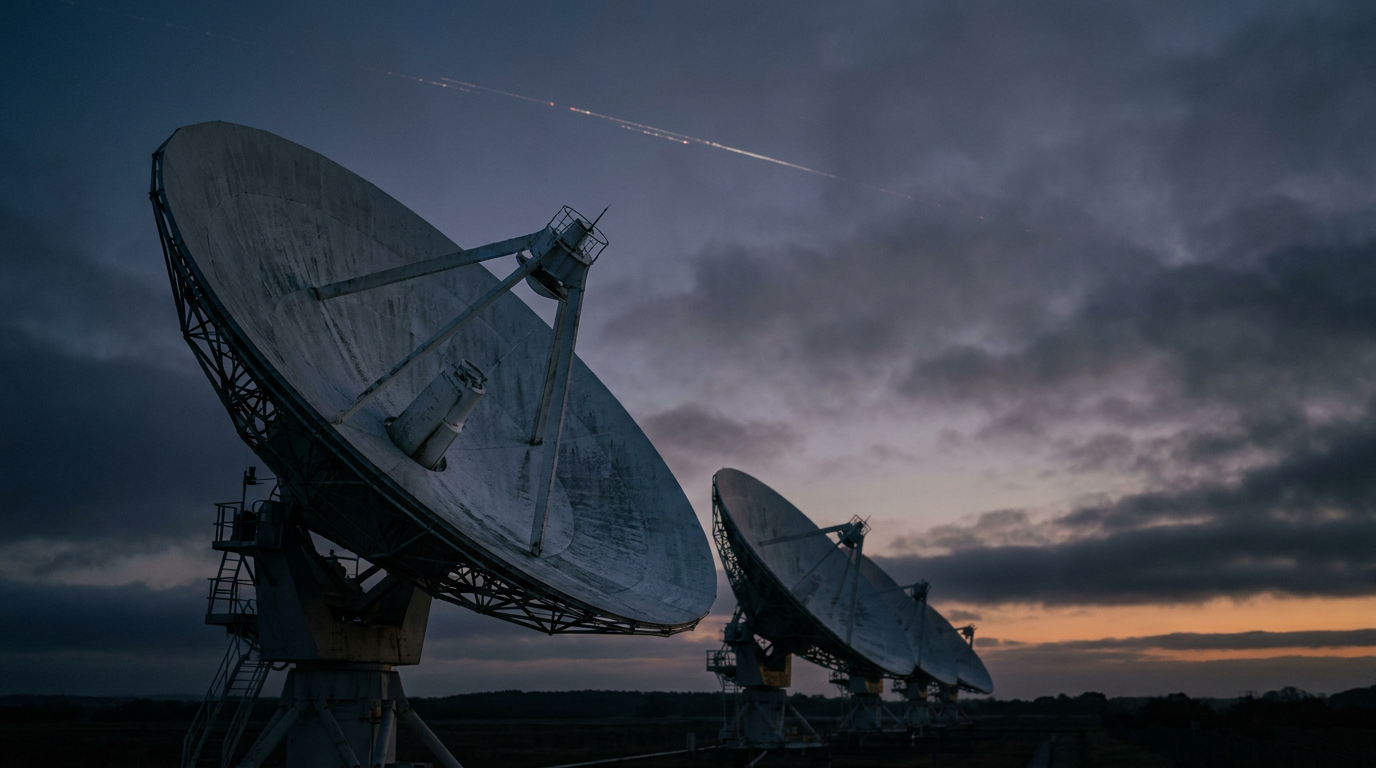
The signal arrived in milliseconds. Less than the blink of a human eye, a radio pulse crossed a billion light-years of intergalactic space and was captured by a telescope array on Earth, logged, timestamped, and added to the growing catalog of what astronomers call fast radio bursts. Then it went quiet. No repeat. No follow-up pulse. No additional structure in the data to suggest it was building toward something. Just a single, luminous scream from somewhere deep in the universe, and then silence.
Fast radio bursts — FRBs — have been the most aggressively puzzling signal problem in modern astronomy for roughly two decades. They release more energy in a millisecond than the Sun produces in days, they arrive from extragalactic distances with no obvious pattern, and they resist clean categorization. Some repeat. Most, so far as anyone can tell, do not. The ones that repeat have helped build a tentative consensus around their origin: magnetars, dense stellar corpses with magnetic fields so intense they occasionally rupture, producing bursts of radio energy that can be detected across the observable universe. It was a tidy model. Imperfect, but tidy.
Then came a particular non-repeating burst, cataloged and studied carefully enough that researchers could do something that is genuinely rare in FRB science: they could reconstruct where it came from with enough precision to look at the neighborhood. What they found sitting next to the burst's home region was another object. A companion. The burst had not come from a lone magnetar spinning alone in the interstellar dark. It had come from inside a binary star system — a relationship, in cosmic terms, between two objects that share gravitational architecture and mutual history.
That single finding, reported in Science[2], is not dramatic in the way that headlines about space tend to be dramatic. There is no photograph. No alien signal. No imminent threat. But it is, quietly and precisely, the kind of result that changes the shape of a problem. If a non-repeating burst can originate inside a binary system, the magnetar-alone model has a serious architecture problem. And the implications branch outward from there in directions that are still being untangled.
What a Fast Radio Burst Actually Is
Before the significance of the binary connection can land properly, it helps to understand how imprecise the phrase "fast radio burst" actually is. It describes a detection characteristic — a brief, bright, dispersed pulse of radio waves — not a mechanism. An FRB is defined by what the instruments see, not by what produced it. The dispersion measure, a quantity derived from how the pulse's higher and lower frequencies arrive at slightly different times, tells astronomers roughly how much ionized material the signal passed through on its way here, which gives a rough distance estimate. But the source itself, the actual engine of the burst, has remained inferred rather than directly observed.
The magnetar hypothesis has the most observational support. In 2020, a magnetar inside our own galaxy, designated SGR 1935+2154[1], produced a burst detectable by Earth instruments[1] — the first time a known source had been caught making something close to an FRB. That was significant. It established that magnetars can, under the right conditions, produce bursts at the right energy scale and in the right frequency range. The problem is that the galactic burst was considerably fainter than the extragalactic events the major catalogs have been accumulating. Whether all FRBs are magnetar-produced, and whether the mechanisms are the same across all of them, remained open questions before the binary discovery. They remain open now, but the shape of the openness has changed.
“An FRB is defined by what the instruments see, not by what produced it.”
The Burst That Had Company
The burst at the center of the recent research was localized — pinned to a specific host galaxy with sufficient precision to examine the immediate stellar environment. Localization at this level is technically demanding. Most FRBs are detected with instruments that lack the angular resolution to say anything precise about where within a host galaxy the signal originated. The events that make it into the detailed-environment category are a small, hard-won subset. This one made it.
What the localization revealed was a persistent radio source at the burst location — an object that was there before the burst and remained after it. That persistent source has the characteristics consistent with a companion object, most likely a massive star or a compact object like a neutron star, locked in a binary orbit with whatever produced the burst. The burst itself, on this reading, was not a solo event. It was something that happened within a gravitational relationship, between objects that have been shaping each other's environment, stellar winds, magnetic fields, radiation output, and orbital dynamics for potentially millions of years.
The specific architecture matters. A lone magnetar in an empty region of space evolves in relative isolation. Its magnetic field decays on timescales of thousands to millions of years. Its surface crusts settle. It cools. A magnetar inside a binary system lives in a fundamentally different environment. Its companion may be actively transferring mass onto it, replenishing or reshaping its magnetic field, stressing its crust in ways that a lone magnetar never experiences. The orbital dynamics could introduce stresses, tidal forces, and electromagnetic interactions that have no equivalent in the solitary case. Whatever produced this burst was embedded in all of that complexity. The silence after — the failure to repeat — is then not simply a statistical feature. It may be a physical clue about what the binary environment does to the burst mechanism.
Why Not Repeating Changes the Problem
The division between repeating and non-repeating FRBs has always been treated with some caution by researchers who know that observation time is limited and that a source observed once may simply not have been watched long enough to catch a second burst. That is a legitimate concern. The classification problem — deciding whether something is genuinely non-repeating versus merely not-yet-caught-repeating — is a known source of confusion in the field, and it has produced real debates about whether repeaters and non-repeaters are genuinely two populations or one population with variable behavior.
The binary-associated burst, however, was monitored with sustained follow-up observation. The silence has been meaningful in duration, not just a gap before the next detection window. A magnetar in a binary system that had fired once and then stopped does not easily fit the standard magnetar flare model, in which the mechanism is essentially crust-cracking under magnetic stress — a process that, once initiated, tends to produce episodic activity rather than a single event and then nothing. The persistent radio source companion sits there in the data, still broadcasting, while the burst source has gone quiet. What is it doing in the silence? That question currently has no clean answer.
“The silence after is not simply a statistical feature. It may be a physical clue about what the binary environment does to the burst mechanism.”
What the Standard Model Gets Wrong Now
The leading magnetar model was built, reasonably enough, from the available constraints. Magnetars are energetically capable. The galactic example proved they can produce FRB-like bursts. Their magnetic field decay is erratic enough to explain the irregular timing of repeaters. The model was not proven, but it was the most parsimonious option that fit the data.
A binary system introduces parameters the solo-magnetar model was not designed to accommodate. Orbital period. Mass transfer rate. Companion type. Wind-wind interaction. The companion's own electromagnetic output. Depending on the orbital separation and the nature of the companion, a magnetar in a binary could be experiencing conditions that have no analog in the scenarios the standard model was built around. If those conditions are doing something to the burst mechanism — suppressing repeats, shaping the burst's spectral properties, affecting the dispersion environment — then any model that treats the magnetar as an isolated object in empty space is structurally incomplete, not just quantitatively wrong.
There are alternative source models that have been proposed over the years. Collisions between compact objects. Interactions between neutron stars and their orbital companions in ways that do not require the lone-magnetar mechanism. Accretion events. Precessing jets. Some of these naturally incorporate binary environments and some do not. The binary discovery does not rule the magnetar hypothesis out entirely — a magnetar inside a binary is still a magnetar — but it insists that the binary context be part of the model, which is a stronger constraint than most existing FRB frameworks were built to satisfy.
What Gets Harder from Here
The immediate practical problem is that localization good enough to examine the stellar environment of an FRB is hard to achieve at scale. Of the hundreds of FRBs that have been detected and cataloged, a relatively small number have been localized with the precision needed to make statements about companion objects or stellar neighborhoods. The instruments capable of this kind of work — high-resolution interferometric arrays, mostly — are in high demand across multiple areas of radio astronomy, and the FRB field competes for time like everyone else.
The next generation of radio facilities, including planned expansions to existing arrays and new telescope infrastructure being developed internationally, should improve localization rates substantially. That will help. But it will also almost certainly complicate the picture. More well-localized FRBs will mean more environmental contexts, more companion objects or their absence, more orbital configurations to try to fit into a unified model. The binary discovery raises the possibility that the FRB population is more environmentally diverse than the standard model implied — that the mechanism behind a burst is not just about the source object's internal properties but about the gravitational and electromagnetic context that object lives in.
“The binary discovery insists that the context be part of the model — which is a stronger constraint than most existing FRB frameworks were built to satisfy.”
The Partner That Stayed Quiet
There is something in this case that resists tidy summary, and it is worth sitting with it rather than smoothing it over. A fast radio burst is by definition a transient event — something that was and then was not. The model built around it imagines a source that is fundamentally alone, firing energy into space independent of anything around it. The binary finding says that at least in this case, the source was never alone. It had a partner. That partner persists, quietly broadcasting, in the data that remains after the burst has gone quiet. The relationship between those two objects — whatever it involved in the moments leading up to the burst, during it, and since — is the actual physical context in which the event occurred. Studying the burst without studying that relationship is like documenting a single conversation without acknowledging that the two people involved had history.
The magnetar model may survive this, modified. Some other model may fit the binary case better and turn out to generalize. What will not survive, or should not, is the instinct to treat the burst source as an isolated object when the data says otherwise. The universe has a way of making the lonely explanation wrong. One flash of radio energy, traveling for a billion years, arrives on Earth carrying information about a relationship — and the relationship turns out to be the part that breaks the theory. That is not the resolution of a mystery. That is how a mystery deepens properly.
References
- A fast radio burst associated with a Galactic magnetar (nature.com)
Provides the 2020 observation of magnetar SGR 1935+2154 producing an FRB-like burst, establishing that magnetars can generate bursts at the required energy scale. - reported in Science (science.org)
Reports the recent discovery of a non-repeating FRB localized to a binary star system, the central finding that challenges the solo-magnetar model.
About Rowan Ellery
Rowan Ellery writes about anomalies, unexplained sightings, strange signals, and the uneasy border between observation, misinterpretation, and genuine mystery. Their work focuses on keeping curiosity alive without letting evidence dissolve into folklore.
More like this
The Radio Burst Lasted a Millisecond. The Argument About It Has Lasted Years.
Fast radio bursts arrive from across the universe in under a millisecond — brilliant, violent, and until recently, assumed to be unrepeatable. A handful of them have since proved that assumption wrong, and the physics debate that followed is far from over.
The Brightest Radio Flash Ever Detected Has a Silence Problem
For the first time, astronomers pinpointed a record-breaking fast radio burst to a region smaller than most star clusters — and what they found there quietly threatens the theory meant to explain all of them.
The FRB That Fired 11,553 Times Has a Math Problem. The Standard Model Can't Solve It.
A hyper-active fast radio burst has already burned through most of what a magnetar can store — and the source was still going when astronomers stopped watching.