Astronomers Watched a Magnetar Be Born. The Universe Was Blinking.
A supernova's strange, rhythmic afterglow gave astronomers their clearest look yet at the moment one of the universe's most extreme objects switches on.
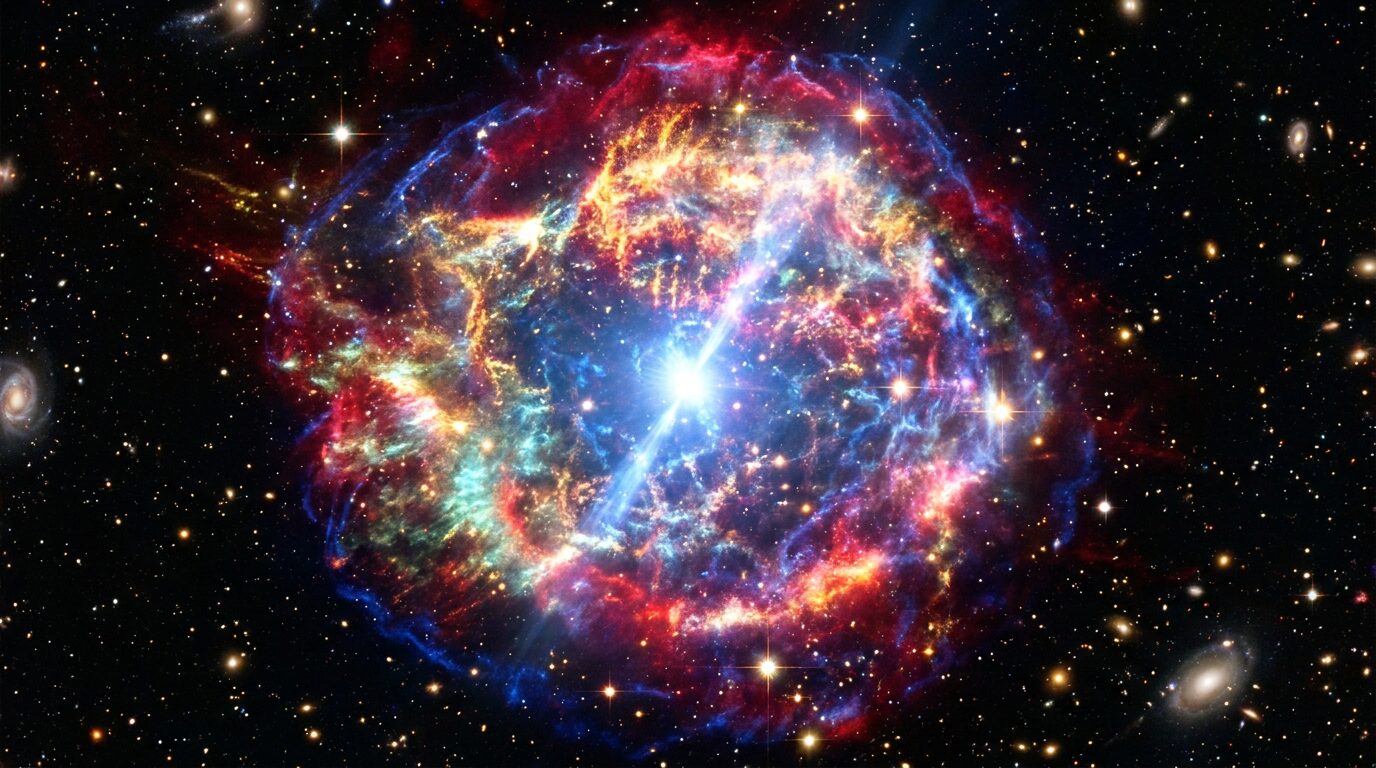
In the weeks after a massive star dies, the debris should behave predictably. It expands outward in a roughly spherical shell, cooling as it goes, its brightness fading on a smooth, exponential curve dictated by the decay of radioactive nickel into cobalt into iron. That curve is so reliable that astronomers use it as a cosmic ruler, calibrating distances across the universe. So when the light from SN 2024afav[3] — a supernova detected in a galaxy roughly 300 million light-years away — began doing something else, something that did not match the expected curve at all, the teams monitoring it at Las Cumbres Observatory had reason to pay close attention.
What they recorded was a quasi-periodic signal embedded in the optical light curve: a brightening and dimming that repeated with a period measurable in days, riding on top of the underlying fade like a slow, deliberate pulse. Not noise. Not instrumental artifact. Something in or around the explosion was modulating the light with a rhythm that changed over time in a very specific way — it started slower and gradually sped up, a behavior astronomers recognize from a different domain entirely. It looked, in the parlance of gravitational-wave physics, like a chirp.
A chirp, in this context, describes a signal whose frequency increases over time. Gravitational-wave detectors like LIGO and Virgo[2] have recorded chirps from merging black holes and neutron stars as their inspiral accelerates in the final moments before collision. But this was optical light from an expanding ball of stellar gas, and the source of the chirp was not a merger. The leading explanation, developed through careful modeling of the signal's shape, timing, and energy budget, is that at the center of SN 2024afav, a newborn magnetar is spinning down — and as it spins down, it is dumping energy into the surrounding ejecta in pulses that the debris translates into light.
If that interpretation holds, this is the clearest direct observational evidence yet that magnetars can form in core-collapse supernovae and immediately begin powering the explosion's optical output. It is not the first time a magnetar has been proposed to explain a supernova's unusual light curve. But it may be the first time the engine has been caught, in real time, showing its hand.
What a Magnetar Actually Is
A neutron star is already an object at the edge of physical credibility. When a star between roughly eight and twenty solar masses exhausts its fuel and its core collapses, the result is a ball of matter roughly twenty kilometers across where protons and electrons have been compressed into neutrons under gravity intense enough to overwhelm every other force. A teaspoon of neutron star material would weigh billions of tons on Earth. The surface gravity is roughly two hundred billion times what you feel standing on this planet. And neutron stars spin — sometimes hundreds of times per second, a consequence of angular momentum conservation as a stellar core the size of the sun collapses to the size of a city.
A magnetar is a neutron star whose magnetic field has been amplified, through processes still not fully resolved, to values somewhere between ten to the fourteen and ten to the fifteen gauss. For reference, a refrigerator magnet produces about one hundred gauss. Earth's magnetic field is less than one gauss at the surface. A magnetar's field is strong enough that if one existed within about a thousand light-years of Earth, it would strip the magnetic stripes off your credit cards from that distance — a comparison that is technically true and also almost entirely useless for conveying the actual scale of what we are describing. More usefully: the magnetic field energy in a magnetar is comparable to, or exceeds, the kinetic energy of the explosion that created it.
“A magnetar's magnetic field carries energy comparable to the kinetic force of the explosion that created it — and for decades, astronomers have suspected that energy has to go somewhere.”
Magnetars were first proposed theoretically in the 1990s, and we know they exist — a handful of confirmed magnetars in our own galaxy have been detected through their X-ray and gamma-ray outbursts, including the dramatic 2004 flare from SGR 1806-20[1] that was detectable even after bouncing off the moon. But the question of how magnetars form, and whether their formation is connected to the most energetic stellar explosions in the universe, has remained stubbornly open. The objects are rare, the formation timescales are short, and until recently, no telescope network was positioned to catch the birth event in sufficient detail.
The Problem with Superluminous Supernovae
For the past fifteen years or so, astronomers have been puzzling over a class of explosions called superluminous supernovae. These are stellar deaths that outshine ordinary core-collapse supernovae by factors of ten to one hundred — events bright enough to briefly rival entire galaxies, visible from billions of light-years away. The energy budget of a superluminous supernova is a problem. Standard radioactive decay from nickel-56 cannot account for it. Something else must be pumping energy into the ejecta long after the initial shock has passed.
The magnetar central engine model was proposed to fill that gap. In this picture, a rapidly spinning, highly magnetized neutron star at the center of the explosion acts as a rotational reservoir. As the magnetar spins down over days, weeks, and months — losing angular momentum through magnetic dipole radiation — it radiates energy into the surrounding ejecta. That energy heats the debris, which re-radiates it as optical and ultraviolet light. The slower the spin-down timescale, the more extended the light curve peak. The stronger the initial magnetic field, the faster the spin-down. By fitting observed light curves to this model, researchers can in principle read off the magnetar's initial spin period and magnetic field strength as though extracting parameters from a data table.
The problem with this elegant picture has always been that it is inferred rather than directly observed. Light curve fitting is powerful, but a model that fits data is not the same as a model confirmed by data. A smoothly declining light curve that matches magnetar spin-down predictions could, in principle, also match other energy injection mechanisms — fallback accretion onto a black hole, circumstellar interaction, even unusual nickel distributions in the ejecta. Distinguishing between these possibilities requires not just a fit, but a signature that only one mechanism would produce.
What Las Cumbres Saw in the Noise
Las Cumbres Observatory is not a single telescope. It is a global network of robotic optical telescopes — currently more than two dozen instruments of one-meter and two-meter aperture distributed across multiple continents — designed specifically to maintain continuous time-domain coverage of transient events. When a supernova, gamma-ray burst, or tidal disruption event is detected, the network can monitor it around the clock, handing observations from one site to the next as Earth rotates. This cadence matters enormously for time-variable phenomena that evolve on timescales of hours to days. A traditional observatory, limited to a single site with weather gaps and daytime interruptions, would miss exactly the kind of fine-structure variation that SN 2024afav appears to have displayed.
“The quasi-periodic signal was not a guess extracted from noisy data — it was a feature consistent across multiple filters, multiple nights, and multiple telescope sites on two continents.”
SN 2024afav was classified as a superluminous supernova shortly after its discovery, and the Las Cumbres network began intensive monitoring almost immediately. Over the weeks of coverage that followed, the light curves assembled from that monitoring showed the expected broad peak and slow decline — and, embedded within it, the quasi-periodic modulation. The signal was visible in multiple photometric bands, which matters: a real astrophysical variation should appear consistently across different wavelengths, while instrumental artifacts or local contamination tend to be wavelength-specific. The chirp behavior — the gradual frequency increase over time — is what elevated the signal from a curious fluctuation to a physically interpretable signature.
The physics of why a spinning-down magnetar would produce a chirp in the optical light rather than a steady signal or a simple exponential is not straightforward. One mechanism involves the geometry of the magnetar's wind — the outflow of high-energy particles and radiation streaming from the spinning neutron star. This wind interacts with the expanding ejecta shell, and if the wind is not perfectly isotropic, or if the ejecta shell has density variations that rotate with the magnetar's spin period, the energy injection into the visible emission region will be modulated. As the magnetar spins down, the period of that modulation lengthens, but the chirp observed in SN 2024afav is an increasing-frequency chirp, which suggests something more complex may be operating — possibly related to precession of the magnetar's spin axis, or a changing geometry as the ejecta shell thins and becomes more transparent.
The interpretation remains in active development, and the researchers involved are careful to frame their finding as the best available explanation for the observed signal rather than a closed case. There is still genuine uncertainty about whether the period evolution is stable enough to unambiguously rule out circumstellar interaction, which can produce quasi-periodic signals through shell collision geometry. But the chirp profile — specifically, the way the period evolves over time — is difficult to reproduce with circumstellar models and falls naturally out of magnetar spin-down physics.
Why This Moment Is Different from Previous Detections
Magnetar central engines have been invoked before, in the explanation of superluminous supernovae, of some long-duration gamma-ray bursts, and of a few rapidly evolving transients that defied standard classifications. What has been missing is not the theoretical framework but the observational resolution. Earlier light curves simply lacked the cadence and signal-to-noise to reveal this kind of internal structure. Even the well-studied superluminous supernovae detected by the Palomar Transient Factory, by Pan-STARRS, and by the Dark Energy Survey were generally sampled too infrequently — every few days at best — to detect period variations on timescales shorter than the sampling interval.
The Las Cumbres cadence for SN 2024afav was finer than that, which is partly why the signal became visible at all. This is a point worth sitting with: the magnetar signal may have been present in other supernovae all along, buried in the gaps between observations. The universe was possibly blinking this way before, and the instruments were simply not watching continuously enough to see it. That is not a failure of past astronomy so much as a reminder that time-domain astronomy — the systematic monitoring of how things change, not just what they are — remains one of the most scientifically productive and still-maturing areas of the discipline.
The Vera C. Rubin Observatory, currently in commissioning in Chile, is designed to perform wide-field, cadenced optical surveys that will detect transients across the sky at a frequency and depth that no previous survey has approached. When Rubin reaches full operational capability and begins its Legacy Survey of Space and Time, it will generate alerts on millions of transient events per year. Superluminous supernovae detected early enough and monitored with sufficient follow-up could yield a statistical sample of light curves with the kind of temporal resolution that SN 2024afav required a dedicated network to achieve. If magnetar chirps are real and relatively common in superluminous supernovae, Rubin's data stream — combined with follow-up from networks like Las Cumbres — should start turning up more of them.
What a Newborn Magnetar Changes About How We Read Stellar Death
“If the magnetar is real, then the explosion was not finished when the star died — the engine came on afterward, rewiring the debris from the inside.”
There is something conceptually important about what the SN 2024afav signal represents, if the magnetar interpretation is correct. A standard core-collapse supernova is, in the conventional picture, a single catastrophic event: the core collapses, the shock wave propagates outward, the envelope is expelled, and the luminosity curve that follows is the passive afterglow of radioactive decay in the cooling ejecta. The explosion is, in a sense, over at the moment it begins. What the magnetar central engine model proposes is that for some supernovae, the explosion is not a single event but an ongoing process — that the neutron star left behind continues to inject energy into the debris for weeks or months, reshaping the light curve from within.
This reframes the relationship between a supernova and its remnant in a way that has implications beyond the optical light curve. If magnetars are active engines immediately after formation, they may also be responsible for accelerating particles to high energies within the young remnant, contributing to cosmic ray populations. They may drive asymmetries in the ejecta that show up later as irregularities in the supernova remnant's morphology — the kind of asymmetries visible in Cassiopeia A and other well-studied remnants in our own galaxy. They may affect the nucleosynthesis of heavy elements in the innermost ejecta layers by maintaining unusual thermodynamic conditions longer than a passively cooling remnant would. None of these secondary effects are confirmed consequences of SN 2024afav; they are the downstream questions that a confirmed magnetar birth would open up.
The magnetar at the center of SN 2024afav, if it exists, is now roughly a year old and 300 million light-years away. Its spin period has lengthened, its luminosity has declined, and the optical modulation it was producing — if the interpretation is right — has faded below the threshold of detection as the ejecta shell expanded and thinned. The object is not gone. It is just too dim, too distant, and too deeply buried in cooling debris to see from here. What remains is the record it left in photons that traveled for 300 million years and arrived, in 2024, at an array of robotic telescopes distributed across a small planet orbiting an unremarkable star. The data is still being analyzed, the models are still being tested, and the next candidate event is already out there accumulating in someone's alert queue.
References
- Giant Flare in SGR 1806-20 and Its Compton Reflection from the Moon (arxiv.org)
Documents a confirmed magnetar outburst (SGR 1806-20 in 2004) demonstrating that magnetars exist and produce detectable high-energy emissions. - GW170817: Observation of Gravitational Waves from a Binary Neutron Star Inspiral (arxiv.org)
Provides context for the term 'chirp' by documenting how LIGO and Virgo detected similar frequency-increasing signals from merging neutron stars. - Lense–Thirring precessing magnetar engine drives a superluminous supernova (nature.com)
Primary source providing observational data on SN 2024afav's quasi-periodic optical light curve showing the chirp signal central to the article's claim. - Las Cumbres Observatory Global Telescope Network (iopscience.iop.org)
Describes Las Cumbres Observatory as a global network of robotic optical telescopes enabling continuous monitoring of transient events across continents.
About Brenna Vance
Brenna Vance writes about the cosmos — stars that predate the universe's own chemistry, spacecraft flying close enough to the sun to catch it misbehaving, the physics of what the universe is still getting wrong. Her work focuses on the moments when an observation breaks a model, and what that break actually means.
More like this
A Star in Andromeda Just Vanished Without Exploding. Scientists Caught It Happening.
For the first time, astronomers assembled a complete before-and-after record of a star collapsing directly into a black hole — and the mechanism behind the silence turns out to be stranger than a supernova.
The Gamma-Ray Burst That Fired for 7 Hours Doesn't Fit Any Known Physics
GRB 250702B lasted nearly twice as long as any gamma-ray burst ever recorded, and the two leading explanations for it are mutually incompatible — which means at least one of them has to be wrong.
The Universe's Oldest Supernova Just Rewrote What Stars Could Do at Cosmic Dawn
JWST confirmed a supernova from when the universe was just 730 million years old — and its unsettling resemblance to modern explosions is forcing astronomers to rethink what the earliest stars were even supposed to be.