The Atmosphere in Your Kitchen Is More Violent Than You Think
Indoor air quality researchers are discovering that a single pan of sautéed onions can spike ultrafine particle concentrations to levels that would trigger outdoor air quality alerts — and the chemistry happening three feet above your stove is stranger and more consequential than anyone expected.
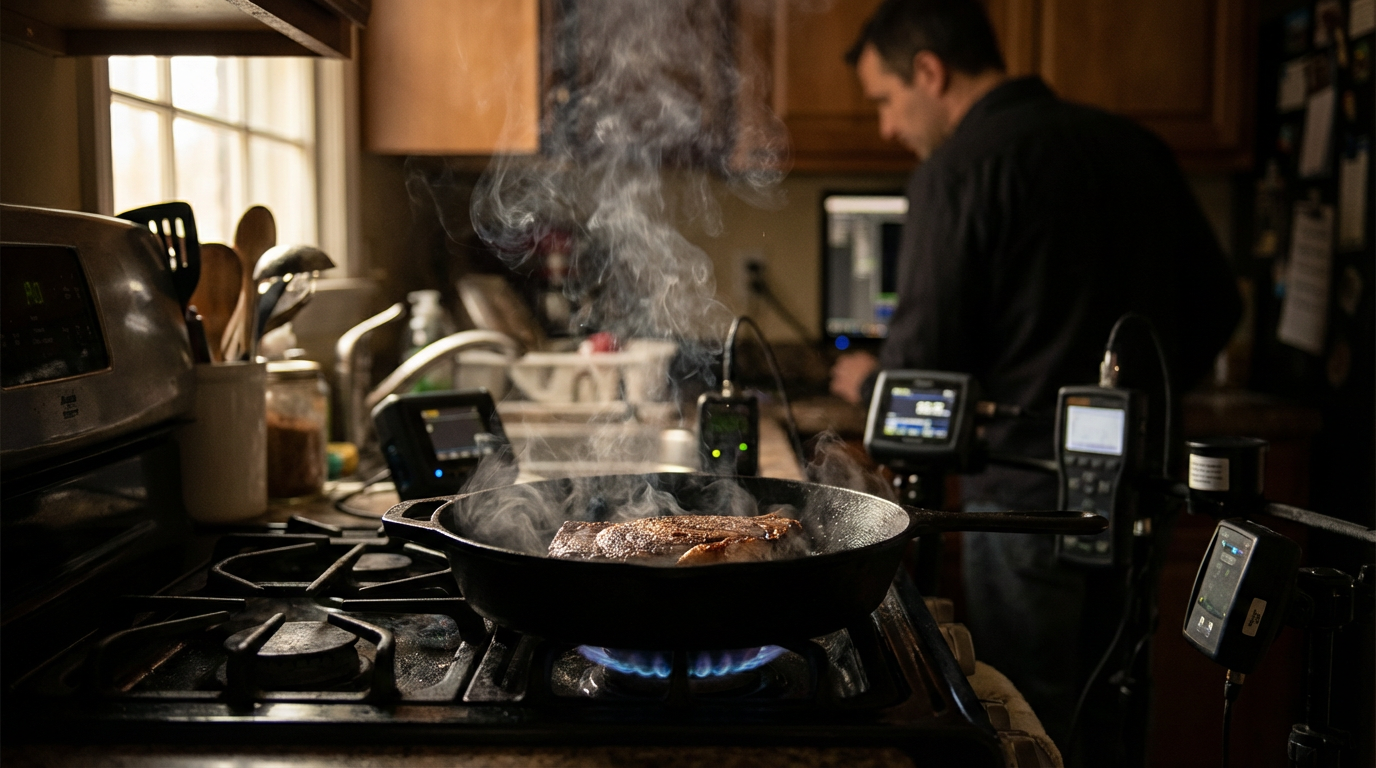
On a Tuesday evening in an ordinary house in Austin, Texas, a researcher set a cast iron pan on a gas burner, added a tablespoon of butter, and began cooking a steak. Within four minutes, the particle counters arrayed around the kitchen registered concentrations of ultrafine particles — those smaller than 100 nanometers in diameter — that exceeded 200,000 particles per cubic centimeter. For reference, a moderately polluted outdoor urban environment might measure somewhere between 10,000 and 40,000. The kitchen, in that moment, was not a comfortable domestic space. It was a low-altitude aerosol event.
This kind of measurement is part of a growing research effort, most visibly organized under the HOME Campaign — House Observations of Microbial and Environmental Chemistry[3] — which has spent years trying to understand what actually happens to the air inside residential buildings when people live in them. What they have found complicates the reassuring mental model most people carry: that outdoors is where the pollution lives, and indoors is where you go to breathe clean air. The reality is considerably murkier. In some conditions, particularly during cooking, cleaning, or the use of aerosolized products, indoor air chemistry becomes almost incomprehensibly active, generating particle classes, gas-phase compounds, and oxidation products that scientists are still working to characterize.
The field is young in a particular way. Outdoor atmospheric chemistry has been intensively studied since at least the 1950s, when smog events in Los Angeles forced researchers to map what happens when sunlight drives reactions in polluted urban air. Indoor air chemistry was, for most of that period, treated as a subset of the outdoor problem — a dilution question, essentially. You figured out the outdoor concentrations, you estimated how much outdoor air was infiltrating the building, and you adjusted accordingly. It took until the 1980s and 1990s for researchers to accumulate enough evidence that something chemically distinct and much more complex was happening inside homes. And it has taken until roughly the last decade for the instrumentation to exist that could follow those reactions in real time, in real kitchens, during actual meals.
What makes this more than an academic chemistry puzzle is the exposure math. The average American spends roughly 90 percent of their time indoors[2]. If the air in those spaces is producing reactive compounds and particle concentrations that rival outdoor pollution events, then the cumulative dose — the amount of material actually passing through human lungs over a lifetime — could be substantially larger than outdoor exposure estimates have suggested. No one is claiming cooking dinner will kill you quickly. But the question of what chronic, low-level exposure to ultrafine particles and indoor volatile organic compounds does to respiratory and cardiovascular tissue over decades is one that epidemiology is still working to answer, and the answer is not nothing.
What a Burning Pan Actually Releases
When you heat cooking oil past its smoke point — or even well below it — you are initiating a cascade of thermal decomposition reactions. Fats are long-chain organic molecules, and heat breaks those chains. The fragments that escape into the air include aldehydes, particularly acrolein and formaldehyde; volatile organic compounds including various alcohols, ketones, and furans; and — critically — the precursor gases that go on to nucleate into ultrafine particles. The specific chemistry depends heavily on the fat. Animal fats and butter, rich in saturated fatty acids, produce a different suite of compounds than olive oil or canola, which carry more unsaturated bonds that break differently under heat. The pan material matters too. Nonstick coatings introduce their own thermal decomposition products at high temperatures. Researchers using proton transfer reaction mass spectrometry — an instrument sensitive enough to detect specific molecular species in real time at parts-per-trillion concentrations — have catalogued hundreds of distinct compounds in cooking emissions, many of which are also found in outdoor smog events.
The particle story is separate from but entangled with the gas-phase story. Ultrafine particles from cooking form primarily through a process called nucleation: gas-phase organic molecules, once they have cooled slightly and their concentrations climb high enough, condense into particle form. These freshly nucleated particles are extraordinarily small — a few nanometers across — and they grow rapidly by coagulation and condensation. Because of their size, they deposit deep in lung tissue, reaching alveolar surfaces that larger particles never approach. They also carry whatever organic chemistry they nucleated from, so they are not inert once they arrive. The toxicology of ultrafine cooking particles is still an active research area, but the basic physics of deposition gives the medical community reason to pay attention.
“A single episode of high-heat pan cooking can generate more ultrafine particles per cubic centimeter than a busy urban intersection at rush hour.”
The Thermal Plume You Cannot See
There is a fluid dynamics component to this that rarely gets discussed, and it is important. When a stove burner heats a pan, and the pan heats the food, and the food begins releasing gases and particles, the hot air directly above the cooking surface rises as a buoyant thermal plume. This is convection, basic and unavoidable. The plume carries everything the cooking process has produced — gases, particles, aerosol droplets of aerosolized fat — and lifts it toward the ceiling. From the ceiling, the contaminated air spreads laterally, eventually recirculating downward along cooler walls. In a kitchen without active ventilation, this means that within a few minutes of serious cooking, the entire room has become a well-mixed aerosol chamber. Studies using tracer gases and particle counters in instrumented test kitchens have tracked this circulation directly, watching the particle front move from the stove outward into adjacent rooms through open doorways, detectable in living rooms within ten to fifteen minutes.
Range hoods complicate this picture in ways that are both reassuring and deflating. A properly sized, properly installed range hood vented to the outside — not recirculating — does capture a meaningful fraction of the cooking plume, particularly if it is running before cooking begins and for several minutes afterward. But most residential range hoods in the United States are undersized, underpowered, and frequently not used at all, either because they are loud, because people do not believe they matter, or because the hood exhausts into the home's interior rather than outside. Research groups that have instrumented actual homes rather than controlled test chambers have found that real-world hood use reduces particle exposure far less than hood performance ratings under laboratory conditions would suggest. The gap between laboratory ventilation efficiency and actual human behavior is one of the persistent confounds in indoor air quality research.
Gas Stoves, Combustion, and the Nitrogen Dioxide Problem
The cooking aerosol and gas-phase chemistry described above applies regardless of heat source — electric, induction, or gas. But gas stoves introduce an additional combustion chemistry layer that is absent from electric cooking. Natural gas burners produce nitrogen dioxide as a direct combustion byproduct, along with carbon monoxide, formaldehyde, and ultrafine particles from the flame itself. Nitrogen dioxide is a respiratory irritant that has been associated with exacerbation of asthma in children[1] and with adverse pulmonary outcomes in long-term exposure studies. The question of how much NO2 a gas stove generates, and whether typical kitchen ventilation keeps concentrations below levels of concern, has become a genuinely contested area in the indoor air literature — contested not because the measurements are in dispute, but because exposure depends heavily on kitchen volume, ventilation rate, cooking duration, and burner size, and those variables differ enormously from home to home.
What is not particularly contested is that gas stoves operating without ventilation in small kitchens can push NO2 concentrations above 100 parts per billion during cooking episodes — the EPA's one-hour outdoor ambient air quality standard for NO2 is 100 ppb. That does not mean indoor and outdoor exposure are equivalent in risk, because the dynamics are different, but it establishes that the numbers are not trivially small. Several research groups have now conducted measurement campaigns in homes across different geographic regions, income levels, and housing types, and the conclusion that emerges is not uniform: some homes with gas stoves and poor ventilation show consistently elevated NO2 even outside of cooking periods, likely from pilot lights and slow combustion leakage. The epidemiological implications of that baseline elevation, particularly for children who spend most of their time at home, are still being worked out.
“The gap between how well a range hood performs in a laboratory test and how much it actually reduces your exposure at home is large enough to matter clinically.”
Cleaning Products, Aerosols, and the Ozone Reaction Nobody Warned You About
Cooking is the most dramatic indoor air chemistry event in most homes, but it is not the only one. Cleaning products — particularly spray-based ones — introduce terpenes, surfactants, and reactive organic species into the air in concentrations that, in the presence of ozone, drive a secondary chemistry that researchers have only recently mapped in detail. Ozone infiltrates homes from outdoors; it is an omnipresent trace gas in ambient urban air. When indoor ozone encounters terpenes from a pine-scented cleaner or a citrus-based spray, the reaction is fast and the products include secondary organic aerosols — freshly formed particles — along with hydroxyl radicals, formaldehyde, and other oxidized organic compounds.
This is the same basic chemical mechanism that produces smog outdoors: ozone plus volatile organic compounds, driven by oxidation, producing particle and gas-phase species that were not present in either reactant alone. The difference is that indoors, the reaction happens in an enclosed volume, the reactant concentrations from a single spray event are extremely high locally, and ventilation is typically far lower than outdoor airflow. The HOME Campaign and parallel research programs at institutions including Purdue University, the University of Toronto, and several European research consortia have instrumented test houses to watch this chemistry unfold in real time, and the results have consistently surprised even the researchers running the experiments. A single spray of a terpene-containing cleaner in a kitchen with moderate outdoor ozone infiltration can produce secondary organic aerosol formation events that last for twenty to forty minutes after the spray, with particle concentrations well above background.
What makes this particularly difficult to communicate is that the products generating the chemistry are often the ones marketed as natural or environmentally friendly. Pine, lemon, and lavender scents are terpene signatures. The organic chemistry does not discriminate based on marketing category. A synthetic fragrance and a botanical extract can drive identical secondary aerosol formation if they carry the same reactive organic functional groups. This is not an argument against cleaning products broadly, and it is not an argument for synthetic over natural formulations. It is an argument for ventilation — opening windows during and after cleaning, running fans, treating the indoor air as a reactive environment rather than a passive container.
Mapping the Air in Real Homes
The methodological challenge that has slowed this field for decades is the difficulty of making comprehensive measurements in actual residential settings without either disrupting normal behavior or drowning in confounding variables. Early indoor air quality work relied heavily on time-integrated sampling — filter cartridges and sorbent tubes that collected compounds over hours or days, then went to a laboratory for analysis. That approach captures averages, not events. It cannot tell you what happened when a specific person cooked dinner, how the particle plume evolved minute to minute, or how long it took the air to return to baseline after the stove was turned off.
Real-time instruments changed this. Condensation particle counters can track total particle number concentrations at second-level resolution. Proton transfer reaction mass spectrometers can identify specific volatile organic compounds continuously. Photoionization detectors, cavity-enhanced absorption spectrometers, and a growing suite of miniaturized sensors have made it possible to run simultaneous, multi-species measurements in fully occupied homes. The HOME Campaign's deployment of this kind of instrument array in a real Austin house[4] — occupied by real people living their real lives — was a landmark effort in part because it generated the kind of temporally resolved, multi-pollutant dataset that researchers had theorized about for years but rarely had the resources to actually collect. The picture that emerged was of an indoor atmosphere that is not stable, not passive, and not well approximated by any simple outdoor-minus-infiltration model. It is a reactive chemical system that responds to human activity at timescales of seconds to minutes, with peaks and valleys that time-integrated sampling would have averaged into meaninglessness.
“The indoor atmosphere is not a diluted version of outdoor air — it is a chemically distinct environment that rewrites itself every time someone turns on the stove.”
What Chronic Low-Level Exposure Actually Means
Epidemiology works at the population level and over long timeframes, which makes it poorly suited to detecting the effects of specific indoor air chemistry events. What it can do — and has done, across large cohort studies in multiple countries — is establish statistical associations between long-term indoor pollutant exposure and respiratory outcomes, cardiovascular markers, and, in some analyses, neurodevelopmental measures in children. These associations are real but modest in effect size, difficult to disentangle from socioeconomic confounders, and poorly linked to the specific chemical mechanisms that bench scientists are identifying. The gap between "we observe this chemistry in real time" and "we know what this chemistry does to human tissue over twenty years" is wide, and bridging it requires a kind of interdisciplinary coordination — atmospheric chemists, toxicologists, epidemiologists, exposure scientists, clinicians — that is resource-intensive and slow.
The ultrafine particle question is probably the most urgent subset of this problem. Particles below 100 nanometers in diameter are not currently regulated in either the United States or the European Union as a distinct pollutant class. Outdoor air quality standards focus on PM2.5 — particles smaller than 2.5 micrometers — and PM10. Those size ranges capture mass well, but ultrafine particles are so numerous and so light that they contribute negligibly to mass-based measurements while dominating particle number counts. A concentration of 200,000 ultrafine particles per cubic centimeter adds almost nothing to a PM2.5 reading. From a regulatory standpoint, that cooking episode in Austin looks like clean air. From a particle number standpoint, it is an event comparable to standing next to a diesel engine.
Researchers in the indoor air community are not, for the most part, trying to alarm people out of cooking. They are trying to build a measurement framework and a mechanistic understanding detailed enough to support eventual intervention — whether that means ventilation standards for residential construction, updated guidance on range hood performance, reformulated cleaning products, or induction stove adoption policies that are based on actual indoor air chemistry rather than energy accounting alone. The science is not finished, and the policy implications are genuinely uncertain. What is no longer uncertain is that the kitchen, during the twenty minutes it takes to cook dinner, is one of the most chemically active environments most people will ever occupy — and that the air inside it has been, until recently, one of the least studied places on Earth.
References
- 24-h Nitrogen dioxide concentration is associated with cooking behaviors and an increase in rescue medication use in children with asthma (pmc.ncbi.nlm.nih.gov)
Documents the association between nitrogen dioxide from cooking and asthma exacerbation in children, supporting the article's claim about NO2 health risks. - Indoor Air Quality (epa.gov)
Provides the statistic that Americans spend approximately 90 percent of their time indoors, establishing the exposure math foundation for the article's claim about cumulative indoor air dose. - Overview of HOMEChem: House Observations of Microbial and Environmental Chemistry (doi.org)
Defines the HOME Campaign (House Observations of Microbial and Environmental Chemistry), the primary research effort organizing studies of indoor air chemistry during residential activities. - Indoor Particulate Matter during HOMEChem: Concentrations, Size Distributions, and Exposures (pubs.acs.org)
Provides the experimental data from the Austin kitchen steak-cooking episode showing ultrafine particle concentrations exceeding 200,000 particles per cubic centimeter.
About Brenna Vance
Brenna Vance writes about the cosmos — stars that predate the universe's own chemistry, spacecraft flying close enough to the sun to catch it misbehaving, the physics of what the universe is still getting wrong. Her work focuses on the moments when an observation breaks a model, and what that break actually means.
More like this
Why Wildfire Smoke Gets Worse Days After the Fire Dies
The gases released by wildfires keep chemically transforming into fine particles for days after a fire ends — which is why smoke crosses continents and poisons air far from any flame.

Indoor Mold's Real Threat Isn't the Stain — It's the Air Around It
A new method for detecting airborne mycotoxins confirms what the stain on your wall can't tell you: the toxic part already left.
Decomposition Has a Smell for Every Stage — And Science Is Finally Mapping It
The odor rising from a decomposing body isn't a single stench — it's a shifting chemical record written by bacteria, and forensic scientists are learning to read it like a clock.