The Dust in Your Home Is a Living Ecosystem — And It's Shaped by Your Shoes
The dust floating through your living room isn't just dead skin and lint — it's a biological record of everywhere your shoes have been, and the science of how it got there is stranger than you'd expect.
Reach down and run a finger along the baseboard behind your couch. That grey film on your fingertip — soft, faintly gritty, lighter than it looks — is not simply inert matter waiting to be vacuumed away. It is a compressed archive. Skin cells, yes. Textile fibers, certainly. Particulates from cooking, candles, and the slow oxidation of everything you own. But woven into that thin grey layer is something most people never consider: a microbial community, partly alive, partly dormant, and surprisingly specific to the places you have walked.
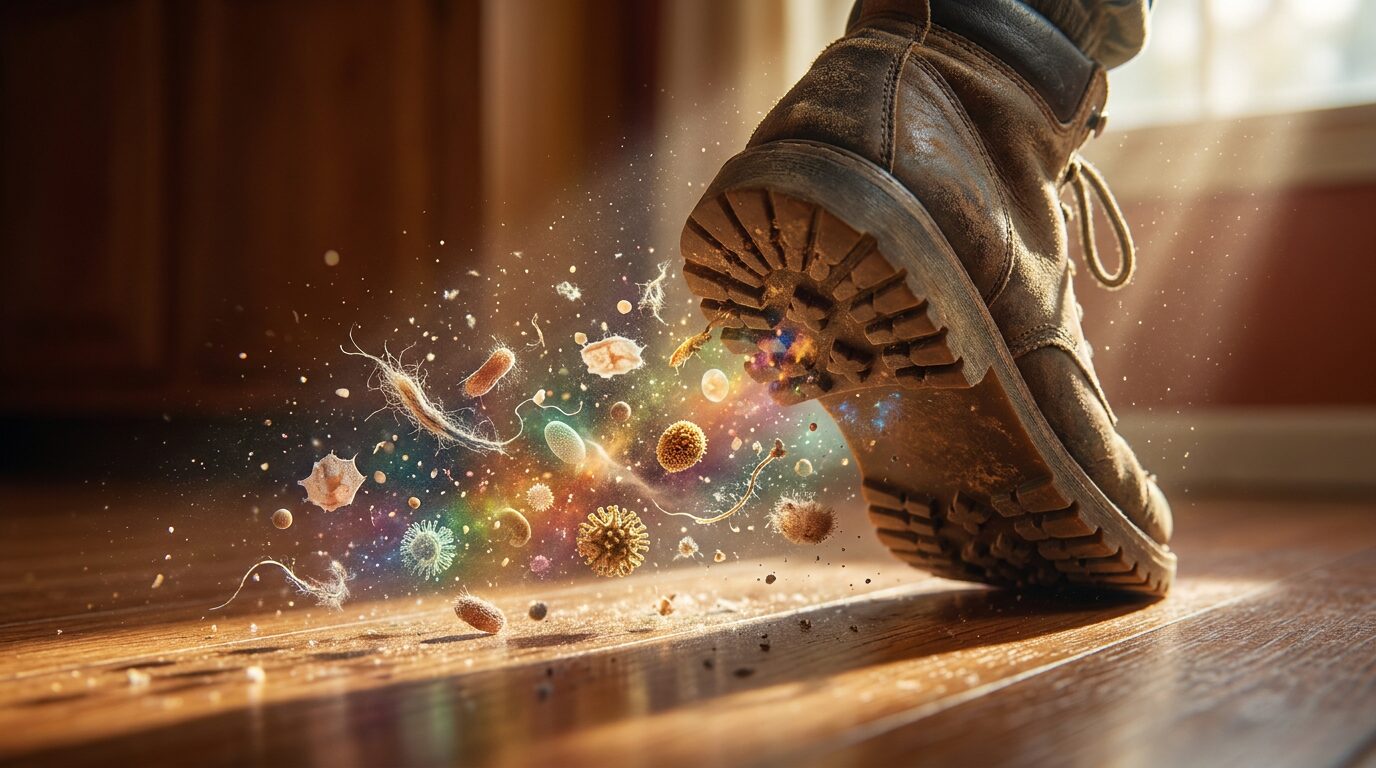
Research published in Environmental Science & Technology has been pulling apart the precise sources of indoor airborne fungi[3] — the spores and hyphal fragments that drift through rooms, settle into carpets, and become part of the dust you breathe every day. What that work found reshapes the way you might think about where indoor microbes actually come from. Shoe sole dust, it turns out, contributes far more to indoor fungal communities than had previously been assumed. Not tracked-in mud or visible dirt — but the fine, nearly invisible residue that accumulates on the undersides of soles and becomes airborne whenever you move across a floor.
This is not a story about hygiene panic. The fungi distributed through your home are not, for the most part, threatening. Most are the same species colonizing sidewalks, soil, leaf litter, and building exteriors — ordinary environmental organisms that humans have coexisted with throughout all of recorded history. The story is more interesting than threat: it is about the invisible pipeline connecting the outside world to the air inside your home, a pipeline that runs directly through the soles of your shoes and operates every single time you take a step indoors.
To understand why that matters, you need to understand what indoor dust actually is — not as a cleaning problem, but as a biological system. And once you do, the act of walking through your own front door starts to look considerably more complicated.
What Dust Actually Is
Indoor dust is a composite material assembled from dozens of overlapping sources, and its composition changes constantly based on who lives in a space, what they do, what they bring in, and what the building itself is made of. Human skin sheds roughly thirty to forty thousand cells per hour, and those cells form a substantial fraction of household dust — along with pet dander, cotton and synthetic textile fibers, pollen grains, combustion particles from cooking, and the fragmented remains of insects and their waste. But underneath all of that, running through it like a thread, is microbial content: bacterial cells, fungal spores, and the structural fragments of organisms too small to see.
Fungi in particular are remarkable travelers. A fungal spore can be as small as two to three micrometers[2] — far smaller than a human hair's diameter — and once airborne, it behaves more like a gas than a solid. Spores are designed for dispersal; they are the fungal kingdom's answer to the question of how to move without legs. Outdoors, they fill the air in concentrations that fluctuate with wind, rain, temperature, and the season. Step outside on a warm autumn afternoon and you are inhaling thousands of them per cubic meter of air. That is not alarming. It is simply the default condition of life on a planet covered in fungi.
Indoors, however, the story gets more layered. Buildings are not sealed environments — air leaks through gaps, windows open, people pass in and out — but they do create a filtered, modified version of the outdoor air. The microbial community inside your home is related to the one outside it but distinctly different, shaped by building materials, HVAC systems, human occupants, and the various pathways through which the outside world gets in. Researchers studying indoor microbiomes call this the indoor-outdoor transfer problem: tracking the routes by which outdoor organisms find their way into the places people spend most of their time.
“Your floor is not a boundary between outside and inside — it is a mixing zone, a place where outdoor biology gets shaken loose and sent airborne.”
The Sole of the Problem
The surface of a shoe sole is, from a microbial standpoint, an extraordinarily efficient collection device. As you walk across soil, pavement, grass, a subway platform, or a grocery store floor, the textured rubber or leather surface picks up fine particulate matter — dust, soil aggregates, biological fragments — and holds it in the grooves and pores of the material. Some of this material is inorganic: silica particles, mineral dust, fragments of asphalt. But a substantial portion is biological, and fungal spores and hyphal fragments are particularly well-represented because of their ubiquity in soil and their physical properties. They are the right size and shape to wedge into surface texture and stay there.
When you walk across an indoor floor, especially a hard surface like wood or tile, two things happen simultaneously. First, the sole makes direct contact with the floor and deposits material directly — a kind of mechanical transfer, like a stamp. Second, and more significantly for airborne exposure, the impact of each footstep generates a small pressure wave. That wave disturbs the settled dust layer on the floor, briefly re-suspending fine particles into the air where they can remain aloft for minutes to hours depending on their size and the airflow in the room. Particles below about ten micrometers in diameter are particularly mobile; they follow air currents rather than settling quickly. Fungal spores fall squarely in that size range.
The Environmental Science & Technology research quantified this pathway more precisely than previous studies had managed by using molecular tools — specifically, sequencing the DNA of fungi extracted from different dust sources in the same homes. When researchers compared the fungal communities found on shoe soles, on floors, and in settled dust from elevated surfaces and breathing-zone air, they found a surprisingly strong signal connecting shoe soles to airborne fungal content. The species composition on the soles closely predicted what ended up in the indoor air. Outdoor-associated fungi — genera like Cladosporium, Alternaria, and Epicoccum, organisms that thrive in soil and on decaying plant material — appeared indoors at concentrations that could not be explained by air infiltration alone. The missing source, the research suggested, was underfoot.
How Fungi Move Through a Room
Once a spore is airborne, it enters a system governed by airflow, particle physics, and the geometry of the space it occupies. Larger particles — anything above roughly fifty micrometers — settle quickly under gravity and end up back on the floor within seconds or minutes. But smaller particles, especially those in the one-to-ten micrometer range where most fungal spores sit, can stay suspended for extended periods. In a room with even gentle air circulation from a heating vent or an open window, those particles travel. They move horizontally across the room, rise with warm air currents, and deposit on surfaces far from where they originally landed.
This is why the microbial content of indoor dust is relatively homogeneous throughout a home despite the fact that shoes are worn primarily near entrances. The particles liberated near the front door migrate. They redistribute through the HVAC system, through convection currents, through the simple act of people moving from room to room — each person functioning as a kind of biological pump, displacing air with every step and gesture. By the time a spore settles somewhere, it may have traveled the full length of the building from where it was deposited.
Carpeting complicates this picture further. Carpet fibers act as a reservoir, trapping particles that would otherwise remain mobile on hard surfaces. Walk across a carpeted room and the mechanical compression and release of the fibers under each footstep launches particles back into the air repeatedly — a process called resuspension. Studies using particle counters in occupied homes show measurable spikes in fine particle concentrations[4] every time someone walks across a carpet, with levels returning to baseline only after several minutes of inactivity. A carpeted home with active occupants has, in this sense, a more continuously stirred airborne microbial community than one with hard floors.
“Every step across a carpeted floor is a small act of resuspension — a brief release of what the fibers have been quietly holding since the last time someone walked through.”
A Fingerprint of Where You've Been
What makes this research genuinely striking is not just the mechanism — it is what the mechanism implies about the individuality of indoor microbial communities. If shoe soles are a primary vector for fungal import, then the fungi in your home are, in a meaningful sense, a biological record of the routes you travel. The commute through a particular subway station. The park where you run on weekends. The specific patch of soil your back garden happens to rest on. The seasonal changes in what is sporulating outdoors in your neighborhood. All of that arrives, in miniature, on the undersides of your shoes.
Indoor microbiome researchers have long observed that the microbial communities inside homes are surprisingly distinctive from household to household, even in the same building or neighborhood. Some of that variation is explained by pet ownership — homes with dogs have markedly different bacterial profiles[1] than pet-free homes, partly because dogs bring in outdoor soil microbes constantly and on a massive surface area of paw and fur. Some is explained by the number and identity of human occupants. But a significant portion had remained unexplained. The shoe sole pathway offers one plausible mechanism for some of that variation: the specific outdoor environments a household's occupants move through are leaving biological traces in the dust their home accumulates.
This idea fits within a broader and quietly fascinating field — environmental microbiome research — that is beginning to treat microbial community composition as a kind of ecological signature. Just as plant communities in a forest reflect the soil chemistry, moisture regime, and disturbance history of a site, the microbial communities inside buildings reflect the inputs those buildings receive and the conditions they create. A home is not a sterile enclosure. It is a permeable structure in ongoing exchange with its environment, and the organisms it contains are the evidence of that exchange, written in spores and cells too small to see.
The Body in the Room
There is a question that tends to follow this kind of research: should any of this change what you do? The honest answer is nuanced. For most healthy adults, the fungi arriving via shoe soles are not a concern. Cladosporium, Alternaria, and their relatives are everywhere in the outdoor environment, and human immune systems have been calibrated by millions of years of exposure to exactly these organisms. Inhaling their spores is normal. The body has mechanisms for clearing them from the respiratory tract — the mucociliary escalator, a coordinated system of mucus and hair-like cilia lining the airways, sweeps inhaled particles upward to be swallowed or expelled. For healthy lungs, most fungal spores at typical indoor concentrations are an unremarkable daily load.
The picture shifts for people with asthma, allergic fungal sensitization, or compromised immune function. For those groups, fungal spore load matters more, and the pathways by which it enters the home become more clinically relevant. Research on allergic respiratory disease has long established that indoor fungal exposure is a significant driver of symptom severity in sensitized individuals — and that indoor fungal load correlates, imperfectly but meaningfully, with outdoor spore seasons. The shoe sole pathway suggests that this seasonal outdoor signal is entering homes not just through ventilation but through occupant behavior, which means behavioral modifications — removing shoes at the door, HEPA filtration, more frequent mopping of hard floors — have a genuine if incomplete rationale behind them.
But even for people without those vulnerabilities, the research points toward something worth sitting with. The custom of removing shoes at the entrance, practiced widely across East Asian, Nordic, and many other cultures, was never explained by fungal import pathways — it emerged from intuitions about cleanliness, respect, and indoor-outdoor separation that long predate microbiology. The science has now provided a mechanism underneath that intuition, a detailed account of exactly why the boundary between outside and inside is not maintained by walls and doors as much as it is negotiated by behavior.
The Air You Inherit
There is something unexpectedly intimate about the shoe sole research, once you sit with it. The dust you breathe in your living room contains, embedded in its grey complexity, biological material from the sidewalks you walked this morning, the park you passed through last week, the trails you visited last autumn. It contains organisms that sporulated on the bark of trees and the surface of puddles in places you have already forgotten visiting. It is, in a literal and not especially metaphorical sense, a record of your movements, compressed into particle form and distributed through the air of the place where you sleep.
“The dust in your home is not generic — it is specific to the routes you walk, the ground you cross, the outdoor world your shoes have touched.”
Indoor microbiome science is still young. The tools that allow researchers to sequence environmental DNA and identify organisms without culturing them in a lab have only been widely available for roughly two decades, and the field is still working out which findings are robust and which will require revision. But the picture emerging from that work is already rich enough to fundamentally reframe what a building is. Not a container sealed against the outside world, but a permeable, dynamic environment in continuous exchange with it — shaped by the people moving through it, the shoes they wear, the floors they cross, and the quiet physics of every footstep releasing what was brought in from somewhere else.
Next time you walk through your front door, the act will not look quite the same. There is a small, invisible cloud of biological material being shaken loose from your soles with every step, settling into the dust, and becoming part of the specific, living atmosphere of your home. The outside world does not stop at the threshold. It follows you in, on the bottom of your shoes, one footstep at a time.
References
- Associations between dog keeping and indoor dust microbiota (nature.com)
Demonstrates that dog ownership creates measurably different bacterial profiles in household dust microbiota across multiple cohorts. - Size-resolved emission rates of airborne bacteria and fungi in an occupied classroom (pmc.ncbi.nlm.nih.gov)
Establishes that fungal spores measure two to three micrometers, small enough to remain airborne and behave like gas particles. - Height-Resolved Analysis of Indoor Airborne Microbiome: Comparison with Floor Dust-Borne Microbiome and the Significance of Shoe Sole Dust (pubs.acs.org)
Provides molecular evidence that shoe sole fungal communities closely predict indoor airborne fungal composition through DNA sequencing analysis. - Resuspension of Particulate Matter from Carpet Due to Human Activity (tandfonline.com)
Documents measurable spikes in fine particle concentrations occurring each time someone walks across carpet, demonstrating resuspension mechanism.
About Aris Thorne
Aris Thorne is a microbiologist who writes about the hidden mechanics of ordinary life: the microbes running your home, the chemistry unfolding in food and water, the physics built into familiar objects, and the biological systems quietly keeping the human body alive. His work follows science from kitchens, bathrooms, dust, soil, and city air into wounds, immune responses, infections, medicines, cells, and other worlds. He is most interested in the moment something familiar stops looking simple and reveals the living machinery underneath.
More like this
Your House Dust Is a Microbial City. Your Cleaning Products Are Reshaping It.
The chemicals in your cleaning products don't kill your home's microbial community — they reorganize it, and the survivors are keeping score.
Indoor Mold's Real Threat Isn't the Stain — It's the Air Around It
A new method for detecting airborne mycotoxins confirms what the stain on your wall can't tell you: the toxic part already left.
The Atmosphere in Your Kitchen Is More Violent Than You Think
Indoor air quality researchers are discovering that a single pan of sautéed onions can spike ultrafine particle concentrations to levels that would trigger outdoor air quality alerts — and the chemistry happening three feet above your stove is stranger and more consequential than anyone expected.