Your Coffee Goes Cold in Minutes. Your Soup Takes Forever. Here's Why.
Same cup, same room, same starting temperature — but coffee and soup are losing heat through completely different physics, and the gap between them comes down to fat, vapor, and the invisible work happening at the surface.
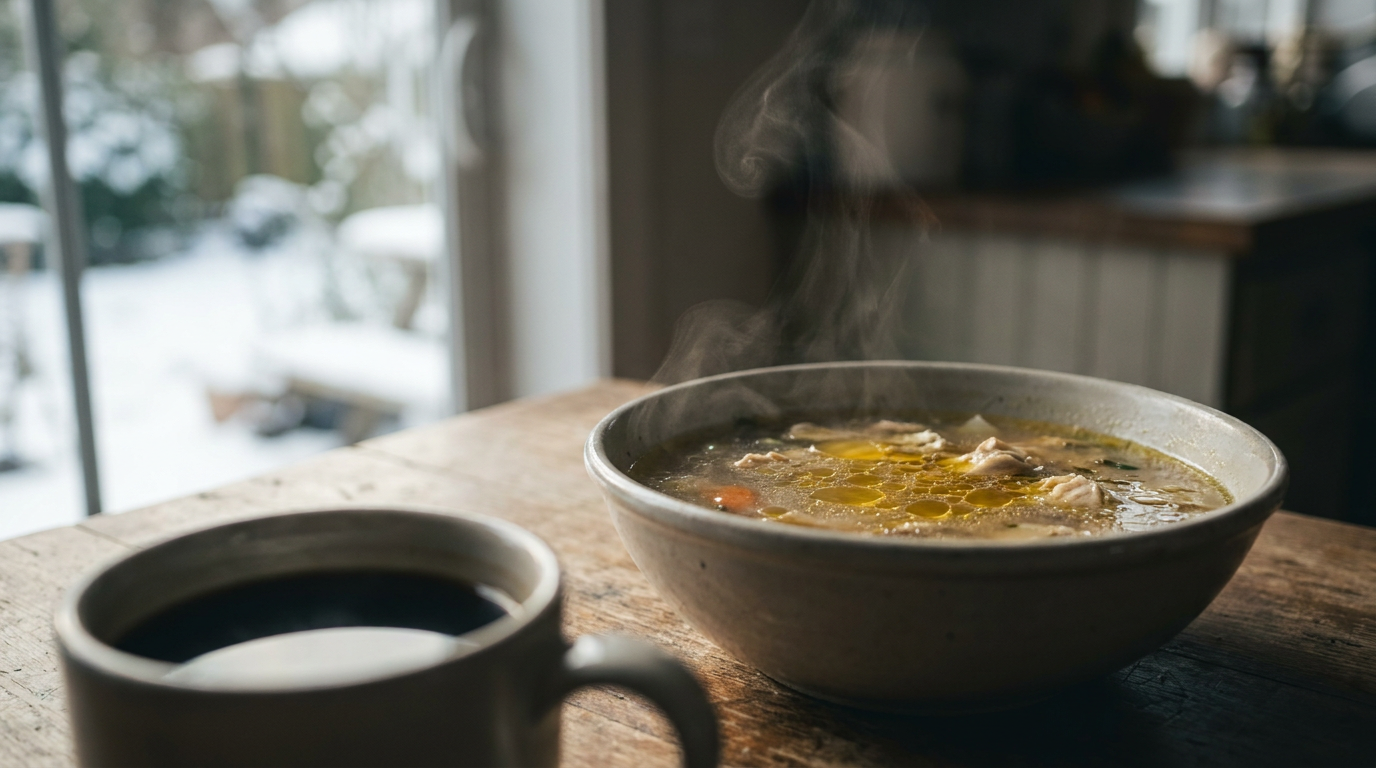
You pour two things on a winter morning: a mug of black coffee and a bowl of chicken broth. Both come off the stove at roughly the same temperature — steaming, too hot to drink, asking you to wait. You wait. The coffee cools in minutes, reaching something drinkable while the broth is still scalding your lip twenty minutes later. You probably chalk this up to the mug shape, or the broth being thicker somehow, or just bad luck with timing. But what is actually happening between those two liquids and the air above them is a small physics lesson running in plain sight, one that touches on evaporation, molecular escape velocity, dissolved fat, and the way heat moves through matter when it has more than one exit.
Heat leaves a liquid in three ways: conduction, radiation, and evaporation. Conduction is heat moving into the cup itself, then into the table, then into whatever the table is sitting on — a slow, material handoff. Radiation is infrared energy leaving the surface and dispersing into the room, invisible and continuous. Both of these processes work roughly the same way for coffee and broth. They are not what explains the gap. The real difference is evaporation, and evaporation is not simply water turning into steam. It is a selective, probabilistic process operating at the molecular level, and it is exquisitely sensitive to what else is in the water.
To understand why, you need to think about a liquid surface differently than you normally do. It is not a boundary — a flat edge where water ends and air begins. It is an arena. At any given moment, molecules near the surface are moving at a range of speeds, following something called the Maxwell-Boltzmann distribution[2]: most near the average, but some moving much faster and some much slower. The fast ones, if they are moving in the right direction and have enough kinetic energy to overcome the attractive pull of their neighbors, escape into the air as vapor. Every molecule that escapes carries its kinetic energy with it, and kinetic energy is heat. When the fastest molecules leave, the average energy of those remaining drops. The liquid cools. This is evaporative cooling, and it is the dominant heat-loss mechanism for a hot liquid sitting in open air.
Black coffee is almost entirely water. A few hundred dissolved compounds from the roasting and brewing process — acids, oils in trace amounts, bitter alkaloids like caffeine — but by mass and by behavior, it behaves like slightly complicated water. Its surface is largely free, accessible to the air, and the molecules at that surface are free to escape at their statistical maximum rate. Broth, by contrast, is carrying passengers. And those passengers change the rules.
The Surface Is Where Everything Happens
A good chicken broth — the kind made from bones and skin rather than a powder dissolved in hot water — carries a significant load of dissolved and suspended fats. Collagen from the bones breaks down into gelatin during the long simmer. Fat renders out of the skin and rises, but some stays emulsified or partially suspended in the liquid, especially if it was stirred or the broth was made vigorously. Even a broth that looks clear contains lipid molecules distributed through it. And lipids, chemically speaking, are hydrophobic: they do not bond readily with water, and they preferentially migrate toward surfaces and interfaces.
What this means for a bowl of hot broth is that its surface — the very arena where evaporative cooling happens — is partially occupied. Fat molecules drift to the liquid-air interface and settle there, forming a thin, loosely organized film. This film does not need to be visible, like the solid yellow disc of chicken fat you sometimes see on a cold batch of broth. It can be molecular-scale, barely a few layers thick, and it still exerts real physical consequences. Water molecules trying to reach the surface and escape as vapor have to contend with this hydrophobic barrier. Their rate of evaporation is suppressed. And because evaporation is the fastest and most efficient route for heat to leave the liquid, suppressing it slows cooling significantly.
“The fat in your broth is not just flavor — it is insulation, floating where the heat most wants to escape.”
This is not merely theoretical. The effect of surface-active compounds[1] — a category called surfactants, of which fats and lipids are a subset — on evaporation rates is well-documented in physical chemistry and in atmospheric science, where researchers study how organic films on ocean surfaces affect the rate of water vapor entering the atmosphere. A monolayer of fatty acid molecules[4] can reduce evaporative flux by a measurable percentage. On the scale of a soup bowl, that percentage translates into real, perceptible minutes.
Gelatin adds another variable. As the broth cools, the collagen-derived gelatin begins to set — not dramatically, not into the solid wobble of a chilled aspic, but into a subtly more viscous state. Increased viscosity means that molecules near the surface move more sluggishly, which again reduces the rate at which the fastest, hottest molecules can escape. Coffee has no gelatin. Its viscosity is barely distinguishable from pure water at the same temperature. It offers no such resistance.
Why Vapor Pressure Matters More Than Steam
The technical name for the tendency of a liquid's molecules to escape into the air is vapor pressure. Every liquid has a characteristic vapor pressure at a given temperature — a measure of how eagerly its molecules push outward into the gas phase. For pure water, this number climbs steeply with temperature: at 100°C it is high enough to boil the water against atmospheric pressure, but at 70 or 80°C it is still substantial, still driving meaningful evaporation even when the water looks placid. The surface is losing molecules constantly, invisibly, carrying heat out of the liquid with each one.
What dissolved substances do to this process is described by Raoult's Law[3], a principle from physical chemistry that states that the vapor pressure of a solution is lower than that of the pure solvent, proportional to the concentration of dissolved particles. Coffee has dissolved solutes — sugars if you add them, various acids and phenolic compounds from the brew — but at typical concentrations, the effect on vapor pressure is small. Broth has dissolved salts, amino acids, sugars from the vegetables, gelatin, and most critically, fat molecules at the surface. The collective suppression of vapor pressure is meaningfully larger. Less vapor pressure means fewer molecules escaping per unit of time means less heat carried away means slower cooling.
“Every escaping water molecule is carrying kinetic energy with it — which is another way of saying it is carrying heat out of your drink.”
Add a thin visible film of fat — the kind you can see shimmering on a bowl of pho or chicken soup — and the effect strengthens. That film is acting as something close to a physical lid, not perfectly sealed, but meaningfully reducing the liquid-air interface available for molecular escape. Soup eaten in many Asian culinary traditions is sometimes kept hot specifically because of this fat layer, consciously preserved rather than skimmed away. The fat is performing a genuine insulating function at the surface, one that cooks intuited long before the physical chemistry had a name.
Surface Area, Shape, and the Geometry of Cooling
There is a second layer to this — literal geometry. Evaporative cooling scales with surface area. The more exposed surface a liquid has relative to its volume, the more molecular escape routes exist, and the faster it cools. This is why a wide, shallow plate of liquid cools faster than a tall, narrow glass holding the same volume. It is also one reason a standard coffee mug and a soup bowl are worth comparing directly: soup bowls are typically wider, with a larger surface area to volume ratio, which should favor faster cooling. And yet the soup still wins the slow-cooling contest. The chemistry of the surface is beating the geometry of the container.
Coffee culture has actually developed around this geometry problem without naming it as such. The squat, wide coffee cup — favored in certain European traditions — loses heat faster than a tall, narrow American diner mug. Latte art lives in wide cups, which is part of why lattes cool faster than a double espresso in a small ceramic demitasse. The demitasse's high ratio of volume to surface area gives it a thermal advantage, holding heat longer per ounce. This is geometry working the same physics as the soup bowl fat layer, just arriving from a different direction.
A lid, incidentally, does something more complex than just blocking airflow. It traps the vapor that evaporates from the surface, raising the humidity of the air immediately above the liquid until it approaches saturation. At saturation, the rate of molecules returning to the liquid — condensation — roughly equals the rate leaving — evaporation. The net transfer of molecules, and therefore of heat, slows dramatically. This is why a lidded pot of soup stays hot long after an uncovered one has gone tepid, and why a travel mug with a lid keeps your coffee warm far longer than an open cup even with the same insulating walls.
What Milk Does to Your Coffee
Here is where it gets practically useful: adding milk or cream to coffee changes its cooling physics closer to soup territory, and not just because you are diluting it with something cooler. Milk contains fat — around 3.5 percent in whole milk, higher in cream — and those fat molecules, like the ones in broth, migrate to the liquid surface and partially suppress evaporation. Milk also contains proteins, including casein, which is itself surface-active. A coffee with a splash of whole milk will retain heat measurably longer than black coffee at the same starting temperature, for the same reasons that broth retains it longer than a clear liquid.
The common advice — add cold milk immediately to slow the cooling of your coffee — turns out to be physically sound, though the reason most people give for it is wrong. They say adding cold milk quickly brings the coffee to a lower temperature from which it cools more slowly, since cooler things lose heat more slowly. That part is true. But the fat in the milk is also changing the surface physics of what is now in your mug, suppressing the evaporative route that does most of the work. You are cooling the coffee by two mechanisms simultaneously: conduction from the cold milk mixing in, and altered evaporation at the surface. If you added an equivalent amount of cold water instead of cold milk, you would get the conductive cooling without the surface-chemistry effect, and your coffee would reach the same starting temperature but cool faster afterward.
The Air Above the Cup Is Part of the System
None of this happens in isolation from the room. The air above a hot liquid matters enormously, and specifically the movement of that air. Still air above an evaporating surface quickly becomes saturated with water vapor, which slows further evaporation. Moving air — a breeze, a draft, the airflow from a ceiling fan — continuously sweeps away that vapor-laden layer and replaces it with drier air, maintaining a steep gradient between the humid surface and the relatively dry air above it. Steep gradient means fast evaporation means fast cooling. Blowing on a hot liquid works for exactly this reason: you are mechanically removing the saturated boundary layer and replacing it with the lower-humidity air from your lungs and the surrounding room.
A drafty kitchen cools a cup of coffee noticeably faster than a still one. A restaurant with strong air conditioning can make a hot dish go cold before the meal is done. This is not about the temperature of the room as much as it is about the humidity and movement of the air above the liquid. A very humid summer kitchen — air already half-saturated with water vapor — slows evaporative cooling of any liquid, which is why coffee sometimes seems to stay hotter on muggy days. The room is not cold enough to pull much heat away by conduction through the air, and it is already too wet to pull much heat away through evaporation. The two mechanisms are working against each other.
“Blowing on hot soup is not impatience — it is applied fluid dynamics, moving the saturated air out of the way so evaporation can resume.”
Reading the Steam
There is one more thing worth noticing, because once you see it you cannot unsee it: the steam rising from coffee and from soup behaves differently, and the difference is visible if you look. Coffee produces a relatively thin, steady column of vapor. Broth, especially a fatty broth, produces less visible steam for its temperature — the fat layer at the surface is suppressing evaporation, so less vapor is escaping, so less is condensing into the visible wisps you associate with something hot. This can be actively misleading. A bowl of broth may look less dramatically steamy than a cup of coffee, while actually being hotter and remaining hotter longer. The suppressed evaporation that insulates the soup also makes it quieter about itself, less visually urgent, more willing to wait.
This is one of those places where the physics produces a genuinely counterintuitive result: the thing that looks cooler is often the thing that will burn your tongue. Fat at the surface reduces visible vapor, reduces evaporative heat loss, and maintains core temperature longer — all while the liquid looks placid and ready. The coffee is advertising its heat through vigorous evaporation, burning through that heat in the process, cooling itself as it announces itself. The broth is keeping its temperature close, giving almost nothing away, patient in a way that has nothing to do with intention and everything to do with the chemistry of what is floating at its surface.
Two cups, same room, same starting heat, different physics — and the whole story written in vapor, fat molecules, and the statistics of which molecules have enough energy to escape. The morning ritual of waiting for your drink to cool is not dead time. It is a quiet experiment running in your kitchen, with a result that has been determined by thermodynamics before you even picked up the mug.
References
- Evaporation suppressing monolayers (en.wikipedia.org)
Describes how monolayers form a physical barrier at air-water interfaces that reduces evaporative water loss, the mechanism behind fat's insulating effect. - Maxwell–Boltzmann distribution (en.wikipedia.org)
Explains the Maxwell-Boltzmann distribution governing molecular speeds at a liquid surface, foundational to understanding evaporative cooling. - Raoult's law (en.wikipedia.org)
Establishes Raoult's Law principle that dissolved substances lower a solution's vapor pressure proportionally to solute concentration, explaining broth's slower cooling. - The Rate of Evaporation of Water through Fatty Acid Monolayers (pubs.acs.org)
Provides empirical evidence that a fatty acid monolayer measurably reduces evaporative flux from liquids.
About Aris Thorne
Aris Thorne is a microbiologist who writes about the hidden mechanics of ordinary life: the microbes running your home, the chemistry unfolding in food and water, the physics built into familiar objects, and the biological systems quietly keeping the human body alive. His work follows science from kitchens, bathrooms, dust, soil, and city air into wounds, immune responses, infections, medicines, cells, and other worlds. He is most interested in the moment something familiar stops looking simple and reveals the living machinery underneath.
More like this
That Oily Rainbow on Your Morning Coffee Is Actually an Optical Instrument
The iridescent film floating on your pour-over isn't a flaw in your brew — it's a self-assembling structure that bends light by the same physics that makes soap bubbles glow.

A Candle Flame Is Rebuilding Itself From Scratch Every Millisecond
What looks like a simple flicker of wax and fire is actually a self-organizing column of vaporization, chemistry, and convection — and without gravity, it wouldn't even have a shape.

No Star Required: How Rogue Planets Could Hold Liquid Water in the Dark
Planets flung into interstellar space were assumed to be dead on arrival — but geothermal heat and hydrogen-rich atmospheres may keep some of them warm enough for liquid water, billions of miles from any sun.