A Candle Flame Is Rebuilding Itself From Scratch Every Millisecond
What looks like a simple flicker of wax and fire is actually a self-organizing column of vaporization, chemistry, and convection — and without gravity, it wouldn't even have a shape.
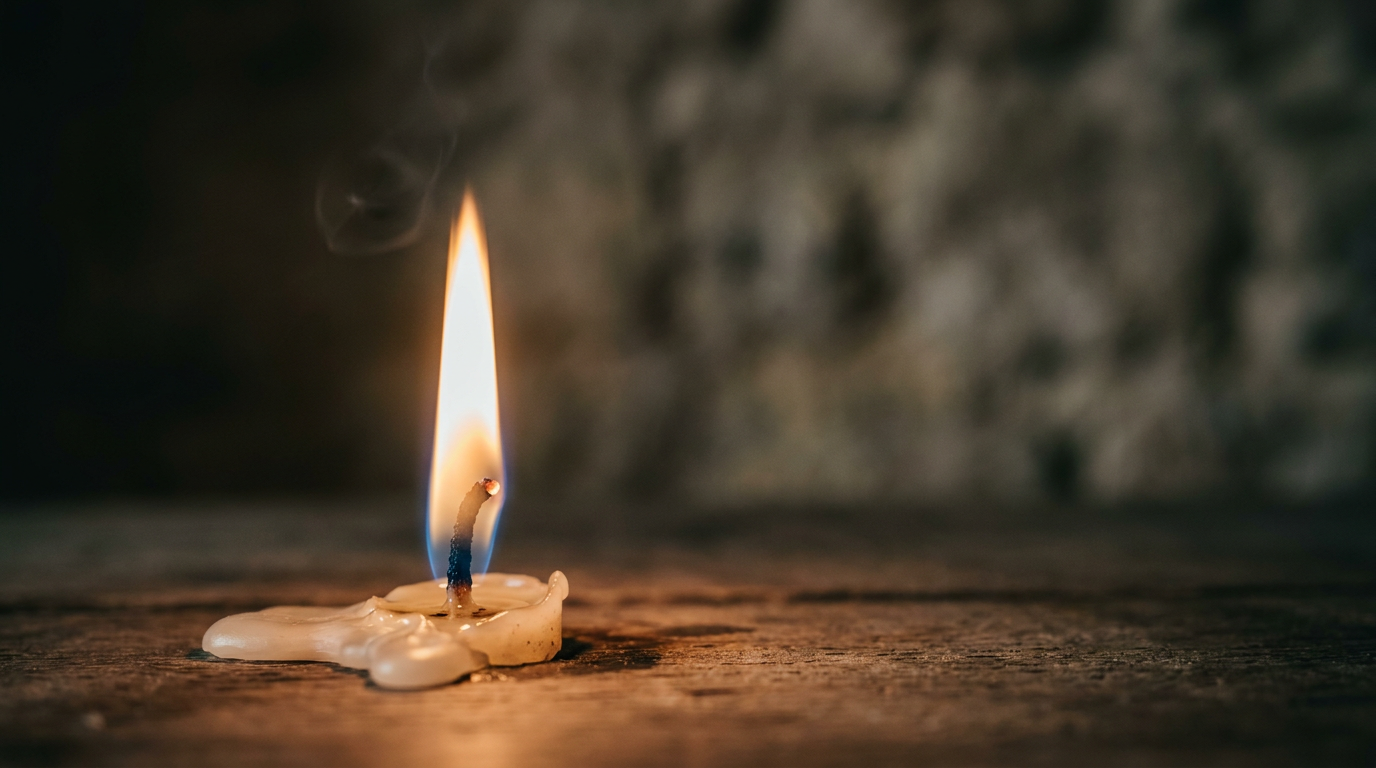
Light a candle and set it on the table in front of you. Watch it for thirty seconds without doing anything else. The flame holds its teardrop shape so reliably, so calmly, that it looks almost painted — a fixed object rather than an event. Poets have stared at candles for centuries and reached for words like eternal and still. What they were actually watching was one of the most precisely self-organized chemical processes in everyday life, running at full speed, rebuilding its own geometry continuously, and held in that familiar pointed shape by nothing more exotic than the pull of the Earth.
The candle flame is not a thing. It is a process masquerading as a thing. Nothing in that bright column is stationary. The hot gas is rising, the fresh air is rushing in at the base, the wax is vaporizing, the vapor is combusting, and the whole structure is constantly dismantling and reconstituting itself in a cycle so fast and so orderly that it looks, to the naked eye, like perfect stillness. What you are seeing when you watch a candle flame is less like watching a rock and more like watching a whirlpool — a stable shape produced by continuous motion, not by anything sitting still.
This distinction matters more than it might seem. A rock is stable because its atoms are bonded in place. A candle flame is stable because the physics governing hot gas, oxygen supply, and combustion chemistry happen to balance each other out in that particular geometry, in that particular gravitational field, at that particular rate. Change any one of those conditions — remove gravity, reduce oxygen, shift the air current in the room — and the flame changes shape, shrinks, or goes out entirely. It is not a fixed structure. It is a fixed relationship between ongoing processes.
So how does it work? What is actually happening inside that two-centimeter tongue of light? The answer involves a layered column of distinct chemical zones, a wick that is more sophisticated than it looks, a convection engine driven by density differences in hot and cold air, and a combustion reaction that is partly why the flame is blue at the bottom and luminous gold at the top. Each part of the flame is doing something different. Each part depends on the others. Pull any one piece out of the system and the whole thing collapses.
What the Wick Is Actually Doing
Start at the base, with the wick. Most people think of a candle wick as a fuse — something that catches fire and burns. But a wick that is burning the wick itself is a wick that is failing. In a well-designed candle, the wick is not the fuel. It is a delivery mechanism. The heat of the flame melts the wax immediately around the wick, pooling it into the liquid reservoir you can see forming around the base of a burning candle. That liquid wax is then drawn upward through the wick by capillary action — the same force that pulls water up through a paper towel pressed against a spill, or that lifts groundwater through soil. The braided fibers of the wick act as a network of tiny channels, wicking the liquid wax upward against gravity through surface tension.
By the time the liquid wax reaches the top of the wick, the heat there is intense enough to vaporize it. This is the step most people skip over entirely: the wax does not burn as a solid or even as a liquid. It burns as a gas. The candle flame is fueled by wax vapor — hydrocarbon molecules like those found in paraffin, typically chains of carbon atoms somewhere in the C20 to C40 range — that have been heated past their vaporization point and entered the gas phase, where combustion can actually occur. The wick is simply a controlled-release mechanism, delivering liquid fuel to the heat source at a rate calibrated by capillary action and the geometry of the braided fibers. Too thick a wick delivers too much fuel, floods the flame, and makes it smoke. Too thin a wick starves the flame and causes it to drown in its own melted wax pool. The wick's job is thermodynamic management.
The Column of Chemistry You Can't See
Above the wick, the flame is not a single unified thing. It is a stratified column of distinct chemical zones stacked on top of each other, each doing different chemistry. Understanding these zones is how you read the flame's color.
Immediately around the wick is a dark zone — the region where the wax vapor is richest and oxygen is scarce because the surrounding air hasn't yet diffused inward. Here the vapor is heating up but not yet igniting. Move outward and upward from there and you hit the blue zone, a thin luminous ring near the base of the flame where complete combustion is occurring. In this zone, hydrocarbon molecules that have vaporized off the wick are reacting with oxygen to produce carbon dioxide and water — the cleanest combustion reaction, the one that burns blue because the excited molecular species there, including CH radicals and C2 molecules, emit light in the blue end of the visible spectrum. This is where the flame is hottest, often around 1400 degrees Celsius. It is also where the most complete chemistry is happening.
“The candle flame is not a fixed structure. It is a fixed relationship between ongoing processes.”
Above the blue zone, the flame transitions into the familiar yellow-orange glow that most people think of as the flame's defining color. This luminosity comes not from the combustion reaction itself but from something produced by it: soot. In the upper regions of the flame, where oxygen supply is lower and the combustion less complete, carbon atoms cluster together into tiny particles — nanoscale graphitic clusters — rather than fully oxidizing into carbon dioxide. These particles are heated to incandescence by the surrounding combustion, glowing a warm yellow-orange the way a piece of metal glows when heated in a forge. The color tells you the temperature: lower in the flame, redder and dimmer; higher, brighter and whiter. This incandescent soot is why a candle flame looks warm. It is also why, when you blow a candle out, you see a thin thread of white smoke rising from the wick — that is unburned wax vapor and carbon particles that the flame was no longer hot enough to combust.
At the very tip of the flame, the soot particles that have risen through the luminous zone finally encounter enough oxygen to complete their combustion. The tip darkens slightly, the luminosity fades, and carbon dioxide and water vapor drift away invisibly into the room. The candle has consumed itself almost entirely — on a molecular level, the products of a candle's combustion are almost perfectly invisible. A candle leaves almost no residue because it is almost entirely converting itself into gas.
The Convection Engine That Keeps Everything Running
None of this chemistry sustains itself without a steady supply of fresh oxygen, and this is where the shape of the flame comes from. The combustion reaction heats the surrounding air. Hot air is less dense than cool air — its molecules are moving faster, spreading farther apart, taking up more space per unit of mass. That lower-density hot air rises, buoyed upward by the cooler, denser air pressing in beneath it. This is convection, the same mechanism that drives weather systems and ocean currents, playing out at the scale of a birthday candle.
As the hot combustion gases rise in a column above the flame, they drag fresh air inward at the base through viscous entrainment — the moving gas physically pulling surrounding air along with it. This continuous inflow of fresh air at the base of the flame is what keeps the oxygen supply replenished. The flame is, in effect, running its own ventilation system. It creates the updraft that feeds it. Hot gas rises, cool air rushes in to replace it, that cool air gets heated and rises in turn, and the cycle sustains itself as long as fuel is available. The teardrop shape — wide at the base, narrowing to a point — is the natural geometry that emerges from this convection pattern. The flame is widest where fresh air is being pulled in and combustion is most vigorous. It tapers to a point at the top because the column of rising hot gas narrows as it accelerates upward.
“The flame is widest where fresh air is being pulled in and combustion is most vigorous — the teardrop shape is not aesthetic, it is aerodynamic.”
What Gravity Has to Do With It
This is where the physics becomes quietly stunning. The teardrop shape — the entire directed structure of a candle flame — depends on gravity. Not loosely, not metaphorically. The convection that ventilates the combustion zone, the buoyancy that lifts hot gases upward, the inward rush of fresh cool air at the base: all of it is driven by the density difference between hot and cold air, and that density difference only matters when there is gravity to exploit it. Gravity is what makes the light gas rise and the dense gas sink. Without it, neither rises nor sinks. The ventilation stops.
Experiments conducted in microgravity — aboard the International Space Station and in drop tower facilities[2] that produce brief periods of near-weightlessness — confirm exactly this. In microgravity, a candle flame does not form a teardrop. It forms a small, dim sphere[2], roughly the size of a marble. Without convection, the combustion products — carbon dioxide and water vapor — simply accumulate around the flame rather than lifting away. Oxygen supply drops to whatever can diffuse inward through molecular diffusion alone, a far slower process than convective flow. The flame burns cooler, produces almost no soot, glows blue rather than yellow[1], and is so starved of oxygen that it often extinguishes itself within seconds. The familiar candle flame, in other words, is specifically a product of Earth's gravitational field. Change the gravity and you change the flame.
Microgravity combustion research has genuine engineering relevance. Understanding how fire behaves without buoyancy-driven convection matters for spacecraft fire safety, for combustion efficiency in engines, and for studying flame chemistry in conditions where gravity is not obscuring subtler physical effects. The humble candle, it turns out, has been a quietly productive research subject. The Flame Extinguishment Experiment — a real series of candle combustion experiments run aboard the ISS — used simple candle flames to investigate fuel droplet combustion in microgravity[3] and produced results that challenged existing models of how flames sustain themselves.
Why the Flame Flickers
The convection column rising from a candle flame is not perfectly steady. It is subject to small instabilities — slight variations in air temperature, tiny asymmetries in the wick, microscopic differences in wax supply — that cause the rising column of hot gas to wobble. These wobbles feed back into the flame's shape, causing it to stretch, bend, and flicker. The characteristic flicker of a candle in still air is not purely the result of external drafts. It is partly intrinsic to the convection column itself, which has a natural oscillation frequency in the range of a few hertz. When you see a candle flame pulsing in a room with no apparent air movement, you are watching the convection column ringing at its own resonant frequency, the way a column of water in a pipe has a natural frequency at which it sloshes.
A draft from an open window amplifies these oscillations dramatically, bending the entire column and distorting the combustion zones. When a flame bends sideways far enough, the soot that would normally rise and combust at the tip instead escapes from the side of the flame before reaching high enough temperatures to finish burning — which is why a candle in a draft tends to smoke. The soot is getting out before the flame can finish with it. A candle flame in still air is a nearly complete combustion machine. A candle flame in a draft is a machine with one of its outputs left unfinished.
What Happens in the Millisecond Before You See It
When you hold a lit match to an unlit wick, you are not simply providing heat. You are initiating a cascade. The match heats the wax near the wick above its melting point, pooling it into liquid. Capillary action pulls that liquid up through the wick fibers. The heat of the match vaporizes the liquid wax at the tip of the wick. The wax vapor, now mixed with ambient oxygen, reaches its ignition temperature and combustion begins. The exothermic reaction releases heat, which vaporizes more wax, which combusts and releases more heat. Within fractions of a second, this feedback loop reaches a self-sustaining equilibrium: the flame is hot enough to vaporize its own fuel without any additional heat input. The match has become irrelevant. You can take it away.
That transition — from externally supplied ignition to self-sustained combustion — is the moment the flame comes alive as a system. Before it, you have a heated wick. After it, you have a convection-fed, self-vaporizing, geometry-stabilizing chemical engine that will run continuously until the wax runs out, the oxygen is excluded, or something disrupts the convection column. Blowing out a candle works not primarily by cooling the flame, as most people assume, but by disrupting the air supply so severely that the convective ventilation collapses faster than combustion can sustain itself. The wax vapor above the wick is momentarily still present — which is why you can sometimes relight a just-extinguished candle by holding a lit match several centimeters above the wick and igniting the lingering vapor trail before it disperses.
“Blowing out a candle works not by cooling the flame but by collapsing the convective ventilation the flame needs to breathe.”
There is something worth sitting with in all of this. The candle on your dinner table, the one you have lit a hundred times without thinking about it, is running a small, exquisite, self-organized system: capillary transport feeding a vaporization zone feeding a stratified combustion column feeding a convection engine that ventilates the whole process and sculpts the flame into its characteristic form. Every piece of that system is performing a function. Every piece depends on every other. The flame rebuilds its own structure continuously, in real time, faster than you can perceive, using nothing but heat, airflow, and the pull of the Earth. When you finally blow it out and watch the thin ribbon of smoke curl upward into the dark — that is the fuel supply running loose, chemistry with nothing left to organize it.
References
- Candle Flame - 1g vs Microgravity - NASA (nasa.gov)
Demonstrates that in microgravity, flames become spherical and blue rather than teardrop-shaped and yellow, proving gravity's role in flame shape and soot formation. - Candle Flames in Microgravity - NASA Technical Reports Server (NTRS) (ntrs.nasa.gov)
Documents NASA research on candle flame behavior in microgravity using drop tower facilities to study gravity's role in flame structure. - Detailed Results from the Flame Extinguishment Experiment (FLEX) March 2009 to December 2011 (ntrs.nasa.gov)
Provides experimental data on fuel droplet combustion behavior in microgravity conditions from NASA's Flame Extinguishment Experiment.
About Aris Thorne
Aris Thorne is a microbiologist who writes about the hidden mechanics of ordinary life: the microbes running your home, the chemistry unfolding in food and water, the physics built into familiar objects, and the biological systems quietly keeping the human body alive. His work follows science from kitchens, bathrooms, dust, soil, and city air into wounds, immune responses, infections, medicines, cells, and other worlds. He is most interested in the moment something familiar stops looking simple and reveals the living machinery underneath.
More like this
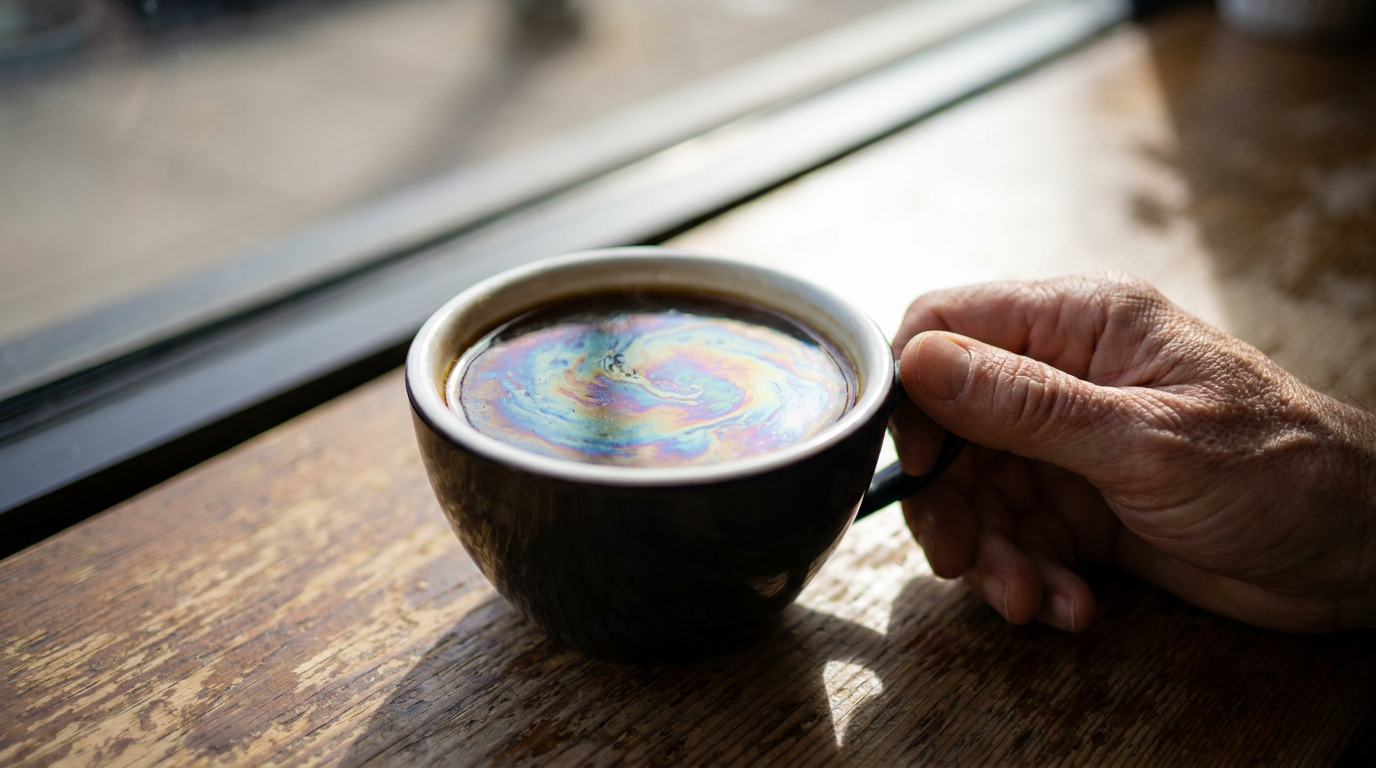
That Oily Rainbow on Your Morning Coffee Is Actually an Optical Instrument
The iridescent film floating on your pour-over isn't a flaw in your brew — it's a self-assembling structure that bends light by the same physics that makes soap bubbles glow.
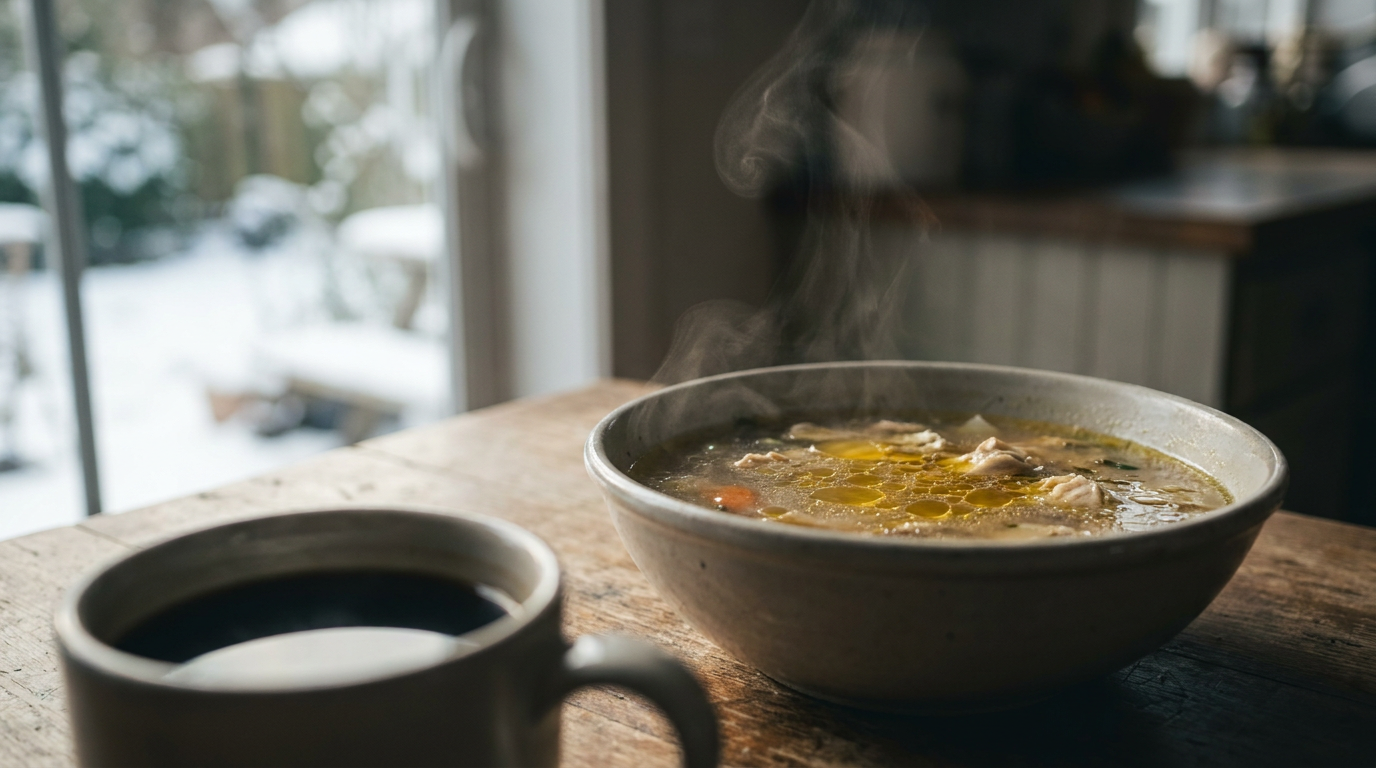
Your Coffee Goes Cold in Minutes. Your Soup Takes Forever. Here's Why.
Same cup, same room, same starting temperature — but coffee and soup are losing heat through completely different physics, and the gap between them comes down to fat, vapor, and the invisible work happening at the surface.

The Butterfly Nebula Is Not a Death. It's a Crime Scene.
JWST peered inside the Butterfly Nebula and found not chaos, but a structured record — jets, rings, and buried dust encoding five billion years of stellar biography.