The Oceans Are Running Out of Breath. The Food Web Feels It First.
Dead zones have multiplied tenfold since the 1950s, but the real damage isn't the fish floating at the surface — it's the invisible collapse happening in the layers beneath them.
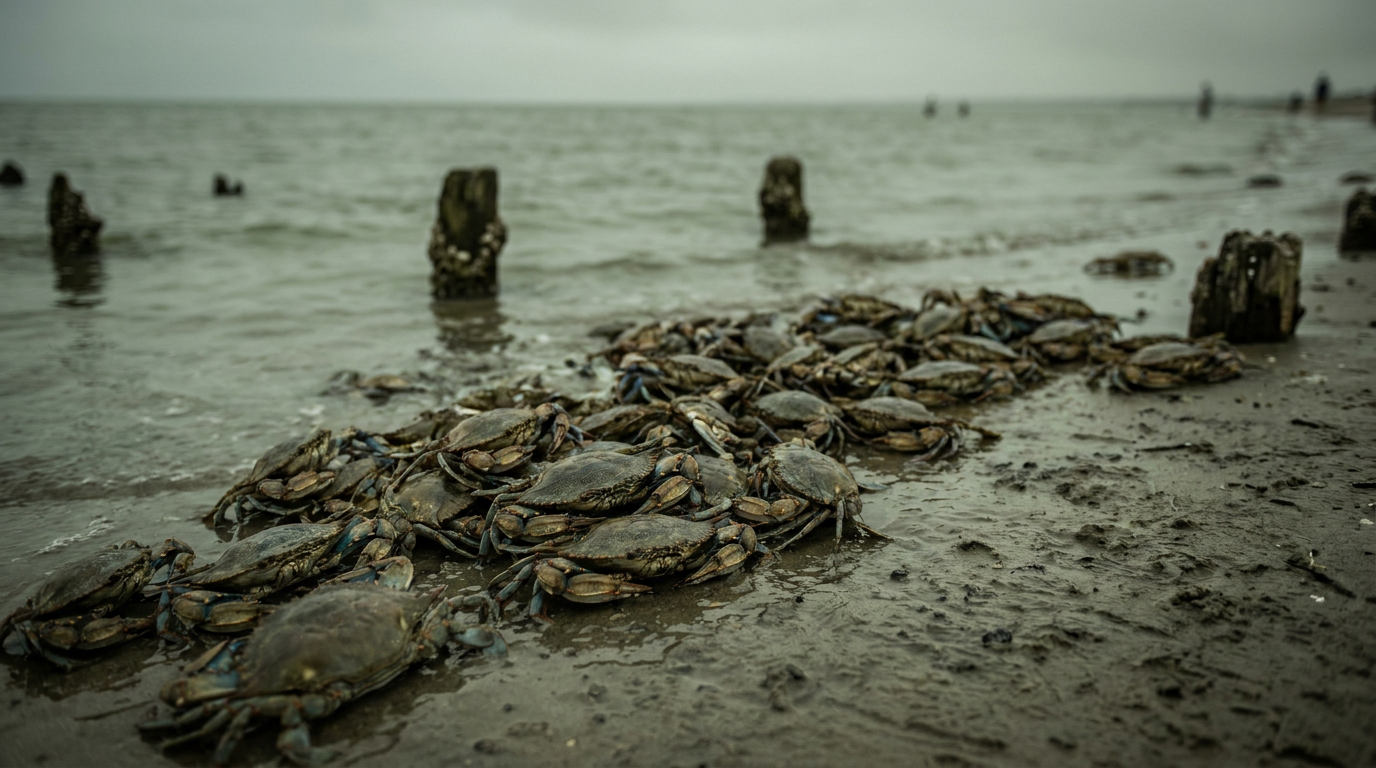
In the summer months, in the waters off the Louisiana coast, there is a place the size of New Jersey where almost nothing breathes. The water looks ordinary from above — the same Gulf green, the same flat horizon. But below the surface, dissolved oxygen has dropped so low that most aerobic life either flees or dies. Shrimp pile up at the edges of the zone in unnaturally high densities, crowded out of their normal range. Crabs crawl onto the beach in slow, heat-drunk masses. Fish avoid the area entirely, rerouting their movements around a void that did not exist in their evolutionary memory.
The Gulf's dead zone is one of the most-studied hypoxic zones on earth, and it is not the worst. Off the coast of Namibia, a massive dead zone forms seasonally and vents hydrogen sulfide gas directly into the atmosphere[4]. In the Baltic Sea, the hypoxic zone has expanded so dramatically that the seafloor in large sections is covered in a bacterial mat, a pale, ghostly layer that replaces the burrowing invertebrate communities that once turned and aerated the sediment. The ocean is losing oxygen in more places and at greater depths than at any point in recorded history, and the zones where oxygen has effectively disappeared now number more than 500, up from fewer than 50 in the 1950s. That acceleration is not a blip.
The framing of this story has always leaned toward the dramatic: dead fish, collapsed fisheries, dying reefs. That framing is not wrong, but it is incomplete in ways that matter. The organisms most sensitive to deoxygenation are not the large, mobile creatures that can swim away. They are the small, slow, bottom-dwelling invertebrates — copepods, amphipods, polychaete worms, larval stages of commercially important species — that form the connective tissue of the marine food web. When oxygen drains out of a water column, these organisms die or disappear first, quietly, without making the news. What follows their disappearance is a restructuring of the food web so fundamental that recovery, even after oxygen returns, can take years or decades to fully materialize.
Understanding ocean deoxygenation means sitting with an uncomfortable fact: the thing being lost is less visible than the thing we are afraid of losing. The public narrative tends toward fish because fish are legible, economically familiar, culturally weighted. But the crisis, at its root, is about the erasure of everything that makes fish possible.
How Water Loses Its Breath
Oxygen enters the ocean through two pathways: it diffuses from the atmosphere at the surface, and it is produced by phytoplankton through photosynthesis. Both pathways are temperature-sensitive. Warmer water holds less dissolved gas — a basic principle of chemistry — which means that as ocean surface temperatures rise, the water physically loses capacity to hold oxygen. This is thermal deoxygenation, and it is happening across the open ocean at a measurable rate, driven by climate warming. Oxygen minimum zones, naturally occurring low-oxygen layers that exist in parts of the Pacific and Indian Oceans, have been expanding for decades[2]. These zones are not dead zones in the traditional sense, but they function as compression layers: they push organisms that need oxygen toward shallower water, compressing the vertical range of the food web and intensifying competition for a shrinking livable column.
The dead zones most people have heard about are driven by a different but compounding mechanism: nutrient pollution. Nitrogen and phosphorus, mostly from agricultural runoff and sewage, flood into coastal waters and trigger massive phytoplankton blooms. When those blooms die and sink, they are decomposed by bacteria that consume oxygen in enormous quantities. The water beneath the bloom becomes hypoxic, sometimes within weeks. This process is called eutrophication, and it has been accelerating in lockstep with industrial agriculture since the mid-twentieth century. The Gulf of Mexico dead zone, fed largely by the Mississippi River's nutrient load[1], forms every spring as snowmelt and rainfall flush the Corn Belt's fertilizer downstream. It is, in one sense, a direct transfer of agricultural runoff into marine suffocation.
“The dead zone forms every spring as snowmelt flushes the Corn Belt's fertilizer downstream — a direct transfer of agricultural runoff into marine suffocation.”
Climate change and eutrophication are not separate problems. Warmer water stratifies more easily, meaning the surface layer separates from cooler, deeper water and oxygen cannot mix down as efficiently. This stratification makes eutrophication-driven dead zones larger and more persistent, because the mechanism that would normally help flush hypoxic water — vertical mixing — is weakened. The two drivers amplify each other. In areas where both are present simultaneously, dead zones are forming faster, lasting longer, and occurring in months when they previously did not.
The Organisms That Die First
Copepods are among the most numerous animals on earth. Tiny crustaceans, most less than a few millimeters long, they drift through the water column in staggering quantities, grazing on phytoplankton and being grazed on by nearly everything else: larval fish, juvenile shrimp, sardines, anchovies, herring, and ultimately the larger predators that feed on those. They are the ocean's middle tier, the layer through which solar energy captured by phytoplankton passes on its way to becoming fish. Copepod populations in hypoxic waters collapse rapidly[3]. They are sensitive to low oxygen and have limited behavioral flexibility — they cannot simply swim to better conditions the way a fish can. When the oxygen level drops below a certain threshold, copepod mortality increases sharply, and the juveniles, which require even more oxygen per unit of body mass, die first.
Polychaete worms, bivalves, and other benthic invertebrates suffer a different but equally significant fate. These are the organisms that live in and on the seafloor sediment, filtering particles, bioturbating the substrate, and forming a food source for demersal fish — fish that live and feed at the bottom. In a healthy system, the seafloor is a dense and active community, turning over nutrients, processing organic matter, and sustaining a food chain that runs from sediment bacteria up through worms and clams to flatfish and cod. When hypoxia sets in, this community dies. The sediment goes anoxic. The worms decompose, the bivalves close and suffocate, and the bacterial mats move in. What had been a productive interface between the water column and the seafloor becomes, essentially, a dead surface. Demersal fish that return to the area after a hypoxic event find no food waiting for them. The pantry is empty.
“When hypoxia sets in, the seafloor goes anoxic, the worms decompose, the bivalves suffocate — and demersal fish that return after the event find the pantry empty.”
Larval stages of commercially important species — shrimp, crabs, grouper, flounder — are among the most vulnerable. Larvae are often planktonic, drifting in the water column and entirely dependent on the zooplankton community for food. In hypoxic water, the zooplankton base is diminished, and the larvae themselves face direct oxygen stress. Recruitment — the process by which juveniles survive and enter the adult population — can fail for multiple consecutive years in areas with chronic hypoxia. This is how deoxygenation becomes a fisheries problem, not through direct fish kill but through the collapse of recruitment, a quieter and more difficult thing to measure than a mass die-off, but structurally more damaging to the long-term population.
The Food Web Under Compression
When an oxygen minimum zone expands or a dead zone persists through a feeding season, it does something to the food web that ecologists call compression. Mobile organisms — pelagic fish, squid, marine mammals — are pushed into a thinner band of oxygenated water near the surface. This sounds like an abundance: everything forced into a smaller space. In some local, short-term contexts it can look that way. Fishers sometimes report better catches near the edges of dead zones, precisely because fish are concentrated there. But the concentration is a symptom of stress, not health. It depletes the compacted zone faster, intensifies predation pressure on zooplankton communities that are already reduced, and leaves populations with no energetic buffer when conditions worsen.
There is also a subtler disruption to vertical migration, one of the ocean's most important daily ecological rhythms. Zooplankton, including copepods and krill, typically migrate from deeper water to the surface at night to feed on phytoplankton, then descend again during the day to avoid predators and regulate their temperature. This daily movement is a transport mechanism for carbon, nutrients, and energy across the water column, and it links the surface ecosystem to the deep. When oxygen minimum zones expand upward, they block this migration. Zooplankton cannot descend as deeply as they normally would, and the vertical nutrient cycling that their movement enables is interrupted. The food web loses a dimension, literally and functionally, and the deep-sea communities that depend on the organic matter carried downward by migrating organisms are also affected.
Recovery Is Not What the Word Implies
After a seasonal dead zone retreats — when autumn cooling and storms mix oxygen back into the water column — the affected area does not simply snap back. The benthic community, which can take years to establish itself in stable conditions, must rebuild from scratch. Larval invertebrates need to settle, survive, and mature. The sediment needs to be reoxygenated before burrowing organisms can colonize it again. In areas where dead zones form annually, as in the Gulf of Mexico, the benthic community never fully recovers between events. It exists in a state of permanent partial recovery, always behind where it was before the previous year's hypoxic event hit. The system is being reset faster than it can rebuild, and each cycle leaves the starting point a little lower.
The Baltic Sea offers a long-term window into what chronic deoxygenation produces. Large portions of the Baltic seafloor have been hypoxic for decades, and the benthic communities there have not recovered in any meaningful ecological sense. What exists now is a simplified system: less diverse, less productive, dominated by opportunistic and hypoxia-tolerant species that do not support the same food web that once sustained one of Europe's most productive fisheries. The fish populations of the Baltic — cod in particular — have been in serious decline, and while overfishing plays a significant role, the collapse of the benthic prey base in hypoxic zones is understood to be a compounding and underappreciated pressure. The habitat simply does not produce enough food to sustain the populations, even when fishing pressure is reduced.
“The system is being reset faster than it can rebuild, and each cycle leaves the starting point a little lower.”
What the Silence Costs
The monitoring networks for ocean oxygen are improving but still thin. Most of what we know about dead zone dynamics comes from heavily studied systems — the Gulf of Mexico, the Baltic, parts of the Pacific coast — and from research cruises that sample point locations at intervals. Large stretches of the ocean, especially in the tropics and the southern hemisphere, have sparse coverage. Oxygen minimum zone expansion in the open Pacific has been documented, but the resolution of the data is coarse. What is happening to the zooplankton communities, the larval fish, the benthic invertebrates in those waters is largely unknown, measured in broad strokes when what the science actually needs is granular, continuous observation.
The gap between what we can document and what is likely happening across the global ocean is itself a kind of loss — not of organisms, but of legibility. We are watching a system change at a scale and pace we cannot fully resolve, using monitoring infrastructure built for a slower, more stable world. Dead zones that form seasonally in new locations, oxygen minimum zones that push upward without warning, benthic communities that fail to recruit without anyone measuring the failure: these are changes that accumulate below the threshold of the dramatic, below the level at which a news story forms. The fish, when they finally disappear, will be the visible end of a process that began somewhere quieter and smaller — in the oxygen content of a water column, in the survival rate of a copepod, in the slow failure of a seafloor that no longer breathes.
References
- Below Average Summer 2025 ‘Dead Zone’ Measured in Gulf - NCCOS - National Centers for Coastal Ocean Science (coastalscience.noaa.gov)
Provides measurements of the Gulf of Mexico dead zone and establishes the Mississippi River as a major nutrient source driving hypoxia. - Declining oxygen in the global ocean and coastal waters (science.org)
Documents that oxygen minimum zones in the Pacific and Indian Oceans have been expanding for decades due to climate warming. - Fewer Copepods, Fewer Anchovies, and More Jellyfish: How Does Hypoxia Impact the Chesapeake Bay Zooplankton Community? (mdpi.com)
Demonstrates that copepod populations collapse rapidly in hypoxic waters, with juveniles dying first due to oxygen sensitivity. - Winning Ways With Hydrogen Sulphide on the Namibian Shelf (frontiersin.org)
Describes the Namibian shelf dead zone's extreme hydrogen sulfide concentrations and how benthic communities adapt to perennial anoxia.
About Sable Pike
Sable Pike writes about habitat loss, ecosystem strain, species decline, climate disruption, and the quiet unraveling of natural systems people once assumed were permanent — and the way that unraveling reaches into economies, politics, and daily life. Her work brings emotional weight to ecological change without sacrificing scientific rigor.
More like this
The Oceans Have Lost 500 Dead Zones' Worth of Silence
Ocean dead zones have grown tenfold since the 1950s, and the deoxygenation driving them is quietly rewiring marine life from the seafloor up — long before fish populations crash.
Florida's Reef Builders Are Functionally Extinct. The Reef Is Still There.
After the 2023 marine heatwave, staghorn and elkhorn corals crossed a threshold scientists call functional extinction — and the reef kept its shape just long enough to hide the damage.
The Coral Reef Restoration Plan Can't Keep up. The Math Proves It.
Restoration science has gotten genuinely good at growing coral — which makes the numbers showing it can't possibly save reefs at scale even harder to look at.