That Cardboard Box Can Hold a Car — Here's the Geometry Behind It
The humble corrugated box is a precision structural system, and the same arch physics keeping it intact once held up the roofs of Gothic cathedrals.
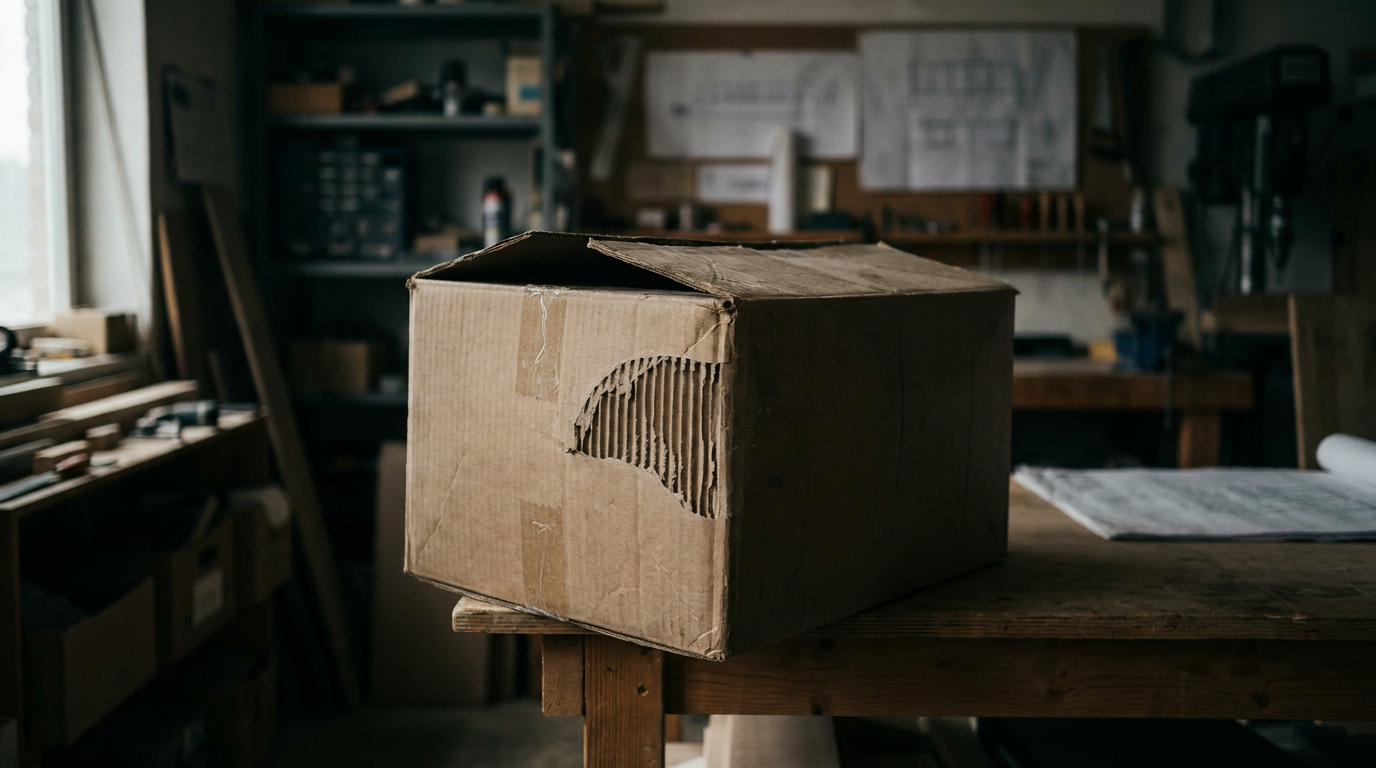
Pick up an empty cardboard box. Not a reinforced crate or a specialty shipping container — just the ordinary kind that arrives holding your online order, the one you break down and leave by the recycling bin without a second thought. Hold it by the bottom edge and notice how little it weighs. Now set it on the floor, stack a few heavy books on top, and watch what does not happen: it does not crumple. The walls do not buckle. The box simply sits there, holding its shape with a patience that feels almost stubborn for something made of paper and glue.
The wall of a corrugated box, if you tear a flap and look at the cross-section, reveals a kind of secret. There are three layers. Two flat sheets of paper — the liners — sandwich a middle layer that runs in a continuous, rhythmic wave. That wave is called the flute. It is not decorative. It is not incidental. It is one of the most quietly elegant structural solutions in everyday manufacturing, a piece of geometry doing exactly what it was designed to do while the rest of the world treats the box as disposable packaging.
The structural logic behind that flute is ancient, and it shows up in the same places humans have always needed to hold weight without adding mass: bridges, vaulted ceilings, doorframes, the bones of a bird's wing. A corrugated box is not just a container. It is a load-bearing system, and once you understand what it is actually doing, you cannot look at cardboard the same way again.
To understand how a few grams of formed paper can hold hundreds of times its own weight, you need to understand arches. Not the ornamental kind, but the structural kind — the shape that turns a downward force into something a material can actually survive.
What a Wave Knows About Weight
Press your fingertip down on a flat sheet of paper lying on a table. It buckles almost immediately, folding under almost no force at all. Now roll that same sheet into a tube, stand it on end, and press again. Suddenly it resists. The geometry changed; the physics followed. Flat paper has almost no capacity to resist compression along its plane — the fibers simply have nowhere to go when force arrives, so they collapse sideways. But give paper a curved shape and the situation reverses. The curve redirects the compressive load, distributing it along the material's length rather than concentrating it at a single point. The paper is now working the way an arch works.
The fluted middle layer of corrugated cardboard is a series of these arches, stacked side by side in a continuous accordion-like wave. Each peak and valley forms a partial arch spanning between the two flat liner sheets. When you set something heavy on top of the box, the compressive force travels down through the top liner, hits the peaks of the flute, and spreads laterally along the curved geometry rather than driving straight through. The load fans outward through each arch and transfers into the bottom liner, which disperses it across the floor. The box does not just absorb force. It choreographs it.
“The box does not just absorb force — it choreographs it.”
This is compressive load distribution in one of its most efficient forms, and it works because of a principle that structural engineers call the arch effect: a curved form under vertical compression develops internal forces that run along the curve itself — called thrust — rather than bending stresses that would crack or buckle the material. The flute channels that thrust. The liners contain it. The whole system works together as a single structural unit, which is why cutting a box in half or wetting it thoroughly causes such a dramatic collapse. You have not just weakened the material; you have interrupted the geometry.
The Cathedral in Your Shipping Label
The arch as a structural device has a long and storied history, but its power became truly spectacular during the construction of medieval Gothic cathedrals in the twelfth and thirteenth centuries. Architects working in stone needed to span enormous interior voids — naves wide enough to seat hundreds, ceilings tall enough to suggest the infinite — without the walls collapsing under the immense weight of the roof. Their solution was not thicker walls but better geometry. They discovered that a pointed arch, more so than a semicircular Roman arch, allowed the thrust to be directed more steeply downward, closer to vertical, which meant it could be carried more efficiently into the walls and then out through the flying buttresses that became the visual signature of Gothic architecture.
The logic is identical to what happens inside a corrugated wall. In a cathedral, the arch redistributes the compressive load of the stone roof and channels it along the curve of the vault and out through the buttress into the ground. In a cardboard box, the flute redistributes the compressive load of whatever is stacked on top and channels it along the wave geometry and down through the liner into the floor. The scale differs by a factor of millions. The physics does not differ at all. Both are material systems shaped into curves so that weight has somewhere to go besides straight down through a structure that cannot bear it.
This is not a coincidence or an analogy being stretched for effect. It is the same physical principle operating across two domains that never needed to know about each other. Structural engineers who study shell structures — thin-walled systems that derive their strength from geometry rather than material mass — see corrugated forms as a textbook case of efficient load transfer. The corrugated steel used in modern warehouse roofing, the ribbed vaulting of airports and train stations, the fluted columns of ancient Greek temples: they are all drawing from the same geometric toolkit. Cardboard arrived at this solution through industrial pragmatism rather than architectural ambition, but it arrived at the right answer.
Flute Types, Face Grain, and Why the Box Has a Strong Direction
Not all corrugated cardboard is built the same way, and the differences are more precise than you might expect. The flute — that interior wave — is manufactured in standardized profiles designated by letters: A-flute, B-flute, C-flute, E-flute, and so on. Each designation describes the height and spacing of the wave. A-flute is tall and widely spaced, producing excellent cushioning and stacking strength. B-flute is shallower and more tightly packed, better for resist puncture and die-cutting. C-flute, the most common type for shipping boxes[4], splits the difference and accounts for the majority of corrugated cardboard produced globally. E-flute is so fine it is nearly invisible as corrugation, used for point-of-sale displays and food packaging where a smooth printable surface matters more than heavy stacking performance.
Beyond flute profile, the orientation of the paper fibers in the liner sheets matters considerably. Paper, like wood, is anisotropic — its mechanical properties differ depending on direction, because the cellulose fibers laid down during manufacturing align preferentially along the direction of production, called the machine direction. A liner sheet is significantly stiffer and stronger in the machine direction than perpendicular to it. Box manufacturers orient the flutes and liners so that the machine direction of the liner sheets runs vertically when the box is assembled and loaded. This is not trivial: a box whose liners run the wrong way relative to the flutes can lose a substantial fraction of its compressive strength. The box has a strong direction, engineered deliberately, even though nothing on the outside tells you which way it runs.
“The box has a strong direction, engineered deliberately, even though nothing on the outside tells you which way it runs.”
The standard test for corrugated board stacking strength is called the Edge Crush Test, or ECT[2], which measures how much compressive force the edge of a small sample of board can withstand before it collapses. ECT values are printed on the manufacturer's certification stamp — the small circle typically found on the bottom flap of a shipping box, the one most people ignore entirely. A standard C-flute single-wall corrugated box with an ECT rating of 32 can be stacked in a warehouse to heights carrying thousands of pounds, all managed by the geometry of its walls and the fiber alignment of its liners. That stamp is a structural specification, not boilerplate.
The Enemy Is Not Weight — It's Water
Corrugated cardboard's structural integrity depends almost entirely on one thing that is easy to take for granted: the cellulose fibers in the paper must remain dry. Cellulose — the long-chain glucose polymer that forms the structural backbone of plant cell walls and, by extension, paper — is hydrophilic. It attracts water molecules. When moisture infiltrates a corrugated box, the hydrogen bonds holding adjacent cellulose fibers in alignment begin to compete with hydrogen bonds to water molecules, and the water wins. The fibers swell, slide against each other, and lose the crystalline rigidity that gives dry paper its stiffness. The flute softens. The arches flatten. The geometric advantage disappears.
This is why a cardboard box left in a damp garage fails so dramatically and so fast. It is not merely getting soggy in some vague sense. The structural system is dissolving at the molecular level, with water molecules inserting themselves between cellulose chains and disrupting the hydrogen-bond network that makes the fiber matrix stiff. Once the flute geometry loses its rigidity, the liner sheets have no internal support, and the whole compressive load system collapses — not because the weight increased, but because the arch geometry was chemically compromised.
Industrial solutions to this problem include wax coatings, moisture-resistant adhesives, and polymer-laminated liners, all of which create a hydrophobic barrier between the cellulose and the environment. Waxed corrugated boxes used in produce shipping can survive wet, cold environments for extended periods precisely because they maintain the geometry that makes the structure work. The engineering challenge is always the same: protect the shape, and the strength takes care of itself.
The Geometry That Refuses to Be Oversimplified
There is a deeper point buried in all of this that is worth staying with. The corrugated box is sometimes cited as an example of biomimicry — the practice of drawing engineering solutions from biological forms — because corrugated structures appear abundantly in living systems. The cross-section of a bird's skull bone shows a cancellous inner layer of tiny struts and voids between two dense outer layers, a geometry almost identical to a corrugated sandwich panel. The internal structure of a nautilus shell follows similar logic. Trabecular bone, the spongy interior material found at the ends of long bones in mammals, is a three-dimensional lattice of struts and arches oriented precisely along the directions of greatest mechanical load, constantly being remodeled by osteoblast and osteoclast activity[1] as loading patterns change throughout a lifetime.
Whether corrugated cardboard's inventors were aware of any of this when they patented the first corrugated shipping containers in the 1870s is doubtful. But nature and engineering arrived at the same conclusion independently: if you need a lightweight structure to resist compression, put a curved geometry between two stiff skins. The arch is not a human invention. It is a mathematical inevitability — the shape that force, given the right material constraints, tends to produce on its own.
“The arch is not a human invention — it is a mathematical inevitability, the shape that force tends to produce when given the right constraints.”
What You're Actually Looking At
The next time you fold down the flaps of a cardboard box and press them flat, notice the resistance before it gives. That resistance is the flute geometry pushing back, the arches momentarily refusing to flatten before the force overcomes them. When you break down the box entirely and it collapses into a flat sheet, what you have done, structurally, is disassemble a load-bearing system into its raw materials. The sheet left in your hands weighs almost nothing and will buckle under a breath of pressure. The box it used to be could have held a stack of concrete blocks.
This is what structural engineering actually is at its core: not exotic materials or high-tech fabrication, but geometry disciplined to serve a mechanical purpose. The same insight that let medieval masons build stone vaults sixty meters high with no steel reinforcement lives inside the wall of a box that held your new kitchen appliance. Both are answers to the same question. How do you take a force that would destroy a flat surface and give it somewhere to go? You curve the material. You build an arch. You let the geometry do the work that mass alone cannot do. The box on your floor already knows this. It has been quietly demonstrating it the whole time.
References
- Mechanical regulation of bone remodeling (nature.com)
- Edge Crush Test: Definition, How It Works, Advantages, and Challenges (xometry.com)
Defines the Edge Crush Test as the standard methodology measuring compressive force corrugated board can withstand before collapse. - Effect of moisture content on the microscopic properties of amorphous cellulose: a molecular dynamics simulations (iopscience.iop.org)
- What is Flute in Packaging? Types & Use Guide (packmojo.com)
Confirms C-flute is the most common corrugated cardboard type used for shipping boxes globally.
About Aris Thorne
Aris Thorne is a microbiologist who writes about the hidden mechanics of ordinary life: the microbes running your home, the chemistry unfolding in food and water, the physics built into familiar objects, and the biological systems quietly keeping the human body alive. His work follows science from kitchens, bathrooms, dust, soil, and city air into wounds, immune responses, infections, medicines, cells, and other worlds. He is most interested in the moment something familiar stops looking simple and reveals the living machinery underneath.
More like this

That Oily Rainbow on Your Morning Coffee Is Actually an Optical Instrument
The iridescent film floating on your pour-over isn't a flaw in your brew — it's a self-assembling structure that bends light by the same physics that makes soap bubbles glow.
The Metal in Your Car Has Never Fully Forgotten How It Was Made
No matter how aggressively manufacturers roll, heat, and reshape metal alloys, a ghost of the original atomic order survives — and physicists are only beginning to understand why.

Your Coffee Goes Cold in Minutes. Your Soup Takes Forever. Here's Why.
Same cup, same room, same starting temperature — but coffee and soup are losing heat through completely different physics, and the gap between them comes down to fat, vapor, and the invisible work happening at the surface.