That Oily Rainbow on Your Morning Coffee Is Actually an Optical Instrument
The iridescent film floating on your pour-over isn't a flaw in your brew — it's a self-assembling structure that bends light by the same physics that makes soap bubbles glow.
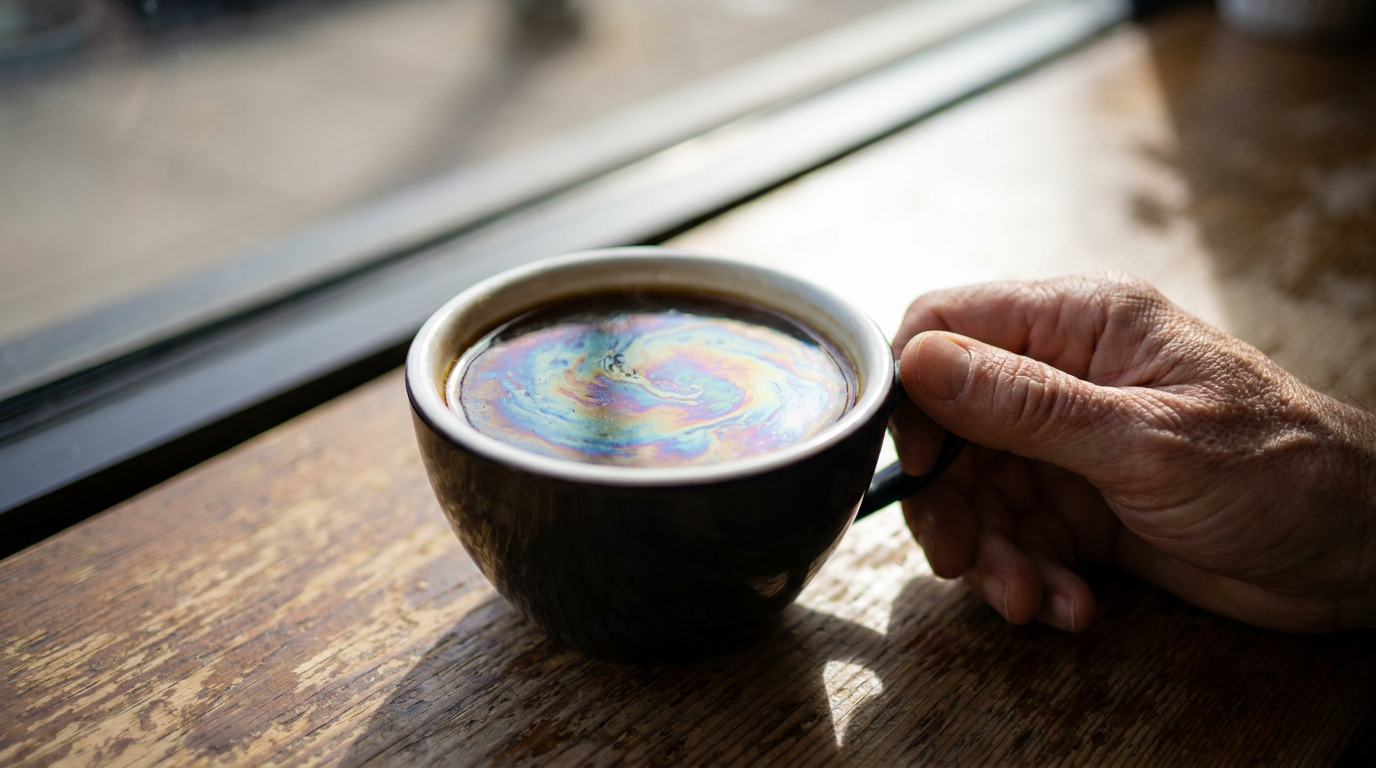
Pour a cup of fresh coffee and hold it near a window. If the light hits right, you'll see it: a thin, shifting film on the surface, barely there, catching colors like a dropped drop of gasoline on wet pavement. It appears for a few seconds, rearranges, and then dissolves back into the dark surface. Most people assume it means something went wrong — that the beans were oily, the water too hot, the grind too coarse. They are not entirely wrong about the oils. But what that film is actually doing, structurally and optically, has almost nothing to do with bad coffee and everything to do with how light interacts with matter at a scale you cannot see.
The film you're looking at is roughly a few hundred nanometers thick. A nanometer is one billionth of a meter — about the width of a few atoms lined up side by side. At that scale, the film is thin enough to do something remarkable: it interferes with itself. Light enters the top surface of the film, bounces back. Some of it passes through and reflects off the bottom surface instead. Those two reflected waves travel slightly different distances before meeting your eye, and that tiny difference — just a few wavelengths of light — causes certain colors to amplify and others to cancel. The result is color without pigment, pattern without dye, a spectrum written in geometry.
This is thin-film interference, and it is not unique to coffee. It is the same mechanism that paints soap bubbles in pastels, makes the wings of morpho butterflies electric blue[2] without a single molecule of blue pigment, and gives oil slicks on rain puddles that particular rainbow quality that seems more alive than regular color. In each case, an ultrathin layer of material acts as a kind of optical instrument, selecting and amplifying wavelengths based purely on its thickness. The coffee on your counter is doing the same thing, with the same precision, for the same physical reasons.
What is different about coffee is where the film comes from. It doesn't arrive pre-formed. It builds itself in the seconds after you pour, assembled from compounds released during the roasting process, migrating to the surface through a chain of physical forces that are invisible but not, once you know what to look for, mysterious at all.
What the Roast Leaves Behind
Coffee beans are seeds, and like most seeds, they carry fats. About ten to fifteen percent[3] of a green coffee bean's dry mass is lipids — triglycerides, diterpenes, waxy esters stored in specialized cells inside the bean's cellular structure. When those beans go into a roaster and temperatures climb past 200 degrees Celsius, the cellular walls that contain those lipids begin to rupture. The fats migrate outward. On a well-roasted dark bean, you can see the result without a microscope: the bean looks slick, almost lacquered. That sheen is literal oil, forced to the surface by heat and expanding gas pressure inside the bean.
Roasting also triggers the Maillard reaction, a cascade of chemical transformations between amino acids and reducing sugars that produces hundreds of distinct volatile compounds — the source of coffee's color, most of its flavor, and a portion of its aromatic complexity. Many of these compounds are amphiphilic, meaning they carry both a water-attracting end and a water-repelling end in the same molecule. Chlorogenic acid lactones, certain melanoidins, and some of the diterpene compounds cafestol and kahweol all fall into this category to varying degrees. An amphiphilic molecule in a water environment has a predictable destination: the surface, where it can orient itself with its hydrophobic tail pointing up and out of the water while its hydrophilic head stays anchored in the liquid. This is the same molecular logic that drives the structure of cell membranes and the behavior of soap.
“The film builds itself in the seconds after you pour, assembled from compounds that migrated to the surface through forces invisible but not, once you know what to look for, mysterious at all.”
During brewing, these compounds dissolve into the hot water along with everything else — acids, sugars, aromatic molecules, bitter compounds. But the amphiphilic ones have a tendency. As soon as the liquid hits the cup and settles, they begin to sort themselves out. The surface of any liquid is a place of lower energy, and molecules that can straddle both environments move there preferentially. Within seconds, a monolayer — or in some cases a multilayer, depending on the concentration — assembles itself across the surface of your drink. It is not random accumulation. It is a thermodynamic preference, a system moving toward stability.
The Geometry of Color Without Pigment
To understand what the film does to light, it helps to think about light not as a particle but as a wave — specifically, as a wave with a wavelength. Visible light spans wavelengths from about 380 nanometers at the violet end to around 700 nanometers at the red end. When light hits the top surface of the coffee film, a portion reflects immediately. The rest enters the film and reflects off the bottom boundary where the film meets the liquid below. Those two reflected waves then travel outward together, but they are slightly out of step because one traveled a longer path.
Whether a given wavelength appears bright or cancels out depends on the relationship between that wavelength and the film's thickness. If the path difference is exactly one full wavelength — or a whole-number multiple of one — the two reflected waves are back in phase, and they reinforce each other. That color looks bright. If the path difference is a half wavelength, the peaks of one wave align with the troughs of the other, and they cancel. That color disappears from what you see. Because the film is not perfectly uniform in thickness — it thins at the edges, thickens slightly where surface tension pulls it — different regions of the film are tuned to different wavelengths, and that is why you see shifting patches of color rather than a single uniform hue.
The refractive index of the film material also matters. When light enters a medium with a different optical density, it slows down, and that slowdown affects how far the wave effectively travels inside the film relative to its wavelength. The diterpene oils and amphiphilic compounds in coffee have refractive indices that differ from water, which means the film genuinely behaves as a distinct optical layer rather than a transparent coating you'd see through without noticing. The physics that describes this is captured in the Fabry-Pérot model of thin-film interference, the same mathematical framework used to design the anti-reflective coatings on camera lenses, the mirrors inside laser cavities, and the filters used in astronomical spectrometers. Your coffee cup is not typically mentioned in the same breath as astronomical equipment, but it is operating on the same principles.
Why Soap Bubbles Taught Us to Look
The soap bubble is the most famous thin-film interferometer in everyday life, and it is worth pausing on what makes it work so well as a demonstration. A soap bubble wall is a bilayer — two sheets of soap molecules arranged with their hydrophobic tails pointing inward toward each other and their hydrophilic heads pointing outward, into the air on one side and the water film on the other. This is a more organized structure than the coffee film, and it is exquisitely sensitive to thickness. As a bubble drains under gravity and evaporation, you can watch the interference colors move and shift in real time: red gives way to yellow, yellow to green, green to blue, and then — right before the bubble pops — the film thins to a point where it becomes thinner than a quarter of any visible wavelength, and it turns black. That black patch is not dark because there is nothing there. It is dark because both reflected waves cancel each other for all visible wavelengths simultaneously. The bubble is still there. You just can't see it.
“The soap bubble turns black right before it pops not because there is nothing there, but because the film has thinned to a point where all visible wavelengths cancel at once.”
Robert Hooke and Isaac Newton both studied thin-film colors in the seventeenth century, pressing glass lenses together and observing the concentric rings of color that formed where the air gap between them gradually thickened outward — what are now called Newton's rings. What they were seeing was interference before the wave theory of light existed to explain it. Thomas Young's double-slit experiments in the early 1800s eventually supplied the framework. By the time James Clerk Maxwell described light as an electromagnetic wave later in the nineteenth century, the mechanism was settled. Thin films interfere because waves interfere. The coffee film is running an experiment that preoccupied some of the most careful observers in the history of physics.
Extraction, Grind, and the Film You Didn't Choose
Not every cup of coffee produces a visible film, and the variation tells you something real. The intensity and persistence of the film depend on how many lipid-bearing and amphiphilic compounds made it into the liquid. Brewing method is the dominant variable. A French press, which steeps ground coffee directly in hot water and has no paper filter, allows the most oils to pass through. The film on a French press coffee is often thick enough to see clearly, sometimes almost iridescent in the way a diesel spill is iridescent. Espresso, which forces near-boiling water through finely ground coffee under roughly nine atmospheres of pressure, produces a different surface layer — the crema, a stable foam of emulsified oils, carbon dioxide bubbles, and colloidal particles — but the same compounds are responsible.
Pour-over coffee, brewed through a paper filter, should in theory strip most of the oils. Paper fibers trap lipid particles effectively, and a fresh, good-quality filter makes a measurable difference in the lipid content of the final cup. But even filtered coffee often shows a faint surface film, especially when freshly brewed from recently roasted beans. Freshness matters because carbon dioxide is still degassing from recently roasted coffee — the same CO2 produced during roasting that causes whole bags to inflate on shelves. That outgassing disturbs the surface and keeps a thin layer of compounds in motion. Older beans, having lost most of their dissolved gas, produce a calmer surface and often a dimmer or absent film.
Water temperature and mineral content shape the film too. Hard water, high in dissolved calcium and magnesium ions, changes how amphiphilic molecules aggregate at the surface. Calcium ions in particular can bridge the charged head groups of certain fatty acid derivatives, drawing molecules into tighter clusters and potentially thickening the film in localized patches. This is one reason the same beans can look different in the cup depending on where you live and what comes out of your tap. The film is reading your water supply with a kind of chemical sensitivity no instrument in your kitchen was designed to have.
Structural Color, Writ Small
There is a category of color in the natural world called structural color, and it is distinct in a fundamental way from pigment-based color. Pigment works through absorption — a red apple contains compounds that absorb blue and green wavelengths and reflect red ones back to your eye. The color is in the chemistry of the molecule, and it fades when the molecule degrades. Structural color works through geometry. The color exists because of the physical arrangement of matter, not its chemical identity. Change the thickness, change the spacing, change the angle, and the color changes. The molecule itself may be colorless.
The morpho butterfly's iridescent wings are the most cited example. The wing scales carry no blue pigment. Instead, they are covered in layered ridges of chitin[2] — the same structural polymer in insect exoskeletons — spaced at intervals that cause blue wavelengths to constructively interfere. The blue is so intense and pure that it remains vivid at extreme distances. Peacock feathers use a similar trick, with periodic nanostructures in the barbules of each feather creating greens and blues through interference. Certain beetles, fish, and cephalopods use structural color for camouflage, signaling, and iridescence. The coffee film belongs to the same optical family: color produced not by dye or pigment but by the geometry of how thin layers of matter interact with waves.
“Structural color doesn't fade when the molecule degrades — it changes when the geometry does, which means it is written in physics rather than chemistry.”
The practical consequence of this is strange to sit with. The color you see on the surface of your coffee does not reside in the compounds themselves. It is an emergent property of the layer's thickness — which means the same molecules arranged slightly differently would show you a different color entirely, or none at all. The film is not colored. The film and the light together produce color, the way a lens and a light source together produce an image. Neither alone is sufficient.
What the Film Is Actually Telling You
Coffee professionals sometimes interpret the surface of a cup the way a wine taster reads the legs on a glass — as a signal, however imperfect, about what went into it. A heavy, persistent film might indicate dark-roasted beans with ruptured cell walls, unfiltered brewing, or both. A complete absence of any surface sheen on a French press cup could suggest very old beans with little remaining outgassed CO2 and diminished lipid content. These are rough heuristics rather than diagnostics, but they are grounded in the chemistry. The film is a record of what the roast did to the bean and what the extraction did to the roast.
From a health standpoint, the diterpenes cafestol and kahweol — among the compounds most likely to end up in an unfiltered cup's surface layer — have drawn genuine research interest because of their effect on LDL cholesterol levels[1]. Paper-filtered coffee substantially reduces their concentration. Whether the film itself represents a meaningful dose of these compounds or is simply a visual trace of their presence in the liquid below is not straightforwardly answered by looking at the surface, and the film's presence alone is not a medical signal. But it does confirm that something real is floating there, assembled by thermodynamics and visible through physics, sitting quietly on top of your breakfast.
Most of the time, we pour a cup of coffee and see the surface as inert — a boundary between liquid and air, featureless except for the steam rising from it. But that surface is active. Molecules are migrating to it. They are arranging themselves by thermodynamic preference into an organized film tens or hundreds of nanometers thick. That film is refracting and reflecting light, selecting wavelengths through the same interference mechanism that colors butterfly wings and confused Newton enough to fill entire notebooks. The next time you see a faint shimmer on your morning cup, you are not seeing a flaw or a residue. You are seeing a self-assembled optical device, built from the remains of a roasted seed, floating on water, doing physics at a scale smaller than anything your eye can resolve, and making itself visible anyway.
References
- Cafestol and kahweol concentrations in workplace machine coffee compared with conventional brewing methods (sciencedirect.com)
- Mechanisms of structural colour in the Morpho butterfly: cooperation of regularity and irregularity in an iridescent scale (pmc.ncbi.nlm.nih.gov)
Demonstrates that morpho butterfly wing color results from structural interference, paralleling the thin-film interference mechanism in coffee films. - Rapid prediction of single green coffee bean moisture and lipid content by hyperspectral imaging (pmc.ncbi.nlm.nih.gov)
Provides the quantified lipid content of green coffee beans (ten to fifteen percent of dry mass) cited in the article.
About Aris Thorne
Aris Thorne is a microbiologist who writes about the hidden mechanics of ordinary life: the microbes running your home, the chemistry unfolding in food and water, the physics built into familiar objects, and the biological systems quietly keeping the human body alive. His work follows science from kitchens, bathrooms, dust, soil, and city air into wounds, immune responses, infections, medicines, cells, and other worlds. He is most interested in the moment something familiar stops looking simple and reveals the living machinery underneath.
More like this
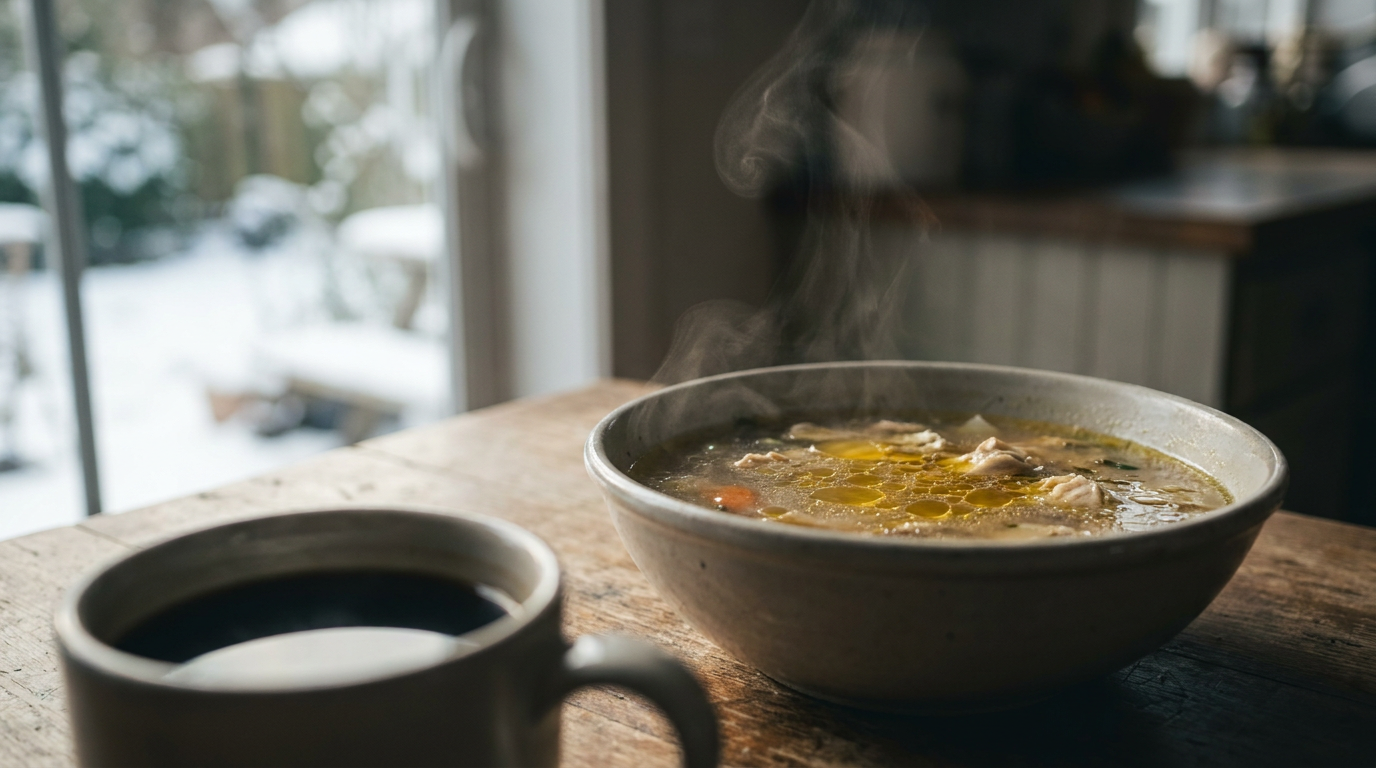
Your Coffee Goes Cold in Minutes. Your Soup Takes Forever. Here's Why.
Same cup, same room, same starting temperature — but coffee and soup are losing heat through completely different physics, and the gap between them comes down to fat, vapor, and the invisible work happening at the surface.
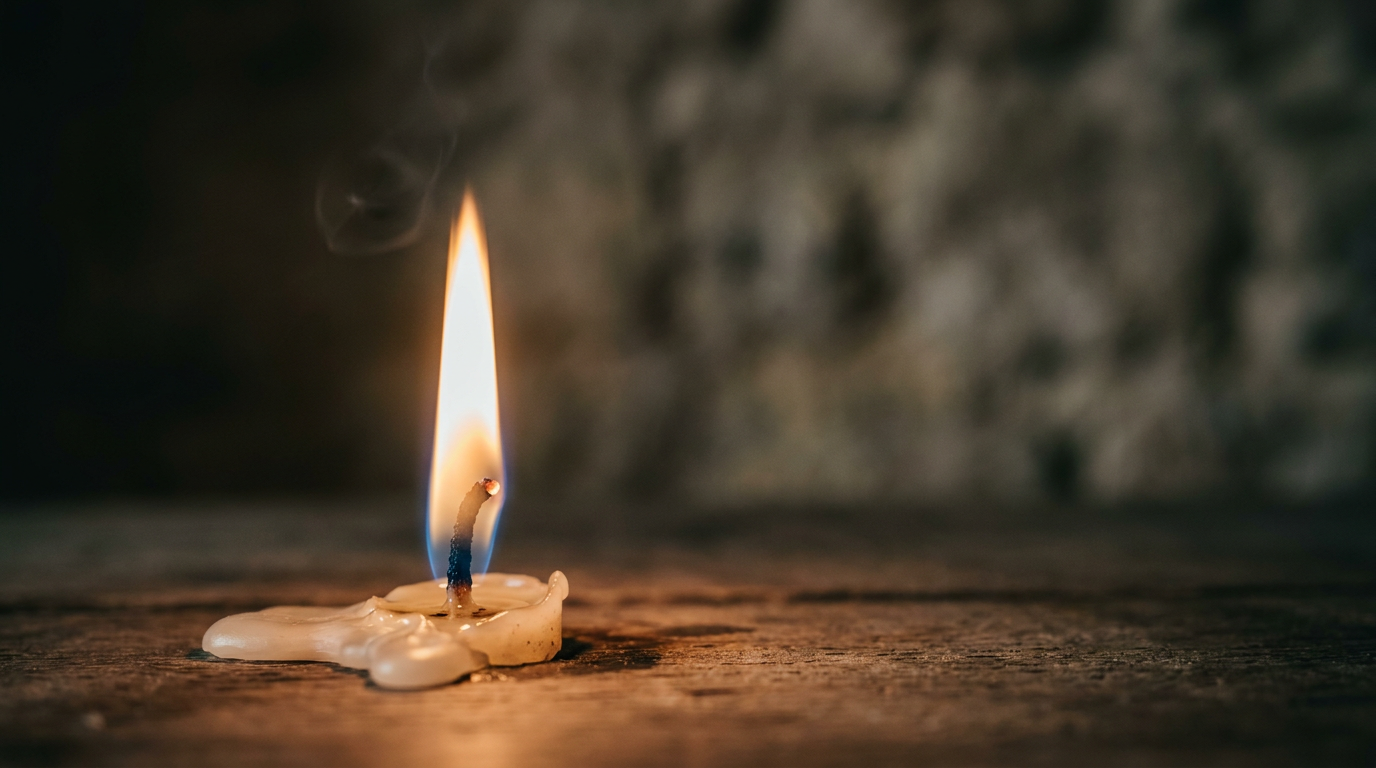
A Candle Flame Is Rebuilding Itself From Scratch Every Millisecond
What looks like a simple flicker of wax and fire is actually a self-organizing column of vaporization, chemistry, and convection — and without gravity, it wouldn't even have a shape.

Stars Twinkle. Planets Don't. The Difference Is Your Atmosphere.
The shimmer you see on a clear night has nothing to do with the stars themselves — it's a live readout of the turbulent air column sitting between you and the cosmos.