No Star Required: How Rogue Planets Could Hold Liquid Water in the Dark
Planets flung into interstellar space were assumed to be dead on arrival — but geothermal heat and hydrogen-rich atmospheres may keep some of them warm enough for liquid water, billions of miles from any sun.
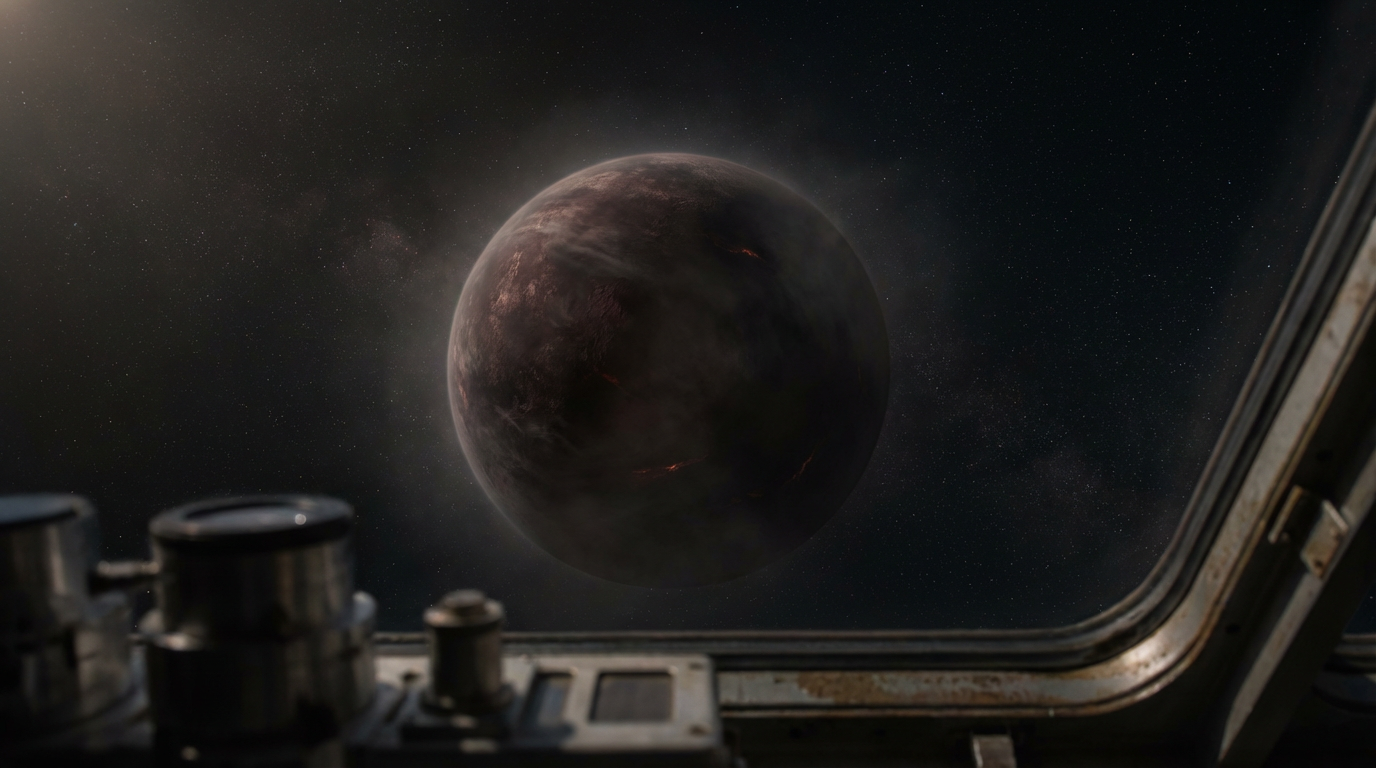
Somewhere in the darkness between stars — not orbiting anything, not illuminated by anything, moving through the Milky Way on a long, cold, unsupervised trajectory — there are planets. Astronomers call them rogue planets, or free-floating planets, or planetary-mass objects, depending on how they formed and who is writing the paper. What they share is the condition of having no host star. They were either ejected from young solar systems during the gravitational chaos of early planetary formation, or they condensed directly from interstellar gas clouds too diffuse to ever ignite into stars. Either way, they travel alone. Current estimates, based on gravitational microlensing surveys including results from the Korea Microlensing Telescope Network and earlier data from the Optical Gravitational Lensing Experiment, suggest that free-floating planets may outnumber stars in the galaxy[3]. That is not a poetic exaggeration. It is a population estimate with real uncertainty on both ends, but the lower bounds alone are staggering.
For most of the time astronomers have been aware of these objects, the response to them as potential sites of anything biologically interesting was swift and dismissive. Without a star, there is no obvious energy source. Without an energy source, any surface water freezes. Without liquid water, the chemistry that life as we know it depends on — the solvent that allows molecules to meet, react, and organize — goes dormant at best, impossible at worst. The logic was clean and seemed final. Rogue planets were written off not because anyone examined them carefully, but because the sun-as-prerequisite assumption was so deeply embedded in how habitable zones were defined that worlds outside any such zone barely registered as worth modeling.
That assumption has been under steady pressure for roughly fifteen years, and the pressure is now coming from multiple directions at once. Planetary scientists modeling the internal heat budgets of Earth-mass and super-Earth-mass rogue planets have found that radiogenic decay — the slow release of heat from radioactive elements like uranium, thorium, and potassium-40 embedded in a planet's rock — continues for billions of years regardless of whether that planet orbits a star. The same process that keeps Earth's mantle churning, drives plate tectonics, and sustains hydrothermal vent systems on the ocean floor works identically in a world untethered from any solar system. The sun is not involved. It never was, for that particular heat source.
The more provocative piece of the puzzle involves atmospheres. A paper published in the International Journal of Astrobiology explored what would happen if an Earth-mass rogue planet retained or acquired a thick hydrogen-dominated atmosphere[1] — not the thin nitrogen-oxygen mix that wraps our world, but something far denser, composed primarily of molecular hydrogen with traces of helium and other gases. The greenhouse effect of such an atmosphere is substantial. It traps heat far more efficiently than our own, and because hydrogen is the most abundant element in the universe, it is not an exotic or improbable ingredient. The modeling found that under the right conditions, a combination of radiogenic internal heat and a thick hydrogen blanket could maintain liquid water on the surface or in a subsurface layer of a rogue planet sitting at interstellar temperatures — roughly 10 Kelvin in the ambient void. That is not a marginal result. That is a mechanism.
The Interior Furnace That Needs No Star
To understand what radiogenic heating actually provides, it helps to think about what it has already done on Earth. The radioactive decay of long-lived isotopes — particularly uranium-238, uranium-235, thorium-232, and potassium-40 — releases heat continuously as their nuclei shed particles and energy on timescales of billions of years. On early Earth, this heat was intense enough to help keep the mantle partially molten. Four billion years later, the flux has declined as the isotopes are exhausted, but it still contributes meaningfully to the heat escaping through the ocean floor, to the slow convection currents driving plate motion, and to the hydrothermal systems where superheated, mineral-rich water circulates through fractured rock. Those vents, on Earth, support entire ecosystems that never see sunlight. The energy budget for life there traces back not to photosynthesis but to chemosynthesis — microbial communities processing hydrogen sulfide, methane, and dissolved minerals. No photons required.
For a rogue planet, the question is whether radiogenic heat is sufficient on its own to raise the temperature at the base of an ice layer or deep within the crust enough to sustain liquid water. This depends on several factors: the planet's mass, its composition, its initial inventory of radioactive elements, and how well it is insulated. A more massive planet retains internal heat longer. A rocky planet with a high metallicity — meaning a higher proportion of heavy elements, including radioactive ones — starts with a larger heat budget. And here the statistics of planet formation become relevant: planets that formed around stars enriched with heavy elements are more likely to have substantial radiogenic inventories, and many of those planets were ejected not because they were depleted worlds, but because the same gravitational interactions that threw them out of their systems happened early, before much of that interior heat had escaped.
“The heat keeping a rogue planet's interior warm has nothing to do with starlight — it was baked into the rock at the moment of formation.”
The subsurface ocean model is the most conservative version of this idea, and it draws direct analogy from what we already suspect about icy moons in our own solar system. Europa, Enceladus, Ganymede, and Titan are all thought to harbor liquid water beneath their frozen surfaces, sustained by tidal flexing and, in some cases, radiogenic heat. None of them receive meaningful warmth from the sun directly — they are far enough from it that solar flux is feeble. What keeps their interiors liquid is internal energy. A rogue planet operating on similar principles, but with a larger mass and a proportionally deeper heat budget, could sustain a subsurface liquid layer over geologically significant timescales — hundreds of millions to potentially billions of years. That is long enough, on the evidence of Earth's own fossil record, for chemistry to become biology.
What a Hydrogen Sky Changes
The surface case — the more striking version of this hypothesis — depends on atmosphere. Here, the modeling gets both more powerful and more speculative, because it requires that a rogue planet retain or accumulate a thick envelope of molecular hydrogen. The mechanism for this is plausible in young planetary systems: hydrogen-rich gas can be captured from the protoplanetary disk during formation, and planets that migrate outward quickly may retain envelopes that inner planets lose to photoionization from their host star. An ejected planet takes its atmosphere with it. Once ejected into the void, there is no stellar wind or ultraviolet flux to strip the envelope away. It stays.
Molecular hydrogen is a remarkably efficient greenhouse gas at the pressures involved in a dense atmosphere. Collision-induced absorption[1] — the process by which hydrogen molecules interacting with each other during close encounters absorb infrared radiation — means that even modest amounts of hydrogen can dramatically suppress heat loss to space. Modeling suggests that an Earth-mass planet with a hydrogen atmosphere ten to twenty times thicker than Earth's current atmosphere, combined with radiogenic heat flux, could maintain surface temperatures above the freezing point of water even in the interstellar void. Not comfortably warm by any habitable standard, but above 273 Kelvin in some scenarios — particularly if the planet also has internal volcanic activity providing additional heat at the surface through outgassing and eruption.
“A thick hydrogen sky traps heat from below rather than above — and in deep space, that inversion is the whole ballgame.”
This is genuinely strange to sit with. We are accustomed to thinking of planetary atmospheres as filters and shields for stellar energy — the atmosphere mediates how much sunlight reaches the surface, how much is retained, how much bounces back. The greenhouse effect, in most contexts, is a conversation about what happens to solar radiation. On a rogue planet, that framework inverts entirely. The atmosphere becomes a blanket for geothermal warmth rather than a window for stellar flux. The heat moves from inside out, and the atmosphere's job is to slow how fast that warmth escapes. It is a different thermodynamic arrangement, but there is nothing physically forbidden about it.
The Hard Numbers and Their Limits
It is worth being precise about what the models show and what they do not. The scenarios that produce liquid surface water on a rogue planet tend to require a fairly specific combination of conditions: a planet of roughly one to several Earth masses, a high initial radiogenic inventory, a retained hydrogen atmosphere that has not been eroded over billions of years, and no major late impact that punches through the atmosphere and allows rapid heat loss. Change any of those parameters significantly and the outcome shifts. A lower-mass planet loses its interior heat faster. A thinner atmosphere insulates less efficiently. An impactor event late in the planet's history could remove the hydrogen envelope outright, dropping surface temperatures precipitously and permanently.
There are also questions about atmospheric stability over billion-year timescales. Hydrogen is light and, given any upward leak pathway, can escape to space even without UV radiation doing the stripping — thermal escape alone can erode an atmosphere over long enough periods. Whether a rogue planet retains its hydrogen envelope for three billion years or loses it in a hundred million years depends on the planet's gravity, its temperature profile, and the detailed physics of atmospheric escape — all of which interact in ways that even current climate models handle only approximately. This is not a failure of the hypothesis. It is a frontier problem in planetary science that applies equally to exoplanet atmospheres around normal stars, where similar uncertainties persist.
The chemistry of habitability adds another layer of constraint. Liquid water is necessary but not sufficient. Life, at minimum, also appears to require a source of chemical energy — something to drive the reactions that build and maintain organized, self-replicating molecular structures. On Earth's hydrothermal vents, that energy comes from redox chemistry: the oxidation of hydrogen and sulfide compounds by minerals in the rock. A rogue planet with active interior geology could plausibly produce similar chemistry. Serpentinization — the reaction of water with iron and magnesium silicate rocks that releases hydrogen gas — occurs in the absence of sunlight and has been identified as a potentially important energy source for early life on Earth. It would work identically in a rogue planet's subsurface. But whether the combination of water, redox chemistry, organic molecules, and sufficient time actually produces life anywhere is a question we cannot yet answer even on Earth, where we can study it directly.
Finding Them Is Its Own Problem
None of this is testable yet, in the sense that we cannot go examine a rogue planet's interior. What we can do is detect them and begin characterizing their properties, which is itself a formidable challenge. Rogue planets emit no starlight and very little of their own. They are cold enough that the infrared signatures are faint, and they are not in fixed orbits that make them easy to find through transit or radial velocity methods. Gravitational microlensing is currently the most effective detection technique: when a free-floating planet passes in front of a background star, its gravity bends the star's light and produces a brief, characteristic brightening. The duration and shape of that brightening encodes information about the lensing object's mass. This is how most known rogue planet candidates have been identified — though the brevity of microlensing events, often measured in hours to days, means detailed follow-up is difficult.
The Nancy Grace Roman Space Telescope, currently scheduled for launch in the late 2020s, is expected to transform rogue planet statistics dramatically. Its wide-field infrared survey capabilities[2] are well-suited to a systematic microlensing survey of the galactic bulge, where stellar density makes lensing events far more frequent. Early projections suggest Roman could detect hundreds of free-floating planetary-mass objects, significantly extending the current sample and providing better constraints on the mass distribution of these worlds. It will not image their surfaces or analyze their atmospheres. But it will give planetary scientists a much sharper picture of how common rogue planets are, how massive they tend to be, and how the population is distributed — data that will anchor the theoretical work substantially.
“We have detected rogue planets mostly by the brief gravitational shadows they cast as they cross in front of distant stars — a census taken entirely from silhouettes.”
Atmospheric characterization of rogue planets is further off. Directly imaging these objects is possible for the most massive and youngest cases — planetary-mass objects still warm from formation can be detected in the infrared by facilities like the James Webb Space Telescope, and Webb has already contributed observations of candidate free-floating objects in young star-forming regions including the Orion Nebula Cluster. The free-floating planet candidates Webb identified in Orion were in the planetary mass range and appeared to exist in pairs — an unexpected finding that raised new questions about formation pathways. Whether they have the kind of chemical complexity relevant to habitability discussions is not what current instruments are built to measure, but each detection sharpens the questions worth asking.
What Ejection Actually Looks Like
The violence of ejection deserves more than a passing mention, because it shapes what kind of world a rogue planet is likely to be. Planetary system formation is not a serene process. In the first tens of millions of years, the gravitational interactions between forming planets, planetesimals, and sometimes a passing star can be chaotic in the mathematical sense — small perturbations amplifying into large orbital changes on timescales that are short relative to a star's main-sequence lifetime. A planet thrown outward by a gravitational encounter with a more massive companion — Jupiter-mass objects are particularly effective at this — may receive a velocity kick of several kilometers per second relative to its former star, enough to escape the system's gravitational well entirely.
What that ejected planet brings with it depends on when the ejection happens. A planet thrown out during the disk phase, while gas is still present, may retain or even accrete additional hydrogen-rich gas on its way out, leaving it with a more substantial envelope than it would otherwise have. A planet ejected after the disk has dissipated leaves its system essentially as it is, with whatever atmospheric and interior inventory it had accumulated by that point. Late ejections, after the system has settled and planets have differentiated, may produce worlds with cooler interiors but also more compositionally evolved crusts — more silicate rock, more water ice, more of the radioactive elements concentrated in the mantle after planetary differentiation. The timing of ejection is therefore not incidental to the habitability question. It may be one of the most important variables.
The Patience Required to Take This Seriously
It is worth stepping back from the specifics and acknowledging what kind of scientific moment this is. The habitability of rogue planets is not an established result. It is a region of theoretical space that has opened up as our models of planetary interiors, atmospheric physics, and prebiotic chemistry have grown more sophisticated. The people working on this are not making extraordinary claims — they are following the physics and asking where it leads. What it leads to, so far, is the conclusion that the universe contains more potential environments for liquid water than we designed our initial definitions to include. The habitable zone — that useful but approximate band around a star where surface water could exist — was always a shorthand, not a physical law. Rogue planets are one of several lines of evidence suggesting the shorthand was too conservative.
Europa was once considered a frozen, lifeless ball of ice. The discovery of its likely subsurface ocean did not require finding life to be scientifically significant — it required only that we follow the physics of tidal heating and allow the evidence to update our assumptions. Rogue planets are asking for the same treatment. The universe has a substantial population of them. They carry the same physics as any other rocky world: radiogenic decay, geothermal heat, the potential for liquid water, the chemistry of rock and water reacting in the dark. Whether any of that has ever crossed the line into biology is a question we cannot yet ask with instruments we do not yet have, pointed at objects we can barely see. But the question is not unreasonable. That is, by any measure, further than we were before.
References
- Life-sustaining planets in interstellar space? (doi.org)
Presents the theoretical model showing hydrogen-rich atmospheres can trap geothermal heat on rogue planets through pressure-induced infrared opacity. - NASA Completes Nancy Grace Roman Space Telescope Construction (jpl.nasa.gov)
- Two new free-floating or wide-orbit planets from microlensing (aanda.org)
Provides gravitational microlensing survey data supporting the estimate that free-floating planets may outnumber stars in the galaxy.
About Brenna Vance
Brenna Vance writes about the cosmos — stars that predate the universe's own chemistry, spacecraft flying close enough to the sun to catch it misbehaving, the physics of what the universe is still getting wrong. Her work focuses on the moments when an observation breaks a model, and what that break actually means.
More like this
We've Found Over 5,000 Exoplanets. Almost None of Them Are Like Earth.
The most common world in the galaxy sits in a size range our solar system completely skipped — and planetary scientists aren't sure whether that's physics or blind spot.
JWST Found a Planet That Shouldn't Exist — Orbiting a Dead Star, Raining Diamonds
A Jupiter-mass planet orbiting a millisecond pulsar carries a helium-and-carbon atmosphere that no known formation pathway can produce — and the physics of what falls from its sky is stranger still.
A Star in Andromeda Just Vanished Without Exploding. Scientists Caught It Happening.
For the first time, astronomers assembled a complete before-and-after record of a star collapsing directly into a black hole — and the mechanism behind the silence turns out to be stranger than a supernova.