Two Continent-Sized Blobs Have Been Sitting at Earth's Core for Four Billion Years
Buried at the base of Earth's mantle, two continent-sized masses of anomalous rock have resisted four billion years of planetary churning — and a new study argues they are fossilized relics of Earth's primordial interior that may have quietly shaped the conditions for life.
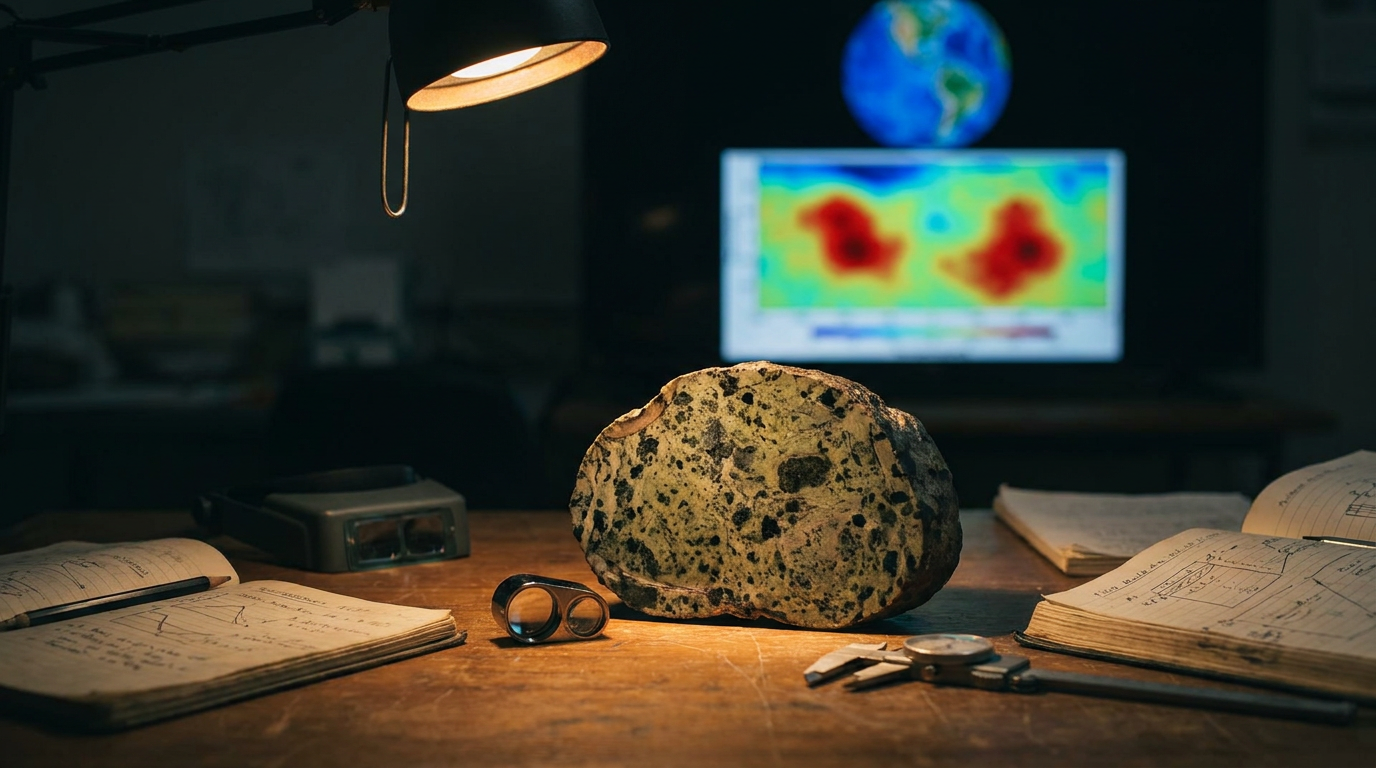
Seismic waves, like all waves, are honest. They do not know what they will encounter; they simply travel, and they slow down or speed up depending on what they move through. For decades, whenever a large earthquake sent shockwaves rippling through the entire body of the Earth, seismologists noticed something strange near the base of the mantle, roughly 2,900 kilometers down, just above the iron core. In two broad regions — one beneath Africa, one beneath the central Pacific — the waves were dragging. Something down there was denser, hotter, and constitutionally different from the surrounding mantle. Scientists named these features low-shear-velocity provinces, which is a deliberately cautious name for objects that are anything but cautious in their implications. Each one is roughly the scale of a continent. Together they have been sitting there, apparently unmoved, since a time when Earth barely deserved the name.
The LLSVPs, as they are abbreviated, are among the most discussed mysteries in deep-Earth geophysics. They are enormous, they are anomalous, and they have survived billions of years of mantle convection — the slow, relentless churning that recycles rock over geologic time. Most things do not survive mantle convection for four billion years. Rock is not rigid on those timescales; it flows, folds, and gets reincorporated. Yet these provinces persist. Whatever they are made of, and whatever process created them, it was resilient enough to outlast almost the entire history of complex geology on this planet.
Now a research team at Rutgers University, publishing in Nature Geoscience[1], has proposed a compelling origin story — one that reaches back to the very beginning of Earth's existence. Their hypothesis: the LLSVPs are fossilized remnants of Earth's primordial magma ocean, a global sea of molten rock that covered the young planet roughly four billion years ago, chemically contaminated by iron and other heavy elements leaking upward from the newly formed metallic core. If they are right, these two blobs are not geological accidents. They are the oldest preserved structures on Earth — physical archives from the planet's infancy, still sitting exactly where they solidified.
The story gets stranger. The Rutgers team argues that the presence of these deep, stable provinces may not be cosmetically irrelevant to Earth's history. The LLSVPs, in their model, are entangled with the long-term behavior of Earth's mantle, its volcanic activity, its tectonic cycling, and ultimately its capacity to maintain the geochemical conditions that allowed life to take hold and persist. Venus and Mars, the two planets most similar to Earth in the inner solar system, do not appear to have anything comparable. The question of what Earth has that they do not may partly answer itself from the inside out.
Reading the Mantle Backward
To understand what the Rutgers hypothesis is actually claiming, it helps to start at the beginning — not Earth's beginning as a rocky body, but its beginning as a differentiated planet. When Earth was young, it was repeatedly struck by large impactors in the chaos of the early solar system's clearing phase. These collisions generated enormous heat. The planet's surface, and much of its interior, melted. A global magma ocean formed, potentially hundreds of kilometers deep, covering the entire planet. At the same time, the heaviest material — iron and nickel, along with dissolved metallic elements — was sinking toward the center, differentiating into what would become Earth's iron core. This process, planetary differentiation, is well-established in the science. What has been harder to constrain is what happened at the interface between the descending core material and the overlying magma ocean.
The Rutgers team's model focuses on exactly that boundary. As the metallic core assembled, it did not simply fall cleanly away from the silicate mantle. There was a transitional period during which iron-rich liquid from the proto-core leaked upward into the base of the magma ocean, dissolving into the molten silicate rock and chemically altering its composition. This contaminated basal material, enriched in iron and other siderophile elements, would have been denser than the silicate above it. As the magma ocean cooled and crystallized over tens of millions of years, this heavy, iron-contaminated layer at the bottom may have been the last to solidify — and when it did, it was chemically different enough from the surrounding mantle to resist being mixed back in.
“Whatever solidified at the bottom of Earth's primordial magma ocean may still be there — two continent-sized masses that have not moved in four billion years.”
The geophysical fingerprint of this process matches the observed properties of the LLSVPs in important ways. Seismic data show that these provinces are not only slow-wave regions but also appear to have higher density than surrounding mantle material — consistent with iron enrichment. Their boundaries are unusually sharp, suggesting they are compositionally distinct from the surrounding mantle rather than simply hotter pockets of the same rock. And their stability over billions of years is consistent with a composition that makes them intrinsically denser and more viscous than the convecting mantle around them, giving them resistance to being churned apart. They are, in the language of geodynamics, thermochemical piles: structures maintained by both their temperature and their chemistry.
Why They Stayed
The persistence of the LLSVPs is itself a scientific puzzle worth pausing over. The mantle is not stationary. On timescales of tens to hundreds of millions of years, it convects — hot rock rises, cool rock sinks, and material cycles through the interior like a very slow, very thick fluid. Tectonic plates are partly the surface expression of this process: they form where mantle upwells, drift across the surface, and sink back down at subduction zones. In this constant circulation, you would expect most heterogeneities to get homogenized over time. Yet the LLSVPs have apparently anchored themselves at the base of the mantle for roughly four billion years.
The answer, in the Rutgers model, is that density is destiny. Material at the core-mantle boundary that is denser than the surrounding mantle does not get easily entrained into convective upwellings. It sits. It may deform at the edges, getting eroded slightly by mantle flow, but the bulk of it stays put, pressed down by gravity and by the weight of everything above. The same chemical contamination from core material that made these basal deposits compositionally distinct also made them gravitationally anchored. They are not sitting there by inertia; they are sitting there because the physics of their composition makes it hard to move them.
There is, however, an important wrinkle. The LLSVPs are not entirely passive. Seismological data and mantle convection models suggest they influence where mantle plumes form — the deep upwellings of hot material that feed hotspot volcanoes like Hawaii and Iceland. Plumes appear to preferentially originate at or near the edges of these provinces. If the LLSVPs are thermochemical piles at the base of the mantle, they could be acting as thermal insulators, building up heat at their margins that eventually forces hot material upward. In that sense, these four-billion-year-old relics may not just be fossils — they may be active participants in Earth's ongoing volcanic and tectonic life.
The Geochemical Fingerprint Problem
One of the genuinely difficult challenges in LLSVP research is that we have never sampled them directly. Everything we know about their composition is reconstructed from seismic tomography — using the behavior of waves to infer interior structure — and from geodynamic modeling. We can see their shape, infer their density contrast, and map their boundaries with improving resolution, but we cannot hold a piece of them in hand. This is not a minor caveat; it means that the distinction between direct observation and inference is unusually large for this topic, and the Rutgers model, for all its explanatory elegance, is still a hypothesis waiting for confirmation.
“We have mapped the LLSVPs with seismic waves for decades, but we have never touched them — everything we think we know about their composition is reconstructed from echoes.”
One potential route toward confirmation involves geochemical anomalies in volcanic rocks sourced from deep mantle plumes. Some ocean island basalts — lavas erupted at hotspot volcanoes fed by mantle plumes — carry isotopic signatures that cannot easily be explained by mixing normal mantle material. Certain isotope ratios of helium, tungsten, and neodymium in these rocks hint that the magma tapped a source that has been chemically isolated from the rest of the mantle for a very long time, and that may have incorporated material from the very early Earth, possibly even from the core-mantle boundary region. If the LLSVPs are indeed primordial remnants contaminated by core material, they should carry distinctive isotopic fingerprints — and if plumes are erupting material eroded from their edges, traces of that chemistry might eventually reach the surface. The isotope evidence is suggestive but not definitive. It is the kind of clue that makes a hypothesis credible without yet making it confirmed.
The Comparative Planetology Angle
Here is where the story widens into something more than deep-Earth geophysics. If the Rutgers model is correct, then the LLSVPs represent a particular outcome of early planetary evolution: a planet that formed with a magma ocean, differentiated a metallic core, produced chemically contaminated basal material, and then preserved that material in stable thermochemical piles for four billion years. That is a fairly specific set of conditions. Did other rocky planets follow the same path?
Venus is roughly the same size as Earth, formed in the same neighborhood of the solar system, and almost certainly went through a similar magma ocean phase. Yet Venus today has no active plate tectonics, an almost entirely static lithosphere that periodically resurfaces through catastrophic volcanic events, and no apparent magnetic field — a sign that its core dynamics are fundamentally different from Earth's. Whether Venus has LLSVP-like structures in its mantle is unknown; we have no seismological data from the Venusian interior, though planned missions including ESA's EnVision[2] and NASA's DAVINCI[3] are designed to change that picture. Mars, smaller and colder, appears to have had a much shorter period of active mantle convection before it largely shut down. The InSight lander's seismic data[4] suggests a mantle with different properties than Earth's, though Mars's interior is still being actively studied.
The broader implication the Rutgers researchers raise — cautiously, as the science demands — is that the longevity and behavior of deep thermochemical structures may be part of what separates geologically active, habitable planets from those that stalled. The LLSVPs appear to help sustain long-term mantle convection by providing thermal focusing points for plumes. Robust mantle convection drives tectonic activity, which drives the carbon cycle, which is one of the primary mechanisms by which Earth has maintained surface temperatures compatible with liquid water — and life — across billions of years despite a gradually brightening sun. That is a long chain of consequence, and not every link is iron-clad. But it points toward an architecture of planetary habitability that has its roots not in surface conditions but in the preserved structure of the deep interior.
What Four Billion Years of Sitting Still Actually Means
“The oldest surviving structures on Earth may not be rocks at the surface — they may be the two giant masses lurking at the base of the mantle, untouched since the planet was new.”
There is something quietly vertiginous about the timeline involved here. The LLSVPs, if the Rutgers hypothesis holds, would have formed during or shortly after Earth's magma ocean phase, roughly four billion years ago or more. To put that in context: the oldest surface rocks on Earth are around four billion years old, and they are rare fragments that have survived an improbable gauntlet of erosion, subduction, and metamorphism. Life did not exist yet in any form recognizable today. The moon had just formed, probably from the debris of a giant impact. The sun was younger and fainter. These structures in the deep mantle predate not just all life, but the entire geological record we normally discuss when we talk about Earth's ancient history. They are contemporaries of the planet itself.
What the Rutgers model offers is not just a mechanism for the LLSVPs — it is a new way of thinking about what Earth has preserved. The surface is constantly erased and rebuilt. Crust subducts, sediments compact and then uplift, mountains erode to plains. But the deep interior has its own kind of memory, slower and more durable. The core-mantle boundary region, where conditions are extreme and mixing is sluggish, may be the closest thing Earth has to a permanent archive — a place where material from the very beginning of the planet's history sits undisturbed beneath 2,900 kilometers of rock, still shaping the surface world above it, still influencing where volcanoes form and how heat escapes the planet's interior. We have been living above these structures for our entire existence as a species without knowing they were there. We are only just beginning to read what they say.
References
- Deep mantle heterogeneities formed through a basal magma ocean contaminated by core exsolution (nature.com)
Provides the Nature Geoscience study proposing LLSVPs are fossilized remnants of Earth's primordial magma ocean contaminated by core material. - Envision (esa.int)
Provides context that Venus lacks comparable deep mantle structures to Earth's LLSVPs, supporting the article's claim about Earth's unique geological advantage. - NASA's DAVINCI Mission (science.nasa.gov)
Provides context that Venus lacks comparable deep mantle structures to Earth's LLSVPs, supporting the article's claim about Earth's unique geological advantage. - Upper mantle structure of Mars from InSight seismic data (science.org)
Provides seismic data showing Mars lacks structures comparable to Earth's LLSVPs, supporting the article's claim that Earth's deep blobs may be unique to this planet.
About Mira Solen
Mira Solen writes about deep time, cosmic history, extinct stars, ancient impacts, and the long memory stored in rock, dust, and light. Her work specializes in making the oldest stories in the universe feel vivid, physical, and strangely near.
More like this
Mars Is Still Cracking Apart — And InSight Heard It Happen
NASA's InSight lander spent four years listening to the interior of Mars, and what it found suggests rocky planets don't die quietly — they contract, fracture, and quake for billions of years after their engines cool.
The Moon Has a Scar the Size of a Continent — And We've Never Explained It
The South Pole–Aitken Basin is 2,500 kilometers wide, ancient beyond easy reckoning, and quietly resisting every model scientists have built to explain it.
Dead Stars Seeded Your Bones — Here's the Exact Chain of Events
Isotope ratios locked inside ancient meteorites let scientists trace the calcium in your skeleton back through a chain of stellar collapse, shockwave dispersal, and slow planetary assembly — link by precise link.