Earth's Oldest Rocks Are Full of Messages We're Only Now Learning to Read
Zircon crystals from the Hadean eon predate every surviving rock on Earth — and the isotope ratios locked inside them are forcing scientists to rewrite the story of a world we thought we'd lost entirely.
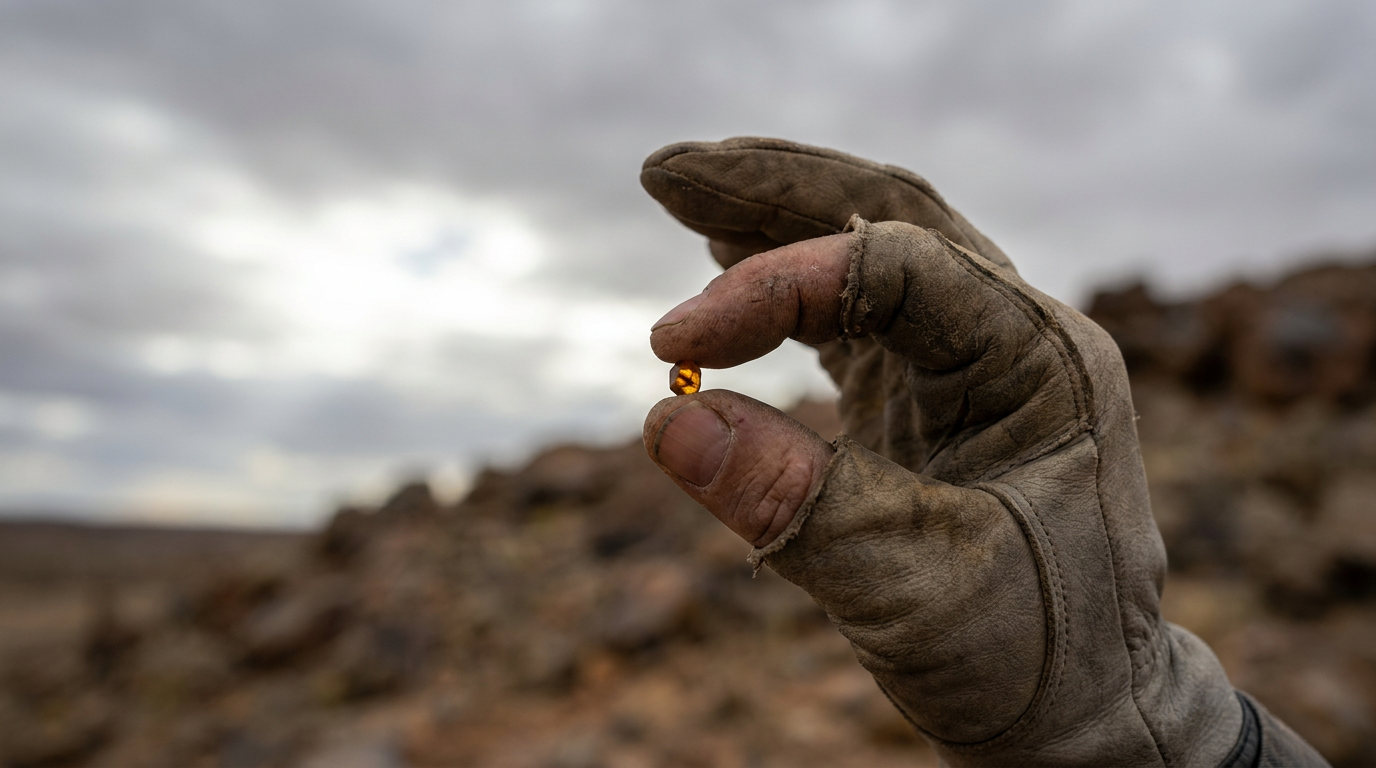
Hold a Jack Hills zircon in your palm and you are holding something that survived the destruction of almost everything that existed when it formed. The crystal itself is a speck — most Hadean zircons are smaller than a grain of table salt — and it has been carried, tumbled, eroded, redeposited, and buried through four billion years of geological violence. The rock it originally grew inside is gone. The landscape around it is gone. The chemistry of the atmosphere above it, the temperature of the ocean it may have looked up at, the tectonic regime that structured the young crust, all of it gone, recycled into the planet's interior or chemically reworked beyond recognition. The zircon endured. And because it endured, it remembers.
The Hadean eon — named after Hades, not because it was necessarily hellish but because it was hidden — spans from Earth's formation roughly 4.5 billion years ago to about 4 billion years ago. It left behind almost no direct rock record. The planet was too geologically active, too hot in places, too convulsive in its early tectonics to preserve surface crust across that kind of time. What little Hadean material has survived comes down to a scattering of detrital zircon grains, found mostly in ancient sedimentary outcrops in western Australia and a handful of other locations. These grains were shed from Hadean rocks, survived as the rocks themselves were destroyed, and eventually accumulated in younger sediments where they waited, patient and insoluble, to be found. They are not ruins. They are the dust left after the ruins collapsed.
What makes them scientifically extraordinary is not their age alone — though being older than any intact rock on Earth's surface is remarkable enough — but what they contain. A zircon crystal, as it grows, locks in trace elements and isotope ratios from the magma or fluid it crystallized from. Those ratios are not static symbols. They are a chemical record of temperature, water content, crustal source material, and even the composition of the rocks that melted to produce the melt from which the crystal grew. The zircon is, in effect, a sealed archive written in the language of nuclear decay and elemental partitioning. Geochemists have been learning to read that language for decades, and what it says about the Hadean is strange.
The Hadean Earth we assumed existed — a magma ocean world, all violence and molten rock, hostile to water and perhaps to solid crust — is not entirely what the zircons describe. Some of what they preserve points toward something more complicated and, in certain ways, more surprising. That revision is still underway. The zircons are still being read, and geochemists are still arguing about what certain signatures mean. But the argument itself, the fact that tiny crystals are forcing a reconsideration of an entire eon, is worth understanding on its own terms.
What a Crystal Remembers
Zirconium silicate is chemically stubborn. It resists weathering, resists dissolution, and resists the kind of internal recrystallization that would erase its isotopic record. When zircon grows, it welcomes uranium into its crystal lattice but strongly excludes lead — a useful property, because it means that essentially all the lead found inside an ancient zircon got there through radioactive decay of uranium after the crystal formed. Uranium-lead radiometric dating is among the most precise[2] geochronological tools available, and it works with particular reliability in zircon. The oldest confirmed zircon grains from the Jack Hills[1] of Western Australia return ages of around 4.4 billion years, placing them comfortably inside the Hadean, roughly 100 million years after Earth's accretion from the protoplanetary disk.
But age is just the entry point. The more interesting data lives in what geochemists call the hafnium and oxygen isotope systems. Hafnium-176 decays to lutetium-176 at a known rate, and the ratio of hafnium isotopes within a zircon reflects the composition of the mantle or crust from which its parent magma derived. If a zircon grew from a melt sourced entirely from fresh, undifferentiated mantle, its hafnium signature looks one way. If the source magma was contaminated — or even dominated — by older, previously differentiated crustal material, the hafnium ratio shifts. Some Hadean zircons carry hafnium signatures consistent with crustal reworking, implying that when they formed, there was already older crust available to be melted and recycled. Crust old enough to have undergone an earlier round of differentiation, even though we have none of that earlier crust left to examine directly.
“Some Hadean zircons carry hafnium signatures consistent with crustal reworking — implying that when they formed, there was already older crust available to be melted, crust we have no other record of.”
The Oxygen Signal and the Question of Water
The oxygen isotope ratios in Hadean zircons have generated some of the most contested interpretations in early Earth geochemistry. Oxygen has three stable isotopes — oxygen-16, oxygen-17, and oxygen-18 — and their ratios in igneous rocks are sensitive to the involvement of surface-processed material. When rocks interact with liquid water at low temperatures, whether through weathering, hydrothermal alteration, or sediment processing, they develop elevated oxygen-18 signatures relative to fresh mantle material[3]. If a magma is then produced by melting rocks that experienced that surface interaction, it inherits a shifted oxygen isotope ratio, and any zircons that grow from it will preserve that shift in their crystal structure.
Certain Jack Hills zircons show exactly this kind of elevated oxygen-18 signal. The implication, if the interpretation holds, is striking: the source rocks for those melts had already been processed by liquid water at the surface before being returned to depth and remelted. This does not require a global ocean. It does not require clement conditions or anything resembling habitability as we think of it now. But it does suggest that liquid water was present somewhere on the surface of the Hadean Earth, perhaps locally, perhaps episodically, earlier than most models had assumed. Not a comfortable world, but not a uniformly molten one either. The magma ocean phase of Earth's infancy, if it existed as a total surface phenomenon, may have been shorter-lived than the old picture suggested, followed by a messier, more patchwork crust threaded with hydrothermal systems and brief wet windows.
This interpretation is not universally accepted. Some researchers argue that the elevated oxygen-18 values could reflect other processes — isotope fractionation during crystallization, for instance, or contamination during the long burial history of the grains. Zircons that have sat inside sedimentary rocks for four billion years have had ample opportunity to interact with fluids, and distinguishing original magmatic signatures from later alteration is painstaking, microanalytical work. Ion microprobe techniques allow geochemists to analyze isotope ratios in spots only a few microns across, targeting pristine crystal interiors while avoiding altered rims. Even so, the debate continues. The water signal in Hadean zircons is taken seriously, but it is treated as suggestive rather than settled.
Reading the Source Rock Through a Crystal Window
One of the stranger implications of Hadean zircon geochemistry is what the trace element chemistry suggests about the kinds of rocks those crystals grew inside. Zircons that form in different rock types carry different trace element fingerprints — the balance of rare earth elements, titanium concentrations, and certain element ratios reflect the mineralogy and temperature of the crystallizing melt. Titanium content in zircon is particularly useful, because the amount of titanium a zircon accepts during growth is temperature-dependent in a predictable way, functioning as a geothermometer[4]. Many Hadean zircons yield crystallization temperatures that suggest relatively cool, water-rich magmas — conditions more consistent with the kinds of granitic or tonalitic melts that form when wet, lower-crustal rocks are partially melted than with high-temperature, dry, mafic magmas from the deep mantle.
“The temperature record locked inside Hadean zircon grains points to cool, wet magmas — not the searing, mantle-sourced melt of a hellworld, but something more like the roots of a drowned, half-formed continent.”
Some geochemists have interpreted this as evidence for a style of crust-building in the Hadean that bears loose resemblance to modern subduction-related arc magmatism, where water-rich oceanic crust descends into the mantle and triggers melting in ways that produce granitic compositions. Others argue for a different mechanism — thick, water-soaked lower crust foundering and melting from below, or impact-driven melting of hydrated surface material. The details are contested. What is harder to contest is that the zircon record seems to rule out a simple picture of a wholly magmatic, undifferentiated Hadean surface. Something was differentiating. Something was cycling material between surface and depth. The planet was already behaving like a planetary body with a history.
The Archive Problem
Working with Hadean zircons requires confronting a fundamental archival problem: the sample is tiny, biased, and hard to contextualize. The Jack Hills population, which contains most of the confirmed pre-4-billion-year grains, represents a vanishingly small fragment of whatever Hadean crust existed. We do not know how geographically representative those grains are. The terranes they eroded from may have been unusual in composition, in their relationship to water, in their tectonic setting. The Hadean Earth was a planet without a single stable continental configuration, almost certainly without modern-style plate tectonics operating globally, and possibly without any persistent large landmasses at all. The zircons that survived into the geologic record are the ones that happened to be shed from source rocks that happened to erode into sedimentary basins that happened to be preserved. That is a brutal filter.
There is also the interpretive challenge of working with indirect evidence across an enormous temporal distance. Each isotope system used to read a Hadean zircon — uranium-lead for age, hafnium for crustal provenance, oxygen for surface interaction, rare earth elements for melt conditions — carries its own assumptions, its own potential pathways for distortion, and its own community of specialists arguing about the edge cases. A single zircon grain may yield internally consistent results across multiple systems, which strengthens confidence. Or it may yield a uranium-lead age that conflicts with its hafnium signature, or an oxygen ratio that looks ambiguous, forcing a choice between interpretations that cannot be fully tested against direct rock evidence that no longer exists. Geochemists working the Hadean are reading a document that has been partially burned, partially soaked, and partially overwritten, in a language that requires probabilistic translation.
What the Silence Means
The absence of surviving Hadean rock is itself a piece of evidence. It is not simply a gap in the record — it is a constraint on what kind of early Earth is possible. A planet that preserved large amounts of ancient surface crust would look different today: different isotope ratios in younger rocks derived from it, different patterns in the distribution of ancient terranes, different thermal evolution signatures in the mantle. The absence of a preserved Hadean crustal reservoir tells geophysicists something about how vigorously the early Earth was recycling material, how hot and convective the mantle was, and how unstable early crust must have been. The rocks are gone, but the shape of that absence carries information. It fits a planet running hot, turning over quickly, unable to stabilize its surface long enough to leave structural survivors.
“The Hadean left almost no rocks — and that absence is itself a data point about how violently the young Earth was consuming its own surface.”
The zircons persist against that backdrop as a kind of exception that illuminates the rule. They are not representative of all Hadean chemistry or all Hadean environments. They are the grains tough enough to outlast everything that formed alongside them. But in their toughness, in the specificity of what they locked inside before the melt cooled and the parent rock was later destroyed, they carry traces of a world that was already doing something more complex than simply being hot and featureless. There was water somewhere. There was differentiated crust somewhere. There were melts produced by recycled material rather than fresh mantle. The early Earth was not a blank state waiting for history to begin. It was already making history, erasing it, and starting again — and a few scattered crystals, smaller than a poppy seed, are what remain.
References
- Evidence from detrital zircons for the existence of continental crust and oceans on the Earth 4.4 Gyr ago (doi.org)
Establishes that Jack Hills zircons reach ages of 4.4 billion years, placing them in the Hadean eon as the oldest confirmed zircon grains. - Hadean age for a post-magma-ocean zircon confirmed by atom-probe tomography (doi.org)
Establishes uranium-lead radiometric dating as among the most precise geochronological tools available for zircon analysis. - Oxygen-isotope evidence from ancient zircons for liquid water at the Earth's surface 4,300 Myr ago (doi.org)
Provides evidence that Hadean zircons show elevated oxygen-18 signatures indicating surface-processed material, suggesting liquid water interacted with rocks before they were remelted. - Zircon Thermometer Reveals Minimum Melting Conditions on Earliest Earth (science.org)
Demonstrates that titanium content in zircon functions as a temperature indicator, allowing geochemists to infer crystallization temperatures of ancient magmas.
About Mira Solen
Mira Solen writes about deep time, cosmic history, extinct stars, ancient impacts, and the long memory stored in rock, dust, and light. Her work specializes in making the oldest stories in the universe feel vivid, physical, and strangely near.
More like this
Dead Stars Seeded Your Bones — Here's the Exact Chain of Events
Isotope ratios locked inside ancient meteorites let scientists trace the calcium in your skeleton back through a chain of stellar collapse, shockwave dispersal, and slow planetary assembly — link by precise link.
Two Continent-Sized Blobs Have Been Sitting at Earth's Core for Four Billion Years
Buried at the base of Earth's mantle, two continent-sized masses of anomalous rock have resisted four billion years of planetary churning — and a new study argues they are fossilized relics of Earth's primordial interior that may have quietly shaped the conditions for life.
The Moon Has a Scar the Size of a Continent — And We've Never Explained It
The South Pole–Aitken Basin is 2,500 kilometers wide, ancient beyond easy reckoning, and quietly resisting every model scientists have built to explain it.