Mars Is Still Cracking Apart — And InSight Heard It Happen
NASA's InSight lander spent four years listening to the interior of Mars, and what it found suggests rocky planets don't die quietly — they contract, fracture, and quake for billions of years after their engines cool.
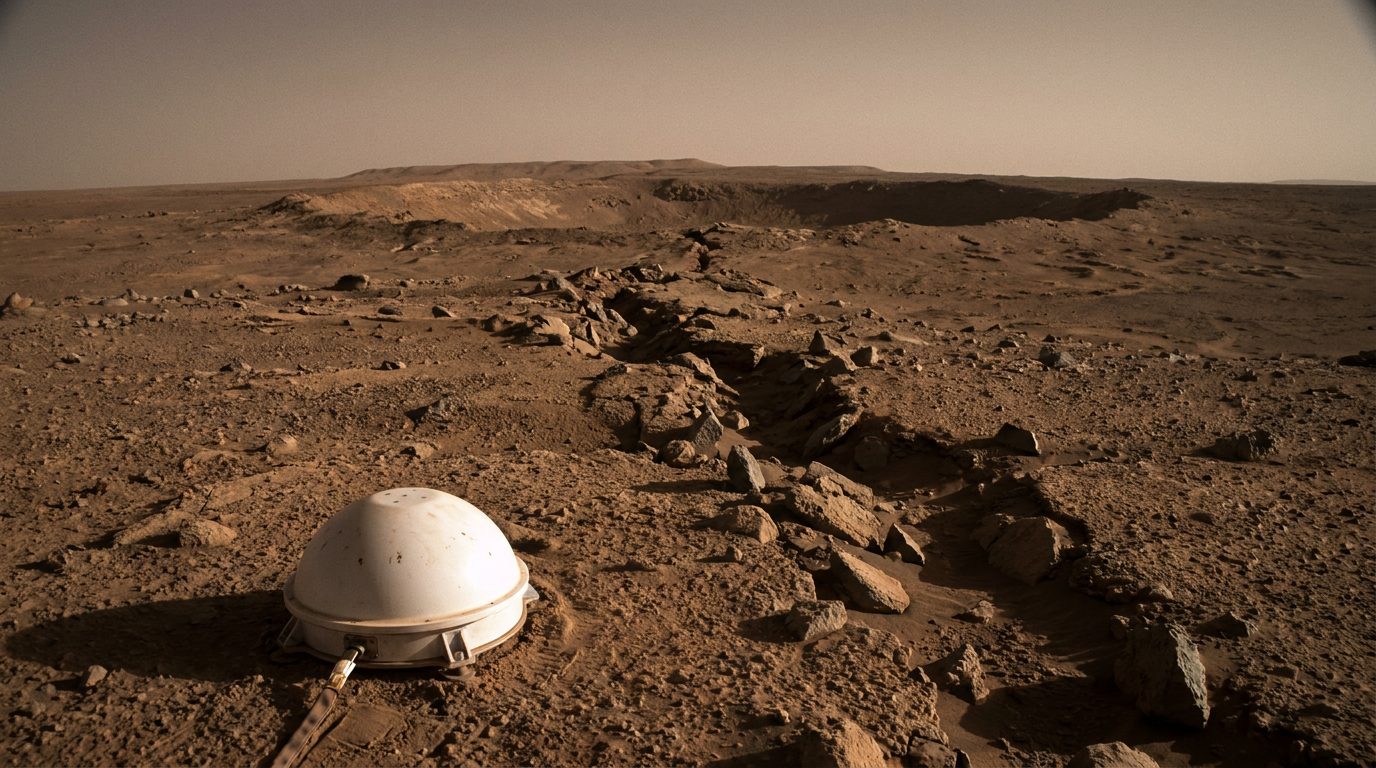
On the night of May 4, 2022, a seismometer sitting on the floor of Elysium Planitia recorded the largest marsquake detected during the entire InSight mission[3]. The event registered at magnitude 5 — not an earthquake that would clear buildings, but on a planet long assumed to be geologically inert, it was significant enough to rattle assumptions that had been accumulating since the Mariner and Viking era. The shockwaves moved through Mars's interior for hours. Scientists later traced them through the planet's mantle with a precision that had never before been possible. What came back from that signal was not just a record of a single rupture. It was a detailed structural portrait of a world that is still, quietly, tearing itself apart.
NASA's InSight lander touched down in November 2018 with a mission that was almost defiantly unglamorous by interplanetary standards. No rover arms. No rock samples. No dramatic images of canyon walls. InSight carried a seismometer called SEIS — the Seismic Experiment for Interior Structure — and its primary job was to stay still and listen. The instrument was sensitive enough to detect ground motion smaller than the width of a hydrogen atom[2]. It was also profoundly vulnerable to wind noise, which is why engineers designed a dome-shaped thermal and wind shield to press over it, improving signal clarity enough to catch events the raw sensor alone would have buried in noise. For four years and a few weeks, InSight sat in the same patch of Martian soil, accumulating seismic data on a planet that had no network of sensors, no reference stations, and no catalog of prior events to compare against. Everything it detected was, in a real sense, the first of its kind.
The mission ended in December 2022, not from mechanical failure but from the slow, inevitable accumulation of Martian dust on InSight's solar panels. The lander needed about 700 watt-hours per Martian day at peak operation; by the final months, its panels were delivering closer to 500, and falling. Engineers had attempted a creative workaround — commanding InSight to use its robotic arm to pour regolith over the panels, hoping the sliding material would drag dust off with it — but it bought only marginal time. The mission fell quiet. What it left behind is a dataset that seismologists and planetary scientists are still working through, and the picture emerging from that data describes a Mars that is geologically alive in ways that complicate the story we thought we knew.
That story had always leaned toward dormancy. Mars has no global magnetic field of the kind Earth maintains through its actively convecting liquid iron outer core. Mars has no plate tectonics redistributing heat through crustal recycling. Its surface is ancient in large swaths, shaped more by impact bombardment and volcanic episodes that appear to have peaked billions of years ago than by anything recent. The conventional picture was of a planet that ran hot early — building Olympus Mons, flooding basaltic lava across vast plains — and then cooled, contracted, and stalled. InSight has not overturned that picture. But it has added resolution to the part the picture always left blurry: the present.
What a Seismometer Learns from Silence and Shaking
Seismology on Earth works through redundancy. When an earthquake ruptures a fault in Chile, seismic waves spread outward in all directions and are recorded minutes or hours later by stations in Japan, Iceland, Kenya, and hundreds of other nodes in a global network. Scientists triangulate the source, measure the wave arrivals, and use the differences to probe the velocity structure of the layers the waves passed through. Different rock types, phase transitions, and compositional changes all alter how seismic waves travel. Do this enough times with enough stations and you build a three-dimensional map of Earth's interior — the crust, the upper and lower mantle, the liquid outer core, the solid inner core, all of it inferred from waves you cannot see moving through material you cannot touch. InSight had one station. On an entire planet. This constraint shaped everything the mission could and could not achieve.
The SEIS instrument detected two types of seismic waves — P-waves, which are compressional and travel through solids and liquids, and S-waves, which are shear waves and cannot propagate through liquid. The presence or absence of S-waves in the signal from that magnitude 5 event in 2022 told scientists something immediate and important about what the waves had passed through. Combined with the timing of arrivals and the way the waveforms evolved, the data allowed researchers to constrain the depth of the Martian crust at InSight's location, characterize the mantle structure beneath it, and probe the nature of the core. The core analysis was among the mission's most striking results: Mars has a liquid outer core, substantially larger than earlier models predicted, and almost certainly enriched with lighter elements — sulfur, oxygen, hydrogen, carbon[1] — that lower its melting point and keep it fluid despite temperatures that would have solidified a purer iron core long ago.
“The core of Mars is liquid, large, and chemically strange — and that single fact reshapes everything we thought we understood about why the planet lost its magnetic field.”
A larger, lighter core complicates the magnetic field story considerably. For decades, the leading explanation for Mars's loss of its global magnetic field — which appears to have collapsed around 4 billion years ago, based on the remnant magnetism locked into ancient crustal rocks — was simple thermal cooling: the core solidified, convection stopped, the dynamo died. But if the core is still liquid, the mechanism is less straightforward. A liquid core that isn't convecting vigorously enough to drive a dynamo is a different kind of problem than a solid one. The chemistry of that liquid — how it stratifies, whether it can sustain the convective overturn needed to generate a self-sustaining magnetic field — becomes the central question. InSight didn't answer that question, but it reframed it at a level of specificity that earlier missions couldn't reach.
The Crust That Won't Stop Moving
Over the four years of the mission, InSight recorded more than 1,300 marsquakes of detectable size, ranging from microseismic tremors barely distinguishable from instrument noise to that magnitude 5 event at the end. The majority were small, shallow, and clustered in a region called Cerberus Fossae — a system of elongated fractures roughly 1,600 kilometers east of the InSight landing site. Cerberus Fossae is not subtle terrain. Even in orbital imagery, the fissures are visible as dark parallel gashes cutting across the surrounding plains, some of them stretching for hundreds of kilometers. Geologically young lava flows have been traced to the region, and some of those flows appear young enough — potentially within the last few million years — that they are a blink of geological time rather than a relic of Mars's ancient volcanic past. InSight's seismic record now establishes that this region is not just structurally fractured but actively seismic in the present. Something is still moving there.
The leading mechanism is thermal contraction. Mars, lacking plate tectonics, cannot recycle its heat through crustal subduction. Instead, heat leaks outward through conduction alone, and as the interior cools, the planet shrinks — very slowly, very slightly, but measurably. That contraction stresses the crust unevenly, and where the lithosphere is thinner or already fractured, it cracks further. Cerberus Fossae sits above what appears to be a relatively thin region of lithosphere, possibly overlying remnant magmatic activity or at minimum a zone that has been thermally and mechanically weakened by previous volcanic episodes. The quakes InSight detected there are consistent with ongoing faulting driven by this contraction-induced stress — the crust adjusting, in small violent increments, to a planet that is imperceptibly smaller today than it was yesterday.
“Mars is shrinking, and the cracks that form as it contracts don't open slowly — they snap, in seconds, releasing energy that SEIS recorded from more than a thousand kilometers away.”
This process has a terrestrial analog, though the comparison requires care. The Moon also lacks plate tectonics and also undergoes thermal contraction, and the Apollo seismic network — four stations operating between 1969 and 1977 — detected shallow moonquakes that are now understood to involve similar mechanisms. The lunar crust buckles in lobate scarps, low ridge-like features that express surface shortening as the interior cools. Mars appears to be doing something related but more energetic, partly because it is larger and retains more internal heat, and partly because it has a more complex compositional history. The analogy is useful for framing the physics; it breaks down when you try to extend it directly, because Mars and the Moon are not the same kind of object and did not cool along the same trajectory.
Reading the Interior Without Going There
One of InSight's mandated instruments was the HP3 — the Heat Flow and Physical Properties Package, built by the German Aerospace Center. It was designed to deploy a self-hammering probe nicknamed the Mole, which would burrow up to five meters below the surface and measure how quickly heat was escaping from Mars's interior. Heat flow is a fundamental geophysical quantity: knowing how fast a planet is losing heat tells you something direct about how much heat remains and how geologically active it is likely to be in the future. The instrument represented one of the most anticipated measurements of the mission. It also failed to achieve its primary objective, in one of the more genuinely painful episodes of recent planetary science. The Mole, designed for soil conditions like Earth's loosest dry sand, encountered a regolith at InSight's landing site that was unexpectedly cohesive — when the probe hammered downward, it lost the friction that normally grounds it, and it bounced. Engineers spent years attempting solutions, including using InSight's robotic arm to press the soil next to the probe and provide it lateral support. The Mole reached roughly 40 centimeters depth at best, nowhere near the intended five meters. The heat flow measurement was never completed.
That failure matters to describe directly, because it is part of the mission's actual scientific record. InSight's seismic results are remarkable. Its core science represents a genuine step forward in planetary geophysics. But the heat flow data it was supposed to provide — data that would have directly constrained the present thermal state of Mars's interior — is absent, and that absence is a real gap in what we can claim to know. The planet's current heat flux, the quantity that would tell us most directly how fast Mars is losing its residual energy, remains poorly constrained. We have proxy evidence from crustal magnetism, volcanic timing, surface morphology, and now seismology, but we do not have the direct measurement that HP3 was designed to provide. Future missions to Mars would benefit from landing site selection that accounts for regolith mechanics, a variable that turned out to matter more than the pre-mission models predicted.
What a Cooling Planet Tells Us About Our Own
Planetary scientists who work on the interior dynamics of rocky worlds are not studying Mars in isolation. The broader research agenda is comparative planetology — understanding why Earth, Venus, Mars, and the Moon, all born from similar material in the same stellar neighborhood, ended up so radically different in their geological present. Earth drives a vigorous dynamo, maintains plate tectonics, and cycles carbon through its crust in a way that appears essential to sustaining surface conditions compatible with life over geological time. Venus has surface temperatures hot enough to melt lead and atmospheric pressure ninety times Earth's, and may have undergone catastrophic volcanic resurfacing within the last billion years. Mars cooled faster, in part because of its smaller size — smaller radius means greater surface area relative to volume, which means heat escapes more efficiently — and in part because of its compositional particulars. These differences are not accidents. They are outcomes of specific physical and chemical variables, and identifying those variables is the point.
InSight's crustal thickness measurements bear directly on this. The crust beneath the lander appears to be between 24 and 72 kilometers thick — a wide range reflecting the difficulty of pinning the estimate down precisely from a single station — with a best estimate clustering around 39 kilometers for the northern lowlands where InSight sits. The southern highlands, heavily cratered and ancient, are thought to be substantially thicker. A thick crust acts as a thermal blanket, slowing heat loss. A thick, immobile crust without plate tectonics also means that heat must escape through conduction through that blanket rather than through the convective recycling that Earth manages. Mars, then, may be cooling more slowly than its small size would suggest, precisely because its crust is insulating it from within. The paradox is not trivial: a thicker crust might extend Mars's geological activity on some timescales while preventing it from sustaining the kind of mantle convection that could maintain a magnetic dynamo or drive volcanism on an ongoing basis.
The Record InSight Left Behind
The InSight dataset is publicly archived and actively being analyzed by teams worldwide. The magnitude 5 event alone generated multiple detailed studies probing core structure, mantle properties, and crustal response. Researchers are applying new signal processing techniques to older, smaller events in the catalog, recovering information from signals that initially seemed too noisy to interpret cleanly. There are open questions that the dataset may yet address: whether the seismicity rate at Cerberus Fossae is steady, seasonal, or episodic; whether any of the detected events involved movement of subsurface magma rather than purely tectonic faulting; whether the core's light element budget can be constrained more tightly from the wave velocity data. None of these will be answered quickly, and some may require a follow-on mission with a proper seismic network — multiple stations — to resolve definitively.
“What InSight accomplished with a single seismometer on a single patch of Martian soil is a reminder of how much structure a patient instrument can find in the ground beneath a planet's silence.”
There are proposals in various stages of development for future geophysical missions to Mars — concepts that would deploy multiple seismometers to different locations, finally giving scientists the network geometry they need to properly triangulate quake sources, map three-dimensional velocity structures, and directly measure the core with the kind of resolution that single-station seismology cannot provide. Those missions, if funded and flown, would build on InSight's catalog the way later solar observatories built on the first grainy images of solar flares — not replacing the earlier record, but making it legible in retrospect. Until then, the 1,300-plus marsquakes InSight recorded sit in a publicly accessible archive, their waveforms available to anyone with the tools and patience to ask new questions of them.
Mars is not dead. That much, at least, InSight established with enough clarity that the debate has shifted from whether the planet retains any geological activity to exactly what kind, at what depth, driven by what mechanism, and for how long. The planet is contracting. Its crust is cracking. Its liquid core is chemically strange in ways that complicate the history of its lost magnetic field. Somewhere beneath Cerberus Fossae, stress is accumulating in fractured rock, and at some point — next year, next decade, next century — it will release again, and if we have a seismometer there to hear it, we will learn something new about what happens to a rocky world when its engine runs down but refuses, slowly, stubbornly, to go entirely quiet.
References
- Evidence for a liquid silicate layer atop the Martian core (doi.org)
Provides the chemical composition of Mars's core—sulfur, oxygen, hydrogen, and carbon—and confirms it is large and low-density. - InSight Science Instruments - NASA Science (mars.nasa.gov)
Describes SEIS seismometer's sensitivity threshold and the dome-shaped thermal and wind shield design that improved signal clarity. - NASA’s InSight Records Monster Quake on Mars (jpl.nasa.gov)
Documents the magnitude 5 marsquake on May 4, 2022, as the largest quake detected during InSight's entire mission and the 1,222nd sol of operation. - The InSight HP3 Penetrator (Mole) on Mars: Soil Properties Derived from the Penetration Attempts and Related Activities (link.springer.com)
About Brenna Vance
Brenna Vance writes about the cosmos — stars that predate the universe's own chemistry, spacecraft flying close enough to the sun to catch it misbehaving, the physics of what the universe is still getting wrong. Her work focuses on the moments when an observation breaks a model, and what that break actually means.
More like this
Two Continent-Sized Blobs Have Been Sitting at Earth's Core for Four Billion Years
Buried at the base of Earth's mantle, two continent-sized masses of anomalous rock have resisted four billion years of planetary churning — and a new study argues they are fossilized relics of Earth's primordial interior that may have quietly shaped the conditions for life.
The Moon Has a Scar the Size of a Continent — And We've Never Explained It
The South Pole–Aitken Basin is 2,500 kilometers wide, ancient beyond easy reckoning, and quietly resisting every model scientists have built to explain it.
We've Found Over 5,000 Exoplanets. Almost None of Them Are Like Earth.
The most common world in the galaxy sits in a size range our solar system completely skipped — and planetary scientists aren't sure whether that's physics or blind spot.