The Moon Has a Scar the Size of a Continent — And We've Never Explained It
The South Pole–Aitken Basin is 2,500 kilometers wide, ancient beyond easy reckoning, and quietly resisting every model scientists have built to explain it.
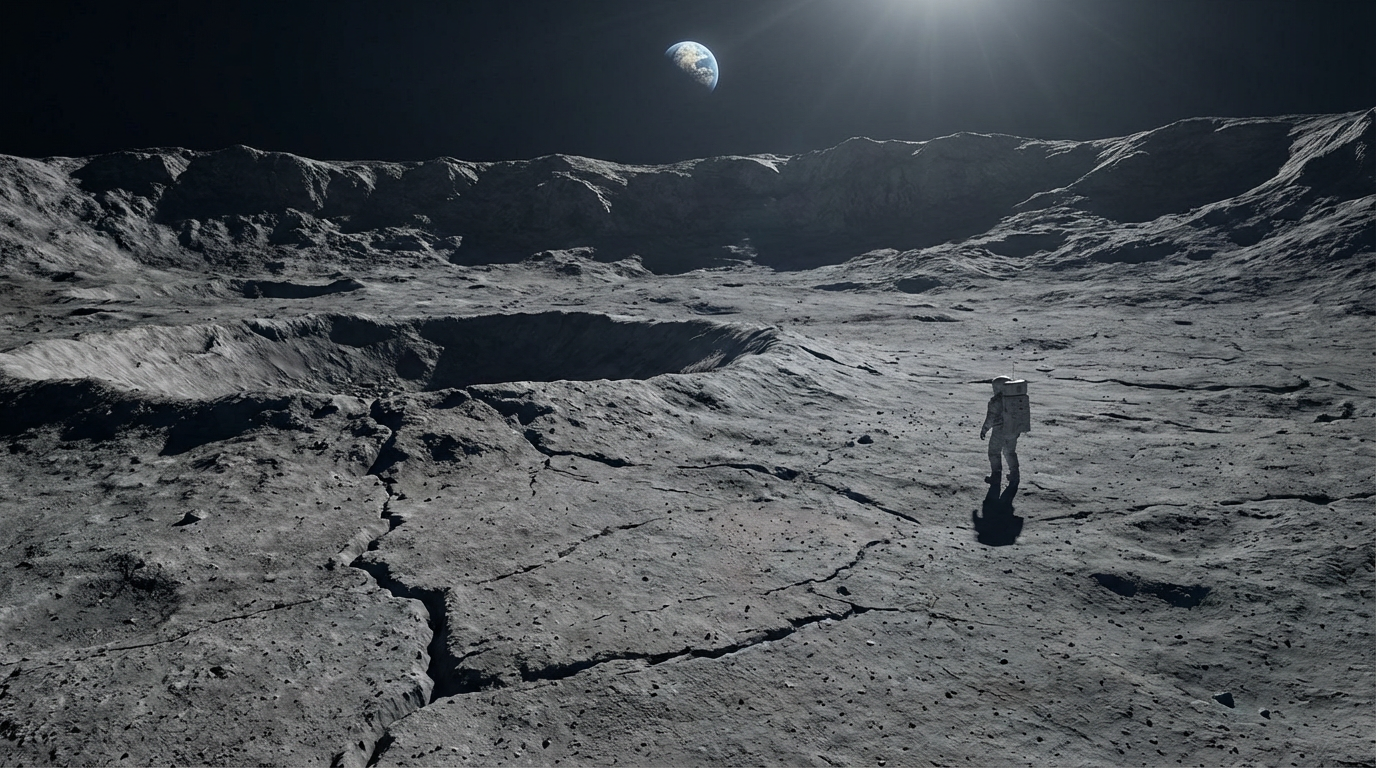
Stand on the lunar far side, near the southern pole, and you would be standing inside the largest confirmed impact structure in the solar system[4] — though you would have almost no way of knowing it. The South Pole–Aitken Basin is so vast that its curvature follows the curve of the Moon itself. Its rim is not a clean wall but a shattered highland arc thousands of kilometers away, barely visible as elevated terrain. Its floor, already depressed by several kilometers, is not a single flat plain but a landscape fractured, re-cratered, layered with billions of years of subsequent damage. You would be inside a wound the size of a continent without a clean edge to see. The scale defeats the eye.
The basin stretches roughly 2,500 kilometers across and plunges at its deepest to about 8 kilometers below the surrounding surface — making it not only the widest impact structure we know of in the solar system, but one of the deepest. By comparison, the Hellas Basin on Mars, long considered a candidate for largest known crater, covers about 2,300 kilometers. The Chicxulub impactor that ended the Cretaceous left a structure roughly 180 kilometers wide. South Pole–Aitken, abbreviated SPA in the planetary science literature, is not a larger version of familiar craters. It is a different category of event entirely, a collision so immense that it left the Moon permanently asymmetric and may have restructured the deep interior of the body it struck.
And yet, despite decades of orbital data, multiple spacecraft missions, and some of the most detailed remote sensing ever applied to another world, the basin remains fundamentally unresolved. Its age is disputed within a range that spans hundreds of millions of years. Its floor composition carries chemical signals that do not cleanly fit the prevailing model of how the Moon formed and cooled. The object that made it has never been convincingly characterized. For a structure this large on a world this well-studied, that degree of open uncertainty is unusual enough to be worth dwelling on.
The SPA Basin is not an unsolved mystery in the sense of something exotic or hidden — it is mapped, photographed, and measured in extraordinary detail. The mystery is subtler: the evidence is there, and the models keep not quite fitting it. That kind of mismatch, between a confident theory and a stubborn dataset, is often where planetary science is actually happening.
A Collision That Reshaped a World
The impact that formed SPA almost certainly occurred during the first billion years of solar system history, when the Moon was young and the inner solar system was still raining debris from the chaotic early period of planetary accretion. The best current estimates date the basin's formation to somewhere between roughly 4.3 and 4.0 billion years ago, though pinning a more precise number has proven genuinely difficult. Some analyses push the formation earlier, into the first few hundred million years after the Moon coalesced. Others suggest it may have occurred during or near the Late Heavy Bombardment, a period — itself still debated in its severity and timing — when impact rates appear to have surged across the inner solar system. The uncertainty is not trivial. A difference of three hundred million years in the formation date changes almost everything about the context: what the Moon's interior was doing at the time, how much heat was still driving its geology, and what population of impactors was available to deliver a blow of this magnitude.
The impactor itself is reconstructed almost entirely from the basin's geometry. Modeling suggests a body somewhere in the range of 170 to 200 kilometers in diameter[1] — roughly the size of a large asteroid — striking at a moderately oblique angle. Some simulations require an even larger impactor, depending on the assumed impact velocity and the mechanical properties of the early lunar crust. What is clear from the basin's shape and depth is that the collision was not a grazing blow. It was deep enough to excavate material from well below the crust, potentially reaching into or near the upper mantle. That excavation is central to one of the basin's most persistent puzzles.
“A collision deep enough to expose the lunar mantle should have left a floor full of minerals that simply are not there.”
The Floor That Doesn't Match
When the Moon formed and then slowly cooled over its first few hundred million years, heavier minerals sank and lighter ones rose — a process called planetary differentiation. The lunar interior developed a dense, olivine-rich mantle beneath a thinner crust dominated by lighter plagioclase feldspar. This is the standard model, derived from Apollo sample analysis, remote sensing, and decades of refining. If the SPA impact was deep enough to puncture through the crust and excavate mantle material, the basin floor should be rich in olivine and related lower-crustal or mantle minerals. There should be a chemical signature of depth down there — the exposed innards of the Moon.
Data from the Kaguya mission, the Lunar Reconnaissance Orbiter, and the Chandrayaan-1 spacecraft have mapped the basin floor's mineralogy in considerable detail. What the spectrometers show is unexpected: the floor is enriched in pyroxene[2], a mineral more associated with mid-crustal material, but the predicted abundance of olivine is largely absent, or present only in ambiguous patches at levels far lower than the excavation depth would demand. The mantle material that the impact should have brought to the surface appears to be missing, or at least not dominant. Several explanations have been proposed: the impactor may have struck at a lower angle than models assume, limiting depth of excavation; the early lunar mantle may have had a different composition than current models suggest; or the billions of years of subsequent impacts and volcanic activity may have buried or mixed the original mantle ejecta beyond recognition. None of these explanations has been confirmed. Each carries its own complications.
One of the more intriguing hypotheses focuses on the thermal aftermath of the impact itself. A collision of this scale would have generated an enormous melt sheet — a sea of liquid rock potentially hundreds of kilometers wide and kilometers deep — that would have taken millions of years to solidify. As that melt sheet cooled and crystallized, it may have produced its own differentiated sequence, with different minerals settling at different rates, effectively overprinting the original excavated composition with a new one. In this reading, the floor of SPA is not showing us the excavated mantle — it is showing us the crystallized residue of the impact melt, which evolved along its own chemical path. The original signal is buried under its own aftermath.
What the Far Side Hides
Part of what makes SPA difficult to study is its location. The lunar far side is perpetually turned away from Earth, invisible from any ground-based telescope, unreachable by direct radio communication with surface landers. Until Chang'e 4, the Chinese mission that landed inside the basin in January 2019, no spacecraft had ever soft-landed on the far side. Chang'e 4 became the first[3]. Its rover, Yutu-2, has been traversing the Von Kármán crater — itself nested within SPA — and collecting in situ spectral data from the surface. Early results suggested the rover had detected material consistent with olivine and low-calcium pyroxene, potentially hinting at excavated lower-crust or even mantle material. The finding was tentative, the spectral interpretation contested, and subsequent analysis has produced ongoing discussion rather than resolution. But it represents the first ground-level evidence from inside the basin, and future missions, including planned sample-return efforts targeting SPA specifically, would give scientists something no orbital campaign ever can: actual rock brought back to a laboratory.
“Chang'e 4 was the first spacecraft to land on the far side of the Moon — and it landed inside the wound.”
The difficulty of accessing the far side has historically biased lunar science toward the near side, which is better represented in the Apollo sample collection and in decades of telescopic observation. SPA's location means that almost everything we know about its composition comes from remote sensing — spectrometers and radar aboard orbiting spacecraft inferring mineral content from reflected light and electromagnetic returns. Remote sensing is powerful and has improved enormously, but it integrates signal across areas far larger than a rock sample and cannot resolve the fine-scale mixing that billions of years of micrometeorite gardening, known as impact-driven regolith turnover, have imposed on the surface. The top layer of any ancient basin floor is a blended archive rather than a clean exposure. Reading it backward to the original impact composition requires assumptions about how much mixing has occurred, over what timescale, and from what source.
The Age Problem
Establishing the absolute age of SPA without samples is essentially impossible with current methods. The technique that has given us confident ages for many lunar features — radiometric dating of returned samples, combined with crater counting calibrated against those dated surfaces — breaks down for SPA in both directions. No samples from the basin have been definitively linked to its formation event. Crater counting on the basin floor can suggest relative age but cannot pin an absolute date without an anchor sample. The floor has been resurfaced, reworked, and re-cratered so many times that counting even the secondary craters from known events has become a complex statistical exercise rather than a clean measurement.
Some researchers have attempted to extract age constraints from the lunar meteorite collection — chunks of Moon rock ejected by impacts and eventually recovered on Earth — searching for samples that might have originated from SPA ejecta. The isotopic signatures in certain meteorites are consistent with very old ages, some approaching 4.3 to 4.4 billion years, which would push SPA's formation close to the Moon's earliest history. Others argue for a younger formation, closer to 3.9 to 4.0 billion years, aligning the event with the proposed Late Heavy Bombardment pulse. The stakes of this debate extend beyond the Moon: if SPA formed during the Late Heavy Bombardment, it adds weight to the case that the bombardment was a genuine spike. If it formed earlier, it may represent a relic of a different, pre-bombardment epoch of large-body collisions. The basin's age is not just a lunar question. It is a question about the early dynamical history of the whole solar system.
Why a Hole in the Moon Matters
“The largest scar in the solar system is also, quietly, one of the most important unread archives we have left.”
There is a practical reason planetary scientists have elevated SPA to one of the highest-priority targets for future sample return missions. Rock retrieved from deep within the basin would carry isotopic records of the impact melt's crystallization, potentially dating the event with the kind of precision — within tens of millions of years — that orbital data cannot achieve. It might also reveal whether the basin floor preserves mantle material, settling the compositional debate. And material from the lower crust or mantle of the early Moon would constrain models of how the lunar magma ocean evolved during the Moon's first hundred million years — a period for which we currently have almost no direct physical evidence.
Beyond the Moon, the questions SPA raises about impact dynamics at this scale apply across planetary science. Giant basin-forming impacts were not rare in the early solar system — Mars carries multiple, Mercury's Caloris Basin is enormous, and the early Earth almost certainly received comparable blows, erased by four billion years of plate tectonics and erosion. SPA is the best-preserved example of this class of event in the inner solar system, which makes it not a footnote to lunar science but something closer to a reference specimen. If we cannot explain what happened here — what hit, when, at what angle, and what it left behind — our models for the most violent phase of planetary formation are carrying an unacknowledged gap.
The Moon is often treated in popular imagination as a place already thoroughly understood, mapped down to its craters, geologically quiet, stripped of surprise. But the SPA Basin sits on its far side like a record we have not yet learned to read, preserving in its fractured floor and ambiguous mineralogy the compressed residue of a collision so enormous it borders on planetary-scale, from a time so early that the solar system's architecture was still being decided by violence. We have the basin. We have the data. The mismatch between them is telling us something. We have not yet figured out what.
References
- Constraining the size of the South Pole-Aitken basin impact (sciencedirect.com)
Provides modeling estimates that the impactor was 170 to 200 kilometers in diameter, roughly the size of a large asteroid. - Correlating Apollo Soil Mineralogical Data With Kaguya Spectral Data for a Global Mineralogical Classification (agupubs.onlinelibrary.wiley.com)
Provides spectroscopic data showing the SPA basin floor is enriched in pyroxene rather than the olivine expected from mantle excavation. - Descent trajectory reconstruction and landing site positioning of Chang’E-4 on the lunar farside (pmc.ncbi.nlm.nih.gov)
Documents that Chang'e 4 was the first spacecraft to successfully soft-land on the lunar far side, landing inside the SPA basin. - What is the South Pole-Aitken Basin? - NASA Science (science.nasa.gov)
Confirms SPA is the largest known impact crater in the solar system, spanning 2,500 kilometers in diameter and approximately 10 kilometers deep.
About Mira Solen
Mira Solen writes about deep time, cosmic history, extinct stars, ancient impacts, and the long memory stored in rock, dust, and light. Her work specializes in making the oldest stories in the universe feel vivid, physical, and strangely near.
More like this
Mars Is Still Cracking Apart — And InSight Heard It Happen
NASA's InSight lander spent four years listening to the interior of Mars, and what it found suggests rocky planets don't die quietly — they contract, fracture, and quake for billions of years after their engines cool.
Two Continent-Sized Blobs Have Been Sitting at Earth's Core for Four Billion Years
Buried at the base of Earth's mantle, two continent-sized masses of anomalous rock have resisted four billion years of planetary churning — and a new study argues they are fossilized relics of Earth's primordial interior that may have quietly shaped the conditions for life.
We've Found Over 5,000 Exoplanets. Almost None of Them Are Like Earth.
The most common world in the galaxy sits in a size range our solar system completely skipped — and planetary scientists aren't sure whether that's physics or blind spot.