The Insects Are Vanishing Even Where We Didn't Touch Anything
A two-decade study in the Colorado Rockies found insect populations collapsing in pristine wilderness — and the culprit has nothing to do with pesticides, habitat loss, or human footprint.
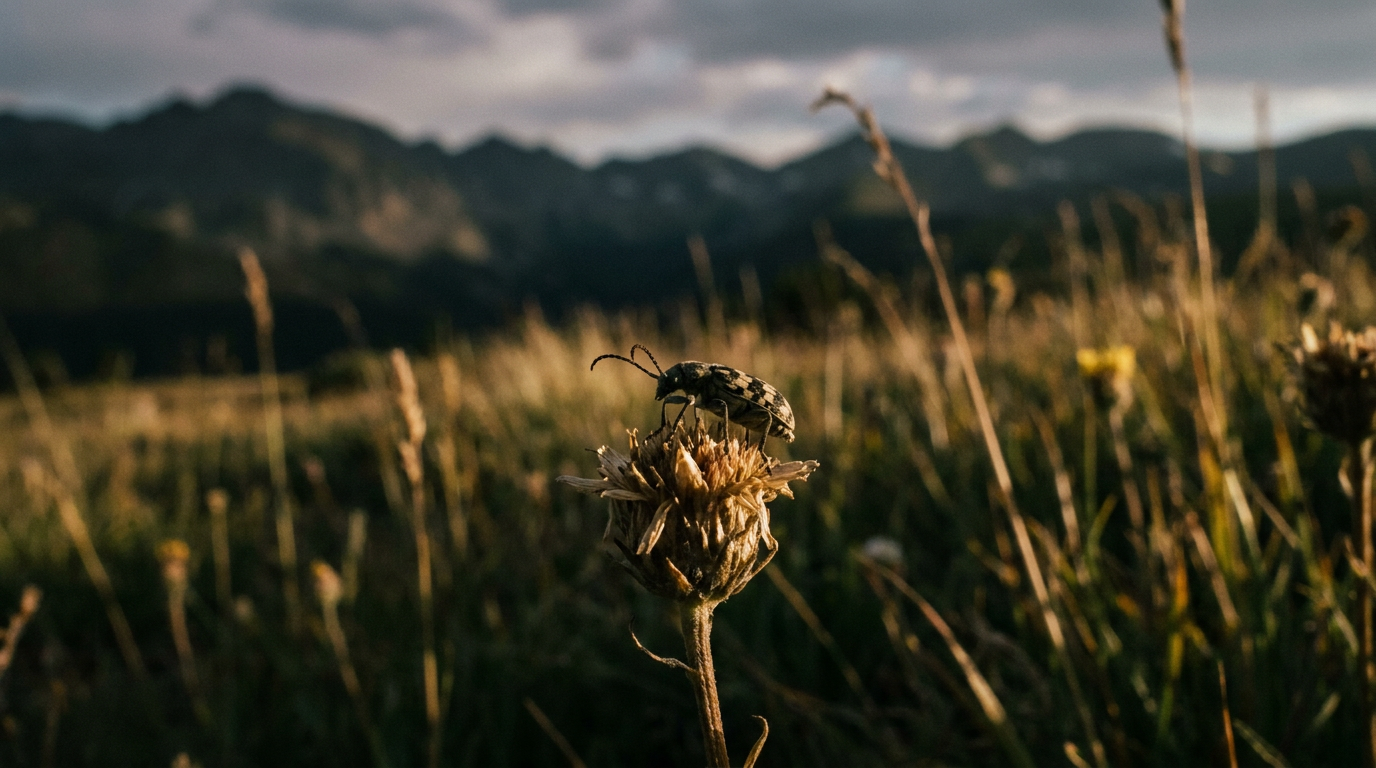
There is a meadow in the Colorado subalpine zone that has not been grazed, developed, sprayed, or fragmented. No roads cut through it. No agricultural runoff reaches it. By nearly every conventional measure of ecological integrity, it is the kind of place conservation biology holds up as a success — land that was left alone and therefore, the assumption goes, land that was spared. For twenty years, researchers returned to that meadow each summer and counted insects. They used standardized traps, consistent methodology, and careful documentation. What they found, published in the journal Ecology in 2025 by researchers at UNC-Chapel Hill[3], should force a rethinking of one of the most foundational ideas in modern conservation: that protecting a habitat from direct human disturbance is enough to protect the life inside it.
Flying insect abundance in that meadow dropped by 72 percent over the study period. Not in a field next to a corn farm. Not in a suburban green space fragmented by subdivision. In a high-elevation wilderness site where, by every physical measure of place, the habitat itself remained intact. The plants were still there. The soil was undisturbed. The meadow looked, from any reasonable distance, like a meadow. But the insects that had filled it were largely gone.
This is the kind of finding that arrives quietly and sits heavily. Because if insects are disappearing from places we never touched, then the story conservationists have been telling about protected land — that preservation buys time, that wild places are refuges, that keeping development out keeps ecosystems in — is incomplete in a way that matters enormously. The question is not whether that story was wrong. The question is what it was missing.
The answer the data keeps pointing toward is warmth. Not pesticides. Not light pollution bleeding in from distant cities. Not the creep of invasive species across a damaged landscape. Warming summer temperatures, the slow and invisible restructuring of what a subalpine summer actually feels like, appears to be driving insect communities into decline even in places where everything else we know how to protect is being protected. The meadow was a refuge from everything except the atmosphere.
What Twenty Years of Counting Actually Shows
Long-term ecological studies are rare enough that each one is worth treating carefully. Most ecological monitoring is short, underfunded, or designed around a specific disturbance event. A study that returns to the same site, with the same methods, across two decades is a different kind of instrument — one sensitive enough to capture gradual change that any single-season survey would miss entirely. The Colorado subalpine meadow study is precisely this kind of instrument, and its output is not a snapshot. It is a trajectory.
The researchers documented flying insects across multiple taxonomic groups, tracking not just total abundance but community composition — which species were present, in what numbers, at what point in the summer. What they observed was not a sudden crash attributable to a single bad year or a random weather anomaly. The decline was gradual and sustained, consistent enough across years to rule out the kind of noise that distorts shorter studies. And critically, it was occurring against a background of rising summer temperatures at the site. The correlation between warming and insect decline held even after accounting for precipitation variability and other year-to-year fluctuations. Warmth, and its compounding effects on a system calibrated for a cooler world, kept emerging as the dominant signal.
“The meadow was a refuge from everything except the atmosphere.”
Subalpine ecosystems are particularly sensitive to thermal change because they evolved under a narrow and relatively stable temperature window. The insects that inhabit these zones are, in many cases, cold-adapted specialists — species whose life cycles, body temperatures, and reproductive timing are tightly synchronized with the cool, compressed growing season that defines high-elevation summers. When that season shifts — when temperatures rise earlier, when peak warmth arrives at the wrong moment, when the window of conditions these species evolved for shortens or slips — the insects do not simply adjust. Many cannot. Their phenology is not infinitely elastic.
Phenology, Pressure, and the Problem of Timing
Phenology is the study of biological timing — when flowers open, when insects emerge, when migratory birds arrive, when seeds set. In a stable ecosystem, these events are tuned to one another with extraordinary precision built across thousands of years of co-evolution. A flower blooms. An insect emerges to pollinate it. A bird arrives to eat the insect. Each event is the trigger and the reward for another. The system works because everything happens in the right order, at roughly the right time, in roughly the right amounts.
Climate change disrupts phenology unevenly. Different species respond to different cues — some track temperature, some track day length, some track snowmelt timing. When warming accelerates one cue without proportionally shifting another, the synchrony breaks down. An insect that evolved to emerge when a particular wildflower blooms may now find that the flower has already peaked. A bee whose colony builds toward maximum foraging capacity in mid-July may find that the peak nectar season now ends in early July. These mismatches do not always produce immediate, visible die-offs. They produce reproductive failure, nutritional stress, reduced colony strength, and over time, population decline — the kind of slow, accumulating pressure that shows up clearly only when you have been watching for twenty years.
Subalpine meadows compress this problem. The growing season at high elevation is already short — sometimes only six to eight weeks of conditions favorable to insect activity. If warming shifts the timing of that window, or if heat stress during peak summer begins to exceed thermal tolerances for cold-adapted species, there is very little buffer. A lowland insect population under similar pressure might shift its range upslope or find refuge in a cooler microhabitat nearby. A subalpine species already at the top of the mountain has no upslope left to go.
The Myth of the Intact Refuge
“Protected land preserves the physical container of an ecosystem, but it cannot preserve the climate the ecosystem was built for.”
Conservation biology has long operated on a triage logic: protect the best-remaining habitats first, keep human disturbance out, and the ecological communities inside will hold. This logic has driven land acquisition campaigns, national park policy, wilderness designation, and international conservation frameworks for decades. It is not wrong, exactly — habitat destruction remains the single largest driver of biodiversity loss globally, and protecting land from development clearly matters. But the Colorado findings expose a structural gap in that logic. Protected land preserves the physical container of an ecosystem, but it cannot preserve the climate the ecosystem was built for.
This distinction matters more than it might seem. When the threat was habitat loss, the solution had a spatial logic: draw a boundary, enforce it, and the inside of that boundary becomes a refuge. When the threat is atmospheric warming, boundaries become almost irrelevant at the scale of the problem. The atmosphere does not stop at a park boundary. Temperatures rise inside wilderness areas and outside them at roughly the same rate. Phenological disruption does not check whether a meadow is federally protected before it begins unraveling the timing relationships that hold the insect community together.
What this means practically is that conservation strategies built entirely around land protection are incomplete. They address one class of threat effectively while leaving ecosystems fully exposed to another. Protected areas will still matter — they reduce cumulative stress on species already under thermal pressure, and they provide cleaner baselines for detecting change. But they cannot substitute for addressing the atmospheric forcing that is warming the interior of those protected landscapes along with everything else.
What Insects Actually Do in a Meadow
A 72 percent decline in flying insect abundance is a number that is easy to record and difficult to fully absorb. It helps to understand what that number represents in functional terms — what insects are doing in a subalpine meadow that makes their absence something other than an aesthetic loss.
Pollination is the most obvious function, but it is only the beginning. Flying insects in meadow ecosystems are simultaneously pollinators, prey, nutrient cyclers, and ecological connectors. They move pollen between plants and support seed set. They are the primary food source for insectivorous birds, many of which time their breeding seasons to coincide with peak insect abundance — a phenological linkage that is now itself under pressure. Insect larvae in soil and vegetation break down organic matter and release nutrients back into the plant community. Predatory insects regulate populations of plant-feeding insects, preventing the kind of outbreak dynamics that can defoliate vegetation. Each of these functions is embedded in a web of relationships, and the web does not remain intact when nearly three-quarters of the participants disappear.
The meadow's plants may still be present. The soil may still look like soil. But the set of ecological relationships operating inside that landscape has already changed substantially — quietly, invisibly, without any visible disturbance to announce the damage. This is precisely the pattern described in decades of ecological research on cascading trophic effects: loss at one level propagates upward and downward through a food web, often producing delayed consequences that only become legible when a population crashes or a plant community shifts in ways that seem inexplicable without the insect data underneath.
Silence as Signal
There is a particular kind of quiet that comes over a landscape when the insect layer thins. It is not the silence of a dead place. It is the silence of a place that still looks alive — still smells like grass and wildflower and thin mountain air — but sounds wrong to anyone who has spent enough time in such places to have an ear calibrated to what right sounds like. Fewer wings. Fewer hums. Fewer of the small, constant interactions that fill the space around you in a healthy meadow and fall below the threshold of conscious notice until they are gone.
“The insect layer does not vanish with a crash. It thins, year by year, until one summer the meadow is quieter than it was and no single event explains why.”
The insect layer does not vanish with a crash. It thins, year by year, until one summer the meadow is quieter than it was and no single event explains why. This is what makes the Colorado findings both scientifically significant and practically alarming for the broader project of understanding what is happening to invertebrate communities worldwide. Studies from Germany's Krefeld Entomological Society[4], from Puerto Rican rainforests[1], from agricultural landscapes across Europe, have all documented severe insect declines over the past several decades. Most of those sites had plausible local drivers: pesticide exposure, light pollution, land conversion, invasive species. The Colorado subalpine site removes those explanations cleanly. What remains is warming. And warming is not a local phenomenon.
Insect monitoring remains poorly funded and geographically patchy, which means the Colorado study is not describing a unique situation so much as providing a rare well-documented view into a process that is likely occurring in many protected high-elevation ecosystems without anyone counting carefully enough to see it. Subalpine and alpine zones globally — the Rockies, the Alps, the Andes, the Himalayas, the Ethiopian Highlands — are warming faster than lower-elevation counterparts[2]. The insects in those zones evolved for conditions that are changing faster than they can track. The meadow in Colorado is probably not alone. It is just the one we happened to watch long enough to understand.
The most uncomfortable implication of a study like this is not the number itself — 72 percent, devastating as it is — but what the number suggests about the relationship between protection and safety. We drew the boundary. We kept the bulldozers out. We did, by the conventional definition, everything right. And the insects left anyway, drawn out not by anything we did inside the boundary but by something we are doing everywhere, all at once, without a fence in the world capable of stopping it.
References
- Climate-driven declines in arthropod abundance restructure a rainforest food web (pnas.org)
Provides evidence that climate-driven arthropod declines occur in ecosystems beyond temperate zones, supporting the article's claim that warming affects insect populations globally. - Elevation-dependent climate change in mountain environments (nature.com)
Provides evidence that mountain environments experience elevation-dependent warming faster than lower elevations. - Long‐term decline in montane insects under warming summers (esajournals.onlinelibrary.wiley.com)
Reports the core 20-year Colorado meadow study documenting 72% flying insect decline in pristine wilderness linked to rising summer temperatures. - More than 75 percent decline over 27 years in total flying insect biomass in protected areas (journals.plos.org)
Establishes precedent for large insect declines in protected areas, showing 75% biomass loss over 27 years in German nature reserves.
About Sable Pike
Sable Pike writes about habitat loss, ecosystem strain, species decline, climate disruption, and the quiet unraveling of natural systems people once assumed were permanent — and the way that unraveling reaches into economies, politics, and daily life. Her work brings emotional weight to ecological change without sacrificing scientific rigor.
More like this
Migratory Birds Are Flying on the Wrong Clock
A warming world is splitting the seasons apart — and migratory birds, flying by an internal clock that no longer matches the land they're flying toward, are paying for the mismatch in empty nests.
Florida's Reef Builders Are Functionally Extinct. The Reef Is Still There.
After the 2023 marine heatwave, staghorn and elkhorn corals crossed a threshold scientists call functional extinction — and the reef kept its shape just long enough to hide the damage.
The Amazon Makes Its Own Rain. Deforestation Is Breaking That.
The Amazon recycles its own rainfall through vast airborne moisture corridors — and new data shows that eastern deforestation is already strangling the forests furthest downstream.