The Amazon Makes Its Own Rain. Deforestation Is Breaking That.
The Amazon recycles its own rainfall through vast airborne moisture corridors — and new data shows that eastern deforestation is already strangling the forests furthest downstream.
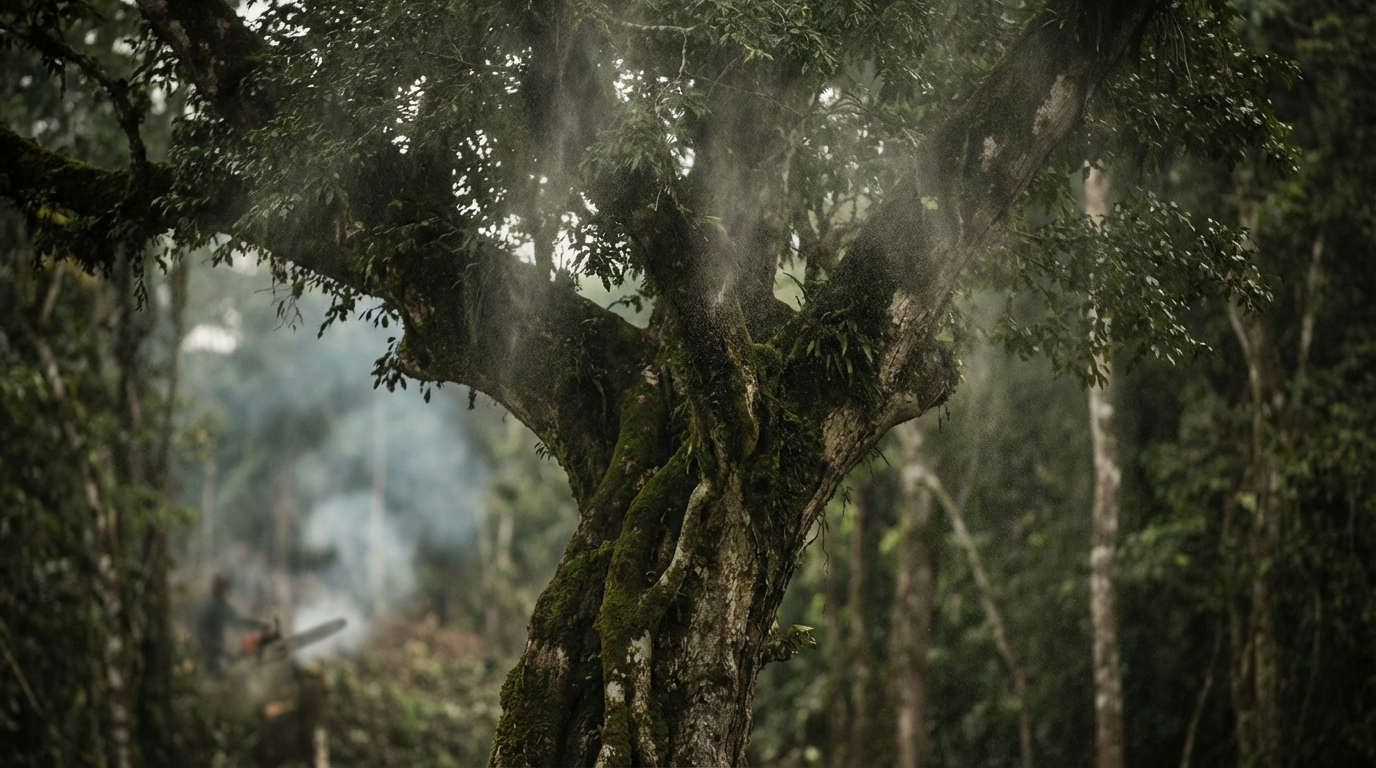
Stand in the western Amazon — in the lowland forests of Madre de Dios, say, or in the green interior of Bolivia's Beni department — and the air itself feels like a living thing. It is heavy, saturated, almost textural. Rain arrives with a reliability that feels geological, as though the forest simply generates weather the way a lung generates breath. In a sense, it does. The moisture hanging over those western forests did not fall from the sky as ocean evaporation alone. Much of it was exhaled by trees — trees that stand hundreds, sometimes thousands, of kilometers to the east, in Brazil's Pará and Mato Grosso states, drawing groundwater up through their roots and releasing it through millions of tiny leaf pores in a process called transpiration. That moisture rises, condenses, moves west on atmospheric currents, and falls again as rain. Then the forest exhales it again. And again. This is the hydrological engine at the center of the Amazon, and it is called the flying rivers.
The concept is not new to atmospheric scientists. Brazilian researchers, particularly the physicist Antonio Donato Nobre[4], have spent decades trying to communicate its scale and its importance: the Amazon's aerial moisture flux carries something in the range of 20 billion tons of water vapor per day[1] during peak season, rivaling or exceeding the discharge of the Amazon River itself. That flux does not simply re-water the basin. It is the mechanism by which coastal rainfall, absorbed by eastern forests, becomes precipitation over the Andes, feeds the agricultural heartland of Brazil's Cerrado, and sustains the hydrological budgets of countries that never touch the Amazon biome at all. The flying rivers are not a metaphor. They are a measurable atmospheric feature. And they depend entirely on the forests remaining intact.
In September 2025, Amazon Conservation's MAAP initiative[3] — Monitoring of the Andean Amazon Project — published an analysis making that dependency concrete and newly alarming. Drawing on satellite-based deforestation tracking and atmospheric moisture modeling, the report showed that ongoing forest loss in the eastern Amazon, disproportionately concentrated in Brazil's agricultural frontier, is already measurably disrupting moisture recycling across the basin. Forests in Peru and Bolivia are receiving less recycled rainfall than historical baselines suggest they should. The mechanism is not hypothetical. The disruption is not future. The eastern forests that generate much of the western Amazon's rainfall are being cleared, and the forests that depend on them are beginning to feel it — in drought stress, in altered bloom timing, in ecosystem pressure that has no immediately obvious cause because the cause is invisible, airborne, and hundreds of miles away.
What makes this finding so difficult to absorb — and so important to understand — is that it reveals a form of ecological interdependence that violates the intuitions most people bring to conservation. We tend to think of habitat destruction as local: a forest that is cleared is a forest that is gone, and the damage stops at the boundary of the clearing. But the flying rivers mean that a forest in Pará is climatically active in Peru. Its destruction is not contained. It travels. The chainsaws are cutting down trees that are watering forests in other countries, and the forests in those other countries have no way of knowing that the source is being removed. They will find out through drought.
How the Amazon Builds Its Own Weather
To understand why this matters, you have to understand what the Amazon's hydrological cycle actually is — not the cartoon version, in which rain falls, flows to the river, and reaches the sea, but the full closed loop that makes the Amazon unlike almost any other forest system on Earth. When rain falls on the eastern Amazon, a portion of it moves into rivers and eventually leaves the basin. But a significant fraction — estimates range broadly but consistently suggest something between 25 and 35 percent of precipitation is recycled at least once within the basin before reaching the ocean — is taken up by tree roots and returned to the atmosphere through transpiration. The canopy also intercepts rainfall directly, allowing it to evaporate back upward without ever reaching the soil. These two processes together make the forest an active participant in its own rainfall regime, not merely a recipient of it.
Above the canopy, this moisture organizes into what researchers call biotic pumps and atmospheric rivers. The forest's evapotranspiration creates low-pressure cells that draw moist air in from the Atlantic, and the condensation of that rising moisture generates cloud cover, reduces surface temperatures, and drives the westward atmospheric circulation that carries vapor inland. Each recycling step adds moisture to the western parts of the basin. By the time precipitation reaches the Andes, a meaningful fraction of it originated as ocean water that has been processed by forest — exhaled, lifted, moved, and rained again — multiple times in sequence. The forest is not just covered by weather. It is making it.
“The Amazon is not merely covered by weather. It is manufacturing it, one tree exhale at a time, across a continent.”
This is the mechanism that gives the tipping point concept its physical teeth. Scientists who study Amazon tipping points — the threshold beyond which the forest loses enough function to begin an irreversible transition toward a drier, more fragmented savanna state — are not speculating about some distant catastrophic event. They are describing a specific breakdown of this hydrological system. The leading research on Amazon tipping dynamics, built on decades of deforestation monitoring and climate modeling, generally locates a critical threshold somewhere between 20 and 25 percent cumulative deforestation[2] of the original biome, combined with climate warming that independently reduces rainfall. The Amazon has already lost approximately 17 to 20 percent of its original extent, depending on how you count degraded forest alongside outright clearing. The system is operating closer to its limits than it ever has.
The Eastern Arc, Where the Rain Begins
The eastern Amazon is where the flying rivers originate. The Atlantic trade winds carry moist ocean air westward, and the forests of Pará, Maranhão, and the arc of deforestation — the heavily cleared agricultural frontier that curves through Mato Grosso, Rondônia, and into Acre — are the first major biological infrastructure that air encounters. These forests absorb and amplify the incoming moisture, feeding it back into the atmosphere enriched by their own transpiration. They are, functionally, the intake valve of the basin's moisture engine. What happens to them does not stay with them.
The deforestation rates in this eastern arc have been among the highest on Earth for decades. Brazil made significant progress in reducing Amazon deforestation after 2004, but the gains were never complete and some were reversed during the late 2010s under weakened enforcement. The MAAP initiative, which aggregates multiple satellite data streams to produce near-real-time deforestation alerts, has documented persistent clearing pressure along the agricultural frontier even during periods of official policy improvement. What the September 2025 analysis added was a downstream accounting: matching patterns of forest loss in the eastern arc to changes in atmospheric moisture flux measured across the basin, and tracing the signal westward into regions where forest cover remains largely intact. The degradation signal arrived before the trees fell. The moisture was already thinning.
“The degradation signal arrived before the trees fell. The moisture was already thinning in forests that had not yet lost a single tree.”
Downstream Drought, Invisible Cause
For forests in the western Amazon — in Peru's Loreto and Ucayali regions, in Bolivia's northern lowlands, in Ecuador's Amazonian territories — the experience of disrupted flying rivers is not yet dramatic. It is not yet a collapse. It is a drying. Dry seasons lengthening by days or weeks. Rainfall totals falling a few percentage points below the multi-decade average. Stream flows in small tributaries running lower than their channels expect. Tree mortality rates in drought-sensitive species ticking upward in ways that field ecologists notice before remote sensing picks it up. The system is registering stress in the registers that living systems use: not catastrophe, but imbalance, phenological mismatch, declining resilience.
This is how ecosystems announce damage before it becomes visible as loss. The western Amazon's forests are extraordinarily biodiverse — Peru alone holds species counts that rival any comparable land area on Earth — and many of those species evolved in conditions of high, predictable moisture. Phenological cues, the timing of fruiting, flowering, insect emergence, and bird migration, are calibrated to rainfall patterns that have been largely stable across centuries. When those patterns shift even modestly, the synchronies begin to break. Fruiting trees and the animals that disperse their seeds fall out of phase. Insect emergence times drift away from the flowering windows they depended on. These are not visible in a satellite image. They are visible in long-term field data from monitoring plots, in the declining encounter rates of specific species, in the things that field researchers note because they have been watching the same forest for fifteen years and they know it is changing without being able to prove it in a single season.
The Tipping Point Is Not a Line. It's a Threshold in a System That's Already Moving.
The language of tipping points can be misleading. It implies a single dramatic threshold: one day the Amazon is a rainforest, the next it is not. The actual dynamics are messier and, in some ways, more frightening. The system does not flip all at once. It degrades in patches. Eastern forests, already more fragmented and heat-stressed, begin to dry further as their moisture recycling capacity falls. That drying amplifies fire risk — the Amazon's forests are not fire-adapted, and cleared or degraded edges are particularly vulnerable. Fire, in turn, releases carbon, kills trees that would have been transpiring, reduces canopy cover, and further diminishes the moisture flux available to forests downstream. Each step in the cascade reduces the system's ability to resist the next step. The flying rivers do not stop suddenly. They thin, and thin, and thin, until the forests at the end of the corridor begin to die back, which thins the rivers further, which pushes the dieback further west.
Some climate and ecological models suggest that this dieback dynamic, if it reaches a self-reinforcing phase, could convert 30 to 50 percent of the current Amazon basin from closed-canopy tropical forest to a degraded, more open woodland or savanna mosaic over the coming decades — not through direct clearing alone, but through the combined pressure of clearing, drought, fire, and the collapse of the moisture recycling system. The Cerrado, Brazil's savanna biome to the south of the Amazon, offers a rough analog: it was once far wetter, and it hosts the remnants of species assemblages that imply a richer, more forested past. The Amazon is not immune to the same kind of long-term drying trajectory. The flying rivers are the reason it has stayed wet for as long as it has. They are not a guarantee.
What This Means for Forests That Have Not Lost a Tree
There is a conservation reckoning embedded in the MAAP findings that has not yet fully entered public understanding. Countries like Peru and Bolivia have significant intact forest cover. Parts of their Amazonian territories are among the least disturbed large-forest landscapes remaining on Earth. Indigenous communities in these regions have resisted extraction pressure for generations, maintaining forest integrity at enormous personal and political cost. Their forests are, by the standard measures, healthy. And yet those forests are now being placed under climatic stress by deforestation that is happening in a different country, driven by different economic forces, governed by different political institutions, and experienced by populations who may have no idea that their agricultural and land-use decisions are reaching across borders through the atmosphere.
“Protecting your own forest is no longer sufficient if the forest that makes your rain is being cleared by someone else.”
The implications for conservation strategy are significant. Basin-wide coordination has been discussed for decades at a diplomatic and policy level, but it has been treated largely as a governance aspiration rather than a physical necessity. The flying rivers data reframes that calculus. Protecting your own forest is no longer sufficient if the forest that makes your rain is being cleared by someone else. This is not a metaphor about shared responsibility. It is a description of how the hydrology actually works. A Peruvian conservation easement that preserves a million hectares of old-growth forest is partially dependent, for its own ecological stability, on deforestation decisions being made by Brazilian soy farmers and cattle ranchers who have never heard of it and are subject to none of the same policies.
The Amazon's moisture system has always been the infrastructure beneath the biome's extraordinary biological richness. It is what made the conditions under which tens of thousands of species found their specific niches, calibrated their timing, built their interdependencies. The flying rivers are not a curiosity, not a climatic footnote. They are the reason the western Amazon is what it is. And they are now being interrupted by deforestation that their dependent forests cannot see coming — measurable in satellite data, traceable in atmospheric modeling, but invisible at the level of the leaf, the fruiting tree, the bird that arrives and finds the timing has shifted. The damage is real before it learns how to look like damage. By the time it does, the distances involved mean the cause will already be gone.
References
- Flying Rivers – how forests affect water availability downwind and not just downstream | Forest and Water Programme | Food and Agriculture Organization of the United Nations (fao.org)
Provides the 20 billion tons of water vapor per day figure for the Amazon's aerial moisture flux during peak season. - MAAP #164: Amazon Tipping Point – Where Are We? (maapprogram.org)
Identifies the 20–25 percent cumulative deforestation threshold as the critical tipping point where Amazon converts to drier ecosystems. - MAAP #232: The Amazon Tipping Point – Importance of Flying Rivers Connecting the Amazon (maapprogram.org)
September 2025 analysis matching eastern deforestation patterns to atmospheric moisture flux changes across the basin, showing downstream forest stress. - The magic of the Amazon: A river that flows invisibly all around us (ted.com)
Establishes the Amazon's hydrological mechanism: 600 billion trees act as lungs, pumping water from seas through atmosphere to sustain forest and rainfall.
About Sable Pike
Sable Pike writes about habitat loss, ecosystem strain, species decline, climate disruption, and the quiet unraveling of natural systems people once assumed were permanent — and the way that unraveling reaches into economies, politics, and daily life. Her work brings emotional weight to ecological change without sacrificing scientific rigor.
More like this
The Amazon Has a Specific Temperature Limit. Scientists Just Found It.
A new study puts a precise number on the Amazon's tipping point — and what happens just past it rewrites what we thought we knew about rainforest resilience.
The Amazon Is Growing a Climate It Has Never Seen Before
Researchers have identified a precise soil-moisture threshold below which Amazon trees don't just wilt — they suffer fatal internal embolisms, and climate models suggest those conditions could persist for five months a year by 2100.

The First Climate Tipping Point Has Already Fallen. Here's What Comes Next.
The 2025 Global Tipping Points Report didn't warn that coral reefs might cross a threshold — it confirmed they already have, and the cascade of consequences that unlocks is not a future problem.