Migratory Birds Are Flying on the Wrong Clock
A warming world is splitting the seasons apart — and migratory birds, flying by an internal clock that no longer matches the land they're flying toward, are paying for the mismatch in empty nests.
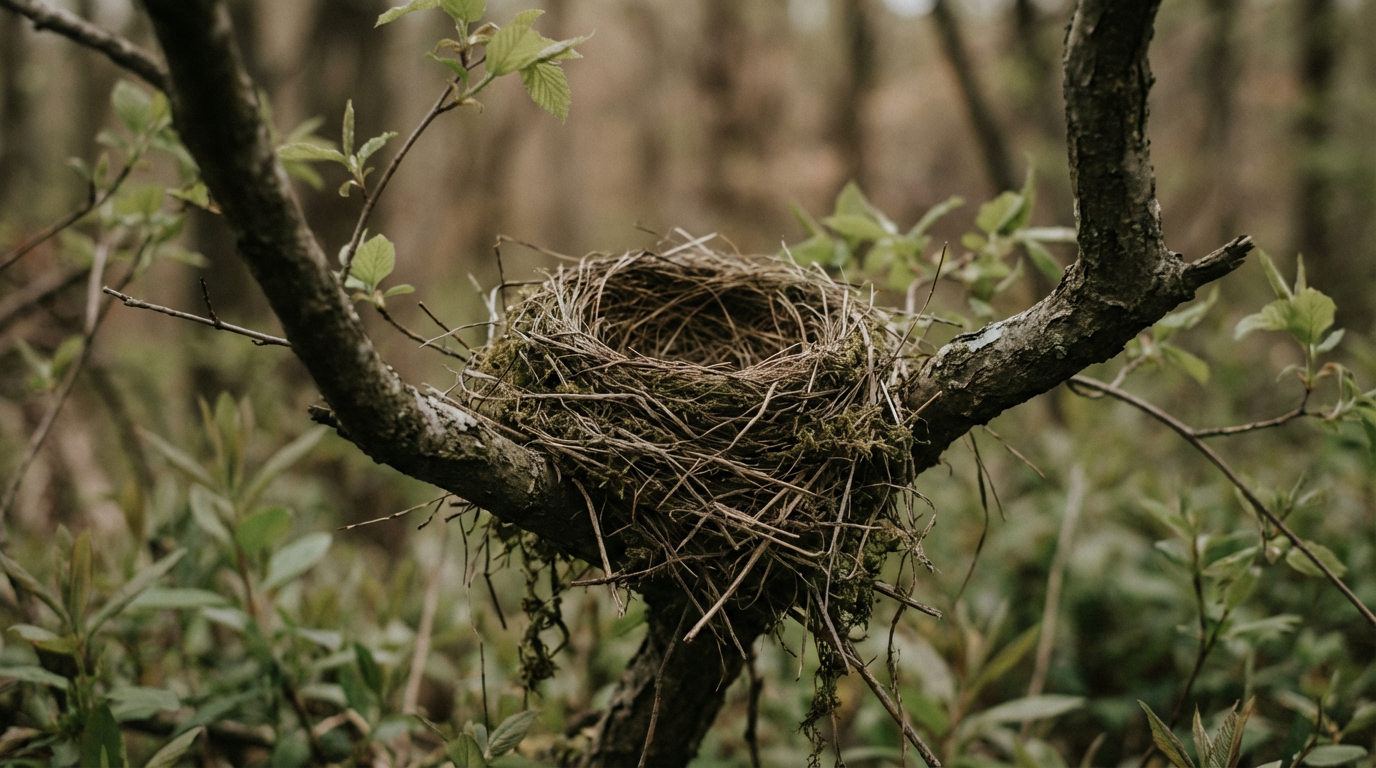
There is a particular kind of silence that arrives in a place where birds used to be. Not the silence of a forest before dawn, which has its own layered texture of insect hum and wind. This is different: a late-May morning that should be loud with warblers and should smell like mud and new leaves and should hold the specific electric urgency of a breeding season in full push — and instead just doesn't. The birds are there, technically. They made it. But the timing is off by enough that the whole system is running on a lag, and that lag is carving out the next generation one clutch at a time.
Phenological mismatch is the technical name for what happens when two biological events that evolved together stop happening at the same time. For migratory songbirds, the catastrophic version of that mismatch goes like this: caterpillars and other invertebrates that time their emergence to spring warming are peaking earlier than they did thirty years ago. Birds that winter in Central America or sub-Saharan Africa, and use day length — photoperiod — as their primary migration cue, are departing on roughly the same schedule they always have. They arrive at breeding grounds that have already warmed up and already moved through the insect peak. The nest is built, eggs are laid, and when the chicks hatch open-mouthed and demanding thousands of calories a day, the flush of protein that used to be there is thinning or gone.
This is not a theoretical problem. Research accumulating over the past two decades has tracked population declines in long-distance migrants at rates that consistently outpace those of resident species or short-distance migrants who can respond more flexibly to local conditions. And a study published in early 2025 in the journal Ecology, drawing on long-term phenological monitoring datasets across multiple flyways, found something that should have felt like a relief but didn't: migration timing has shifted somewhat in many species, arriving slightly earlier than historical norms. The problem is that the breeding grounds have warmed faster. The shift in bird phenology is real[3]. It just isn't keeping up.
The margin matters enormously. A mismatch of a few days between peak caterpillar availability and peak chick demand may not sound like an existential gap. But nestlings in that critical window require staggering quantities of invertebrate protein — soft-bodied, high-calorie, bite-sized prey that adults can carry rapidly back to the nest. Miss that window by a week and the food is still present in the landscape but is older, tougher, less nutritious, and distributed differently. The chicks still beg. The parents still forage. But the conversion rate — energy invested per calorie returned — degrades, and fledgling weight at departure is one of the strongest predictors of first-year survival. Lighter birds die at higher rates. The mismatch doesn't look like starvation. It looks like a slow bleed from the cohort.
The Clock That Doesn't Know It's Wrong
To understand why birds can't simply adjust, it helps to understand what they're adjusting from. The photoperiodic system — the biological mechanism that reads day length and uses it to time hormone cascades, fat deposition, and eventual departure — is ancient, stable, and extraordinarily precise. It evolved over millions of years in environments where day length was the most reliable proxy available for what the breeding season in a distant location would look like when the bird arrived. Temperature varied. Rainfall varied. Insect emergence varied year to year. Day length did not. So natural selection built a clock calibrated to light, not warmth, and it worked beautifully for a very long time.
The problem is that climate change is decoupling day length from the conditions it used to predict. The birds read the same astronomical signal in February or March, their gonads enlarge, their migratory restlessness kicks in, and they begin moving north along the same corridors they always have. But the breeding grounds they're tracking by memory and magnetic sense have been altered by a warming that accelerated faster at higher latitudes than at the wintering grounds. The cue and the condition it was supposed to signal are no longer synchronized. The birds are not confused — their physiology is doing exactly what it was selected to do. The environment simply moved.
“The birds are not confused. Their physiology is doing exactly what it was selected to do. The environment simply moved.”
There is some evolutionary flexibility here, but it is constrained in ways that matter. Migratory timing is partly heritable, and populations where earlier-arriving individuals consistently outperform later ones should, in theory, shift over generations toward earlier departure. Some species have shown this. European populations of pied flycatchers[1] have been studied closely enough to demonstrate both the mismatch and the partial genetic response to it. The complication is pace. Evolution works across generations. The warming that has advanced insect emergence by weeks in some regions has happened over decades. For species that raise one clutch per year and have relatively long juvenile mortality periods, generational turnover is slow. The climate is changing faster than selection can track it.
What Mismatch Looks Like on the Ground
The image that captures phenological mismatch best is not dramatic. It is a parent bird — a wood thrush, say, or a blackpoll warbler — making foraging trips back and forth to a nest full of chicks, covering the same territory repeatedly and returning with smaller prey items than the trip requires. From a distance the breeding season looks intact: birds present, nesting behavior occurring, apparent activity. The collapse is happening in the caloric math. Long-term nest monitoring studies, which involve thousands of volunteer observers and professional researchers tracking individual nests from egg-laying to fledging, have been the primary tool for documenting this. They show reproductive success declining, clutch size holding roughly stable, but fledgling condition — weight, wing length, fat reserves at departure — dropping in years and locations where mismatch is most pronounced.
There is also a compounding effect that makes the story harder to read from any single location. Migration is a chain of connected habitats, and conditions along the chain interact. Birds leaving wintering grounds in poorer body condition because habitat there has degraded arrive at breeding grounds already running a deficit. If they then encounter a mismatch between their arrival and peak food availability, they are absorbing a second hit. Research on condition carryover — the degree to which body state in one part of the annual cycle affects performance in the next — finds that these deficits don't reset cleanly at each seasonal transition. A bird that arrives lean from a difficult migration with compromised fat reserves may begin nesting later, lay fewer eggs, or invest less in incubation. The mismatch at the breeding ground lands on a bird that was already behind.
“The mismatch at the breeding ground lands on a bird that was already behind.”
Species That Are Losing and Species That Aren't
Not every migratory species is equally exposed. The gradient of vulnerability tracks roughly along the axis of migration distance and habitat specialization. Long-distance Neotropical migrants[2] — birds that winter in South and Central America and breed in North American forests — face the most severe version of the problem because their wintering grounds are warming at a slower rate, giving the photoperiodic cue less corrective signal, and because their breeding habitats are often forest interiors with highly seasonal insect dynamics that compress the window of peak availability. Short-distance migrants that winter in the southern United States and breed farther north have more flexibility: they can track actual temperature conditions more directly, their migration is shorter, and local warming may even pull some stopover resources earlier in ways that partly compensate.
Habitat generalists show more resilience than specialists. A species like the American robin, which forages across lawns, edges, and disturbed ground for a broad range of invertebrate and fruit resources, can absorb mismatch in any one food category by shifting to another. A species like the cerulean warbler, which depends on high-canopy forest structure and the particular invertebrate community that lives within it, has nowhere to shift. Its niche is precise, its wintering habitat in the Andean foothills is under agricultural pressure, and its breeding habitat in mature eastern deciduous forest has been fragmenting for over a century. The mismatch problem arrives on top of everything else the cerulean is already navigating.
The Corridor Problem
Migration is not a single event. It is a sequence of stops, each one critical: rest, refueling, sometimes waiting for favorable wind conditions before the next leg. Stopover habitat — the coastal shrublands, riparian corridors, wetland edges, and forest patches where migrants pause and eat before continuing — is already under pressure from development and agricultural expansion. Climate change is adding a timing dimension to that pressure. If a bird's internal schedule brings it to a stopover site in the Gulf Coast in mid-April and the invertebrate bloom there now peaks two weeks earlier, the bird arrives to a larder that is past its best. It leaves for the breeding ground in poorer condition than it would have a generation ago. The gap between what a stopover now offers and what migrants need when they arrive there is itself a form of mismatch, occurring before the breeding ground is even reached.
The 2025 Ecology study emphasized this layered nature of phenological disruption — that the mismatch researchers most often document at breeding grounds is the visible outcome of a cascade that may have begun at wintering sites or along the migratory corridor itself. This reframing matters practically: conservation efforts focused only on protecting breeding habitat may be addressing the final stage of a problem that begins much earlier. The birds that arrive late or underweight to a well-preserved forest patch were not failed by that forest. They were failed somewhere south of it, by a chain of small deficits that accumulated across thousands of miles.
What the Silence Is Telling Us
“Populations erode not through sudden collapse but through years of reproductive shortfall so incremental it can be invisible until the numbers are far enough down to be undeniable.”
Population trend data for many long-distance migrants have been declining for decades, and the rate of decline has not stabilized. The Breeding Bird Survey[4], which has been tracking relative abundance across North America since 1966, shows negative trends for a disproportionate share of Neotropical migrant species. The mechanism that phenological mismatch research proposes — reduced fledgling survival due to food timing failures at the breeding ground — is consistent with those trends, though habitat loss, window strikes, cat predation, and pesticide-driven invertebrate decline all compound the same curves. What mismatch adds is a process that operates even when breeding habitat is intact, even when the birds make it through the migration, even when the nest survives. It erodes populations not through sudden collapse but through years of reproductive shortfall so incremental it can be invisible until the numbers are far enough down to be undeniable.
The forests where this is happening are not silent yet. There are still wood thrushes in the eastern hardwoods, still warblers moving through in waves during peak migration, still the particular electric quality of a May morning in good habitat. But the abundance is thinner than the records say it should be, and the thinning is not evenly distributed across years and sites — it accumulates in the same direction, the same species, the same trajectory. What the science of phenological mismatch has done is give that thinning a mechanism, a physical explanation for why a system that still looks mostly intact is quietly running out of the margin it needs to replace itself. The birds are not failing to migrate. They are migrating into a season that has already moved on without them, arriving precisely on a schedule the world below them no longer keeps.
References
- Climate change and population declines in a long-distance migratory bird (nature.com)
Documents pied flycatcher populations demonstrating both phenological mismatch and partial genetic response to earlier breeding conditions. - Decoupling of bird migration from the changing phenology of spring green-up (pnas.org)
Establishes that long-distance Neotropical migrants face the most severe mismatch vulnerability due to slower-warming wintering grounds and seasonal forest breeding habitats. - Shifts in avian migration phenologies do not compensate for changes to conditions en route in spring and fall (esajournals.onlinelibrary.wiley.com)
Provides 2025 study data showing migratory birds have shifted arrival times earlier, but breeding grounds warmed faster, confirming the mismatch persists. - The North American Breeding Bird Survey: Helping Keep Common Birds Common (usgs.gov)
Provides historical context on long-term bird population monitoring infrastructure used to track population declines in migratory species.
About Sable Pike
Sable Pike writes about habitat loss, ecosystem strain, species decline, climate disruption, and the quiet unraveling of natural systems people once assumed were permanent — and the way that unraveling reaches into economies, politics, and daily life. Her work brings emotional weight to ecological change without sacrificing scientific rigor.
More like this
The Insects Are Vanishing Even Where We Didn't Touch Anything
A two-decade study in the Colorado Rockies found insect populations collapsing in pristine wilderness — and the culprit has nothing to do with pesticides, habitat loss, or human footprint.
The Forest Still Looks Green. That's the Problem.
Research on Southwest US woodlands reveals that trees can lose the hydraulic and carbon reserves that keep them alive long before their canopy shows a single yellow leaf — meaning the forests we think we're watching die may already be past saving.
The Amazon Makes Its Own Rain. Deforestation Is Breaking That.
The Amazon recycles its own rainfall through vast airborne moisture corridors — and new data shows that eastern deforestation is already strangling the forests furthest downstream.